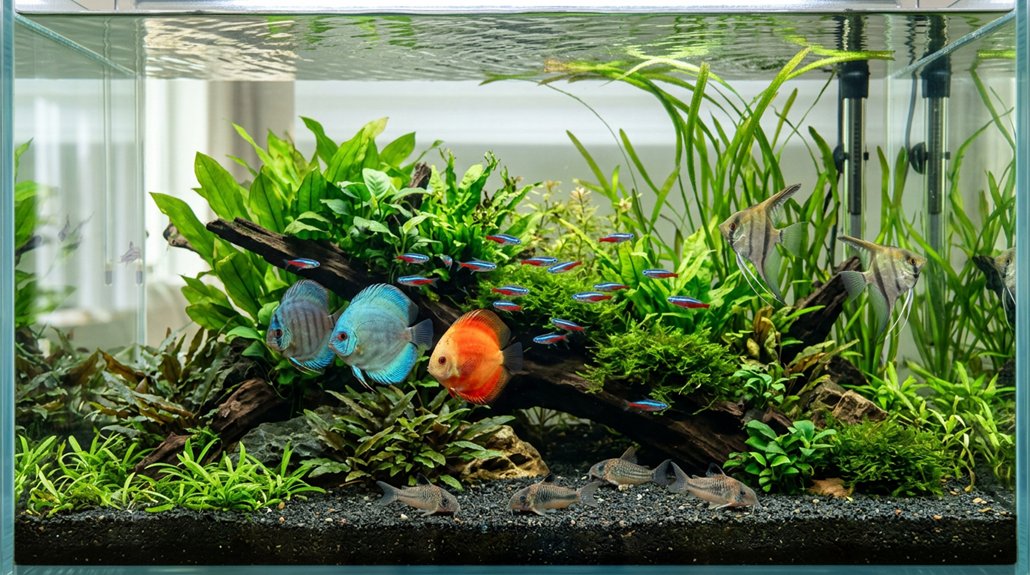
Build your community aquarium around adult fish size, temperament, and swimming zone, not just inch-per-gallon rules. Choose the largest feasible tank with a wide footprint, then add peaceful, compatible species in groups of six or more. Set up plants, driftwood, and caves before stocking so territories form cleanly. Fishless cycle the tank until ammonia and nitrite hit 0 ppm, then stock in stages and keep water changes, testing, and aggression control consistent for long-term stability.
Key Takeaways
- Choose the largest feasible tank with a wide footprint to give community fish stable water and open swimming space.
- Stock peaceful, compatible species in groups of six or more, based on adult size and actual water volume.
- Add hardscape, plants, and hiding places first to create territories, cover, and clear front swim lanes.
- Cycle the tank fishlessly until ammonia and nitrite are 0 ppm and nitrates are detectable before adding livestock.
- Introduce fish in stages, quarantine new arrivals, and maintain regular water changes and testing to keep bioload stable.
Build a Balanced Community Tank
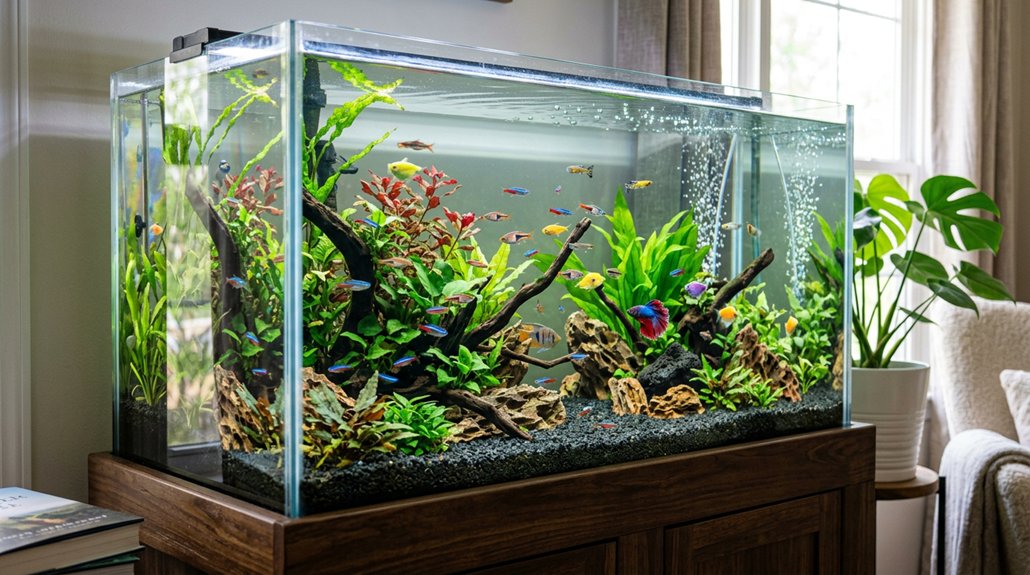
Before you add fish, size the tank by adult bioload, not by the fish you’re buying today: use the “one inch of adult fish per net gallon” rule only as a starting point, then adjust for true water volume after substrate and decor, adult size, and the extra space territorial species need. You should match dimensions to behavior: wider tanks suit danios and barbs, while taller tanks fit angelfish and gouramis. Stock schooling fish in groups of six or more, and pair similar temperaments and sizes to limit aggression. Plant the back and midground densely, add caves and wood, and use plant compatible lighting to support cover. Cycle fully before sensitive fish, keep stocking conservative, and allow microfauna introduction as filtration matures.
Plan the Right Tank Size and Shape
Once you’ve matched species and temperament, the next decision is tank size and shape, because both directly affect water stability, swimming room, and long-term compatibility. Choose the largest tank you can reasonably afford; 55+ gallons gives you more stable chemistry and more flexibility than a 20-gallon setup. Prioritize tank footprint for active swimmers, since a wide, shallow footprint provides better swim space than a narrow column. Use depth considerations to match less-active or vertically oriented fish, but don’t let height replace usable area. Treat the “one inch per net gallon” rule as a starting point only, then adjust for adult size, schooling needs, and territorial species. Also subtract substrate, hardscape, and equipment from labeled capacity, and arrange décor to preserve visual balance while leaving open front swimming lanes.
Choose Peaceful Fish That Stay Compatible
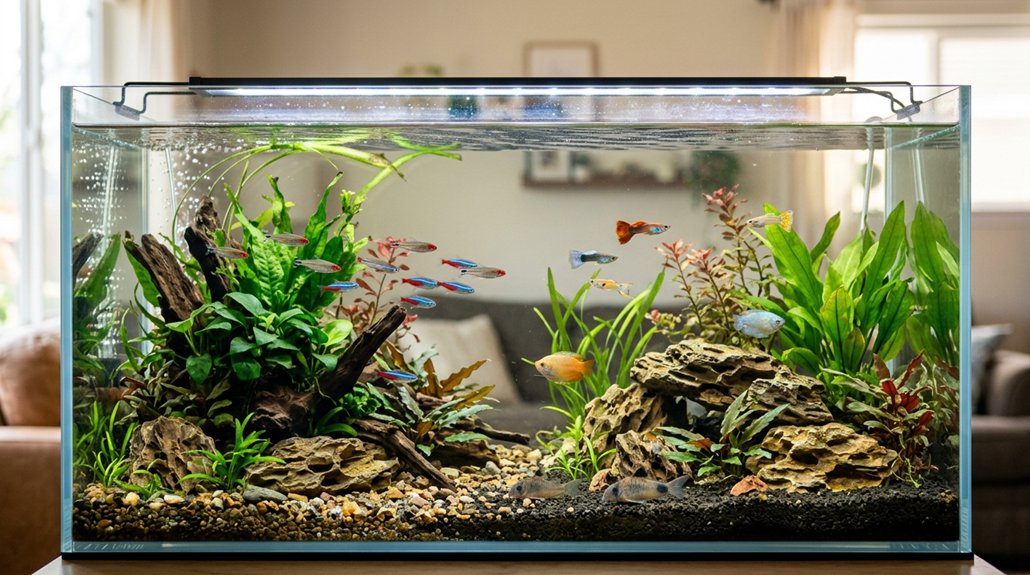
Choose peaceful species that naturally fit each other’s adult size, swimming zone, and temperament, because compatibility is easier to maintain than to fix later. Build schooling harmony by keeping shoaling fish in groups of six or more, which lowers stress and curbs nipping.
- Match sizes: pair 1–2″ midwater tetras with tiny bottom dwellers, not territorial cichlids.
- Match zones: choose fish that use different levels without competing for the same space.
- Buy tank-bred stock when you can; they’re usually calmer and adapt to tap water better.
- Set ratios carefully: avoid male-only groups, and keep 2–3 females per male for livebearers.
When mixing species, favor similar ecological niches and compatible temperament, and skip predators that can swallow tankmates.
Add Plants, Wood, and Hiding Places
Adding structure with plants, wood, and hiding places helps your community tank stay calm and organized. Place tall, dense plants such as Amazon sword, Vallisneria, and dwarf Sagittaria along the back and sides, then keep the front open for swimming and fewer conflicts. Use careful plant placement: anchor Anubias and Java fern to driftwood or rocks, keeping rhizomes exposed, and don’t bury them. For heavy root feeders, use sand over nutrient media or root tabs, with substrate about 1½–2 inches deep. Add driftwood caves and rock shelters to define territories and give shy fish secure retreats. If you add territorial species later, rearrange decor to disrupt dominance. Floating plants or fast stems can also boost nutrient uptake and help you keep nitrate levels lower.
Cycle the Tank Before Adding Fish
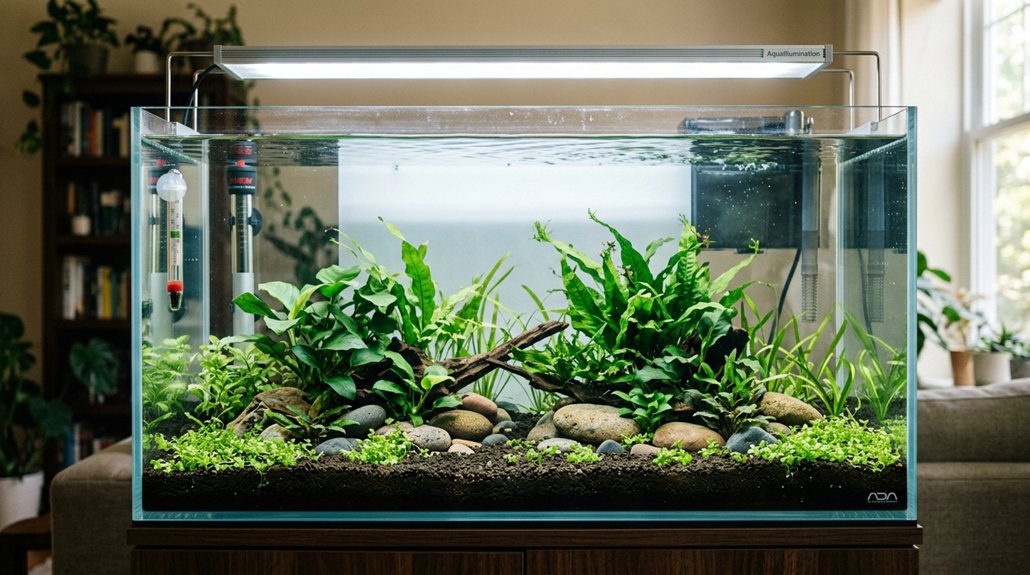
Cycling the tank before stocking is essential because beneficial bacteria must establish enough to process waste safely. You should complete fishless cycling with pure ammonia, decaying plant matter, or soil, then test ammonia, nitrite, and nitrate daily until ammonia and nitrite both read 0 ppm and nitrates stay detectable, around 20 ppm, for several days. Starter bacteria can speed this process, but they still need weeks on filter media and substrate.
Cycle the tank fully first; wait until ammonia and nitrite hit zero and nitrates remain detectable.
- Dose ammonia to feed bacteria.
- Monitor levels every day.
- Confirm the full nitrogen cycle.
- Stock lightly and watch for spikes.
If ammonia or nitrite appear, use mature filter media or small water changes to protect sensitive fish while colonies adjust.
Stock the Tank in the Right Order
You should map out your stocking order before adding any fish, beginning with hardy, low-bio-load species and advancing only when water parameters stay stable. Add hardscape first so the tank’s structure, cover, and territories are established before fish are introduced. Then build the community in stages, giving the filter, plants, and biofilm time to adjust between additions.
Plan Fish Order
Once the aquarium is fully cycled and stable, introduce livestock in a deliberate sequence so the biological filter can adapt without spiking ammonia or nitrite. Use quarantine procedures before each addition, and account for seasonal adjustments if temperature or behavior shifts.
- Start with 6–8 zebra danios or a comparable school of hardy tetras.
- Wait 7–14 days, confirm stable tests, then add mid-level fish like dwarf rasboras, peaceful barbs, or gouramis, spacing additions several days apart.
- Add bottom-dwellers last: 6+ Corydoras, or small colonies of Amano shrimp and nerite snails.
- Hold back large, territorial, or predatory species until the tank has matured for months, adding them one at a time with observation.
This order limits stress, preserves water quality, and lets bacteria and plants adjust predictably.
Add Hardscape First
Set the permanent hardscape before any planting or stocking so the tank’s structure, flow, and territory lines are locked in early and you won’t have to disturb fish later. Use hardscape sequencing to place rocks, driftwood, and caves first, then do territory mapping with your layout. In wide tanks, favor horizontal rock lines for active swimmers; in taller tanks, use vertical wood for gouramis. Keep the front half open for swimming, and build cover along the back and sides for schooling fish and bottom dwellers. Attach Anubias and Java fern to wood or rock with thread or super glue gel so rhizomes stay exposed. Then run the filter and heater for several days, checking flow, sightlines, and dead zones before you add sensitive or territorial fish.
Keep Water Parameters Stable
You should test your water regularly so you can keep temperature, pH, hardness, ammonia, nitrite, and nitrate within stable ranges instead of reacting to sudden swings. Before you stock the tank, make sure the nitrogen cycle is fully established, with ammonia and nitrite at 0 ppm and nitrate controlled through water changes or plant uptake. Keep your water-change schedule consistent and match new water’s temperature, pH, and hardness closely so you don’t stress fish or disrupt the system.
Test Parameters Regularly
Regularly test your aquarium water to keep conditions stable and catch problems early. Use reliable test kits and log trends so you can spot drift before fish show stress.
- Test ammonia, nitrite, and nitrate at least twice weekly during cycling and after major changes; aim for 0 ppm ammonia, 0 ppm nitrite, and nitrate below 20–40 ppm.
- Check pH and temperature weekly, or daily if unstable; target about 7.0–7.6 and 24°C, with minimal swings.
- Measure GH and KH monthly to confirm medium hardness and enough buffering to prevent pH shifts.
- Record dates, values, water changes, stocking events, lighting hours, and CO2 use.
When readings rise, adjust with water changes, filtration, or plant management before conditions become harmful.
Cycle Before Stocking
Before adding most fish, complete the nitrogen cycle so ammonia and nitrite stay at 0 ppm and nitrate stabilizes around 20 ppm for several days, confirming the biofilter can process waste reliably. Use fishless cycling with pure ammonia, then track bacterial colonization as ammonia converts to nitrite, then nitrate. Keep temperature near 24°C and pH around 7–7.6; abrupt swings can slow bacteria and distort tests.
| Parameter | Target |
|---|---|
| Ammonia | 0 ppm |
| Nitrite | 0 ppm |
| Nitrate | ~20 ppm |
| Temperature | ~24°C |
If nitrate spikes early, address it with cautious controls, but don’t rush stocking. Wait several weeks after cycle completion before sensitive species, and add schooling fish in groups of 6+ so your bioload rises gradually and predictably.
Maintain Consistent Water Changes
Consistent partial water changes are the simplest way to keep a community aquarium stable, since 20–30% weekly or 30–50% biweekly changes remove accumulated nitrates and dissolved organics before they become stressful. Use scheduled reminders so you don’t miss them. Match your water source to the tank: dechlorinate it, and keep temperature within 1°C and pH within 0.2 units.
- Vacuum substrate and behind decor.
- Remove uneaten food and detritus.
- Test ammonia, nitrite, nitrate, and pH.
- Adjust frequency to bioload and plant uptake.
In heavily planted tanks, you can change water less often, but stocking should stay modest so nitrate remains ideally under 20–40 ppm. Track results for several weeks, then lock in a schedule that keeps parameters steady and livestock unstressed.
Fix Aggression and Overcrowding
Even with healthy fish, aggression and overcrowding can destabilize a community tank, so start with stocking based on the actual adult size of each fish and the true water volume, using the “one inch of adult-size fish per net gallon” rule only as a rough baseline and reducing it for territorial species. You should treat crowding thresholds as hard limits, not targets, and add behavioral enrichment with plants, caves, and open swim lanes. Keep schooling fish like tetras or danios in groups of six or more, and match tankmates by size to limit bullying and predation. Use dense back planting and multiple hides to break sightlines, and rearrange decor before introducing territorial fish. Keep livebearer ratios near 2–3 females per male, remove chronic aggressors, and stagger additions only after cycling is complete.
Frequently Asked Questions
How to Create a Balanced Aquarium Ecosystem?
You create balance by matching stocking to true volume, cycling fully, and keeping water parameters stable. Prioritize plant selection, lighting schedules, substrate choices, and filtration; then monitor nitrates, remove aggression, and adjust feeding and maintenance.
What Makes a Good Community Fish Tank?
A good community fish tank’s got compatible species, adequate space, and matching temperaments. You’ll stock based on adult size, keep schoolers in groups, watch stress indicators, and provide plants, caves, and open swimming areas.
How to Set up a Community Aquarium?
Set up your community aquarium by cycling the tank, matching peaceful species, and installing filtration, plants, and hiding spots. Maintain temperature control and breeding prevention with proper ratios, regular water changes, and conservative stocking.
Is It Cheaper to Build Your Own Aquarium?
Yes, you can save money if you build it yourself, especially with DIY filtration and budget lighting. You’ll spend less upfront, but quality gear usually costs less over time because it’s more reliable.
Conclusion
When you build your community aquarium with care, you set the stage for a steady ecosystem, not a tug-of-war. By choosing the right tank, stocking with compatible fish, and cycling the water first, you give every finned resident room to breathe. Stable parameters and thoughtful aquascaping act like the tank’s backbone, keeping stress low and harmony high. If trouble appears, adjust quickly, and your aquarium’ll stay as balanced as a well-tuned instrument.