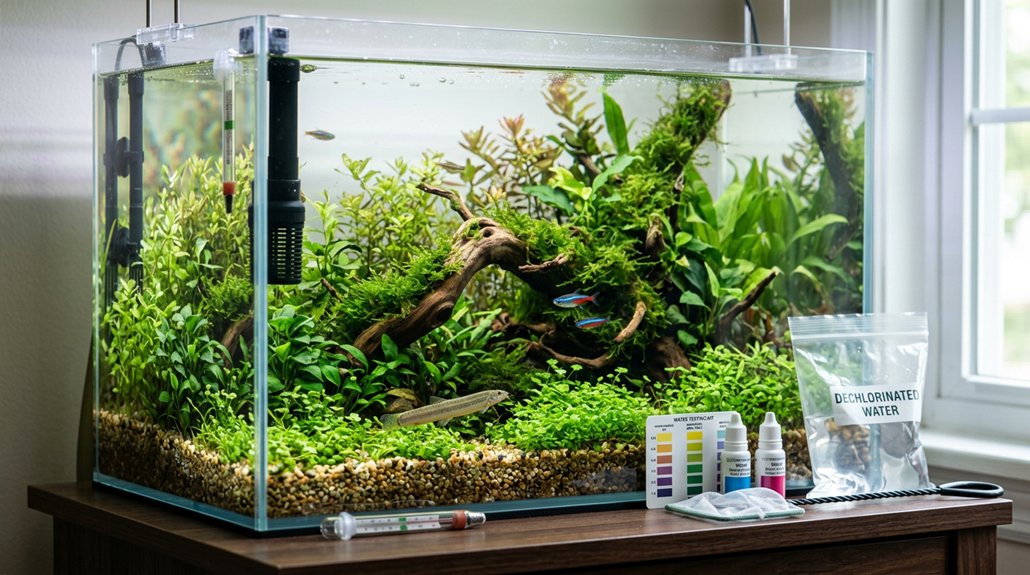
You should stock a fish tank slowly, using each fish’s adult size, shape, and behavior instead of inch-per-gallon rules. Add no more than about 25% of the planned total at a time, then wait 2–4 weeks while you test ammonia and nitrite daily at first. Keep ammonia and nitrite at 0 ppm, and nitrates below 40 ppm, ideally under 20 ppm. If water clouds, fish gasp, or aggression starts, stop and adjust. There’s more to get right.
Key Takeaways
- Stock by adult size and behavior, not juvenile length or inch-per-gallon rules.
- Add no more than about 25% of planned fish at a time, then wait 2–4 weeks.
- Test ammonia and nitrite daily for the first week after each addition, and keep both at 0 ppm.
- Keep nitrate below 40 ppm, ideally under 20 ppm, before adding more fish.
- Stop stocking if water clouds, fish gasp, or aggression and stress increase; improve filtration and water changes first.
How to Stock a Fish Tank Safely
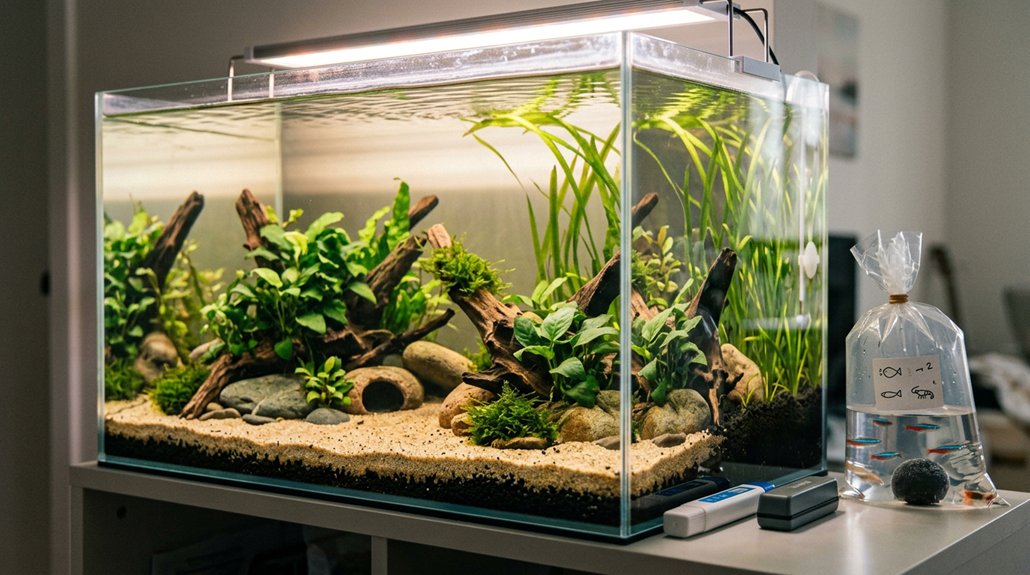
Start stocking your fish tank slowly, adding no more than about 25% of your planned total at a time and waiting 2–4 weeks before adding more. During each interval, test for 0 ppm ammonia, 0 ppm nitrite, and nitrates below 40 ppm, ideally under 20 ppm, before you continue. Base your plan on adult size, behavior, and filtration capacity, not the old inch-per-gallon rule. Make sure schooling species are kept in proper groups, and avoid mixing fish that’ll fight or claim territory. Strong biological filtration and aeration should outpace the bioload, especially in heavily stocked tanks. Watch water clarity, activity, and stress closely. If conditions worsen, stop adding fish, adjust water changes, and use quarantine practices plus careful feeding schedules to reduce disease and waste risks.
Start With Adult Fish Size
Once you’ve settled on a slow stocking schedule, the next step is to size the tank for the fish’s adult bodies, not the juveniles you bring home. Use adult measurements for every species, then turn them into space calculations instead of guessing from current size.
| Species | Adult length | Notes |
|---|---|---|
| Platies | 1.9–2.7 in | Use adult size, not fry size |
| Community fish | 1–3 in | One-inch-per-gallon is only a crude start |
| Fancy goldfish | ~8 in | Need far more volume than length suggests |
Full-bodied or active fish need extra room because bioload matters. When you mix sizes, estimate load by weight, not just length. As fish near adulthood, watch water clarity, nitrate levels, and behavior, and remove or rehome any individual that pushes the tank past adult capacity.
Match Fish to Your Tank Size
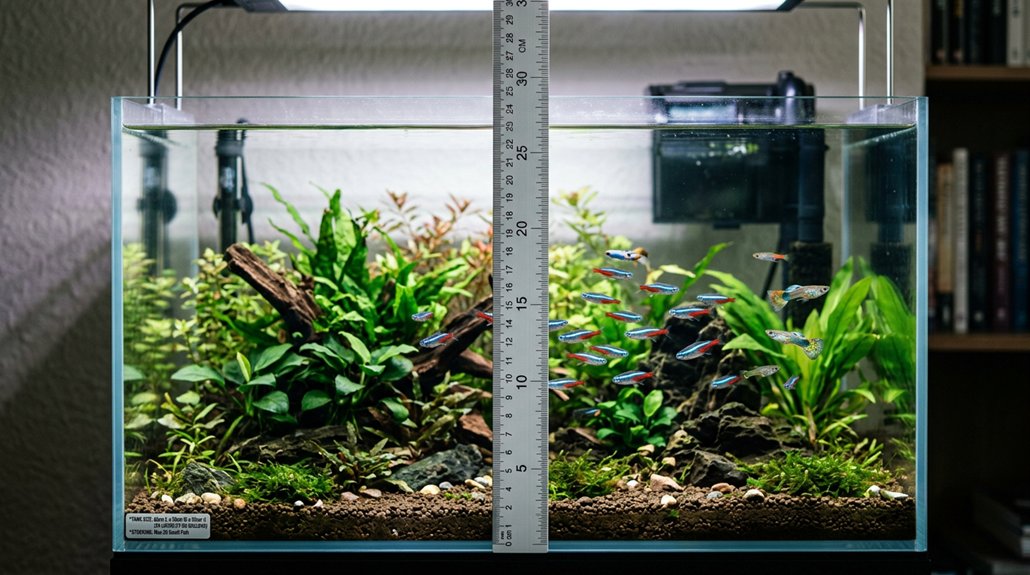
Your tank size sets the real limit on how many fish you can keep, so match each species to the space it’ll need as an adult. In a 10–20 gallon tank, you can usually keep a small school of six tiny community fish, while a 30–40 gallon gives you room for mixed groups or a few larger species. Don’t judge by length alone either—body shape, activity level, social needs, and filtration all affect how many fish your tank can safely support.
Tank Size Basics
A good rule of thumb is to size your tank for the fish’s adult needs, not the tiny juveniles you’re buying today. Use adult length, body shape, and behavior to judge fit: 6 adult platies can live in about a 10-gallon tank with strong filtration, while angelfish need taller tank dimensions, and danios or barbs need longer tanks for swimming room. Don’t rely on volume alone; surface area and oxygen matter too, especially for active species. In very small tanks, choose fish under 1 inch and keep proper schools of six or more. Check lighting placement so it doesn’t block access or create heat spots. Add fish slowly, watch clarity and nitrates, and stop if water clouds or readings climb.
Fish Size Matching
Matching fish to your tank size starts with adult length, not the tiny fish you’re buying home from the store. Plan for full-grown size, because fin growth and sexual dimorphism can change what a fish actually needs. In a 37-L, or 10-gallon, tank, you can realistically keep about six adult platies if filtration’s solid. Match body shape to the tank too: tall tanks suit deep-bodied angelfish, while long, shallow tanks fit active, slender danios. For tanks under 10 L, choose tiny species under 1 inch and keep six or more of social fish like white clouds or pygmy corydoras. Also count metabolic load, not just inches. Even if the math works, aggressive or territorial fish may still need isolation or partitions.
Choose Fish With Compatible Behavior
Choose fish that can actually live together, not just fit in the same gallonage. Behavior compatibility matters as much as size, so do temperament matching before you buy. Check each species’ adult size, activity level, and social needs; neon and cardinal tetras need groups of 6+, while platies cope with smaller groups.
- Match where they swim: bettas stay near the surface, rasboras and danios use open midwater, and dwarf Corydoras need bottom cover.
- Skip pairings that mix aggressive or territorial fish, like adult male bettas or many cichlids, with peaceful community species.
- Plan for growth: juveniles become larger, more territorial, and messier.
If a species needs conspecifics to reduce aggression, add enough of them or use a partition, but remember that filtration demand doesn’t drop.
Add Fish Slowly
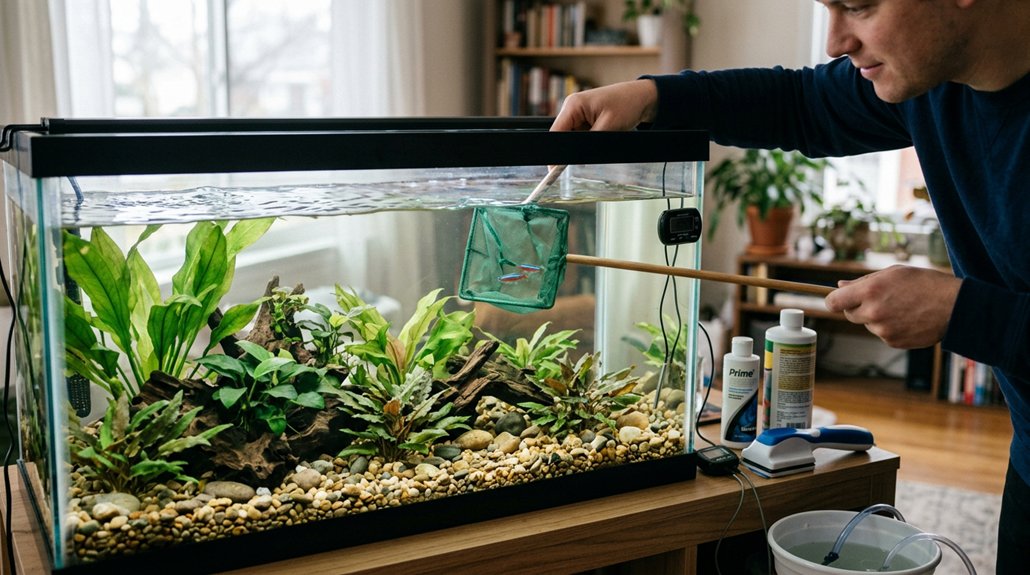
Add fish slowly, and keep each addition to no more than 10–25% of your tank’s current biomass or 1–2 small fish at a time. Wait 2–4 weeks between additions, and test ammonia and nitrite daily until they stay at 0 ppm before you add more. Watch water clarity closely, and keep an eye on nitrate so you can catch any hidden stress early.
Slow Stocking Pace
Stocking slowly helps your tank biology keep up with the new waste load, so don’t add more than about 25% of your planned total bioload at one time. For example, if you want 20 small community fish, start with 4–6 and wait 1–2 weeks before the next group. That gives your filter’s beneficial bacteria, plants, and temperature stabilization time to adjust. Use patient acclimation for each addition, then test ammonia and nitrite daily for the first week.
- Add fish only when ammonia and nitrite read 0 ppm.
- Keep nitrate stable before stocking again.
- Pause if you see stress or need 10–25% water changes.
Choose additions by adult size and species needs, and only expand when filtration and aeration stay within safe limits.
Watch Water Clarity
Watch your tank’s clarity closely after each addition, because it’s one of the fastest signs that you’re pushing stocking too hard. Add fish in small steps, about 10–25% of the final bioload, then wait 1–2 weeks before adding more. Test ammonia, nitrite, and nitrate after each round; keep ammonia and nitrite at 0 ppm, and aim for nitrate under 40 ppm in freshwater or under 20 ppm in planted tanks. If the water turns cloudy, dull, or film-covered, stop immediately and don’t add more until visual clarity returns. Use mature filtration and good algae management as your guide, not inch-per-gallon rules. If fish gasp, fade, or act lethargic, do a water change, remove some stock if needed, and pause stocking.
Use Filtration for the Bioload
Dial in filtration to match the bioload, not just the tank size: you need enough biological media surface area and volume to process the waste your fish will produce, especially in heavily stocked setups. Choose a sump or canister with high turnover circulation so oxygen and waste move efficiently through the filter. Use mature media, and don’t deep-clean it unless you must; preserving bacteria helps prevent ammonia and nitrite spikes when you add fish.
Match filtration to bioload, not tank size—use enough mature media and strong flow to handle waste.
- Size media for heavy stocking, not minimal coverage.
- Favor strong flow over weak cartridge filters.
- Test ammonia, nitrite, and nitrate after each stocking step.
Keep ammonia and nitrite at 0 ppm, and hold nitrate below 40 ppm in freshwater. Filtration can reduce metabolic load, but it won’t solve territory or aggression issues.
Stock Schooling Fish and Shrimp Correctly
When you add schooling fish, keep them in proper group sizes so they can behave naturally and stay less stressed—at least 6 rasboras, tetras, or many small danios, and about 8–10 pygmy corydoras. Stock by adult size and metabolic load, not just inches per gallon; a 10-gallon tank with strong filtration can support roughly six adult platies, while nano tanks should stay with fish under 1 inch and still keep social species in groups. Add shrimp like red cherry slowly, because they add little bioload but need cover and gentle flow, and choose tankmates that won’t prey on them. Watch breeding behavior and territorial aggression, then stop if water clarity or ammonia, nitrite, or nitrate worsens.
Know When Your Tank Is Overstocked
Cloudy water, persistent green tint, or a dull surface film after adding fish are early signs that your tank’s bioload is outrunning its filtration, so stop stocking until the water clears and parameters recover. Test strips or kits should read 0 ppm ammonia and nitrite; if either rises, or nitrate climbs above about 40 ppm, your tank’s biofilter can’t keep up. Watch oxygen indicators too: gasping at the surface, especially in warm hours, means dissolved oxygen is dropping.
- Frequent large water changes are a warning.
- Disease signals and lethargy often follow overstocking.
- Aggression or hiding can mean territorial stress.
If you’re doing urgent changes more than weekly, or chasing ammonia spikes, you’ve added too much bioload for your filtration and maintenance routine.
Frequently Asked Questions
How Long Should a New Fish Tank Sit Before Adding Fish?
Usually, you should wait 2–8 weeks before adding fish, until your tank’s cycle time is complete. You’ll need water testing to confirm 0 ammonia, 0 nitrite, and low nitrates before stocking.
How Do I Know if My Tank Is Overstocked?
You know your tank’s overstocked when cloudy water, rising ammonia or nitrite, and relentless fish waste turn the gravel murky; fish gasp, and oxygen demand spikes. You’ll also need unusually frequent water changes.
Do Fish Like When You Rearrange Their Tank?
Usually not—you’re causing territory disruption and aquascape stress. You’ll see hiding or skittish behavior. Change decor gradually, keep water stable, and add hiding spots so fish can adjust with less stress and fewer conflicts.
What Is the Fish Tank Rule?
The “one inch per gallon” rule’s your rough guide for stocking density, but it’s only a starting point. You should judge tank capacity, fish shape, filtration, and water quality, not just fish length alone.
Conclusion
Stocking your tank the right way keeps your fish healthy and your aquarium balanced. Start with adult size, match species to your tank, and choose fish that get along. Add them slowly, and let your filter handle the bioload, not just the water volume. Schooling fish and shrimp need proper numbers, too. If your tank feels crowded, it’s already waving a red flag. Plan carefully, and you’ll build a thriving aquatic home.