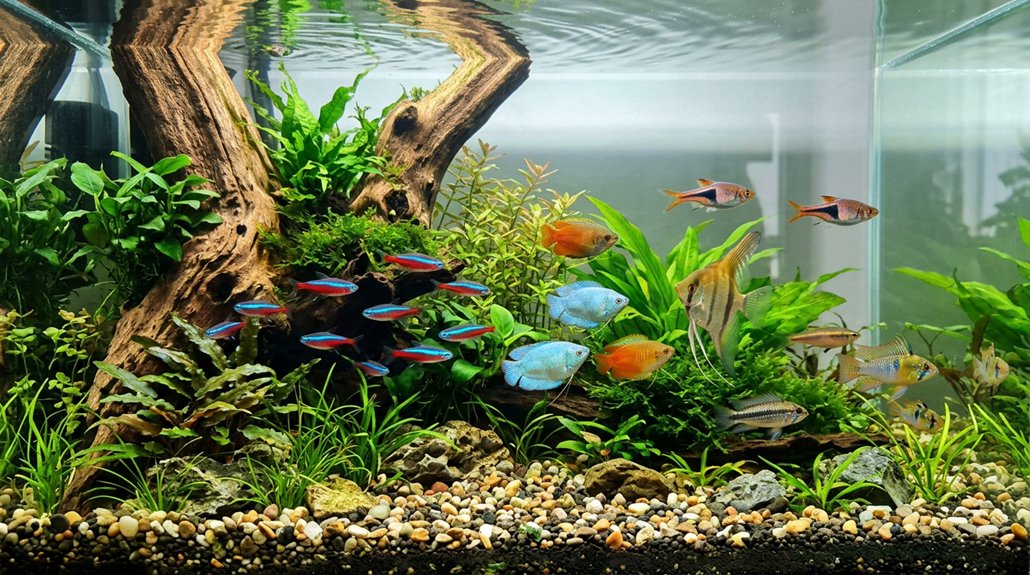
You can prevent fish fighting by planning territory, stock, and stress before aggression starts. Keep compatible species, add newcomers in groups, and avoid overstocking or poor filtration. Break sightlines with plants, rocks, and caves, and give each fish a hideout. Keep lights and temperature steady, feed small portions in several spots, and rearrange décor if one fish starts claiming the tank. If trouble continues, isolate the aggressor, and you’ll see what works next.
Key Takeaways
- Stock compatible fish in balanced numbers, and add newcomers in groups to reduce bullying and dominance fights.
- Provide plenty of hiding spots, caves, plants, and broken sightlines so fish cannot easily chase or claim one area.
- Keep temperature and lighting stable, and avoid overly warm or bright conditions that can increase aggression.
- Feed small portions several times daily and spread food across the tank to reduce competition for resources.
- Rearrange décor or isolate aggressive fish temporarily when fighting starts, giving territories time to reset.
Why Aquarium Fish Fight
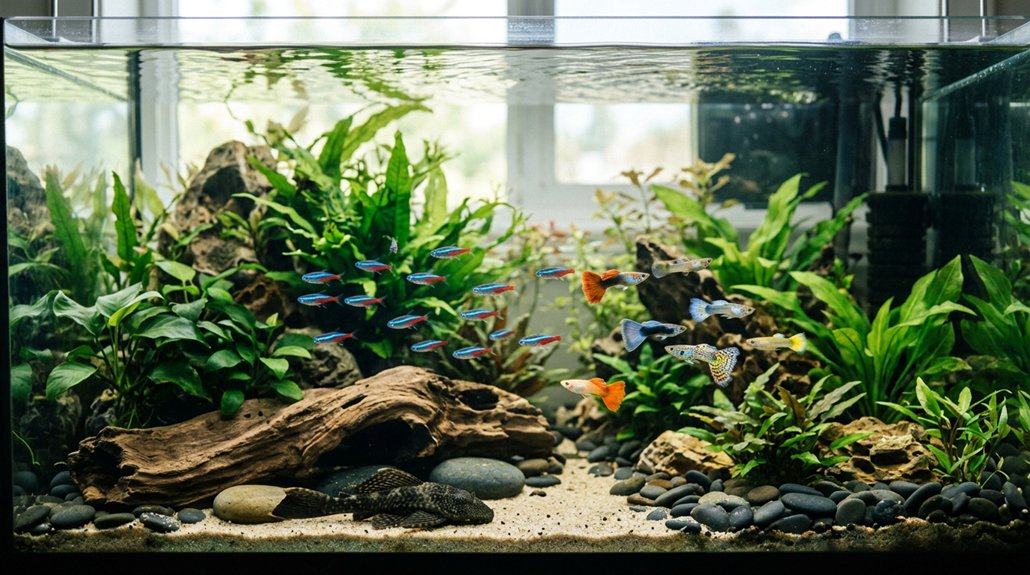
Fish fight mainly to defend resources: territory, mates, and food, and aggression usually rises when those resources are scarce, such as in overstocked aquariums or tanks with too few hiding places. You’ll also see more attacks when social rank isn’t settled; dominant fish tend to stay more aggressive, and new hierarchy shifts can trigger repeated chasing after introductions. High temperature and bright light can amplify aggression by raising activity and sensitivity to sensory cues. Captive-bred fish often show stronger baseline aggression than wild-caught fish, especially in bare or crowded setups. Disease and parasites can make fish act erratically, weaken contest ability, and increase stress signals. If you read these signs early, you can identify why fighting starts before it escalates.
Stock Fish to Reduce Fighting
One effective way to reduce aggression is to stock the tank so no single fish can dominate the entire space. Use balanced stocking to spread attention and protect weaker fish. Add newcomers in groups of 4–6, not one at a time, so bullying gets diluted. Keep sex ratios appropriate; for livebearers, aim for 1 male per 2–3 females to limit harassment. Match species compatibility and body shape to avoid conflicts.
| Strategy | Why it helps | Example |
|---|---|---|
| Overstocking | Blocks territorial control | Mbuna in 125 gal |
| Group additions | Diffuses targeting | 4–6 fish at once |
| Sex ratios | Reduces harassment | 1:2–3 male:female |
| Species matching | Lowers interspecific aggression | Similar body forms |
| Filtration | Handles bio-load | Strong mechanical and biological |
Stock density should be planned, not random.
Build Territories and Hideouts
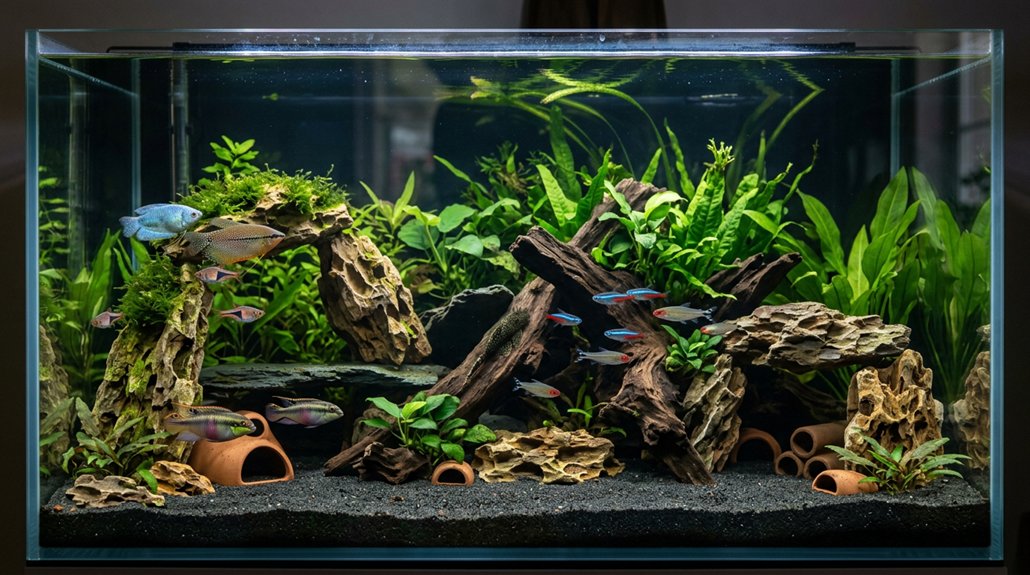
To cut down on territorial fights, you need to break the tank into multiple defensible zones with rocks, driftwood, dense plants, and caves so each fish can claim a separate shelter and encounter fewer rivals. Use tall Vallisneria, stacked stone, and crevices to block sightlines and interrupt chasing. Provide identical hideouts, such as clay pots, as breeding refuges and nocturnal shelters, so subordinates can escape without being cornered.
Break the tank into defended zones with plants, rocks, and caves so each fish can claim shelter.
- Space shelters across the tank
- Match territory count to species needs
- Avoid overstocking
- Rearrange hardscape periodically
- Mimic natural habitat structure
When you reset décor, you dissolve entrenched claims and reduce fixed aggression. Keep each zone accessible, durable, and separated, so fish can establish temporary ownership without constant conflict.
Control Light and Water Temperature
Keep the tank on the cooler side of each species’ comfort range, because higher temperatures can increase aggression and speed up stress-related decline; for many tropical fish, that means holding closer to 78°F/25.5°C than 84°F/29°C. Don’t make abrupt setpoint changes when you add fish or rearrange décor; adjust gradually over hours or days to limit thermal stress. Use thermal gradients carefully, so fish can self-regulate without crowding. Keep lighting stable with light timers and programmable dawn/dusk ramps, because sudden brightness changes can trigger chasing and fin-nipping. During introductions, dim the tank or shorten the photoperiod; low light reduces territorial aggression. If warm water and intense light coincide, expect stronger conflict, so lower both slightly during sensitive periods and monitor behavior closely.
Reduce Feeding-Time Aggression
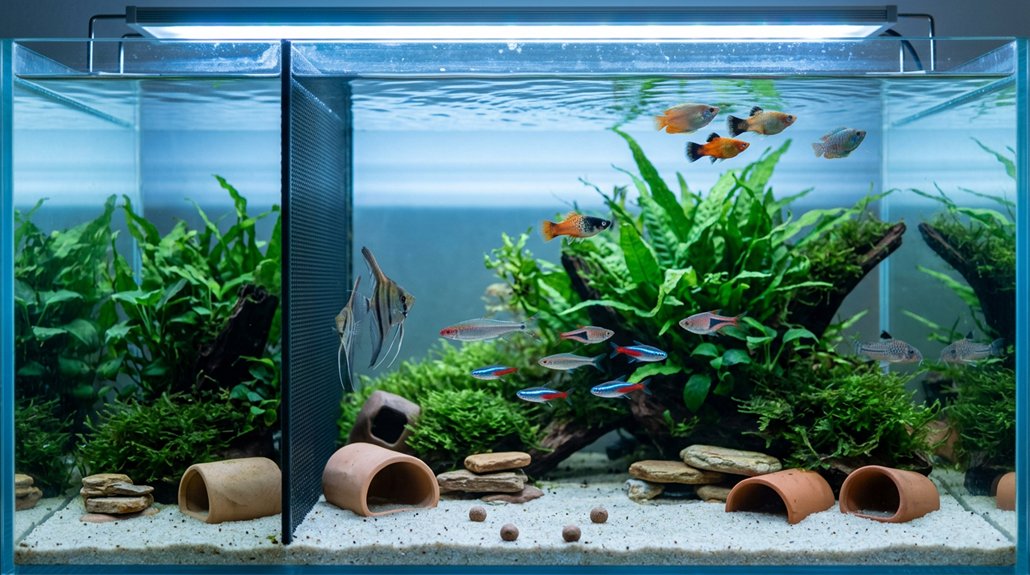
You should feed fish more often in smaller portions, since 3–4 short feedings a day can reduce competition and food-scarcity aggression. Distribute food evenly across the tank so dominant fish can’t monopolize it, and use feeding tools or slow-sinking food if needed to give timid fish access. Watch for scavenging and chasing during meals; if aggression drops when you increase feedings slightly, your schedule and portions are on track.
Feed More Often
Feeding more often can quickly lower feeding-time aggression by shortening the window in which fish compete for food. Use meal timing and portion control to shift from one large feed to 2–3 smaller meals daily, so you’re not triggering intense bursts of chasing.
- Monitor ammonia, nitrite, and nitrate after changes.
- Increase food cautiously to avoid overloading filtration.
- Use flake, gel, sinking pellets, or micro-pellets.
- Feed right after adding new fish or moving decor.
- Match food form to each species’ feeding zone.
During introductions or high-stress periods, this keeps dominant fish occupied and gives newcomers time to settle. If aggression stays high, adjust frequency first, then reassess quantity. Don’t push feeding so hard that water quality drops or waste accumulates.
Distribute Food Evenly
Distributing food evenly helps prevent feeding-time aggression by breaking up the scramble that lets dominant fish monopolize meals. You should place food at multiple stations across the tank, or use a feeding ring, so shy fish can eat without constant chase pressure. Offer varied textures, such as sinking pellets and floating flakes, to match different feeding zones and reduce vertical competition. Feed smaller portions 2–4 times daily instead of one large dump to limit pileups and frantic pursuit. During introductions or tense periods, spread protein-rich treats like frozen mysis in several locations to occupy bullies and let others feed. Watch each session closely, and remove leftovers after about 5 minutes so clustered foraging doesn’t trigger more nipping.
Watch For Scavenging
Watch for scavenging during meals, since food scarcity and feeding-time competition often trigger chasing and fin-nipping. You should treat scavenger behavior as a signal: one fish may be monopolizing food remnants, especially if bottom-feeders miss surface drops. Scatter food widely, and rotate feeding zones so all fish can eat without crowding.
- Feed small, frequent meals.
- Offer pellets, frozen food, and vegetable matter.
- Use multiple feeding points.
- Increase rations slightly during introductions.
- Watch for nocturnal foraging and substrate sifting.
If aggression rises, pause feeding, then resume with smaller portions. In your tank, this reduces bullying, limits overfeeding, and helps you identify which fish escalate the feeding response.
Reset Territories by Rearranging the Tank
You can reset territorial behavior by rebuilding the rockwork, caves, and driftwood so established boundaries no longer match the old layout. When you rearrange the tank, each fish has to renegotiate space, which can reduce repeated targeting of newcomers. Add a few new hiding spots as you rescale the setup so no single fish can monopolize the same area.
Rebuild Rockwork Boundaries
Rebuild the tank’s rockwork and décor in one reset to break established territories and force all fish to reassess boundaries, which often shifts aggression toward exploring new shelters instead of chasing tankmates. Keep your rockwork aesthetics functional, not decorative, and preserve substrate gradients so the layout stays stable and practical.
- Add caves, overhangs, and crevices
- Change the layout all at once
- Start near the bully’s usual haunt
- Give subordinates clear refuges
- Watch behavior for several days
You’ll reduce site fidelity by avoiding small, incremental moves that let fish memorize old routes. A full re-scape levels the field, helps newcomers integrate, and spreads pressure across multiple sites. Afterward, monitor closely, because hierarchies can re-form unevenly. If one fish keeps dominating, isolate it temporarily before the pattern locks back in.
Disrupt Existing Territories
Once the rockwork is in place, the next step is to disrupt any territories the fish have already memorized by rearranging large sections of hardscape, caves, driftwood, and other décor. This habitat rotation dissolves fixed shelter maps, giving subordinate fish time to claim new refuges. Move key features enough to break routine routes, but keep water flow and filtration stable. Add plants, stacked rocks, and other line-of-sight breaks so aggression has fewer focal points. If possible, do this when you’re introducing new fish or after isolating an aggressor; scent masking from the new layout can reduce immediate targeting. Expect a short burst of exploration, chasing, and display. Over days to weeks, the tank’s hierarchy usually settles, and territorial pressure drops as fish reestablish boundaries.
Use Mirrors to Distract Bullies
A simple mirror can redirect an aggressive fish’s attention away from tankmates by making the bully focus on its own reflection. For effective mirror placement, tape it to the side or back corner where the aggressor patrols most. You’ll often see reduced harassment within 2–14 days, especially with tangs and clownfish. Use these steps:
- Keep the mirror in place 1–2 weeks.
- Watch for lowered chasing and fin nipping.
- Remove it gradually to avoid renewed territoriality.
- Try reflection alternatives, like a photo of the same species, if stress rises.
- Pair the trick with rearranged decor and extra hiding spots.
This buys newcomers time to settle, but don’t let the decoy become a permanent fixture.
Separate an Aggressive Fish When Needed
When one fish keeps injuring tankmates, isolate it in a quarantine or time-out tank for at least 1–2 weeks, since short removals usually don’t reset the tank’s social memory. Use a sump, refuge, or hospital tank to keep it out of the main display while you watch for stress or disease. Catch it with a net, baited trap, or by briefly rearranging rockwork to corral it; if it’s trap-shy, expect repeated attempts. Before reintroduction, rearrange hardscape so territories change and the fish is treated like a newcomer. This supports behavioral rehabilitation and lowers immediate aggression. If conflict returns, continue long term monitoring. If isolation and reintroduction fail, or it keeps killing tankmates, rehome it permanently to protect the rest of the aquarium.
Why Captive-Bred Fish Fight More
Captive-bred fish often fight more than wild-caught fish because the conditions they’re raised in can favor bolder, more aggressive individuals. In your tank, this can reflect genetic drift, enrichment deprivation, and altered social learning, not just “bad behavior.”
- Bare, crowded hatchery tanks raise stress and aggression.
- Reduced foraging time leaves more energy for chasing.
- Isolation or unstable hierarchies make later introductions harder.
- Domestication can shift genes and brain pathways toward aggression.
- Enriched, naturalistic rearing usually lowers fighting.
When you buy captive stock, expect stronger territoriality, fin-nipping, and rapid escalation after release into shared space. To reduce conflict, give cover, break sight lines, and avoid overstocking.
Frequently Asked Questions
What to Do if Two Fish Are Fighting?
Separate them immediately if they’re bleeding or stressed; you’ll need a divider or quarantine tank. Rearrange territory markers, adjust feeding schedules, and add hiding spots. If aggression continues, rehome or isolate the bully.
Why Do Fish Fight in a Tank?
You’ll see fish fight over space, mates, and food—territorial instincts and mating competition drive it. Crowded tanks, bright light, heat, poor cover, and skewed sex ratios can make aggression worse, especially if you’ve got dominant fish.
Is It Normal for New Fish to Fight?
Yes, brief fighting’s normal when you introduce new fish. You’ll often see stress signals as they sort hierarchy and territory; introduction timing matters. If aggression stays constant or causes injury, you’ve got a problem.
What to Do if One Fish Is Bullying Another?
Separate the bully immediately, then add tank enrichment and review feeding schedules. Rehome it if harassment continues. Rearrange décor, add shelters, and keep the victim monitored until aggression drops and injuries heal.
Conclusion
Keeping fish peace in your aquarium comes down to planning, observation, and quick intervention. When you stock compatible species, add territories, manage light and temperature, and control feeding, you reduce most aggression before it starts. If fighting still develops, can you really ignore a bully fish? Resetting the tank layout, using mirrors briefly, or separating the offender can restore balance. With these steps, you’ll keep your aquarium safer, calmer, and healthier.