For beginner fish combinations, you should match adult size, temperature, pH, and temperament so your tank stays stable and low stress. In 5–10 gallons, keep a single species or very small nano groups; in 20–50 gallons, pair schooling tetras or rasboras with Corydoras or a bristlenose pleco. Use proper group sizes, low bioload, sand or smooth gravel, and dense plants to reduce aggression and support natural behavior. The best setups get easier once you know the details.
Key Takeaways
- Choose peaceful species with similar temperature, pH, and hardness needs for stable community tanks.
- In small tanks, keep bioload low and stick to small adult fish under about 2 inches.
- Use proper group sizes: tetras 8–12, danios or barbs 6+, Corydoras 4–6.
- Pair midwater fish like rasboras or guppies with gentle bottom dwellers like Corydoras.
- Add dense plants, hiding spots, and sightline breaks to reduce stress and territorial conflict.
What Makes Beginner Fish Combinations Work?
Beginner fish combinations work best when you match species to the same water parameters, activity zones, and adult size requirements; for example, many tetras, danios, and guppies thrive in 24–26°C slightly soft-to-neutral water, with midwater schooling fish paired with surface-dwelling danios and bottom-dwelling Corydoras in appropriate groups. You should verify water chemistry first, because pH and hardness need to fit all species. Then account for schooling behavior: keep danios and barbs in 6+ fish, small tetras in 8–12+, and diamond tetras in 4–6 to reduce aggression. You’ll also need to match feeding methods, so flakes and sinking tablets reach every level. In a 13-gallon tank, low bioload and small adult size are essential for stability and stress reduction.
Choose Fish by Size and Temperament
You should select tankmates with similar adult size, because a 13-gallon system can’t safely support species that exceed about 2–3 inches. You’ll also need to match temperament and swimming zone, pairing peaceful midwater fish such as tetras, rasboras, or guppies with small, nonterritorial bottom dwellers. Schooling species should be kept in proper group sizes, and you shouldn’t mix fin-nippers or aggressive fish in a beginner tank.
Fish Size Matters
Size compatibility is the first filter when selecting tankmates: adult body size should stay within a similar range, and in a 13-gallon (52 L) aquarium that usually means species under about 2 inches long to reduce predation and competition. You’ll get better results when you base stocking strategies on adult proportions, not juvenile size. Small, compact species such as guppies, small tetras, rasboras, danios, and panda Corydoras fit this constraint better than larger livebearers or plecos. Keep schooling fish in proper numbers, because adequate group size reduces stress and bullying. In practice, torpedo-shaped tetras need 12+ and many barbs or danios need 6+. Also, choose fish with comparable swimming levels and growth rates, since unequal space demand can distort access to food, territory, and oxygen.
Match Temperaments Carefully
Even when fish are similar in size, temperament and activity level can make or break compatibility. You should match adults within 1–2 inches so larger fish don’t interpret smaller tankmates as prey. Pair species with similar swimming zones: active midwater fish like danios and barbs perform best together, while slow, delicate species such as fancy goldfish or bettas need calmer companions. Schooling species need proper numbers—6+ for torpedo-shaped tetras and barbs, 4–6 for diamond-shaped tetras—to suppress bullying. Watch behavioral cues for stress, fin nipping, or hiding. Avoid mixing territorial cichlids or solitary species with peaceful community fish unless your tank is large and structured. For livebearers, use female-biased ratios, 1 male to 2–3 females, and select compatible diets to reduce chronic harassment.
Best Fish Combinations for 5–10 Gallons
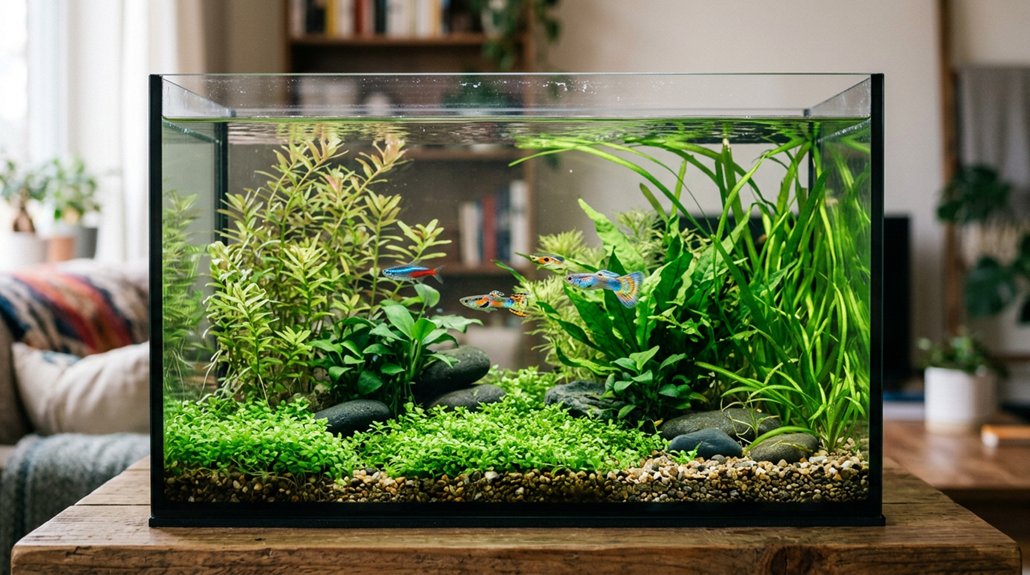
In 5–10 gallon aquariums, the safest stocking choices are single-species setups or very small, low-bio-load groups: one male betta, or a trio of adult Endler’s livebearers or guppies with a 1 male:2–3 female ratio to reduce harassment and overcrowding. You should keep density low, because stable chemistry matters more than variety.
- 1 betta, planted, calm
- 3 Endler’s livebearers, balanced sex ratio
- 3 guppies, sexed correctly
- 4–6 pygmy rasboras only if fully cycled
- nano shrimp or mystery snails as companion invertebrates
If you choose Corydoras, use 4–6 only in a 10-gallon with soft substrate and sinking food; in 5 gallons, they’re cramped. Avoid goldfish, mollies, swordtails, plecos, and large barbs; keep adult length near 1/2″–2″.
Best Fish Combinations for 20–50 Gallons
For 20–50 gallon aquariums, you can build stable community layouts that balance swimming space, territorial behavior, and bioload: a school of 6–8 tiger barbs or similar barbs pairs well with a peaceful gourami pair and 4–6 Corydoras, while a midwater-focused tank can run 8–12 small tetras with 4–6 Corydoras and a single bristlenose pleco in the upper end of the range. You can also use 6+ danios with 6 barbs and 4–6 Corydoras if you keep open water and structured cover. In planted setups, 3–6 guppies or platies with 6 cherry barbs can work if you maintain a 1 male:2–3 female ratio. Choose fine substrate choices for Corydoras and moderate lighting schemes to reduce stress. For 29–50 gallons, 3–4 fancy goldfish need heavy filtration and sinking pellets.
Best Fish Combinations for 55–120 Gallons
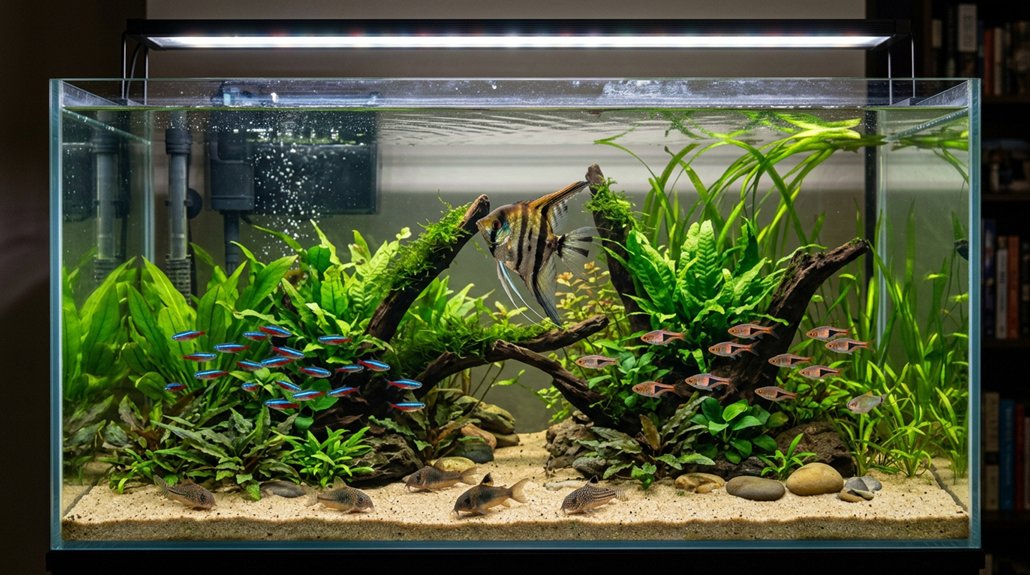
As tank volume rises into the 55–120 gallon range, you can shift from compact community layouts to more structured systems that manage territory, filtration load, and swimming behavior with greater flexibility. You’ll gain room for species-specific zoning, higher biomass, and tighter control of aggression through rockwork density and schooling dynamics.
- 10–15 mbuna with harem ratios
- 6–8 rainbows, angelfish, tetras
- 1 redtail shark, barb school, catfish
- 6–8 giant danios, 12+ tetras
- 3–6 Synodontis with cichlids
In Malawi setups, dense rockwork diffuses dominance. In community cichlid tanks, you can pair midwater fish with calm angelfish if you keep filtration strong. Mixed communities work best when you separate open water, midwater, and bottom layers, so each fish occupies a distinct niche and stress stays low.
Best Fish Combinations for 125+ Gallons
In a 125+ gallon tank, you can support large cichlid communities, but you’ll need to match species by temperament, structure, and territorial demand. You can also use the extra footprint for big catfish options such as Corydoras, Synodontis, or a large pleco, provided your filtration and waste export can handle the bioload. With adequate rockwork, open swimming space, and stable water chemistry, you’ll get a more balanced and durable beginner setup.
Large Cichlid Communities
When you have 125 gallons or more, you can build large cichlid communities around species that match in adult size, aggression, and water-load demands. With Oscar care, keep Oscars singly or as one pair; they’ll reach 12–14 inches and need robust tankmates plus strong filtration. Mbuna crowding works best in dense harems with abundant rockwork, because broken sightlines reduce targeted aggression.
- A confident Oscar centerpiece
- A stable Mbuna colony
- Synodontis scavengers below
- Managuense with Red Hook Silver Dollars
- Powerful filtration and weekly changes
You should overcrowd visually, not biologically, to diffuse aggression while preserving oxygen and waste-processing capacity. In very large setups, select fish by adult size, temperament, and niche, and avoid mismatched weak species.
Big Catfish Options
For 125+ gallon aquariums, big catfish can add substantial bottom-dwelling biomass, but you need to match adult size, diet, and behavior carefully.
| Species | Key requirement |
|---|---|
| Florida Pleco | 180+ gallons, heavy filtration, driftwood |
| Giraffe Catfish | 180–200 gallons, strong flow, meaty sinking foods |
| Synodontis spp. | Group of 3+, peaceful, 6–8″ |
Your safest large-catfish choice is usually the Florida Pleco if you can exceed 180 gallons; it’ll graze wood and algae, but its 24″ body produces high waste. The Giraffe Catfish also reaches about 24″, and you shouldn’t understock flow or protein. If you want a smaller, social option, Featherfin Synodontis stay manageable and can share space with robust cichlids, including an Oscar, provided you maintain strong filtration and avoid bite-sized tankmates.
Beginner Fish That Stay Peaceful
Peaceful beginner fish are the best choice when you want a stable community tank with minimal aggression and predictable behavior. You’ll get strong peaceful compatibility when you select species with similar temperaments and water needs. Community schooling species reduce stress and improve natural behavior.
- Neon tetras: keep 10–12 in soft, slightly acidic water.
- Harlequin rasboras: keep 8–12; they adapt well.
- Guppies: keep at least 3, with 1 male to 2–3 females.
- Corydoras: keep 4–6; they’re gentle and social.
- Cherry shrimp: pair with non-predatory tetras or rasboras.
For best results, maintain stable temperature, oxygenation, and low aggression. Dense planting and hiding places help limit stress, support behavior, and improve long-term survival in your beginner aquarium.
Bottom Feeders by Tank Size
In small 5–10 gallon tanks, choose compact Corydoras species such as Panda or Salt & Pepper and keep them in groups of 4–6, with direct feedings of sinking pellets or tablets to prevent nutritional deficits. You should use fine substrate selection, since abrasive gravel can damage barbels and reduce foraging efficiency. Their nocturnal activity means they’ll often feed after lights dim, so target food near the bottom rather than assuming they’ll find leftovers. In 20–50 gallons, a Bristlenose Pleco is better than a Common Pleco; offer wafers and weighted cucumber or zucchini. For 55–120 gallons, Synodontis spp. handle aggression and scavenge efficiently. In 125+ gallons, Florida Plecos or feather catfish need sinking wafers and vegetable matter.
Plants and Layout for Harmony
Dense plantings and structured hardscape reduce conflict by breaking sight lines while still preserving open water for active swimmers. You’ll get better stability with dense planting of Java Fern, Anubias, and Java Moss, plus midwater lanes for 6+ neon tetras, rasboras, or danios. Use driftwood, rocks, or cork bark to define territories for Corydoras groups of 4–6 and dwarf cichlids. Fine sand or smooth gravel protects barbels and supports foraging. Place Vallisneria and Amazon Sword at the back and sides to create vertical stratification and separate zones. Anchor floating duckweed or Salvinia to diffuse light and lower stress for bettas and gouramis.
- calmer school movement
- fewer territorial clashes
- safer bottom feeding
- clearer habitat structure
- reduced light stress
Frequently Asked Questions
What Is the Most Beginner Friendly Fish?
You’d usually find guppies most beginner-friendly: they’re hardy, small, and adaptable for community tanks. If you need coldwater species, zebra danios can work too, but they’ll still need stable, well-cycled water.
What Fish Can Live Together for Beginners?
You can keep a community tank with neon tetras, harlequin rasboras, dwarf Corydoras, and female-biased guppies or platies. You’ll get seasonal compatibility by matching temperature ranges, stocking schools properly, and avoiding territorial species.
What Is the Best Combination of Fish?
You’ll do best with 6–8 Ember tetras or Harlequin rasboras, plus 4–6 pygmy Corydoras, in a planted tank with soft substrate. That mix keeps behavior compatible, water stable, and your feeding schedule simple.
What Fish Are Best in Pairs?
You’ll usually do best with kribensis, gouramis, angelfish, and apistogramma pairs; they show breeding behavior in suitably sized tanks. Match their tank chemistry closely, and keep corydoras in groups rather than strict pairs.
Conclusion
In your tank, the right fish combinations behave like well-matched gears, turning smoothly rather than grinding. When you balance size, temperament, and bioload, you create a stable system where stress stays low and compatibility rises. You’ll see peaceful midwater swimmers, cautious bottom feeders, and planted cover working together like parts of a calibrated machine. If you choose deliberately, your aquarium won’t just survive—it’ll function as a precise, resilient ecosystem.