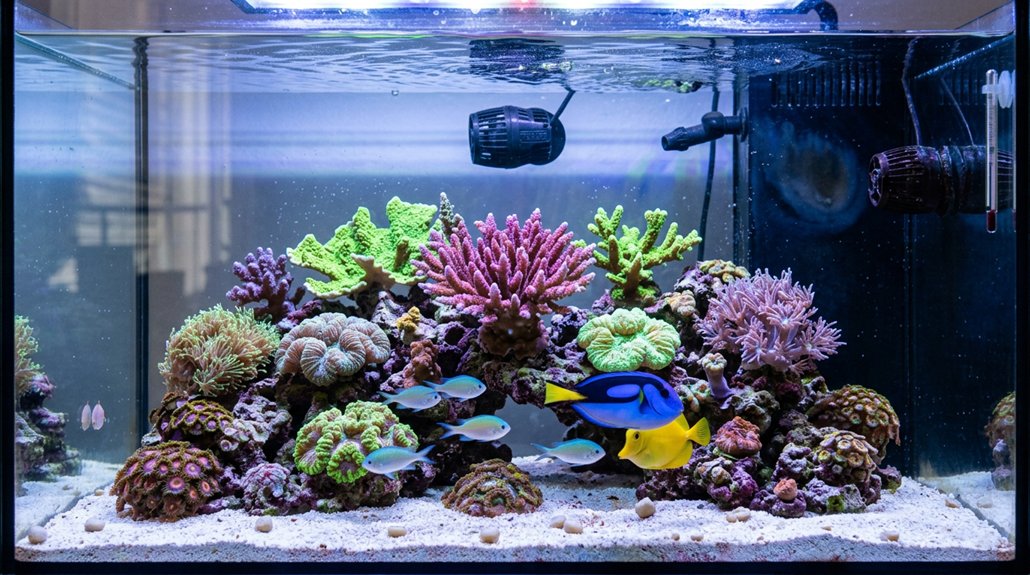
Common saltwater aquarium problems usually come from unstable salinity, ammonia or nitrite spikes, poor flow, excess nutrients, or weak maintenance. You should test water weekly, keep salinity at 1.025–1.026, top off with RO/DI only, and correct chemistry slowly with small water changes. Reduce algae with shorter lighting, lower feeding, GFO, skimming, and manual removal. Quarantine new livestock, inspect for pests, and keep flow and filtration tuned for a healthier reef that stays stable longer.
Key Takeaways
- Cycle new tanks 4–6 weeks, keep ammonia and nitrite at 0 ppm, and test frequently to prevent livestock losses.
- Maintain stable salinity, temperature, calcium, alkalinity, and magnesium using RO/DI water and gradual dosing.
- Control algae and nutrient blooms with weekly water changes, reduced feeding, proper lighting, GFO, carbon, and UV sterilization.
- Provide strong, well-mapped flow and proper skimming to eliminate dead spots, remove waste, and support coral health.
- Quarantine new livestock 1–2 months and inspect regularly to reduce disease, parasites, and pest outbreaks.
Why Saltwater Aquarium Problems Start
Saltwater aquarium problems often start when the system is pushed before it’s biologically ready: a new tank typically needs about 4–6 weeks to establish nitrifying bacteria, and adding fish too early can trigger ammonia and nitrite spikes that stress or kill livestock. You also run into trouble when you choose a tank under 29 gallons, because small water volumes swing faster in temperature, salinity, and chemistry. Untreated tap water or weak salt mix can add nitrates, phosphates, metals, or low calcium and magnesium, driving algae and instability. Inexperienced stocking and overfeeding increase waste beyond filtration capacity. Equipment neglect, like poor heater calibration or skipped testing, compounds the risk. Sudden salinity, alkalinity, or temperature changes can disrupt bacteria and cause cascade failures.
Fix Saltwater Aquarium Water Quality
You should test ammonia, nitrite, nitrate, phosphate, salinity, temperature, and reef chemistry every week so you can catch instability early. If ammonia or nitrite spikes, do a 25–50% water change and check filtration, but correct other parameters gradually to avoid shocking livestock. Keep salinity at 1.025–1.026, top off only with RO/DI water, and maintain calcium, alkalinity, and magnesium in target ranges with regular dosing.
Test Water Regularly
Regular water testing is the fastest way to catch chemistry problems before they stress livestock. You should test ammonia, nitrite, nitrate, and phosphate at least weekly, and more often during cycling or after a crash. Ammonia and nitrite must stay at 0 ppm; keep reef nitrate ideally under 10–20 ppm. Check salinity daily at about 1.025–1.026 specific gravity, or 35.5 PPT, and verify temperature daily because small shifts can destabilize the tank. For reefs, test calcium, alkalinity, and magnesium weekly, targeting 400–450 ppm Ca, 8–9 dKH, and 1250–1350 ppm Mg. Use weekly logging to track trends and source testing to confirm your RO/DI or premixed saltwater isn’t adding nitrates, phosphates, or metals before you mix.
Correct Chemistry Gradually
Once a problem is identified, correct it gradually so the tank’s chemistry can stabilize without adding more stress to livestock. When salinity drifts after evaporation, top off only with fresh RO/DI water, not saltwater, and target 1.025–1.026 specific gravity. For ammonia or nitrite spikes, use frequent small partial water changes, test daily, and add beneficial bacteria to rebuild filtration. Adjust alkalinity and calcium with slow dosing; limit alkalinity increases to 0.5–1.0 dKH per day, then retest before the next dose. If magnesium is low, raise it through measured dosing or reef-grade salt during changes. For excess nitrate or phosphate, reduce feeding, increase small water changes, and use GFO or carbon dosing reactors. Make incremental adjustments to avoid precipitation, pH swings, and osmotic stress.
Stop Algae Blooms and Green Water
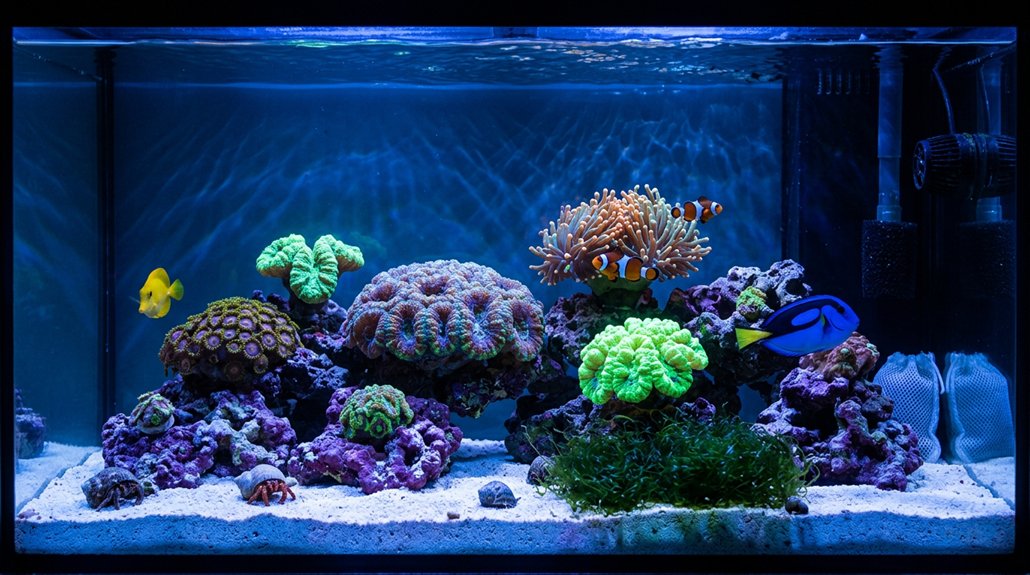
You’ll slow algae blooms by cutting excess light, because long photoperiods and high-intensity lighting can fuel green water and nuisance growth. Improve filtration and water movement with strong protein skimming, UV sterilization for green water, and better circulation to keep nutrients and suspended algae from accumulating. If you keep nutrient export, flow, and lighting under control, you’ll reduce recurrence and stabilize the aquarium’s water column.
Reduce Excess Light
Excess light can rapidly fuel hair algae and green water blooms when nitrate and phosphate are already present, so start by reducing the photoperiod to 6–8 hours per day and, if needed, lowering intensity with dimmers or adjustable LEDs. Use photoperiod experiments to find the minimum light your livestock tolerates, and keep spectral balance stable while you test.
| Action | Target | Result |
|---|---|---|
| Shorten lighting | 6–8 hrs | Less algae growth |
| Lower PAR | Gradual over days | Reduced stress |
| Shade tank/clean covers | Monthly | Less stray light |
| Water change | 10% weekly | Lower nutrients |
Move the tank away from direct sunlight, and clean light covers with vinegar monthly. Reduce light over several days, not all at once. If green water persists, keep nutrient control tight while continuing reduced lighting.
Improve Filtration And Flow
Boost circulation and filtration to starve algae at the source: use appropriately sized powerheads or a wave maker to eliminate dead spots and target a total turnover of about 20–40× tank volume per hour in reef systems. Dial in pump sizing so flow reaches behind rockwork without blasting corals, and build return redundancy into the system for reliability. Add a protein skimmer, mechanical prefilter sponges, and replace disposable media just before or after water changes to protect biofiltration. Run GFO in a reactor to hold phosphate below 0.03 ppm, and use activated carbon about every 2 months to strip dissolved organics. Test nitrate and phosphate weekly, keep nitrate under 10 ppm, and change 10% of water weekly. A UV sterilizer sized to your flow can clear green water and free-floating algae.
Control Cyanobacteria and Dinoflagellates
Cyanobacteria and dinoflagellates are usually controlled by correcting the nutrient and flow conditions that let them take hold. If you see red slime, you should manually siphon it off and do 10–15% water changes every 3–5 days until phosphate and nitrate fall into range. Check source water first; if tap water is contaminated, switch to RO/DI or premixed saltwater, and replace exhausted RO/DI filters. For dino blooms, identify near-zero nutrients, then begin careful nutrient dosing with a nitrate/phosphate supplement to restore balance. Pair that with daily manual removal, fresh filter socks, and beneficial bacteria dosing. A UV sterilizer can help reduce free-swimming cells. Keep testing regularly so you catch rebounds early and maintain stable, safe nutrient levels.
Fix Flow, Lighting, and Skimmer Issues
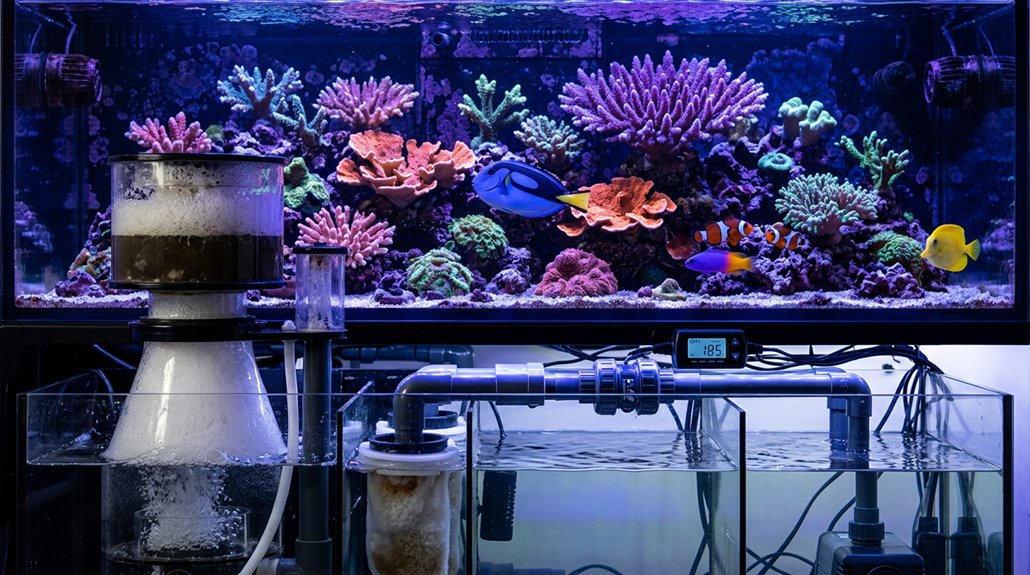
Poor flow, incorrect lighting, and an underperforming skimmer can all destabilize a saltwater tank, so you should correct them methodically rather than all at once. Start with flow mapping to find dead zones, then aim for 20–40x turnover with powerheads or wavemakers. Mix laminar and turbulent patterns to keep detritus suspended.
| Issue | Target | Action |
|---|---|---|
| Flow | 20–40x turnover | Reposition pumps |
| Lighting | Coral-specific PAR | Match spectrum |
| Skimmer | Dark skimmate | Adjust water level |
| Flow/light | No shading | Move corals |
| Skimmer | Monthly upkeep | Clean air intake |
Set LEDs to suit coral type; SPS usually need higher PAR, while LPS and soft corals need less. Use skimmer maintenance to keep air intakes clean and foam dense. Add changes gradually, and if chemistry shifts, test ammonia, nitrite, nitrate, alkalinity, calcium, and salinity.
Prevent Saltwater Aquarium Problems Long Term
Preventing problems long term comes down to consistency: perform small water changes on a regular schedule, using RO/DI water and reef salt to replace trace elements like calcium, magnesium, and alkalinity while keeping nitrate and phosphate from building up. Keep salinity at 1.025–1.026 by topping off evaporation with pure RO/DI water, not saltwater. Your preventive maintenance should include weekly ammonia, nitrite, and nitrate testing, plus skimmer-cup cleaning and media checks.
- Use a stocking strategy that matches tank size and filtration capacity.
- Feed sparingly and remove uneaten food quickly.
- Quarantine new livestock for 1–2 months, and research compatibility before purchase.
With proper circulation, your system’s dead spots shrink, organics stay controlled, and disease, pests, and algae pressure drop.
Frequently Asked Questions
What Are the Common Problems With Saltwater Fish Tanks?
You’ll commonly face ammonia or nitrite spikes, algae blooms, salinity swings, cloudy water, and temperature or circulation issues. Poor water chemistry, overfeeding, and equipment failure can quickly stress fish, so you’ve got to test and maintain regularly.
What Is the Average Lifespan of a Saltwater Aquarium?
You can’t pin down a single lifespan, but tank longevity often reaches decades if you maintain it well. Your system usually fails from owner limits or worn equipment upgrades, not biology, especially in larger tanks.
What Is the New Tank Syndrome in Saltwater Aquariums?
New tank syndrome is the first 4–8 weeks in your saltwater aquarium when cycling stress leaves ammonia and nitrite unchecked, causing bacterial blooms, cloudy water, stressed fish, and losses until nitrifying bacteria fully establish.
Why Are All My Saltwater Fish Dying?
Anachronistically, you’re likely seeing ammonia, nitrite, salinity, oxygen, copper, poor acclimation, or undetected disease killing them. Test water now, verify specific gravity, inspect pumps, and do a 20–50% change if anything’s off.
Conclusion
When you correct water chemistry, flow, and lighting, you don’t just solve today’s issue—you reduce the conditions that let new problems appear. If your tank suddenly improves after a small adjustment, that isn’t luck; it’s coincidence revealing the system’s imbalance. Keep testing, cleaning, and observing on a schedule, and you’ll catch shifts early. With steady maintenance and precise correction, you can keep your saltwater aquarium stable, clear, and far easier to manage.