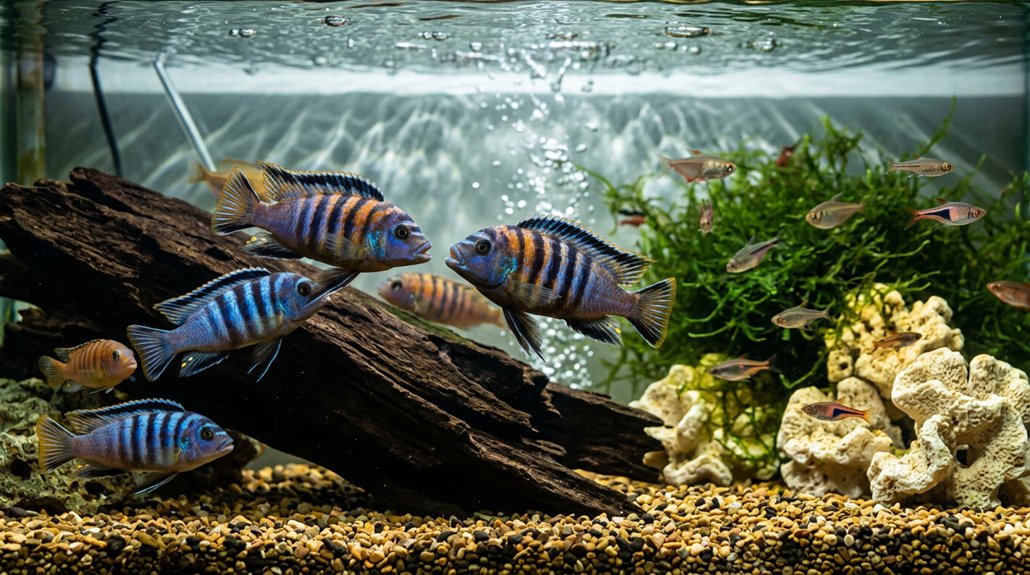
You should avoid fish that nip fins, chase tankmates, or outgrow community tanks, because they can cause chronic stress, wounds, and infections. Tiger barbs, serpae tetras, some angelfish, common plecos, Chinese algae eaters, and freshwater sharks can all become territorial or destructive as they mature. Predatory cichlids, like Oscars and flowerhorns, also need species-only setups. Choosing fish by adult size, temperament, and bioload will save you trouble, and there’s more to sort out.
Key Takeaways
- Avoid fin-nippers like tiger barbs, serpae tetras, and black widow tetras; they harass slow or long-finned fish.
- Avoid predatory species such as Oscars, peacock bass, Midas cichlids, and pike cichlids in community tanks.
- Avoid large plecos and freshwater “sharks,” which become territorial and create heavy waste as they grow.
- Avoid scale-eaters like Exodon paradoxus unless kept in large, same-sized species-only groups.
- Watch for repeated chasing, cornering, and fin damage, which signal bullying that may require isolation or species-only housing.
What Makes Aggressive Fish Bad for Community Tanks
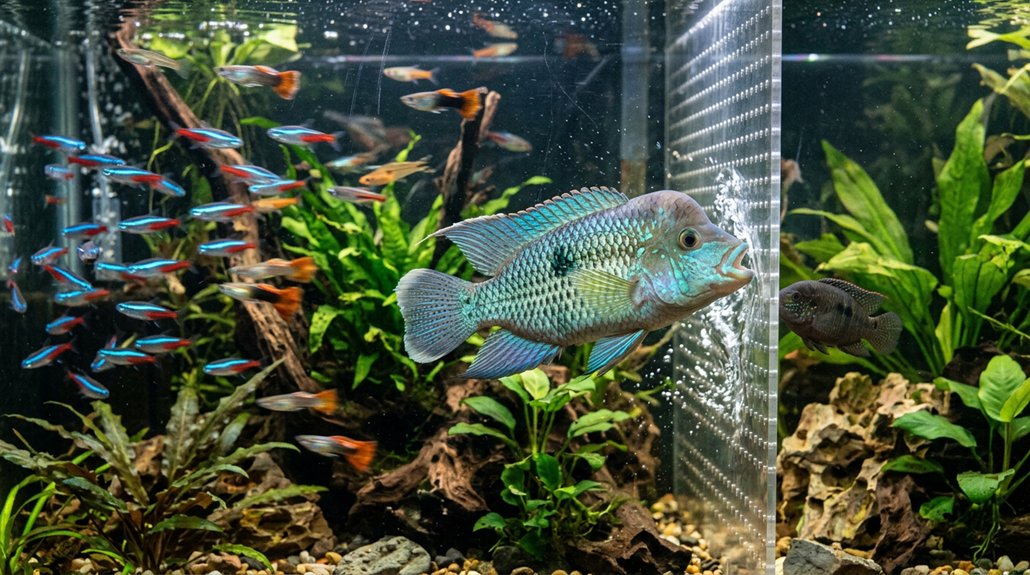
Aggressive fish can quickly undermine a community tank by turning normal coexistence into constant stress. You’ll usually see stress indicators first: torn fins, hiding, loss of appetite, rapid breathing, and faded color. Some species don’t just intimidate tankmates; they fin-nip repeatedly, opening wounds that invite infection. Others outgrow their juvenile size and become territorial, skittish, or scale-eating, so compatibility testing has to include adult size and feeding behavior, not just appearance. Bottom dwellers and algae-eaters may also become problem fish when they get larger than advertised, increasing bio-load and disturbing plants. If a species defends a large area, you’ll need far more space than a standard community tank provides, or chronic stress will spread through the entire system.
Bullies vs. Predators: The Two Aggression Types
When you’re evaluating a species for a community tank, it helps to separate bullies from predators because the management strategy is different for each. bullies harass tankmates through fin-nipping, chasing, cornering, and repeated biting; tiger barbs and serpae tetras are classic examples. Their aggression often reflects social hierarchy, so improper group size can worsen conflict, especially with lone tiger barbs or a few angelfish. You can sometimes reduce this with environmental enrichment, decor rearrangement, larger conspecific groups, or isolation. predators, by contrast, don’t just intimidate—they eat fish small enough to fit in their mouths, as seen with Exodon and many large cichlids. As they grow, juveniles can become dangerous, so you’ll usually need same-sized tankmates or a species-only setup.
Plecos, Sharks, and Other Large Aggressive Fish
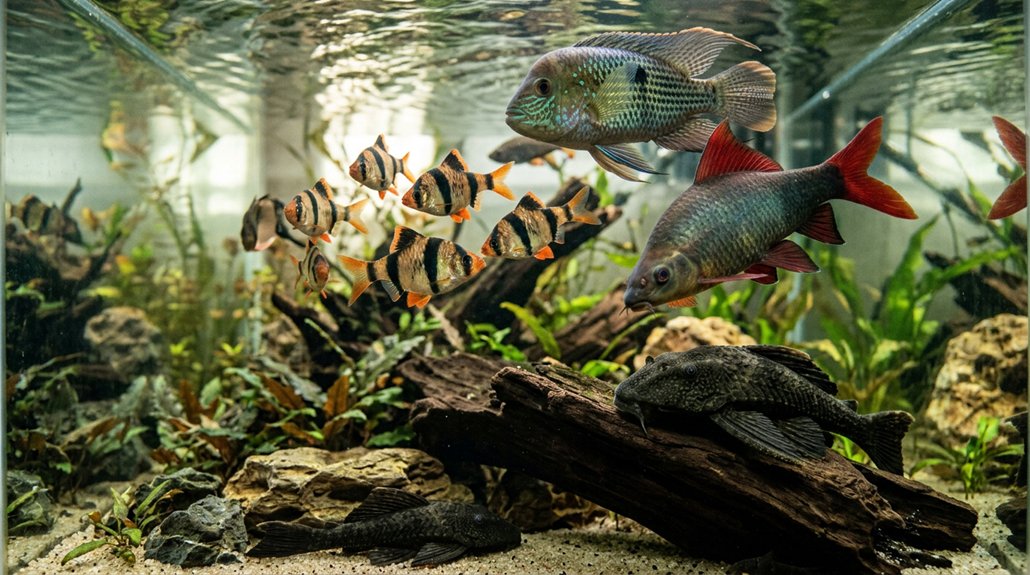
If you add common plecos, Gibbiceps, or Golden Nugget variants to a community tank, you’re often dealing with fish that can reach about 45 cm and sharply increase waste, territoriality, and plant damage. You’ll see similar problems with freshwater “sharks,” since red tail and ruby sharks are highly territorial, while larger silver sharks can exceed 30 cm and may prey on small tankmates. Species like Chinese algae eaters also become increasingly aggressive with age, so you shouldn’t assume these fish will stay community-safe as juveniles.
Plecos and Tank Size
Many common plecos, including common and Gibbiceps types, can seem like ideal algae eaters in a community tank, but they often grow to about 45 cm (18 in) and produce so much waste that they can effectively double the bioload, demanding far larger filtration and tank volume than beginners expect. You need to evaluate adult size before purchase, because juvenile fish won’t stay small. Their filtration needs rise sharply as they grow, and undersized systems quickly accumulate nitrate and debris. In cramped tanks, you may see territorial behavior, plant damage, and shredded décor as the fish matures. For reliable algae control, choose a smaller species matched to your aquarium’s capacity. If you can’t provide a large, stable system with adequate flow and maintenance, don’t rely on a pleco as a cleanup fish.
Sharks and Territoriality
Beyond size and filtration, aggression and territoriality are major reasons certain fish don’t belong in community tanks. If you keep freshwater sharks, you’re managing territory dynamics, not just swimming patterns. Red tail black and ruby sharks actively chase tankmates; silver sharks can exceed 30 cm and may eat small fish like Neon tetras. | Fish | Risk |
| — | — |
|---|---|
| Freshwater sharks | Chasing, predation |
| Large plecos | Overcrowding, plant damage |
| Big cichlids | Conspecific aggression |
Common plecs and Chinese algae eaters often look peaceful when young, then become highly territorial as adults. Large species need species-specific tanks, robust tankmates, and habitat enrichment that supports conflict reduction. Otherwise, you’re setting up repeated stress, injuries, and chronic instability in the aquarium.
Angelfish, Tiger Barbs, and Other Fin Nippers
You’ll find that angelfish can become territorial and, when breeding, may injure very small tankmates like neon tetras, so you need to match them with appropriately sized species. Tiger barbs are persistent fin-nippers that can shred the fins of slow or long-finned fish, and even nippy tetras can cause repeated damage and infection. To protect long-finned fish, you should choose compatible tankmates, keep nippers in larger groups to spread aggression, and isolate any fish that keep bullying others.
Angelfish Fin Damage
Angelfish’s long, flowing fins make them especially vulnerable to fin-nipping tankmates like Tiger Barbs, which can repeatedly tear delicate tissue and leave the fish open to secondary bacterial or fungal infections. You may see chronic fin damage if nipping continues, and that stress can slow fin regrowth. To reduce risk, don’t house angelfish with known fin-nippers such as Tiger, Serpae, or certain tetra species unless the tank is very large, heavily planted, and stocked to diffuse aggression. When injury appears, move the angelfish to hospital isolation for treatment and to stop further harassment. In the display tank, you can also rearrange décor and territories, which may interrupt repeated attacks and improve recovery.
Tiger Barb Nipping
Tiger barbs are notorious fin-nippers, and they’ll often target slow-moving or long-finned fish such as angelfish, whose flowing fins are easy to tear and slow to heal. You should avoid mixing these fish with active, nip-prone species, because different swimming speeds and fin types often trigger persistent aggression. Keep tiger barbs in groups of 6–12+ so their attention spreads across the shoal instead of one tankmate. Add tank enrichment with dense plants, wood, and hiding spots, and rearrange decor to disrupt territorial patterns. Use feeding strategies that distribute food widely across the tank, which lowers competition and reduces mealtime strikes. If nipping continues, move the victim to a calmer aquarium or relocate the offending species permanently.
Protecting Long-Finned Fish
Long-finned fish need special protection in community tanks because their trailing fins make them easy targets for nippers and, in some cases, potential aggressors themselves. You should avoid placing angelfish with tiger barbs unless the barbs are kept in 8–12+ fish shoals; even then, nipping can persist. Choose fin safe companions of similar size, and remember that angelfish may also bully smaller fish unless housed in pairs or larger groups. Use tank placement to separate territorial species, add visual barriers with plants or driftwood, and spread food widely during feeding strategies so chasing doesn’t concentrate. Serpae, Bleeding Heart, Black Widow, and some White Spot or Red Eye tetras can tear tissue and invite infection. If nipping continues, isolate the offender or relocate the target.
Predatory Cichlids to Avoid in Community Tanks
Predatory cichlids are among the most unsuitable fish for community tanks because their size, territoriality, and feeding behavior quickly make them incompatible with smaller or more peaceful species. You’ll find that Oscars, peacock bass, Midas cichlids, pike cichlids, and Flowerhorns function as large piscivores or territorial cichlids, not community fish. Oscars can reach 18 inches and need 55+ gallons each; peacock bass may require 150–300 gallons and can eat tankmates. Midas cichlids defend large breeding territories, while pike cichlids are ambush predators that do best alone. Flowerhorns’ hybrid genetics often intensify aggression, making them destructive in shared aquaria. If you keep these species, you’ll need species-only setups, heavy filtration, and careful monitoring to prevent injury, predation, and chronic stress.
Aggressive Schooling Fish That Turn Nasty
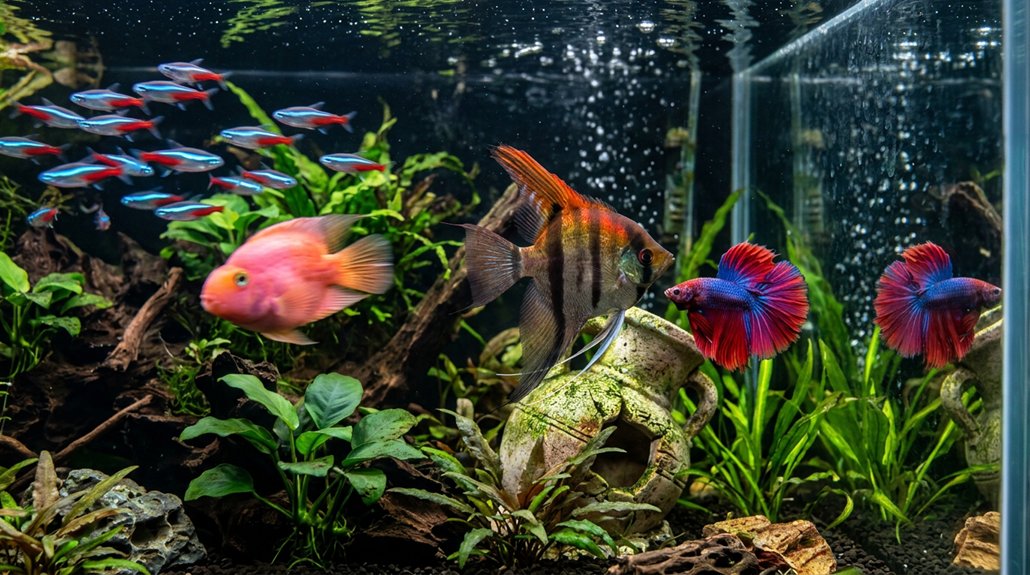
Not all troublemakers in community tanks are lone predators; some look harmless in groups until their social behavior shifts into fin-nipping, scale-eating, or territorial aggression. You’ll see this with tiger barbs, whose schooling dynamics can suppress nipping only when you keep 8–12 or more; fewer fish often focus aggression on slow, long-finned tankmates. Serpae, black widow, and red-eye tetras can do the same, especially when aggression triggers include cramped space or mismatched tankmates. Exodon paradoxus is more extreme: it’s a true scale-eater and should be kept in large groups of 12+ similarly sized fish. Even silver or black widow tetras may turn territorial as they mature. When you house these species, same-source groups and dense cover matter.
How to Manage Fish Tank Bullies
To manage tank bullies effectively, start by confirming the behavior is persistent rather than a brief stress response: watch for repeated chasing, fin-nipping, and cornering over several days before intervening. Use behavior monitoring to document patterns, then modify the layout.
Confirm it’s persistent bullying, not a brief stress response, by monitoring repeated chasing, fin-nipping, and cornering.
- Shift rocks and driftwood to disrupt territories.
- Add dense plants to block sightlines.
- Spread food across the surface with feeding strategies.
- Place a breeding or hospital box in the tank for temporary isolation.
This time-out can reduce injury and let wounds heal while you test whether the fish calms down when returned. If aggression continues after habitat changes and isolation, you’ll need a permanent fix: a species-only setup, rehoming the bully, or housing it alone in an appropriately sized aquarium.
Peaceful Fish Alternatives for Community Tanks
A well-chosen community tank often starts with small, nonterritorial fish that spread activity evenly and reduce pressure on any one species. You should build around neon tetra groups of 6–10 or glass rasboras to dilute aggression and limit fin-nipping. For the substrate, corydoras bottomdwellers kept in groups of 4–6 are safer than large plecos, which can exceed 30 cm and create heavy bioload. In mid-water, platies or swordtails work well because they tolerate pH 6.8–8.0 and match similarly sized tankmates. If you want soft-water specialists, keep discus in species-only systems; for mixed tanks, harlequin rasboras are harder and less territorial. Protect long-finned fish by avoiding tiger barbs and serpae tetras, or keep nippers in large shoals.
Frequently Asked Questions
What Is the Most Aggressive Fish for a Fish Tank?
Exodon paradoxus is often the most aggressive fish you’ll keep; its habitual scale-eating and relentless nipping exceed typical betta behavior and many cichlid aggression patterns. You’ll need a large, same-size group, not a community setup.
What Are the Four Fish to Avoid?
You should avoid angelfish, freshwater sharks, plecos, and tiger barbs; in one tank, cichlid aggression and territorial betta behaviors can escalate fast. You’ll prevent fin damage, overcrowding, and stress in your community aquarium.
What Aggressive Fish Can Live Together?
You can keep territorial cichlids together in a very large, species-specific tank, and fin nipping barbs in same-species shoals of 8-12+; you’ll reduce aggression, but you can’t eliminate risk completely.
What Fish Go Well in a Community Tank?
You’d do well with compatible tetras, peaceful gouramis, rasboras, Corydoras, and livebearers in a stable, well-filtered tank. You’ll want similar size, temperament, and water parameters, plus proper schooling numbers to reduce stress and aggression.
Conclusion
In a community tank, you need to keep the peace or risk turning the aquarium into a battleground. Aggressive fish can harass, injure, or outcompete calmer species, so you should choose tankmates with care. By understanding bullies, predators, and fin nippers, you can build a stable system where fish coexist safely. If you manage aggression early, your tank’ll run like a well-tuned machine, not a war zone.