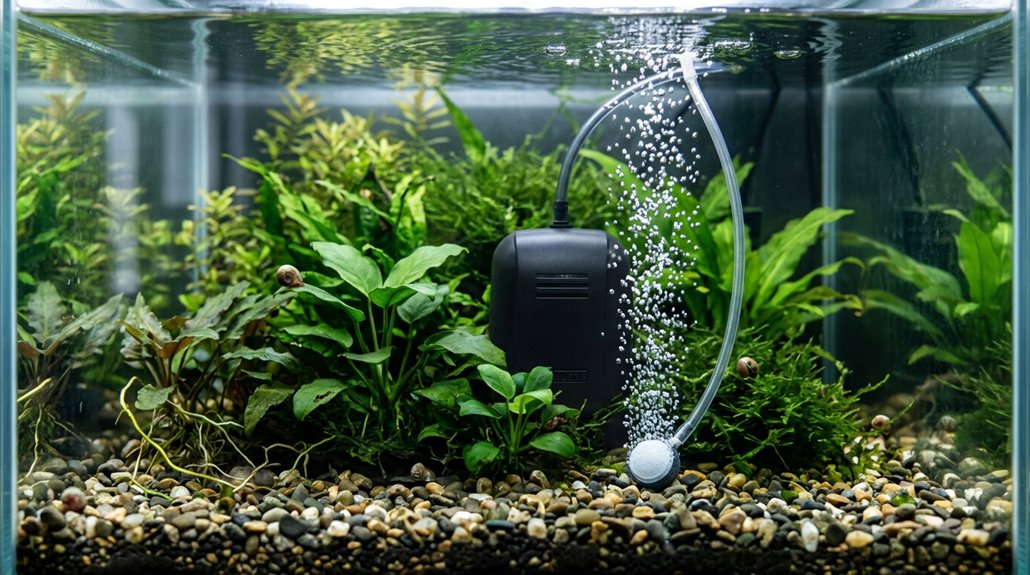
An aquarium air pump is an external device that pushes room air through tubing into your tank, usually to run air stones, sponge filters, or other air-driven gear. It boosts surface agitation, helps oxygen exchange, and can be useful in warm, crowded, or poorly circulated tanks. You don’t always need one if your filter already ripples the surface well. If you’re unsure, the basics below will show you when it’s worth adding one.
Key Takeaways
- An aquarium air pump sits outside the tank and pushes air through tubing to devices like air stones or sponge filters.
- It improves oxygenation by creating bubbles and surface agitation, which helps gas exchange in the water.
- You often need one for sponge filters, quarantine tanks, tall tanks, heavily stocked tanks, or during power outages.
- If your filter already creates strong surface movement, you may not need a separate air pump.
- Choose quiet, adjustable, or battery-backup models if you need low noise or emergency aeration.
What Is an Aquarium Air Pump?
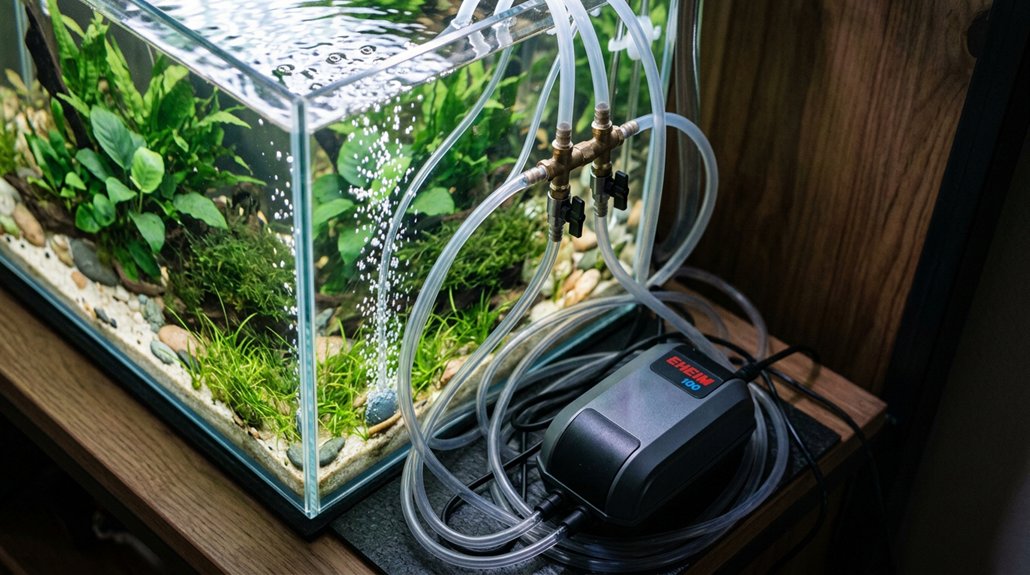
An aquarium air pump is an external device that pushes ambient air through airline tubing into your tank, creating bubbles and surface movement. You don’t submerge it; instead, it sits outside the aquarium and drives air with an electric diaphragm or piston. You can connect it to air stones, sponge filters, or decorations to spread airflow. In the history evolution of fishkeeping, these pumps became common as aquarists looked for steadier aeration and simpler backup systems. The bubbles increase surface agitation, which helps oxygen enter and carbon dioxide leave the water. You should match pump output to tank size and depth, add a check valve, and place it above the waterline. Modern models also emphasize noise reduction and can run battery backup during outages.
How Does an Aquarium Air Pump Work?
When you switch on an aquarium air pump, it pulls in room air and pushes it through tubing to an air stone, sponge filter, or similar device. That airflow creates bubbles, and as they rise and burst at the surface, they boost agitation and help gas exchange happen more efficiently. You’ll get the best results when the pump matches your tank depth and the air-driven gear you’re using.
Airflow And Bubble Action
At work in a simple but effective way, an aquarium air pump vibrates a diaphragm or piston to push ambient air through airline tubing and into the tank, usually through an air stone or sponge filter. The rising bubbles don’t add much oxygen while they travel; most gas exchange happens when they burst and stir the surface. That’s why bubble size and surface agitation matter so much.
| Factor | What you’ll notice | Why it matters |
|---|---|---|
| Fine bubbles | More even release | Better surface movement |
| Stronger pump | Steadier output | Handles depth and long lines |
| Check valve | Stops back-siphon | Protects against power loss |
If you use long air stones, split lines, or deep tanks, you may need a stronger unit. Smaller pumps can leave bubbles uneven.
Driving Filters And Aeration
Most aquarium air pumps do their real work by moving air, not by “adding oxygen” directly, as the bubbles mainly help once they reach the surface and break it. Inside the pump, a diaphragm or piston pulls in room air and sends it through airline tubing to an air stone, sponge filter, or ornament. That airflow creates bubble distribution and surface agitation, which boosts O2 uptake and lets CO2 escape. If you run a sponge filter, the rising air also pulls water through the media, giving you mechanical and biological filtration, plus useful filter power. Match pump output to tank depth and line length, or bubbles will weaken. Use check valves, keep the pump above the waterline, and never submerge it.
When Do You Need an Aquarium Air Pump?
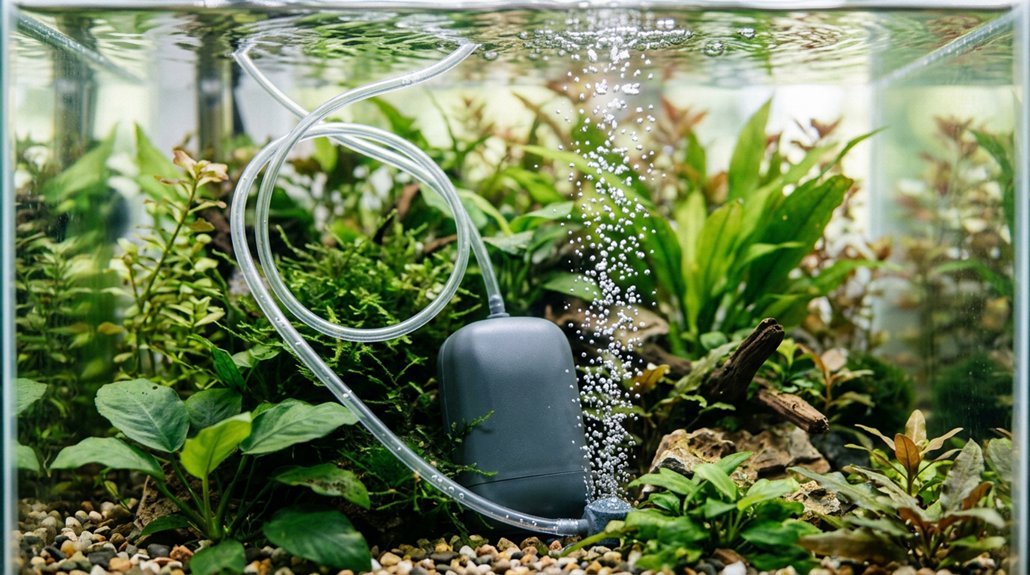
You need an aquarium air pump when your tank isn’t getting enough surface agitation from the filter or powerhead to keep dissolved oxygen at healthy levels, especially in heavily stocked, tall, or poorly circulated setups. Use oxygen sensors to check whether DO stays near 5–7 ppm. If you keep sponge filters, a quarantine tank, or use medications that create films or consume oxygen, an air pump can be necessary. Warm tanks above 78°F and planted tanks at night may also need extra aeration. | Situation | Need? |
| — | — |
|---|---|
| Low surface movement | Yes |
| Sponge filter tank | Yes |
| Quarantine or hospital tank | Yes |
| Hot or night-time planted tank | Often |
| Strong agitation already | Optional |
For noise mitigation, choose a quiet model or add airline dampening. Battery backup units also help during outages.
When Air Pumps Help Most
You’ll get the most benefit from an air pump in heavily stocked, warm, tall, or poorly aerated tanks, where oxygen can drop to unsafe levels. It’s also essential during low-oxygen emergencies like power outages, or in medicated tanks and those with surface film, because it keeps water moving and helps gas exchange. If you run sponge filters or under-gravel filters, the pump isn’t optional—it’s what powers that filtration and helps keep fry, shrimp, and sensitive fish safer.
High-Need Tank Types
Air pumps matter most in tanks that have a harder time exchanging oxygen, such as heavily stocked goldfish setups, warm-water aquariums above about 78°F, and tall or narrow tanks with limited surface area. In these setups, you’ll usually get better gas exchange from extra surface agitation, and your fish won’t have to work as hard for oxygen. They’re also useful in medicated or quarantine tanks, where surface films can slow diffusion, and in sponge-filter, fry, or shrimp tanks that need gentle circulation.
- Ripples shimmer across the waterline
- Airstones lift streams of fine bubbles
- Decor placement leaves open space for movement
An air pump can also support plant respiration at night, helping keep conditions steadier without strong flow.
Low-Oxygen Emergencies
When oxygen levels start dropping, an air pump can be a lifesaver during power outages or filter failures because it keeps water moving at the surface and helps prevent dissolved oxygen from falling to dangerous levels. You’ll want it most in heavily stocked or warm tanks, where oxygen can crash fast and fish may gasp, dart, or show rapid gill movement. It’s also useful in hospital or quarantine setups, especially when treatments create surface films or use oxygen. For emergency protocols, keep a battery-powered backup sized to your tank, and add a check valve with the pump mounted above the waterline to stop back-siphoning. Pair this with oxygen monitoring so you can react before levels drop below the healthy range.
Air-Driven Equipment
An air pump really earns its keep when it’s running air-driven gear like sponge filters, under-gravel filters, and air stones, since it pushes air through airline tubing to create bubbles that drive water flow and surface agitation. You’ll get gentle filtration from sponge filters, which are great for fry, shrimp, and breeding tanks, and you’ll add oxygen by breaking the surface. If you split one pump between several devices, airflow can drop, so use a larger unit or adjustable manifold.
- A column of fine bubbles rising through dark gravel
- A sponge filter humming in a quiet nursery tank
- Bubble curtains shimmering along the glass
Install inline check valves, replace worn air stones, and choose silent pumps when noise matters. Air-driven gear also gives you low-energy backup aeration if other equipment fails.
How Much Oxygen Do Fish Need?
Most freshwater fish do well when dissolved oxygen stays around 5–7 ppm, and you’ll want to avoid letting it drop below about 2–3 ppm, where severe stress or even death can occur. Those oxygen thresholds help you judge whether your tank is safe, but species requirements vary. Goldfish and livebearers often need more oxygen than low-demand fish, especially in crowded tanks. Warmer water holds less oxygen, so as temperature rises, your margin shrinks and aeration becomes more important. Watch for rapid gill movement, surface gasping, lethargy, or fish clustering near filter outflow. You can confirm levels with a dissolved oxygen meter or test kit, and it’s smart to keep readings above about 5 ppm for a healthy aquarium and stable conditions.
Do Saltwater Aquariums Need an Air Pump?
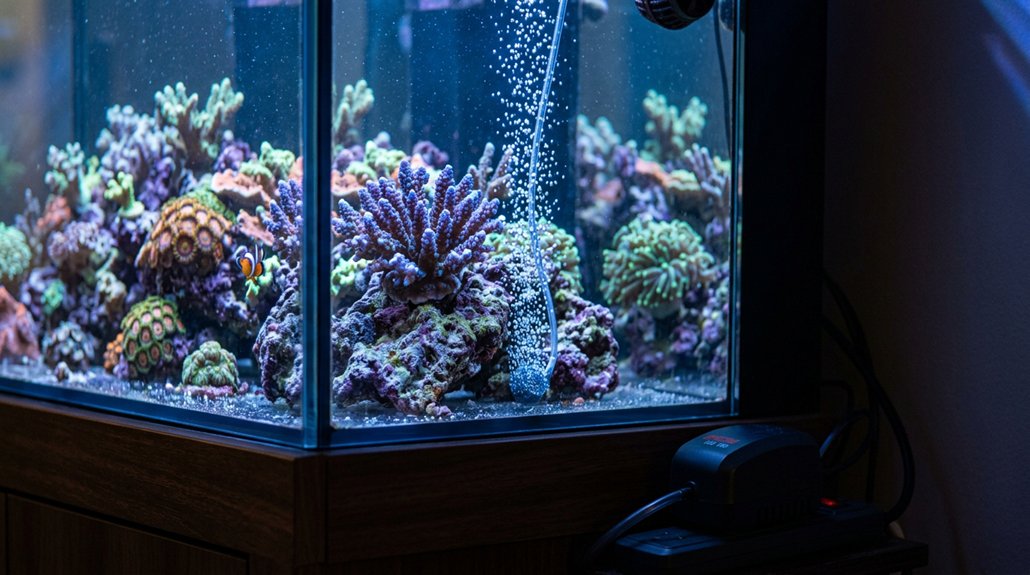
Saltwater aquariums often don’t need a dedicated air pump if your powerheads, return pump, or protein skimmer already provide strong surface agitation and gas exchange. In many setups, that’s enough to keep oxygen levels healthy without extra equipment.
Many saltwater tanks stay well-oxygenated without an air pump, thanks to strong surface agitation and gas exchange.
- A reef with rippling water and a calm, open surface
- A sponge filter bubbling in a quarantine tank
- A battery backup humming during a blackout
You may still want one for emergency aeration, sponge filters, or airline-driven reactors. In taller or heavily stocked tanks, added aeration can help keep dissolved oxygen near the 5–7 ppm range. Use caution with airstones in reef tanks, since microbubbles can bother bubble sensitive invertebrates and hurt skimmer performance. If you do use one, add a check valve to prevent back-siphon and keep flow from interfering.
What Types of Aquarium Air Pumps Are There?
If you’ve decided an air pump makes sense for your aquarium, the next step is choosing the right type. Diaphragm pumps are the most common; they use a vibrating rubber membrane, often offer multiple outlets, and need occasional diaphragm maintenance. Linear and piston-style pumps deliver higher pressure for deeper tanks or long air curtains. Battery-powered or 12V backup units are handy during outages, but they’re not built for long runtime. Adjustable-output and multi-outlet models help you feed several air stones or sponge filters without losing pressure. Quiet versions use rubber feet and insulated housings, and silencer upgrades can make them better for bedrooms.
| Type | Best use |
|---|---|
| Diaphragm | Everyday aquariums |
| Piston-style | Large or deep setups |
| Battery backup | Emergency aeration |
What Are the Best Alternatives to an Aquarium Air Pump?
You don’t always need a dedicated air pump, because several other pieces of equipment can provide the oxygen your aquarium needs. Powerheads or water pumps sized to turn the tank over 4–10 times per hour can create strong surface agitation and circulation, boosting gas exchange without bubbles. Hang-on-back or canister filters with a rippling return often do the same, while also handling filtration. In saltwater setups, protein skimmers help too, though they’re best as support rather than your only source of aeration. For emergencies, keep battery backups or battery-powered powerheads ready during outages. You can also improve oxygen levels by using a wider, shallower tank, lowering temperature, or directing spray bars toward the surface.
- A shimmering ripple across the waterline
- A filter return pushing lively current
- A backup pump beside a darkened tank
Frequently Asked Questions
Is an Aquarium Air Pump Necessary?
No, you don’t always need an aquarium air pump if your filter already provides strong surface agitation. You’ll want one for crowded, warm, or tall tanks, plus backup safety, equipment maintenance, and bubble aesthetics.
Do You Need Both a Filter and an Air Pump?
You don’t always need both; a good filter can handle oxygen and waste. Add an air pump if surface movement’s weak, stocking’s heavy, or you want sponge support, backup aeration, and subtle aesthetic enhancements.
Can Aquarium Fish Survive Without an Air Pump?
Yes, your fish can survive without an air pump if your filter creates enough surface agitation to support fish metabolism. In warm, crowded, or sealed tanks, though, you’ll likely need extra oxygenation.
How Do I Oxygenate My Aquarium Without an Air Pump?
You can oxygenate it by creating strong surface agitation with your filter outflow or a powerhead. Live plants help in daylight. Oxygen drops as water warms, and most fish need about 5–7 ppm dissolved oxygen.
Conclusion
So, do you really need an aquarium air pump? Maybe not always. If your tank is small, lightly stocked, and your water is already well-aerated, you could be fine without one. But if your fish seem to linger near the surface or your tank feels still, an air pump might be the simple fix you’ve been missing. The answer isn’t just “yes” or “no”—it depends on what happens in your aquarium next.