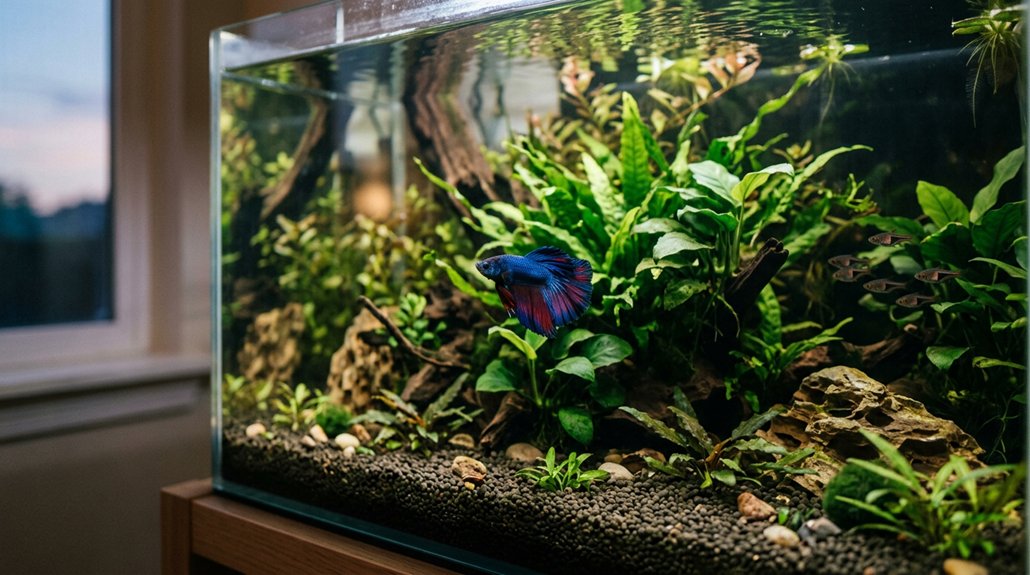
Wait at least 2 weeks before adding more fish, and 3 weeks is better when you can manage it. Add only a few fish at a time, then test ammonia and nitrite daily for at least 7 days. You should wait longer if either reading is above 0 ppm, or if fish are gasping, hiding more, or breathing fast. Stable 0 ppm ammonia and nitrite, plus modest nitrate, mean you’re closer to ready, and there’s more to check.
Key Takeaways
- Wait at least 48 hours after setup before adding the first fish, and 2–3 weeks between later additions.
- Add fish only when ammonia and nitrite read 0 ppm consistently, with low nitrate and stable conditions.
- Test ammonia and nitrite daily for at least a week after each addition, or until they stay at 0 ppm.
- Introduce fish in small groups, with one species at a time, so the biological filter can adjust gradually.
- If ammonia or nitrite rise above 0.25 ppm or stay elevated, delay stocking and perform water changes.
How Long Should You Wait Between Fish Additions?
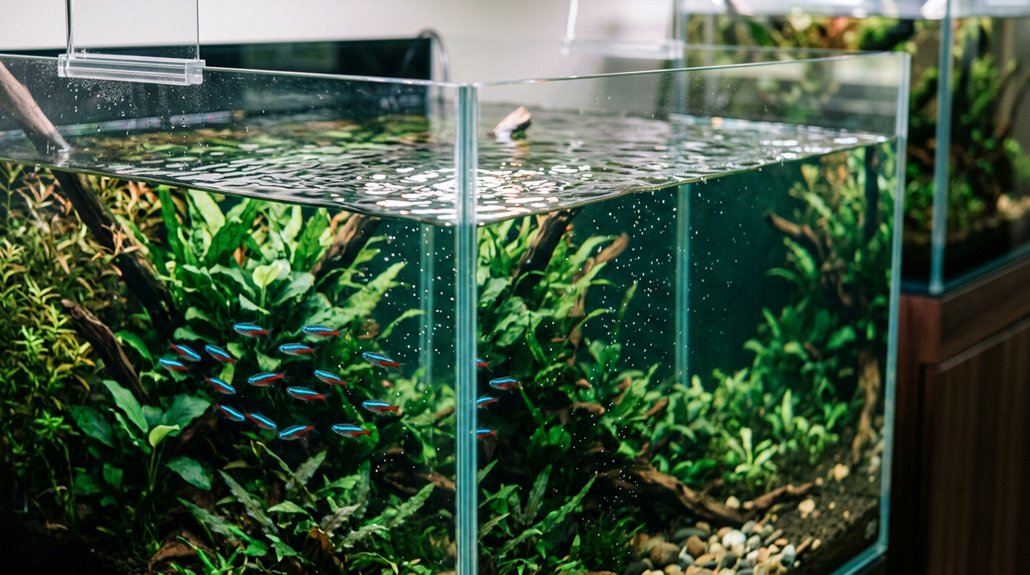
You should wait at least 2 weeks between adding new fish, and 3 weeks is better when you can manage it, so the tank has time to stabilize and the biological filter can respond. After each addition, you should test ammonia and nitrite daily for at least one week, or until both read 0 ppm, before adding more fish. If you detect a small bump, up to 0.25 ppm, use 1–2 water changes as needed and recheck within 1–2 days. Even with rapid-cycle additives, add only a few fish at a time. Keep your feeding schedule modest, and don’t skip quarantine procedures for new arrivals. If you’re adding schooling fish, place the largest school first, then wait the recommended interval before smaller groups.
Why Aquariums Need Time Between Stocking
You need time between stock additions because your filter’s nitrifying bacteria don’t increase instantly, and the tank can’t absorb a sudden rise in bioload without risking ammonia or nitrite spikes. You should wait at least 2 weeks, preferably 3, and confirm that ammonia and nitrite stay at 0 ppm before adding more fish. Even with cycling aids, you still need to add stock gradually and monitor water closely so the system stays stable.
Cycling Needs Patience
Because new aquariums need time to establish the nitrogen cycle, adding fish too quickly can overload biological filtration. You should expect biological succession to take at least 2–6 weeks, and you shouldn’t restock noticeably until your liquid test kit shows 0 ppm ammonia and 0 ppm nitrite. Wait 48 hours after setup for initial stabilization, but don’t mistake elapsed time for cycling. Use test results to guide decisions. Add only one species or a small group at a time, then space new fish 2–3 weeks apart. Monitor daily for at least a week after each addition. Brief ammonia blips ≤0.25 ppm can be tolerated if they clear in 1–2 days. If you use bacterial starters, still apply patience strategies and test frequently.
Stable Parameters First
Stable parameters should be confirmed before any new fish are added, with ammonia and nitrite at 0 ppm and nitrate present at a low level, since the beneficial nitrifying bacteria that process waste need weeks to fully establish. You should verify stable cycles with daily parameter checks, then wait at least 2 weeks, preferably 3, before adding more livestock. That gap lets your biofilter adjust and gives you time for 1–2 water changes if minor rises appear. After each addition, monitor for at least 7 days; brief ammonia elevations up to 0.25 ppm that clear within 1–2 days may be tolerated, but sustained readings mean you should stop stocking. Add schooling fish in proper groups, not singles, and match future bioload to filtration capacity.
How to Tell When the Cycle Is Ready
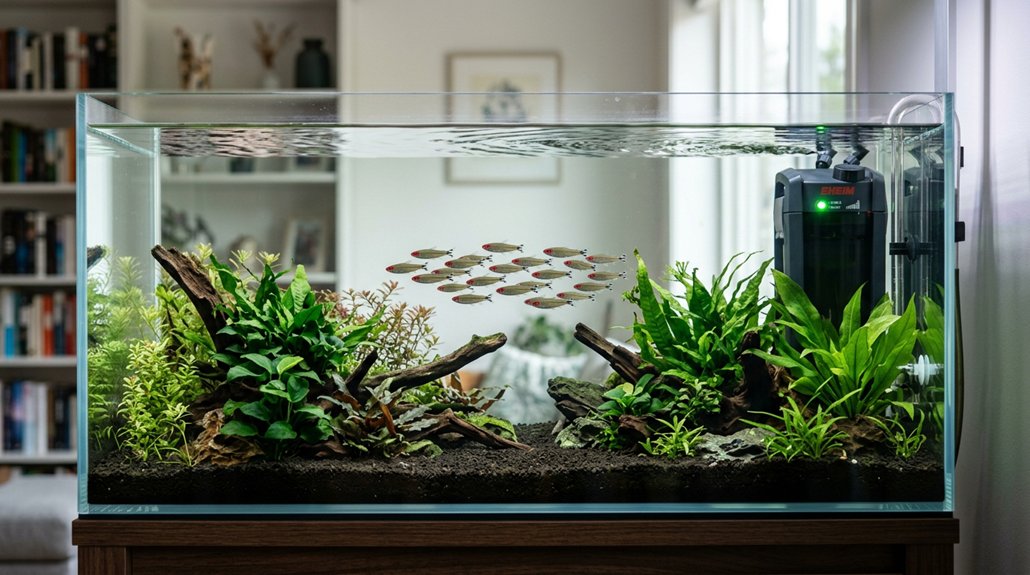
A tank’s nitrogen cycle is ready for more fish when ammonia and nitrite both read 0 ppm consistently on a liquid test kit for several days. You should confirm ammonia zeroing with daily testing, and you shouldn’t ignore transient spikes after a small stock increase. A brief ammonia rise should stay at or below 0.25 ppm and return to 0 within 24 to 48 hours without a meaningful nitrite increase. If you’re adding schooling fish, wait until the existing school is settled and results stay stable for 2 to 3 weeks. After each addition, test every day for at least a week, or twice daily during rapid cycling. If ammonia approaches 2.0 ppm or nitrite remains elevated, stop adding fish and treat the system as not ready.
Wait Times for New Freshwater Tanks
After you set up a new freshwater tank, wait at least 48 hours so the temperature and equipment can stabilize before adding the first fish. You shouldn’t assume the tank is cycled within days; cycling usually takes 2–6 weeks, and you should add more fish only when ammonia and nitrite stay at 0 ppm. After each new batch, wait at least 2 weeks, preferably 3, and test daily for ammonia and nitrite while making 1–2 water changes between additions.
Initial Waiting Period
Before you add the first fish to a new freshwater tank, wait at least 48 hours after setup so the water temperature and basic chemistry can stabilize. During this interval, make any needed glass acclimation checks, verify lighting adjustment, and confirm the filter is running normally. Don’t assume the tank is cycled simply because time has passed; cycling often takes 2-6 weeks and should be confirmed with test kit readings, not guesswork. Use this waiting period to observe for leaks, cloudiness, and equipment problems. If you’re using a rapid-cycling additive or quarantining fish, still proceed conservatively. Add only a few fish at a time, then test ammonia and nitrite daily for at least one week. Add more fish only when readings stay at 0 ppm and filtration remains stable.
Cycling Before Stocking
Once the tank has been filled and the equipment is running, wait at least 24–48 hours for temperature and basic conditions to stabilize; however, that does not mean it’s ready for full stocking. You still need full biological cycling before adding fish. In a new freshwater tank, bacterial succession and biofilm maturation must develop enough to process waste reliably. This usually takes 2–6 weeks, though it can take longer. You should use a reliable liquid test kit and confirm ammonia is 0 ppm, nitrite is 0 ppm, and nitrate is stable before increasing stock. If you add fish earlier, keep it minimal and monitor daily for spikes. Don’t assume clarity means safety; test results determine readiness for more fish.
Staggered Fish Additions
With cycling complete and water tests stable, fish should still be added in stages rather than all at once. Wait at least 48 hours after setup before the first fish, then test daily for a week after each addition. Keep ammonia at 0 ppm and nitrite at 0 ppm before continuing.
| Action | Minimum wait | Purpose |
|---|---|---|
| First fish | 48 hours | Stabilize basics |
| Next species | 2–3 weeks | Support schooling dynamics |
| Larger school first | 10 fish | Reduce targeting |
| Small ammonia bump | 1–2 days | Confirm recovery |
Add the largest school first, then smaller groups. This supports schooling dynamics and stress mitigation. If ammonia rises ≤0.25 ppm, monitor closely; if it reaches about 2.0 ppm, stop additions and correct filtration before proceeding.
How Many Fish Should You Add at Once?
Add fish in small, deliberate groups rather than all at once. You should limit each stocking event to a few fish, then wait 2–3 weeks before the next addition. This lets you monitor ammonia and nitrite, perform 1–2 water changes, and keep bioload increases controlled. In a new tank, wait at least 48 hours before the first fish, then add only small numbers until both readings stay at 0 ppm. If you’re using rapid-cycling methods or bacterial additives, the same caution applies: add only a few fish and test daily for at least a week after each addition. For schooling species, preserve group dynamics and visual hierarchy by introducing adequate numbers, such as one school of about 10 or multiple schools of 6–8, not scattered singles.
Should You Add One Species at a Time?
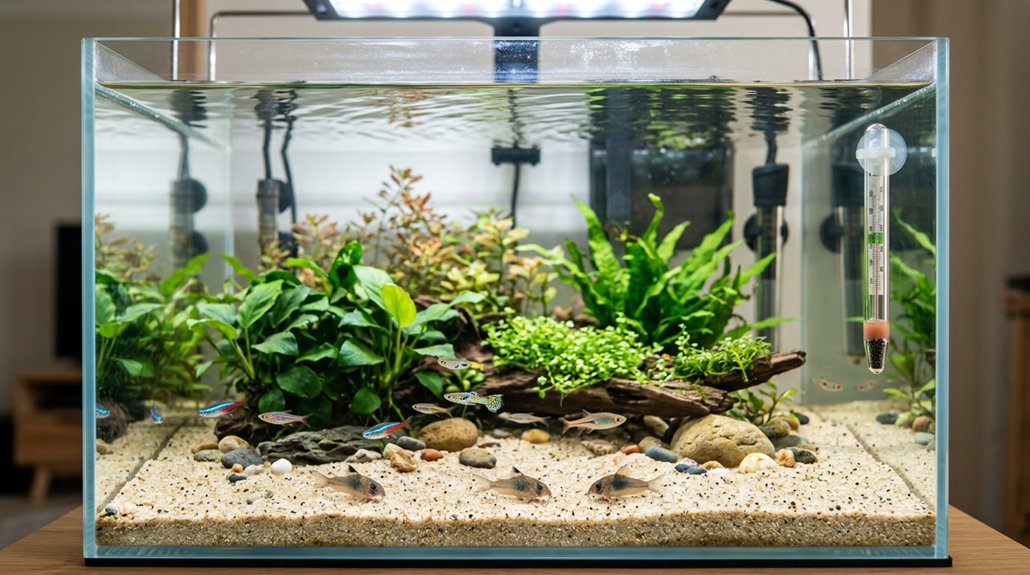
Yes—it’s best to add one species at a time so each group can settle before the next arrival. You should introduce a full school first, ideally about 10 fish or two schools of 6–8, so individuals aren’t singled out and social bonding can stabilize. This approach also supports stress reduction in territorial fish by limiting novelty.
- Wait at least 2 weeks, preferably 3, before adding another species.
- Test ammonia and nitrite daily for 7 days after each addition; both should return to 0 ppm.
- Quarantine new fish when possible and confirm the system can handle the added load.
Start with the largest school first; that helps the tank’s social structure form around them and lowers the risk that later arrivals’ll be targeted.
How Bettas Change Stocking Order
A betta can change the order you stock the tank because its territorial behavior depends on what it encounters first. You should usually add larger schooling fish, like 10 neon tetras or danios, before the betta so it meets a full school, not a lone target. In an established community, wait 2–3 weeks after the school settles so a stable betta hierarchy and boundaries form before the betta enters. If you add the betta first, use a careful introduction sequence: add one species at a time in groups of about 10, or two groups of 6–8, with 2–3 weeks between additions. After moving decor or hardscape, wait several days to a week before adding fish. Then monitor for 1–2 weeks.
Signs You Should Wait Longer
If ammonia or nitrite tests show any detectable reading above 0 ppm, you should wait, test daily, and not add more fish until both return to 0 ppm. You should also delay stocking if small spikes persist above 0.25 ppm or last more than 1–2 days. Watch these behavioral indicators closely:
- gasping at the surface
- rapid breathing or clamped fins
- increased hiding after a recent addition
If your school sizes are still below recommended numbers, wait longer; small groups can destabilize school dynamics and trigger aggression. After a tank rearrangement or adding a semi-territorial fish, such as a betta, allow 1–3 weeks before introducing tankmates. In every case, cautious pacing reduces stress and improves long-term compatibility.
How to Monitor Water After Each Addition
Once you’ve added fish, closely monitor the water for at least the next week. Use daily testing for ammonia, nitrite, and nitrate, aiming for 0 ppm ammonia and 0 ppm nitrite. A brief ammonia rise to about 0.25 ppm can be tolerated if it resolves within 1–2 days; any sustained level near 2.0 ppm suggests inadequate filtration and needs immediate action. Track nitrate increases and keep them low with water changes. Do at least one 25% change between additions, and retest 12–24 hours later. Continue behavioral monitoring for gasping, rapid breathing, clamped fins, or hiding, since stress can appear before test values spike. Keep records, and don’t add more fish until the system’s stabilized for 2–3 weeks.
Frequently Asked Questions
How Soon After Adding Fish Can I Add More Fish?
You should wait at least 2 weeks, ideally 3, before adding more fish; that quarantine duration lets your stocking strategy stay safe while you test ammonia and nitrite daily and confirm they’re 0 ppm.
How Long Should I Wait to Get More Fish?
You should wait at least 2 weeks, ideally 3, before adding more fish. That timing lets your water chemistry settle, and your stocking strategy stay controlled—coincidentally, it also helps you catch hidden ammonia spikes early.
How Many Fish Can I Add at Once?
You can usually add only a few compatible species at once, keeping stocking density low enough for your filter. Start with one small school, test ammonia daily, and add more only when levels stay at zero.
How Long Should a Fish Tank Cycle Before Adding Fish?
You should cycle it 2–6 weeks, often 4–8, until water testing shows ammonia 0 and nitrite 0; your biofilter maintenance isn’t ready before then, and patience here is practically legendary.
Conclusion
You may want to rush your tank, but your fish won’t thank you for it. Waiting between additions lets bacteria catch up, ammonia stay low, and stress stay manageable. Even if the water looks clear, the cycle may still be fragile. Add stock slowly, then watch for any spike in readings before moving on. In practice, patience isn’t optional here; it’s the most reliable way to avoid a very small, very expensive disaster.