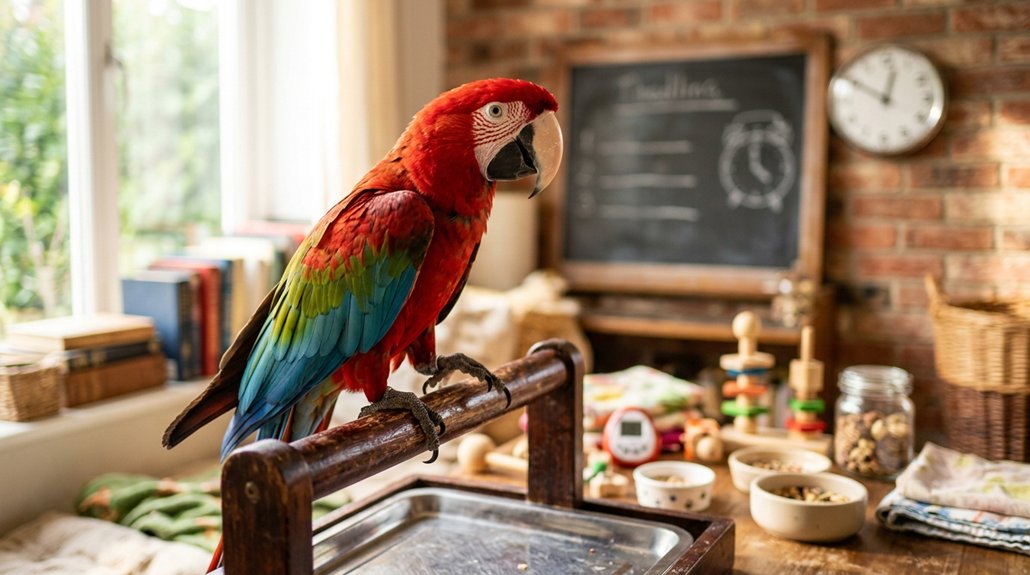
A pet bird can learn simple cues like step-up or targeting in about 7 to 10 days, and a cooperative bird may show basic progress in a week. More fearful birds often need several weeks, while speech, tricks, and durable habits can take months to years. Your bird’s age, temperament, handling history, and training consistency all affect speed. Short, frequent sessions with immediate rewards work best, and you’ll see the fastest gains when you know the readiness signs.
Key Takeaways
- Simple cues like step-up or targeting often take about 3–10 days with short daily sessions.
- Cooperative birds may learn basic skills in about a week; fearful birds often need several weeks.
- Complex behaviors like speech, tricks, and durable habits can take months to years.
- Short, frequent 1–5 minute sessions with immediate rewards usually speed learning.
- Calm body language signals readiness; stress, biting, or lunging means slow down or stop.
How Long Does Pet Bird Training Take?
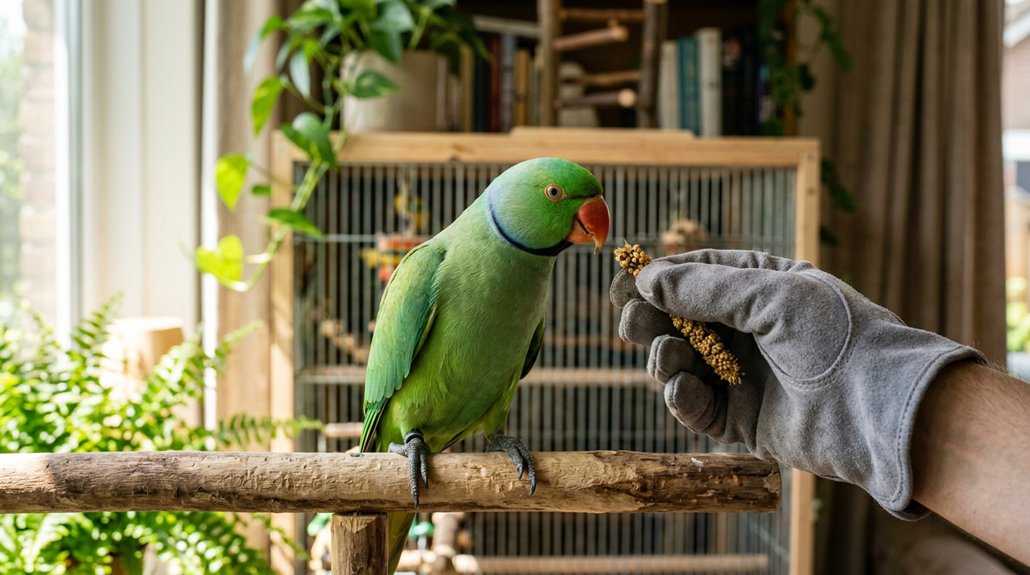
How long pet bird training takes depends on the behavior, the bird’s temperament, and how consistently you work, but you can usually expect measurable progress in simple cues such as “step up” within about 7–10 consecutive days of short, regular sessions. If you start on day 1 and use brief, stimulating practice several times daily, you’ll usually speed learning and reduce unwanted rehearsal. A cooperative, well-socialized bird may master basic skills in about a week; fearful or difficult birds often need several weeks and may benefit from professional guidance. More complex behaviors, including speech, tricks, or durable habit change, can take months. Age differences and seasonal cycles can influence readiness, so you should keep sessions short and repeat exposures daily, especially for new equipment.
What Affects How Fast Birds Learn?
Bird learning speed depends first on temperament and prior handling: a cooperative, well-socialized bird may master a simple cue such as “step up” in 3–7 days, while a fearful or difficult bird may need 7–10 days or more. You should begin with temperament assessment, because age, species, and handling history shape response.
- A calm bird on a steady perch learns faster.
- A cautious bird near a new harness may stall.
- A motivated bird will repeat rewarded behavior.
Use brief, frequent sessions, not long drills, and pair the cue with high-value treats, environmental enrichment, or foraging opportunities. Keep stressors low, introduce equipment gradually, and redirect attention to novel perches or short walks. Consistent structure, immediate reinforcement, and your handling style all shorten learning time and improve tolerance.
Training Timelines for Common Bird Skills
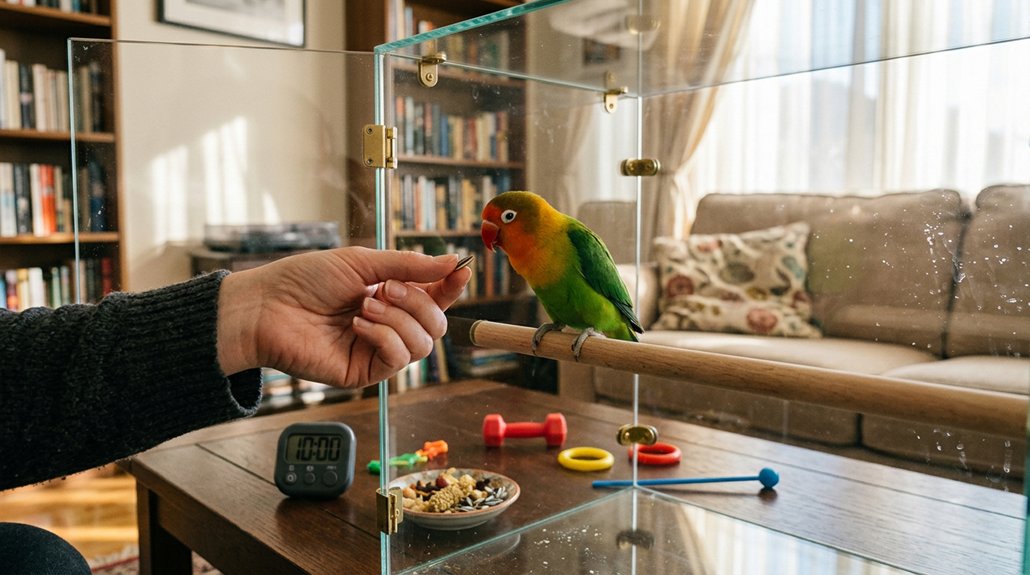
You can usually expect a cooperative, well-socialized parrot to learn step-up in about 7–10 days of short daily sessions, though fearful birds may need several weeks. Simple tricks such as targeting, waving, or spinning often take about a week of consistent brief practice, while speech and complex mimicry usually develop over weeks to years, depending on repetition and motivation. A harness also typically needs 7–10 days of repeated short exposures before your bird stops fixating on it and can tolerate it during outings.
Step-Up Timelines
A reliable “step up” can often be taught in about a week for a cooperative pet bird when training sessions are short, frequent, and ended before the bird becomes fatigued or fixates on the task; fearful or difficult birds may require 7–10 days with professional-level handling skills, or several weeks of consistent practice. Begin on Day 1 if the bird’s receptive; otherwise, allow a settling-in period. Use short sessions and gradual desensitization to avoid negative associations.
- A perch, then a curved surface.
- A gentle touch on the lower chest.
- A finger placed under the lifted foot with “step up.”
You’ll usually progress from one trusted hand to another, but age, species, prior handling, and temperament can alter the timeline. Some birds comply immediately; others may never fully accept the cue.
Speech And Mimicry
Developing speech and mimicry in pet birds usually starts with brief exposure: many parrots will imitate simple sounds or words within weeks, but clear, reliable speech typically requires multiple short sessions each day over several months. You’ll usually see budgies and cockatiels begin within 1–3 months. African greys and amazons often need 3–12 months for clear phrases, and some macaws and cockatoos learn more slowly. Juveniles and birds with prior human-speech exposure tend to progress faster. Use vocal enrichment, high-value rewards, immediate reinforcement, and playback scheduling of target phrases during 5–10 minute sessions, repeated daily. Older or poorly socialized birds may need months to a year. Advanced mimicry, including consistent phrase use, takes years of reinforcement and regular practice to maintain.
Tricks And Targeting
Once a bird is comfortable with handling, step-up usually becomes the first dependable training milestone, and even a difficult bird can often learn it in about 7–10 days with consistent shaping, while a cooperative bird may need only a week or so. You should use short, frequent sessions and positive reinforcement, ending before fatigue or fixation appears. Targeting often becomes reliable in 3–7 days when you repeat daily with a clear cue and high-value rewards. After that, you can add simple tricks.
- A bird touching a target stick.
- A clean turn or wave on cue.
- A brief bow or obstacle navigation task.
Most birds need 1–3 weeks for these behaviors, but species, age, and temperament change the timeline. Consistent consecutive days and enrichment improve retention.
When Should You Start Training Your Bird?
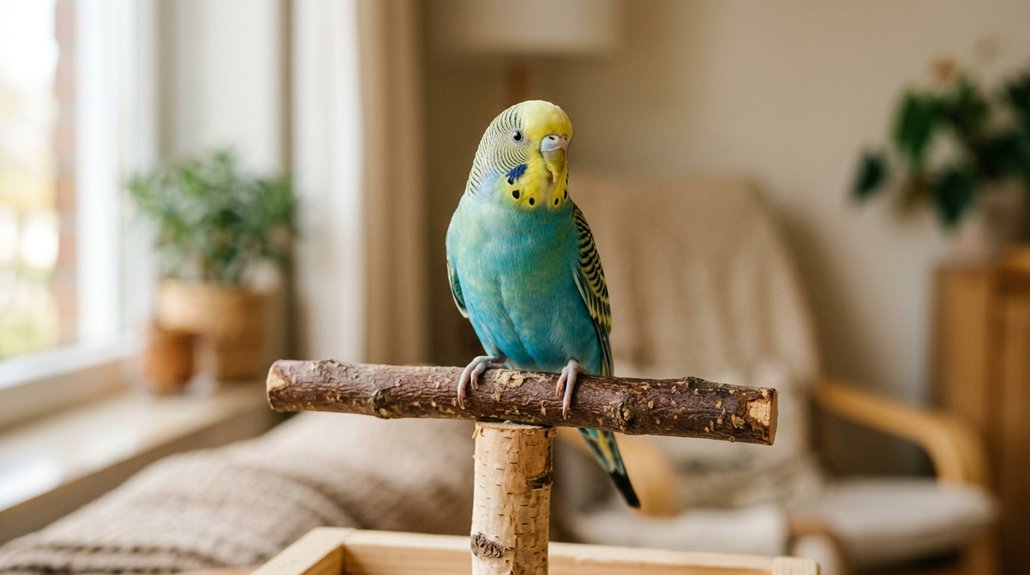
Start training as soon as your bird is comfortable with you—often on day 1—because every interaction you have, from your voice to how you approach and deliver food, is already shaping behavior. If your bird is very young or newly rescued and fearful, give a brief settling period, then begin simple tasks within a few days. This supports early bonding and gradual desensitization while limiting rehearsal of unwanted habits. Keep sessions short, frequent, and highly structured, using high-value reinforcers and immediate enrichment to build positive associations. With a cooperative bird and clear plan, you can expect reliable basic responses in about one week. Fearful or difficult birds usually need 7–10 days or longer, especially when handling must stay consistent, calm, and professional.
How to Teach Step Up Fast
Teach step up as soon as your bird is calm, even on day 1, using very short 1–3 minute sessions several times a day to prevent fixation and build a positive association. Work in a quiet environment and use short rewards to keep attention precise.
- Hold your finger level with the lower chest.
- Gently press the belly to cue a lifted foot.
- Say “step up,” then lift smoothly.
If your bird is skittish, begin with a small perch or stick, then transfer the behavior to your finger once it accepts it reliably. End each session before fatigue or fixation appears, and redirect immediately to a new activity. With consistent daily handling, a cooperative bird may learn in about a week; a difficult bird may need 7–10 days or more.
How to Make Bird Training Stick
Consistency is what makes bird training stick: use short, frequent sessions of 3–5 minutes several times a day for at least a week, and reinforce each correct response immediately with a high-value treat or praise within 1–2 seconds. Your reward timing should be exact; delayed reinforcement weakens retention. Use consistent cues and vary the setting so the behavior transfers beyond one perch or hand.
| Session | Focus | Outcome |
|---|---|---|
| 1–3 | Cue-response | Rapid acquisition |
| 4–7 | Location change | Generalization |
| Weekly | Maintenance | Skill retention |
End each session while your bird is still engaged, not fatigued, to avoid negative associations. Brief maintenance sessions 1–2 times weekly, with occasional reinforcement, prevent extinction and keep learned behaviors reliable for months.
Signs Your Bird Is Ready for More
You can raise the training bar when your bird stays calm during brief handling for several consecutive days, with no frantic wing-flapping or biting. If it’s also shifting weight and lifting a foot in response to gentle chest or belly pressure across multiple short sessions, that’s a reliable sign it’s ready for step-up work. Consistent calm body language and steady step-up attempts indicate you can introduce more structured skill training.
Calm Body Language
Calm body language tells you when a bird is ready for more demanding training. You should see gentle eye contact and a relaxed wing hold, with feathers smooth, not fluffed. Watch for these cues:
- Half-closed eyes or slow blinking, plus even weight on both feet.
- Soft preening or light head bobbing, paired with low chirps or quiet squeaks.
- A closed beak, steady crest, stable breathing, and no tail flicking.
If your bird approaches the cage front willingly, stays in contact, and doesn’t back away, it’s likely prepared for longer sessions. This posture indicates low stress and sufficient focus for more complex exercises. Avoid escalation if you notice rapid panting, lunging, biting, or frantic hopping, because those behaviors show the bird isn’t ready yet.
Steady Step-Up Attempts
Once your bird shows calm body language, the next step is to test whether it can handle steady step-up attempts. Use gradual desensitization: press lightly on the lower chest and watch for a lifted foot over several short sessions across 7–10 days. If it shifts weight and steps onto your finger or a perch without freezing in at least 3 of 5 tries, it’s ready for more. Focus on cue response, not the harness.
| Indicator | Meaning |
|---|---|
| Quick approach | Readiness is improving |
| Less protest | Stress is declining |
| Current behavior | Action |
| Hesitation under 10 seconds | Advance slowly |
| Bites or fixation | Stop, shorten sessions |
Add handler variation only after stable performance.
Frequently Asked Questions
What Is the 3 3 3 Rule for Birds?
You’re using the 3-3-3 rule: 3 days to acclimate, 3 weeks to settle and begin social bonding, and 3 months for trust, behavioral adjustment, and environmental enrichment. It’s a guideline, not a strict timetable.
Is It Ever Too Late to Train a Bird?
No, it’s not too late; age limits rarely block learning. You can pursue behavioral rehabilitation with patient, structured work. Even older birds’ll improve, though progress may be slower, especially after negative experiences or neglect.
How Do You Say “Hi” in Bird Language?
You can’t translate “hi” into bird language; instead, you teach bird greetings through vocal mimicry. You repeat a short cue, like “hi,” consistently, pair it with attention or treats, and your bird may learn it.
What Is the Easiest Pet Bird to Train?
Budgies are usually your easiest choice, though cockatiels come close. Their sociability makes Bonding exercises effective, and Clicker training works quickly. You’ll see faster results if you’re consistent, calm, and reinforce behaviors immediately.
Conclusion
So, how long does it take to train your pet bird? Usually, long enough for your patience to develop a minor personality disorder. You’ll see faster results with consistency, short sessions, and a calm bird, but every parrot, cockatiel, or budgie carries its own stopwatch. Start early, reward often, and don’t expect instant mastery. If your bird’s ready, you’ll know: it’ll step up like a tiny, feathered executive finally approving the memo.