Choose fish that fit your tank’s footprint, not just its gallon label, and base stocking on adult size, mouth gape, and bioload. Match species with similar temperament, activity, and water needs, then keep schooling fish in groups of six or more. Avoid tiny tankmates with predators, and use caves, plants, and driftwood to break sight lines. Quarantine new fish before adding them, and stock slowly so your filter can stabilize. There’s more to fine-tune.
Key Takeaways
- Match tank size and shape to the fish’s adult size, swimming style, and habitat needs.
- Choose species with similar water temperature, pH, and hardness requirements.
- Stock based on adult size, mouth gape, and temperament, not juvenile appearance.
- Keep schooling fish in groups of six or more and avoid overly aggressive tankmates.
- Quarantine new fish and watch for fin-nipping, chasing, or predation before adding them permanently.
Choose Fish by Tank Size
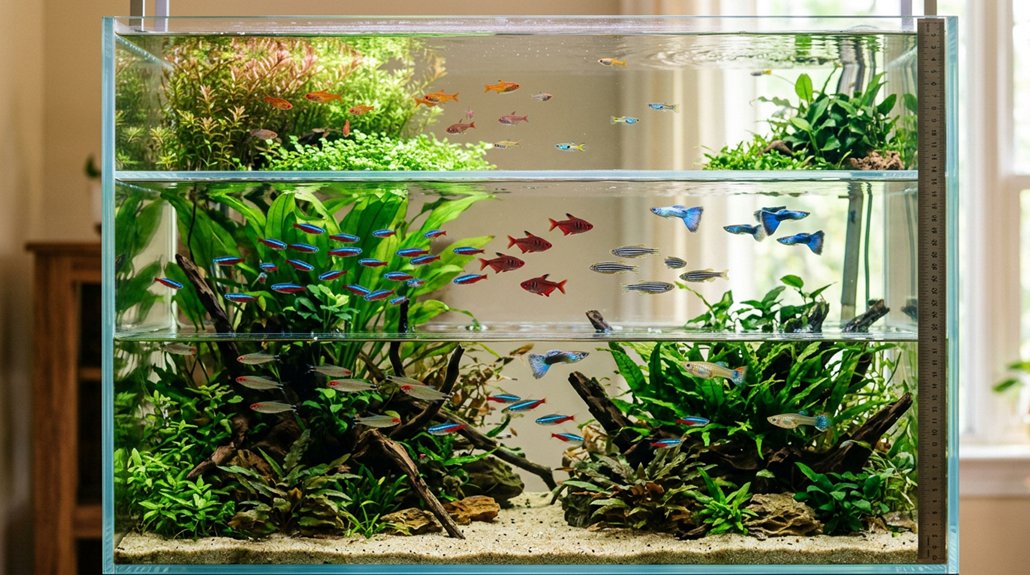
When you’re choosing fish by tank size, don’t rely on the old “one inch of adult fish per net gallon” rule except as a rough starting point; what matters more is each species’ adult size, activity level, territorial behavior, and overall bio-load. Subtract space taken by gravel, décor, and equipment, because the labeled capacity overstates usable water. Match the tank’s shape to the fish: long, wide layouts suit danios, barbs, and tetras; taller tanks fit angelfish and gouramis. Stock only 30–50% at first, then add fish over weeks so bio-filtration can stabilize. This also helps your feeding schedules stay consistent and reduces ammonia and nitrite spikes. Leave extra room and hiding spots for territorial species; good tank aesthetics should never compromise space or water quality.
Account for Adult Fish Size
Planning for adult size is essential, because many fish sold as juveniles will grow far larger than they look in the store, sometimes doubling or tripling in length once mature. You should base stocking on adult growth, not current size, and use product references to confirm each species’ maximum length and minimum tank volume. A rough rule is one inch of adult fish per net gallon, but cut that back for territorial or high-bioload species, and subtract space displaced by gravel and décor. For schooling fish, plan enough adult-sized swimming room for groups of six or more, ideally in long, wide tanks. Similar adult size also helps limit predation risk, since any fish that fits in a mouth can be eaten. Good space planning prevents overstocking and stress.
Match Temperament Before You Buy
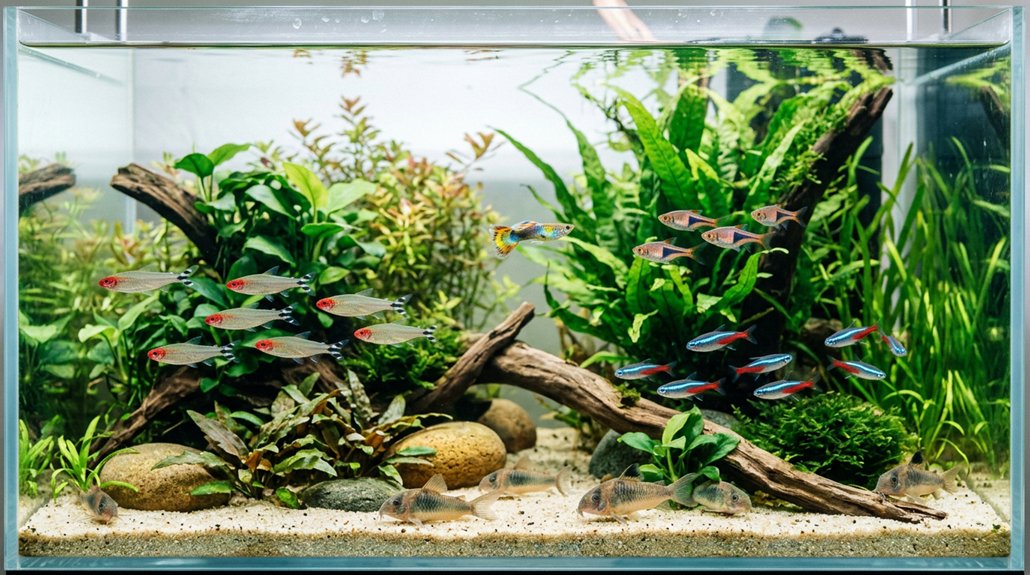
Once you’ve confirmed adult size and tank volume, the next step is making sure the fish actually get along. Research temperament before buying: keep peaceful schooling fish like tetras, danios, and rasboras in groups of six or more, and don’t mix them with African cichlids or large bichirs. Match activity levels and tank zones so you’re not forcing slow, vertical species into fast, open-water setups.
Confirm temperament before buying: match schooling fish, activity levels, and tank zones for peaceful compatibility.
- Pair similar adult sizes to reduce opportunistic predation.
- Use female-biased livebearer ratios, about 2–3 females per male.
- Quarantine new fish to check for aggression and fin-nipping.
For behavioral enrichment, choose species with compatible schooling dynamics and swimming patterns. Avoid combining shrimp or long-finned fish with tiger barbs unless you’ve got extra space and close monitoring.
Identify Territorial Fish Early
Even a fish that seems calm in the store can turn territorial as it matures, so identify these species early and plan around their adult behavior. You should flag cichlids, many loaches, some gouramis, and large plecos as likely zone defenders. Track adult size, because early aggression often escalates when juvenile restraint disappears. In quarantine, watch for territorial markers: repeated chasing, nipping, lunging at one section, or one fish monopolizing a cave or rock. Tank shape matters too; narrow tall aquariums can compress territories, while wide layouts reduce friction but don’t erase defended sites. If you’re keeping Rift Lake cichlids, stock by size and numbers; otherwise, add dense cover and consider separate breeding tanks. This lets you predict conflict before it starts and adjust stocking with confidence.
Avoid Predators and Small Tankmates
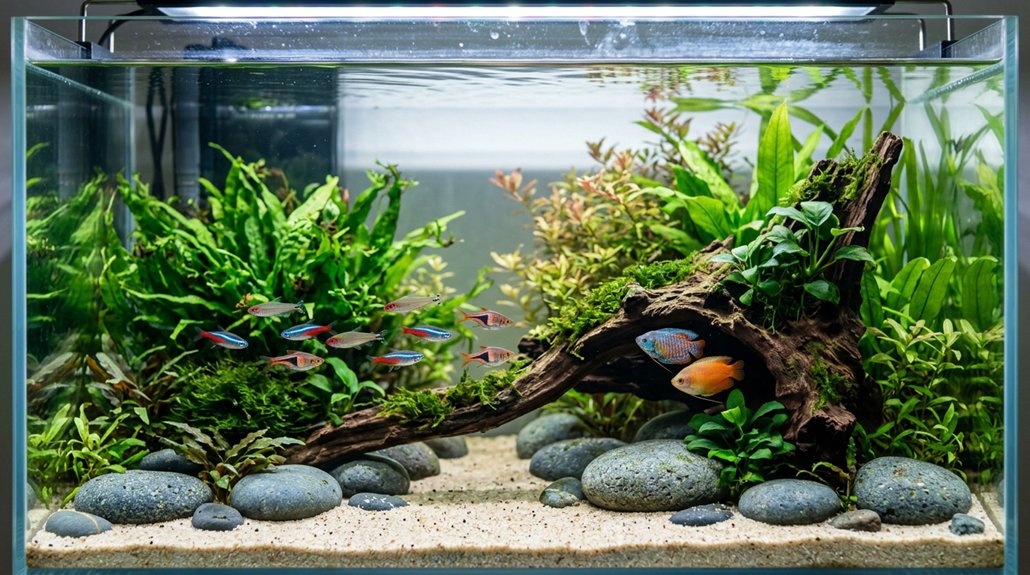
You shouldn’t pair fish with large mouth gapes—if a predator can fit a tankmate into its mouth, it’ll likely eat it, so match species by maximum adult size, not current size. When you add opportunistic predators, choose tankmates that are at least as large as the predator’s gape and stay with robust, adult-sized fish rather than juveniles. You also need to account for nighttime hunting, because nocturnal catfish, knifefish, and similar species can catch small or slow fish while they’re sleeping.
Predator Mouth Size
Predators usually decide a tankmate’s fate by mouth size, not by body length, so a good rule is to avoid fish smaller than about two-thirds of the predator’s maximum mouth width. You should measure adult predator gape, since arowanas, bichirs, gar, and large catfish can swallow community fish whole. Their feeding strategies matter, too: nocturnal hunters may take resting fish after lights out.
- Base stocking on adult mouth size, not juvenile size.
- Add similarly sized tankmates early to reduce predatory learning.
- Avoid small invertebrates, long-finned, or slow fish near a wide gape.
For mixed tanks, keep prey at least as deep and long as the predator’s gape limit.
Match Tankmate Size
A well-matched tank starts with fish of similar adult size, because larger species can quickly see smaller tankmates as food if they can fit them into their mouth. You should compare maximum adult length and gape, not just juvenile growth or current size, when mixing arowanas, bichirs, gar, catfish, or cichlids. Buy tankmates at comparable sizes and plan for size progression so nobody becomes an easy target later. Keep groups of six or more when you’re stocking schooling or boisterous fish, and match their sizes closely to limit stress and bullying. Use the “one inch of adult fish per net gallon” rule only as a rough guide; prioritize compatible size and bio-load instead. Territorial species often need more room than that rule suggests, so don’t rely on it alone.
Nighttime Hunting Risks
Even when tankmates match in adult size, nighttime behavior can still make or break compatibility. You’ll avoid losses by treating predators as mouth-gapers: arowanas, bichirs, gar, leaf fish, large catfish, and some cichlids can swallow anything that fits. Nocturnal hunters—catfish, knifefish, loaches—may patrol after lights out and eat sleeping fish or shrimp. Stock for adult girth, not juveniles, and plan for growth.
- Add caves, driftwood, bushy plants, and rock crevices.
- Use motion activated lighting and light safe feeding to monitor without startling fish.
- Choose similar temperaments, quarantine, and observe under realistic night lighting.
If you keep vulnerable species, rehome them fast after any predation.
Stock a Peaceful Community Tank
Stock a peaceful community tank by planning the bioload first: use the one-inch-per-net-gallon rule only as a rough starting point, then judge stocking by each fish’s adult size and waste output, beginning at about 30–50% of your target capacity and adding fish gradually. That stocking density keeps filtration stable and supports gradual additions without spikes in ammonia. Choose small, peaceful species like tetras, rasboras, guppies, platies, corydoras, or small schooling catfish, and buy schooling fish in groups of six or more for schooling behavior and stress reduction. Avoid aggressive or territorial fish, and introduce tankmates of similar size. Provide dense plants, caves, and driftwood so weaker fish can retreat. Watch for bullying, keep quarantine ready, and remove persistent aggressors quickly.
Match Water Parameters and Habitat
You’ll get better compatibility when you match each fish’s temperature range, pH, and hardness to its natural requirements, since mixing species with conflicting water needs creates chronic stress. You should also fit the tank’s layout to the fish’s habitat: use open swimming space for active species and dense cover, rocks, caves, or driftwood for fish that need structure. When possible, keep regionally similar tank mates together, since species from the same waterways often share the same chemistry and habitat preferences.
Temperature And pH Match
Matching fish by temperature and pH is essential because chronic parameter mismatch stresses fish, suppresses immunity, and often leads to poor long-term health. You should target overlapping ranges, not broad “tropical” labels. Most community species do well at 75–80°F, while discus need 82–86°F and many African cichlids sit near 76–82°F. Keep temperature gradients minimal so fish aren’t forced into chronic thermal stress, and use pH buffers only when they keep values stable, not to chase swings.
- African Rift Lake cichlids: alkaline, hard water
- Tetras and discus: soft, slightly acidic water
- Sensitive breeders: warm, stable, low-stress conditions
When mixing species, match GH/KH, test frequently, and acclimate with float-and-drip methods to reduce shock.
Habitat And Decor Fit
Habitat fit matters as much as chemistry, because fish can be technically compatible on paper and still struggle if their environment doesn’t match their swimming style, cover needs, or territorial behavior. You should match decor to the species: use rocky caves and hardscape for territorial cichlids, dense tall plants and driftwood for schooling tetras or dwarf cichlids, and open swimming lanes for danios and rainbowfish. Choose tank shape accordingly: long, wide setups suit active midwater fish, while taller tanks with vertical cover fit angelfish, gouramis, and discus. Think about substrate selection, since sand or fine gravel changes usable volume and affects digging species. Lighting placement also matters, because shaded zones under plants or wood can reduce stress. Always account for displaced volume when stocking, and give territorial fish extra space.
Regionally Similar Tank Mates
Regional neighbors usually make the safest tank mates because they tend to share the same temperature, pH, hardness, and habitat demands. When you stock fish from one biogeographic schooling zone, you’re matching natural chemistry and behavior, which cuts stress and improves feeding. South American tetras, discus, and cardinal tetras often want 78–86°F, soft, acidic water, while African Rift Lake species need hard, alkaline conditions. Don’t mix incompatible ecologies.
- Match pH and GH/KH first.
- Match adult size and predation risk.
- Match habitat use: open water, rocks, or caves.
Also consider seasonal migrations and local ecology; active danios and barbs fit with other fast swimmers, but mbuna need similarly territorial rock dwellers.
Add Plants and Decor for Cover
Plants and decor do more than improve appearance; they help define territories and reduce aggression. You should build planted refuges with tall, bushy background plants like Vallisneria or Amazon swords for tetras, danios, and barbs, while using driftwood caves, rocks, and other hardscape to split sight lines for cichlids. Match the layout to the species: active swimmers need wider tanks with open lanes and scattered low decorations, whereas angelfish and gouramis do better in taller tanks with vertical cover. Plan for displaced water from substrate and decor, since usable volume is less than the label suggests, so stock more conservatively than the one-inch-per-net-gallon rule. If you add new territorial fish, rearrange hardscape to disrupt established boundaries and lower aggression during acclimation.
Introduce New Fish Carefully
You should quarantine new fish in a separate tank for 2–4 weeks so you can observe them for illness and treat any issues before they enter your display tank. When you do add them, use a slow acclimation method and introduce them in small batches so you don’t overload the biological filter or trigger shock. If you’re adding territorial species, rearrange the decor and add hiding places first, because disrupting established boundaries can reduce immediate aggression.
Quarantine New Additions
Before adding any new fish to your display tank, quarantine them in a separate setup for 2–4 weeks so you can watch for disease, treat infections early, and reduce the risk of introducing parasites or pathogens. Use a bare-bones tank with a heater and sponge filter, and test water daily so ammonia and nitrite stay at 0.0 ppm; make 10–20% water changes as needed. Acclimate them with a floating-bag method or a 30–60 minute drip to match temperature and chemistry before transfer. During quarantine, focus on behavioral observation, appetite, and signs like ich, fin rot, or labored breathing so medication timing is accurate.
- Feed lightly to limit waste
- Watch for stress and aggression
- Add similarly sized fish gradually
Rearrange Tank Decor
Once new fish have cleared quarantine, change the aquascape before release if you’re adding a territorial species such as a cichlid: move rocks, caves, and driftwood to break up established landmarks, disrupt fixed dominance zones, and remove any resident fish’s advantage. Rework the visual flow by breaking open sightlines and adding fresh cover near the release point, so the newcomer isn’t exposed in a bare lane. Use tall, bushy plants and extra hiding spots to create new boundaries for schooling or bullied species. If you’re adding several fish, do decor cycling first, then stagger introductions over weeks so territories form around the new layout, not existing fish. After stocking, watch closely for 1–2 weeks and be ready to use dividers, quarantine tanks, or remove persistent aggressors quickly.
Solve Fish Compatibility Problems
When compatibility issues arise, the most reliable fix is to evaluate fish by adult size, mouth gape, and behavior rather than by how they look in the store. You’ll prevent predation and aggression by matching similar-sized tankmates and keeping schooling species in groups of six or more. Watch for behavioral cues like fin nipping, hiding, or chasing, then use long term monitoring to confirm the pattern isn’t stress-related.
Evaluate adult size, mouth gape, and behavior—not store appearance—to prevent aggression and predation.
- Quarantine new fish for 2–4 weeks before adding them.
- Introduce them gradually with drip or floating acclimation at 30–50% stocking.
- Provide the right tank shape, cover, and species-specific water conditions.
Don’t mix incompatible bioregions or territorial species; African cichlids, for example, rarely fit peaceful community setups.
Frequently Asked Questions
What Are the Best Fish to Put Together in a Tank?
You’ll do best with peaceful community schools like tetras, rasboras, danios, and guppies, plus compatible nocturnal species like corydoras or kuhli loaches. Keep sizes, water needs, temperament, and tank space matched for stability.
What Fish Should Not Be Together in a Tank?
You shouldn’t mix aggressive cichlids, territorial bettas, predatory fish, fin-nippers, or tiny schooling fish with big bullies; it’s like fireworks in a glass box. You’ll also need matching water parameters, or they’ll stress.
How to Choose Fish for Your Aquarium?
Choose fish by adult size, temperament, and water chemistry first; then match tank stocking to your gallons, tank dimensions, and filtration. You’ll avoid aggression, stress, and ammonia spikes by quarantining additions and stocking gradually.
How to Know Which Fish Can Live Together?
Check adult size, water needs, and temperament compatibility first. You’ll want habitat overlap, similar schooling behavior, and comparable aggression levels. Quarantine newcomers, add fish gradually, and make sure your tank’s hiding spaces match their territorial needs.
Conclusion
Choosing compatible fish for your tank means thinking beyond appearance. You need to match tank size, adult length, temperament, territorial behavior, water parameters, and habitat needs before you buy. Notably, many home aquarium problems start with poor compatibility, not poor care. By adding cover, introducing fish carefully, and watching for aggression early, you’ll create a more stable tank. When you choose fish this way, you’ll reduce stress, injury, and avoidable losses.