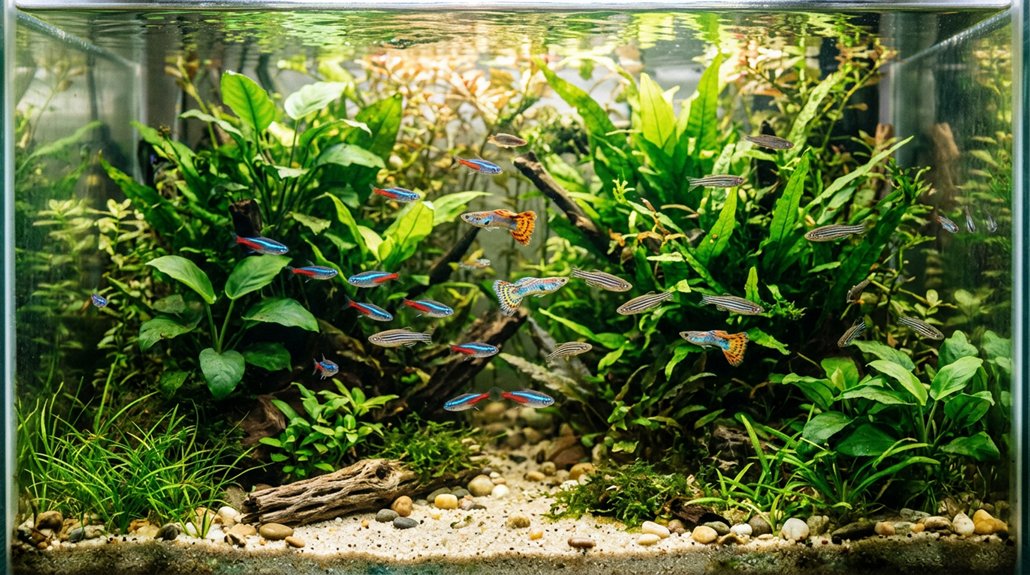
You can usually keep about 8–12 small fish in a 20-gallon tank to start, but the real limit depends on adult size, bioload, behavior, and filtration. A 20-gallon long gives you better swimming space than a tall tank, and slim schooling fish can sometimes be kept in larger groups with strong filtration. Don’t stock by inches alone, and add fish slowly while testing water. The best setup depends on species, so there’s more to contemplate.
Key Takeaways
- The old inch-per-gallon rule is oversimplified; stocking should consider adult size, behavior, and bioload.
- A conservative start for a 20-gallon tank is 8–12 small fish, around 1–2 inches each.
- Slim-bodied schooling fish can sometimes reach 12–20 individuals with strong filtration and careful maintenance.
- A 20-gallon long tank suits active swimmers better than a tall tank because it offers more horizontal space.
- Add fish slowly, test water regularly, and choose compatible species to avoid overstocking and stress.
How Many Fish Fit in a 20-Gallon Tank?
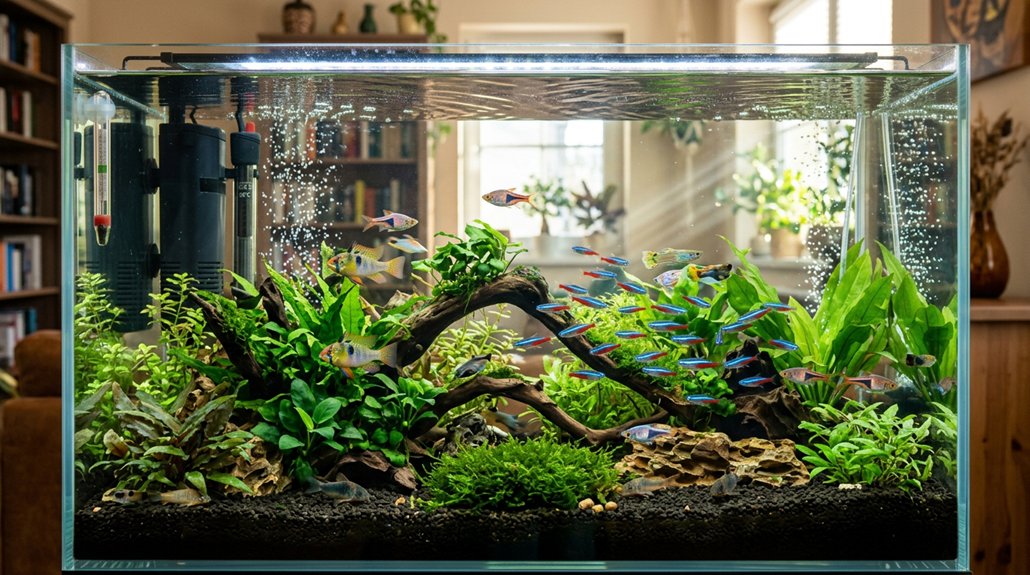
How many fish fit in a 20-gallon tank isn’t determined by a simple inch-per-gallon formula; while that rule suggests about 20 inches of fish total, it ignores adult size, species behavior, and waste production. You should instead evaluate mature length, body mass, and activity level. In practice, 8–12 small 1–2-inch fish is a conservative start, though small schooling tetras can reach 12–20 individuals if you choose slim-bodied species and maintain strong filtration. A 20-gallon long’s broader footprint supports better aesthetic design for active swimmers than a taller tank. Your feeding schedules should stay controlled, and water chemistry must be monitored routinely. With community involvement from all household members, you can add fish slowly and observe compatibility, letting the tank stabilize before increasing density.
What Limits Stocking in a 20-Gallon Tank?
Stocking limits in a 20-gallon tank are set by biology first: every fish adds ammonia through waste, and species with heavier body mass or higher activity create a much larger bioload than their size alone suggests. You also need to match filter capacity to that load; a unit rated for about 30–40 gallons gives stronger mechanical and biological processing than a filter sized only to the tank. Oxygen exchange matters too, because surface area and tank shape affect how much dissolved oxygen enters the water. A long 20-gallon tank usually supports more active fish than a tall, narrow one. Finally, your maintenance routine sets the ceiling: frequent testing, water changes, gravel vacuuming, and filter cleaning are essential when stocking rises.
Why Adult Size and Bioload Matter?
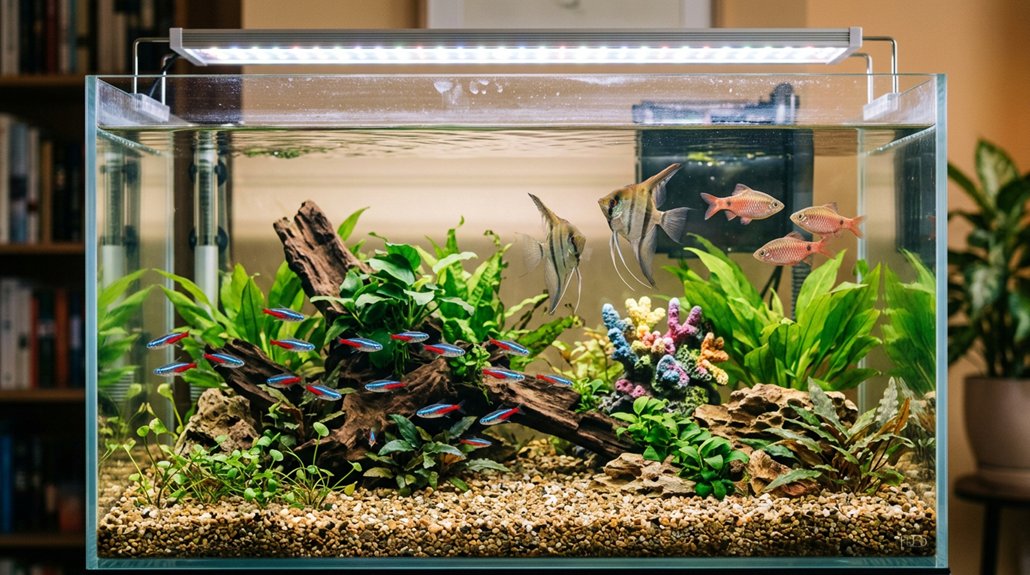
Even with adequate filtration and good maintenance, the fish you choose must be sized for their adult condition, not the tiny juveniles you see in the store. You’re managing adult waste, not temporary size, because ammonia from feeding and respiration becomes nitrite, then nitrate, and that load rises fast with long term growth. Heavier-bodied or messy eaters generate more bioload than slim fish of the same length, so species matters.
Stock fish for their adult size, not their juvenile size—bioload grows fast as they mature.
- Two 2-inch tetras don’t equal two 2-inch goldfish.
- Schooling and territorial behavior change total waste output.
- Filter capacity should match expected adult load, often 30–40 gallons for a full 20-gallon setup.
Plants, water changes, and careful feeding help, but they can’t replace species-specific stocking based on adult biology and metabolism.
Safe Stocking Examples for a 20-Gallon Tank
A practical 20-gallon community tank usually works best with a small school of low-bioload fish rather than a random mix of species. You could keep 8–10 neon or ember tetras, or 12 neon tetras with 3–4 pygmy corydoras, because that pairing matches the tank’s usable swimming space and keeps waste production modest. Another stable option is 6–8 guppies with 4–6 corydoras, but you’ll want filtration rated for 30–40 gallons. If you prefer invertebrates, 10–20 cherry shrimp plus a few nerite snails can coexist with 8–10 ember tetras. Your aquascape layout should preserve open water while leaving shaded bottom zones for corydoras. Always account for adult size, behavior, and breeding considerations, and test water regularly; if ammonia or nitrates rise, reduce stocking or increase maintenance.
What Not to Put in a 20-Gallon Tank?
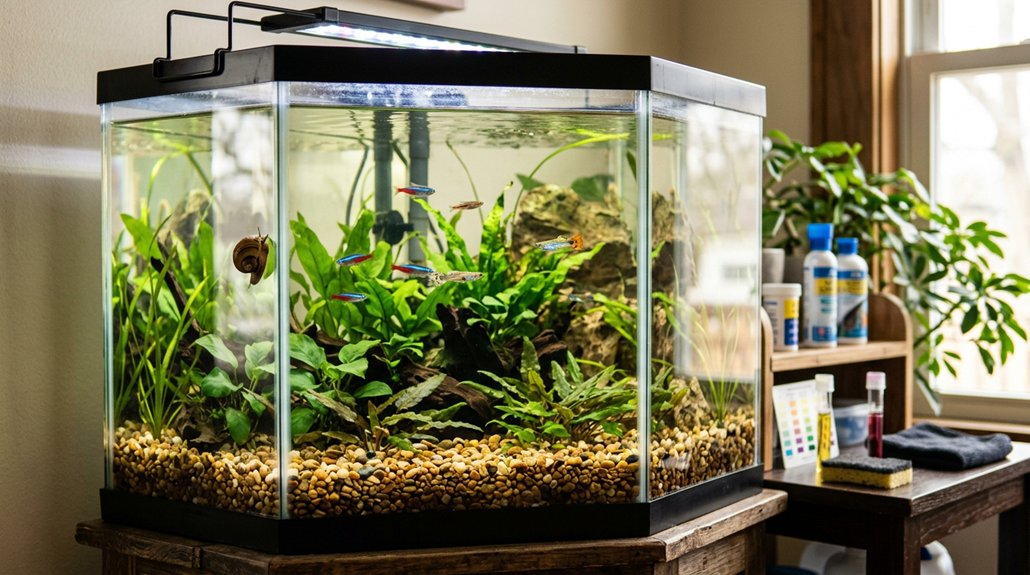
You should rule out fish that will outgrow, outcompete, or overload a 20-gallon system, because limited water volume leaves little margin for heavy waste production or territorial stress. Avoid goldfish and other cold-water, high-waste species; their metabolic load and adult size overwhelm filtration fast.
Rule out fish that outgrow or overload a 20-gallon tank; limited volume leaves little margin for waste.
- Skip oscars, arowanas, bichirs, and large cichlids.
- Reject aggressive barbs and species needing broad territories.
- Question “juvenile misconceptions” when buying angelfish, plecos, or large tetras.
You also shouldn’t overstock deep-bodied livebearers such as platies or mollies unless you’ve upgraded filtration and can manage frequent water changes. Prioritize adult size, bioload, and decor compatibility, not store display appeal. A 20-gallon tank works only when each fish’s full-growth behavior and waste output stay well below system limits, so plan for maturity, not temporary size.
Frequently Asked Questions
What Fish Can You Have Multiple of in a 20-Gallon Tank?
You can keep multiple Neon tetras, Cherry shrimp, pygmy corydoras, guppies, endlers, and small rasboras in a 20-gallon tank. You’ll want schooling species in groups of 6–15, depending on bioload, filtration, and maintenance.
What Fish Can Go Together in a 20-Gallon Tank?
You can keep community tankmates like neon tetras, ember tetras, pygmy corydoras, a honey gourami, or a betta together if temperament compatibility matches. Think of your tank as a small constellation, balancing zones, bioload, and territory.
What Is the Largest Fish I Can Keep in a 20-Gallon Tank?
You can usually keep only fish reaching about 4–5 inches adult size in a 20-gallon tank; larger fish, like a large cichlid or oversized betta, will overtax your bioload, waste load, and filtration.
Is 20 Gallons Enough for 2 Goldfish?
No, 20 gallons isn’t enough for two goldfish; you’d risk poor goldfish health from heavy bioload and cramped conditions. Don’t trust stocking myths—each adult needs far more space, strong filtration, and frequent water changes.
Conclusion
In a 20-gallon tank, you can’t judge stocking by fish count alone; adult size and bioload matter more. A few small fish may be safer than many tiny ones if your filtration is weak. For example, a single inch of fish can quickly become several inches of waste-producing biomass as it grows. If you overstock, ammonia can rise fast and stress every fish. Choose species carefully, and you’ll keep your aquarium stable and healthy.