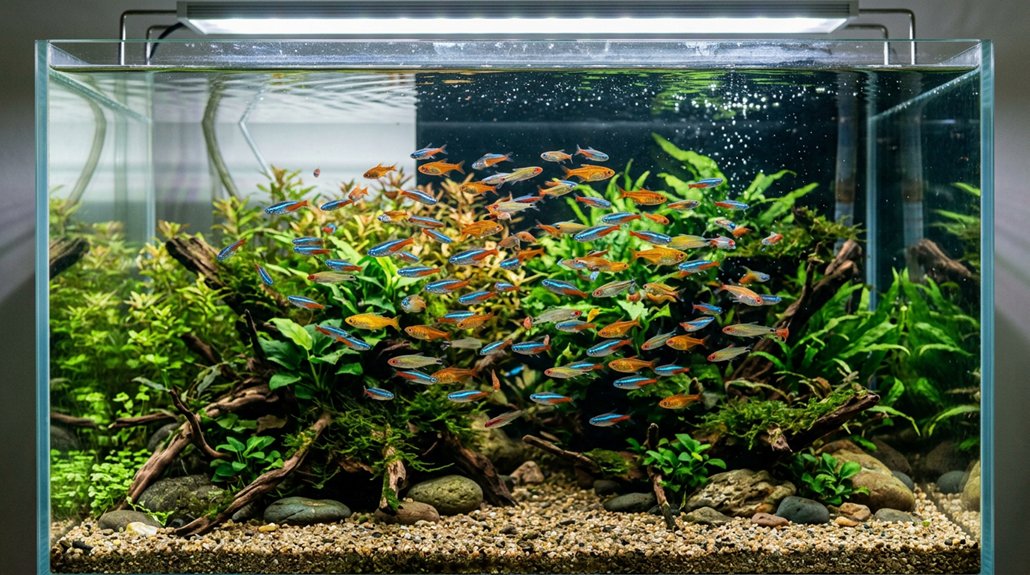
You can usually keep about 7 to 8 inches of adult small, slim-bodied fish in a 10-gallon tank, not a full 10 inches. That rule is only a rough baseline, and you’ve got to account for adult size, body shape, activity, filtration, oxygen exchange, and weekly maintenance. A single betta, 6 ember tetras, or a small livebearer group can fit if the tank is cycled and stocked conservatively, and the details matter more than the shortcut.
Key Takeaways
- A conservative 10-gallon target is about 7–8 inches of adult fish, not a full 10 inches.
- The inch-per-gallon rule works best for small, slim-bodied fish; body shape and activity level matter.
- Good 10-gallon options include 6 ember tetras, 6 guppies, or one single male betta.
- You can add small bottom dwellers like 3 pygmy corydoras, but keep mixed setups modest.
- Cycle the tank first, stock slowly, and keep ammonia and nitrite at 0 ppm with weekly water changes.
How Many Fish Fit in a 10-Gallon Tank?
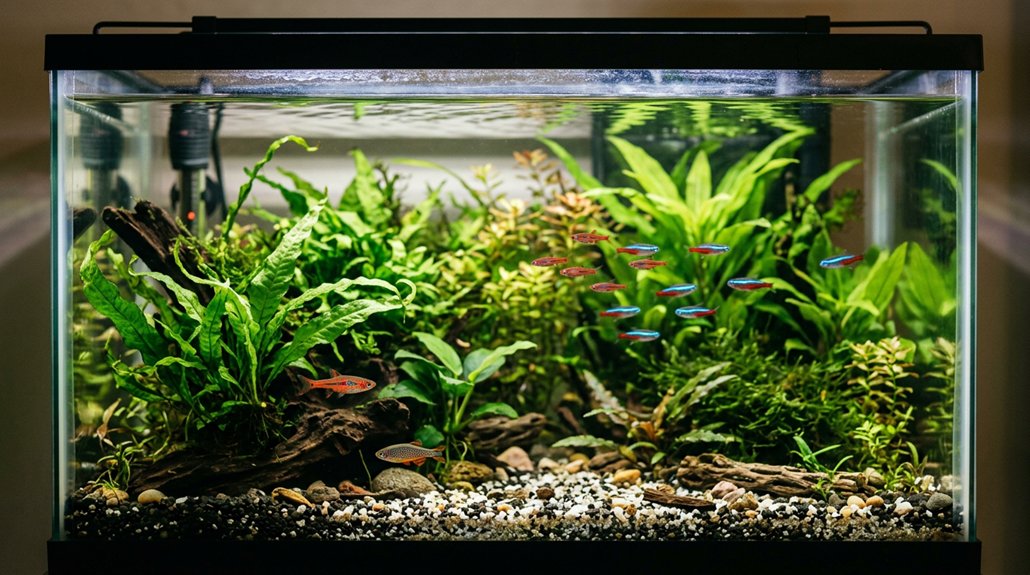
A 10-gallon tank can typically support about 10 inches of adult fish length using the common 1 inch per gallon guideline, though a more conservative stocking target is closer to 7–8 inches total. You should treat this as an upper estimate, not a target. In practice, you’ll do better by matching species size, activity, and social needs. For example, six ember tetras or six guppies can work, and you can add three pygmy corydoras if filtration is adequate. A single male betta also fits well. Tank lighting and plant maintenance can affect algae and visual space, but they don’t replace proper stocking. Cycle the tank first, add fish gradually, and monitor ammonia, nitrite, and nitrate.
What Limits Stocking in a 10-Gallon Tank?
Stocking a 10-gallon tank isn’t limited by gallon count alone; it’s constrained by biology, gas exchange, and husbandry. Your biological filtration must be mature enough to convert ammonia and nitrite to 0 ppm; if you add fish faster than beneficial bacteria can expand, toxic spikes follow. You also need to match bioload to species, since a 1-inch tetra produces far less waste than a 2–3-inch gourami or goldfish. Tank shape matters too: a long, shallow 10-gallon gives better oxygen exchange than a tall one, so dissolved oxygen becomes limiting later. With consistent 25–30% weekly water changes and filter maintenance, you can run closer to capacity; with weak care, you shouldn’t. Social needs matter, so schoolers need proper group size.
How Does the 1-Inch Fish Rule Work?
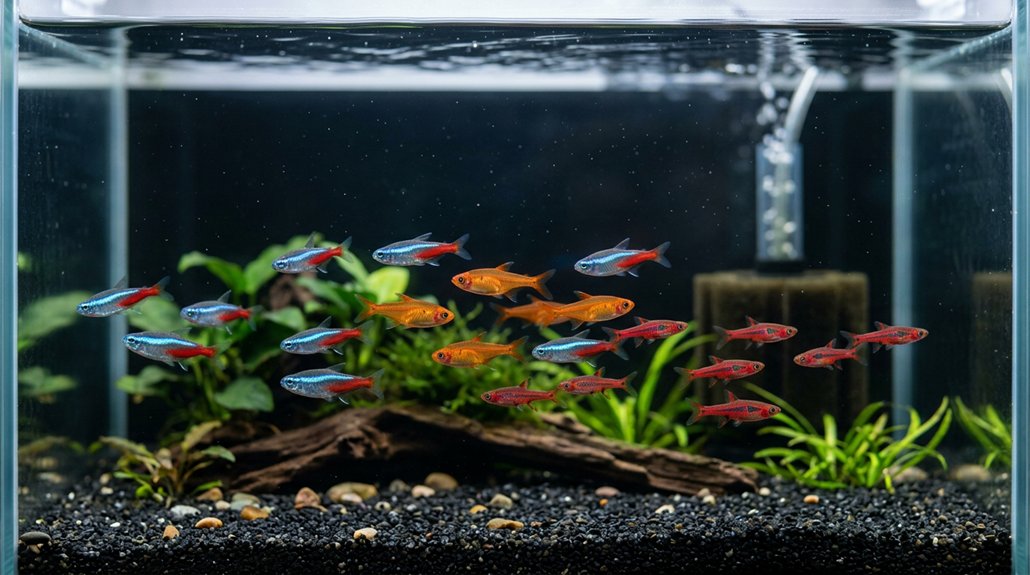
You can treat the 1-inch-per-gallon rule as a rough starting point: in a 10-gallon tank, that means about 10 inches of adult fish length total. You’ll need to adjust that estimate for species-specific adult size, body shape, schooling needs, and waste output, because length alone doesn’t reflect bioload. In practice, filtration, maintenance, and plant load can shift the safe total, so you shouldn’t use the rule as a stand-alone stocking limit.
One-Inch Rule Basics
The one-inch-per-gallon rule estimates stocking by allowing roughly 1 inch of adult fish length per gallon of water, so a 10-gallon tank suggests about 10 inches of total fish length. You can use it as a coarse starting point, not a definitive limit. It’s most valid for small, similarly sized, low-bioload schooling fish, and it breaks down when fish produce more waste, have greater mass, or need more oxygen and space. For fish welfare, many aquarists reduce the estimate to about 75%, or 7–8 inches total, to lower stress and water-quality risk. Stocking myths persist because the rule ignores body shape, activity, and bioload. You should prioritize species-specific minimum tank size, cycle the tank first, add fish gradually, and monitor ammonia, nitrite, and nitrate carefully.
Adjust For Species
Species-specific traits can change the usable capacity of a 10-gallon tank far more than the raw inch count suggests. You shouldn’t treat the 1-inch rule as universal. Use it as a baseline, then adjust for bioload, activity, and body mass.
- High-waste fish, like goldfish, need far more volume.
- Fast swimmers need horizontal room, not just gallons.
- Layer use matters: surface, middle, and bottom fish don’t stress the tank equally.
- Add only about 75% of the theoretical load, then test water chemistry.
A male betta with 3–4 ember tetras is more defensible than strict inch math. Keep decor placement from restricting movement, and monitor ammonia, nitrite, and nitrate after each addition.
Stocking Beyond Length
Although the “1 inch per gallon” rule is a useful starting point, it’s only a rough proxy for stocking small, slim-bodied freshwater fish between about 1 and 3 inches long. You can’t treat length as the primary variable, because bioload, activity, and body mass change waste production dramatically. A 3-inch betta may stress aquarium chemistry more than a 1-inch ember tetra. You also need to respect schooling behavior: tetras often require 6+ individuals for behavioral enrichment, so an inch-based count alone can understock socially. In a 10-gallon tank, filtration, surface area, and weekly 25–30% water changes set the real limit. Use nitrate below 40 ppm, with ammonia and nitrite at 0 ppm, and verify capacity with a stocking calculator before adding fish gradually.
What Are the Best Fish for a 10-Gallon Tank?
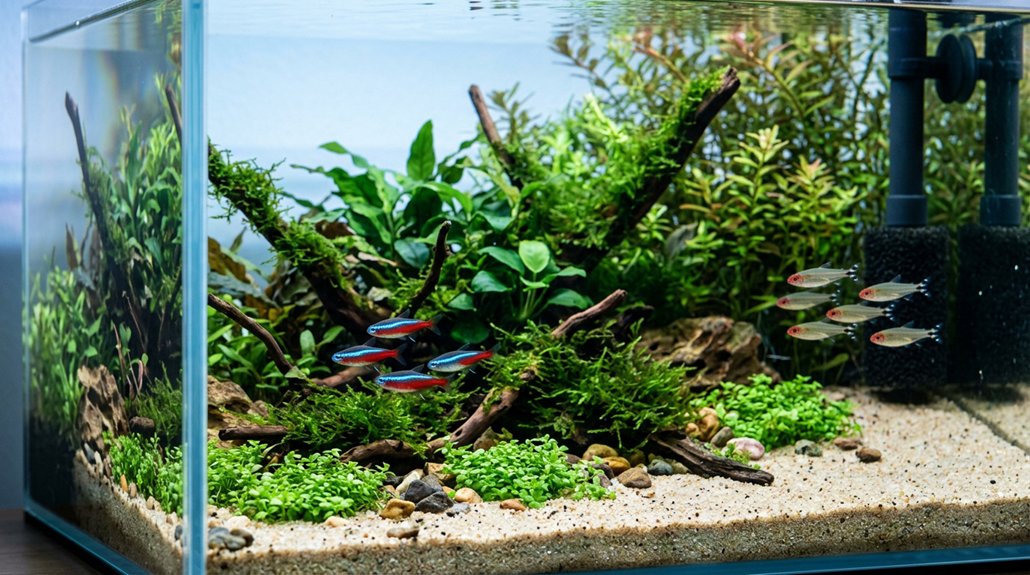
When you stock a 10-gallon tank, you should prioritize small freshwater species with low bioload and clear group-size requirements. Ember tetras, pygmy corydoras, neon tetras, celestial pearl danios, a single betta, or limited livebearers can all work if you match the fish to filtration capacity and maintenance frequency. You’ll need to keep stocking density conservative, monitor aggression and breeding, and use regular water changes to maintain stable water quality.
Best Freshwater Fish
In a 10-gallon tank, the best freshwater fish are small-bodied, low-bioload species that can be kept in appropriate social group sizes without overtaxing filtration. You’ll optimize aquarium aesthetics and feeding strategies by selecting taxa with modest adult size and compatible behavior.
- Ember tetras: keep 8–12 in planted setups.
- A single male betta: add 3–4 pygmy corydoras or a few Nerite snails.
- Pygmy corydoras: maintain 6 on soft substrate.
- Guppies or endlers: keep 4–6, with more females than males.
For a balanced community, you can combine 6 neon or ember tetras, 3 pygmy corydoras, and 1–2 snails. This approach preserves water quality and supports stable, technically appropriate husbandry in a small aquarium.
Stocking Tips And Limits
Stocking a 10-gallon tank requires restraint: a rough rule is about 1 inch of small fish per gallon, but adult size, activity level, and bioload matter more than raw length. You should favor low-bioload species such as ember tetras, with 6–12 suitable in a planted system, or pygmy corydoras in groups of 4–6. Three otocinclus can work if the tank is mature and algae is available. A single betta is the safest centerpiece; don’t add two males. Keep total stocking near 75% of theoretical capacity, and add livestock slowly after a 4–6 week cycle. Monitor ammonia, nitrite, and nitrate, and verify limits with a stocking calculator. Stable water chemistry and a strict quarantine protocol reduce disease, stress, and losses.
How Many Fish Work in a 10-Gallon Community Tank?
For a 10-gallon community tank, a practical starting point is about 1 inch of adult fish per gallon, or roughly 10 inches of fully grown fish total, but many aquarists target closer to 75% of that limit—about 7 to 8 inches—to account for bioload, activity level, and water-quality stability. You should stock by adult size, not juveniles, and factor in aquascape impact and feeding schedules. Common options include:
A 10-gallon tank does best with about 7 to 8 inches of adult fish total.
- 6 ember tetras with 3 pygmy corydoras.
- 6 neon or ember tetras alone.
- 6 pygmy corydoras in the bottom zone.
- 3 otocinclus plus 4–6 shrimp.
Cycle the tank 4–6 weeks, add fish gradually, test ammonia, nitrite, and nitrate, and reduce stocking if parameters drift unsafe.
How Many Fish Work in a 10-Gallon Betta Tank?
A 10-gallon betta tank is best kept simple: one male betta is the safest stocking choice, since it gives him adequate swimming space and minimizes territorial aggression. You can add only limited companions if your betta behavior is calm and the layout supports tank enrichment. Suitable options are 3–4 pygmy corydoras or 4–6 ember tetras, but they must remain peaceful and non-fin-nipping. In an even more conservative setup, keep just one betta with 1–3 snails or 4–6 cherry shrimp as a cleanup crew. Use a sponge filter or low-flow HOB filter, and provide plants and hides to reduce stress. Stock at roughly 75% of theoretical capacity, add fish slowly, and test ammonia and nitrate weekly while changing 25–30% of the water.
How Many Guppies or Platies Fit?
When you’re stocking a 10-gallon tank with guppies or platies, the safe range is modest: about 4–6 guppies or 3–4 platies by the common 1 inch-per-gallon rule, then reduced to roughly 75% of that load for better water quality.
For a 10-gallon tank, stock conservatively: about 3–4 guppies or 2–3 platies for better water quality.
- Guppies: 3–4 for conservative stocking.
- Platies: 2–3 for safety margin.
- Use same-sex groups for breeding control.
- Expect color variation across strains.
Because livebearers reproduce quickly, you’ll need to limit fry or reduce adults further. Add fish only after cycling, then track ammonia, nitrite, and nitrate. Weekly 25–30% water changes help keep waste low and stabilize filtration. With plants and effective aeration, you can support a small, healthy group, but overstocking will accelerate nitrate accumulation and algae growth. Keep feeding precise, and don’t exceed the adjusted capacity if you want long-term stability.
How Many Bottom Dwellers Fit in 10 Gallons?
In a 10-gallon tank, you can keep only a small group of bottom dwellers because their adult size, schooling behavior, and waste output quickly limit capacity; typically, that means about 6 pygmy corydoras, or 3–4 otocinclus if the aquarium is mature, stable, and well-supplied with biofilm and supplemental foods. Avoid larger species like Bristlenose Plecos; they outgrow the volume and elevate bioload.
| Species | Count |
|---|---|
| Pygmy corydoras | 6 |
| Otocinclus | 3–4 |
For mixed setups, stay near 3–4 total small bottom dwellers, not more. Your sand dweller behavior assessment should favor active, schooling forms, while substrate preference studies consistently support fine sand for delicate barbels and foraging efficiency. Keep totals below theoretical capacity, around 75%, to reduce crowding.
How Do You Stock a 10-Gallon Tank Safely?
To stock a 10-gallon tank safely, start with the tank’s real biological limits rather than its nominal volume: use the inch-per-gallon rule only as a rough baseline, then stock at about 75% of that level to leave margin for waste load and water-quality swings. Prioritize adult size, temperament, and swimming demand.
- Cycle 4–6 weeks.
- Add fish in small batches.
- Test ammonia, nitrite, and nitrate.
- Keep weekly water changes.
You can maintain 6 ember tetras or 6 guppies, plus 6 pygmy corydoras or 3 otocinclus, if filtration is properly sized. Avoid zebra danios and other high-activity species. Match substrate selection to bottom dwellers, and keep plant maintenance consistent to stabilize nutrients. Keep ammonia and nitrite at 0 ppm, nitrates under 40 ppm, and use a sponge or low-flow HOB filter.
Frequently Asked Questions
How Many Fish Should I Keep in a 10-Gallon Tank?
You should keep about 7–8 inches of adult fish total in a 10-gallon tank, adjusted for stocking density and filtration needs. You’re usually looking at 6 small fish, added gradually after cycling.
What Fish Can You Have Multiple of in a 10-Gallon Tank?
You can keep multiple ember tetras, pygmy corydoras, or guppies; they’re small, low-bioload species. A sparkling gourami works as a single centerpiece, not a group. You’ll need stable filtration and disciplined stocking.
What Fish Do Well in a 10-Gallon Tank?
You’ll do well with a single male betta, 6 ember tetras, or 6 pygmy corydoras; you can add nerite snails or shrimp refuges, but monitor bettas compatibility and maintain stable, lightly stocked water.
Can I Put 3 Goldfish in a 10-Gallon Tank?
No—you can’t keep 3 goldfish in a 10-gallon tank; it’s a pressure cooker. You’d violate goldfish ethics and filtration requirements. Goldfish need far more volume, or you’ll get toxic waste, stress, disease.
Conclusion
In your 10-gallon tank, stocking is like loading a small bridge: each fish adds weight, and too much traffic causes collapse. You must account for adult size, waste output, and territorial behavior, not just length. A single betta, a few guppies, or a modest bottom-dweller group can fit if you keep the bioload low and water changes consistent. If you overfill the tank, water quality drops fast, and your aquarium’s balance breaks.