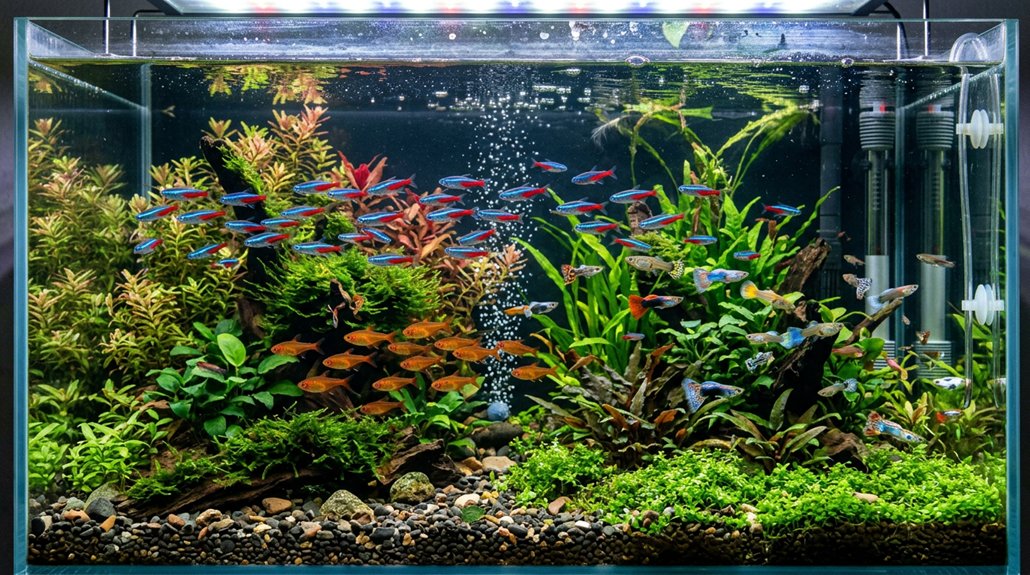
In a 30-gallon tank, you can usually keep about 12 to 25 small adult fish, but you should stock by adult size, not juvenile count. A conservative ceiling is roughly 30 inches of small-bodied fish, or about 45 inches if filtration is strong and stable. Leave room for plants and décor, and keep ammonia and nitrite at 0 ppm. Guppies, platies, mollies, and small schooling fish work best, and the details matter if you want the right balance.
Key Takeaways
- A 30-gallon tank usually supports about 12–25 small adult fish, depending on species, filtration, and aquascape.
- Use adult size, not juvenile length, and treat about 45 inches total fish length as an upper ceiling.
- For small livebearers like guppies or platies, a practical starter group is about 12 fish total.
- Strong filtration and weekly 20–30% water changes are essential; keep ammonia and nitrite at 0 ppm.
- Schooling fish need proper group sizes, and large species like goldfish, plecos, and many cichlids are unsuitable.
How Many Fish Fit in a 30-Gallon Tank?
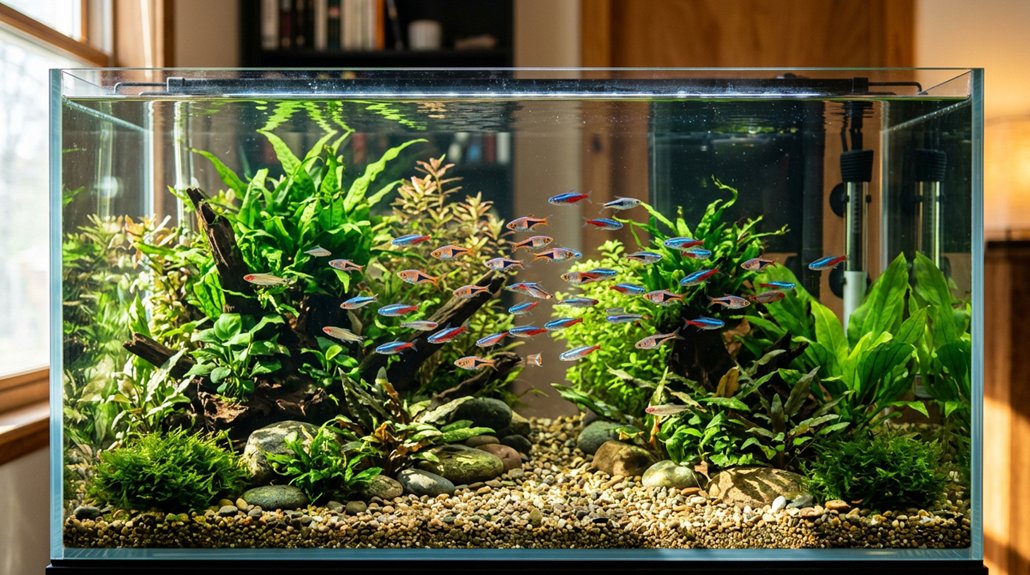
In a 30-gallon tank, a practical starting estimate is about 45 inches of adult fish total using the 1.5 inches-per-gallon rule, or about 30 inches total if you’re stocking small-bodied community species at a more conservative 1 inch per gallon. You should base that estimate on adult size, not juvenile length. For example, 5–6 neon tetras, ember tetras, or guppies fit differently from a single goldfish, pleco, or cichlid, which can demand far more space. During tank cycling, keep stocking light and add fish gradually. If a species shows breeding behavior or must be kept in a school, plan the group size first, then verify filtration, live plants, and maintenance capacity. Decorations can reduce usable volume, so don’t push the upper limit without margin.
Use Adult Fish Size, Not Count
Start with adult size, not the number of fish you can buy as juveniles, because stocking limits are determined by full-grown length, biomass, and waste production. For 30 gallons, you should use adult growth estimates for each species, not temporary size, when making space planning decisions. A mixed small-bodied community tank often uses about 1.5 inches of adult fish per gallon, so you’re near 45 inches total.
- True dwarf species can fit at roughly 1 inch per gallon.
- Goldfish, plecos, and many cichlids need far more room per adult.
- Schooling fish need enough adults to form a proper group, and snails or shrimp can add load.
Leave margin for plants, décor, and growth so you don’t crowd the tank.
Check Filtration Before Stocking More
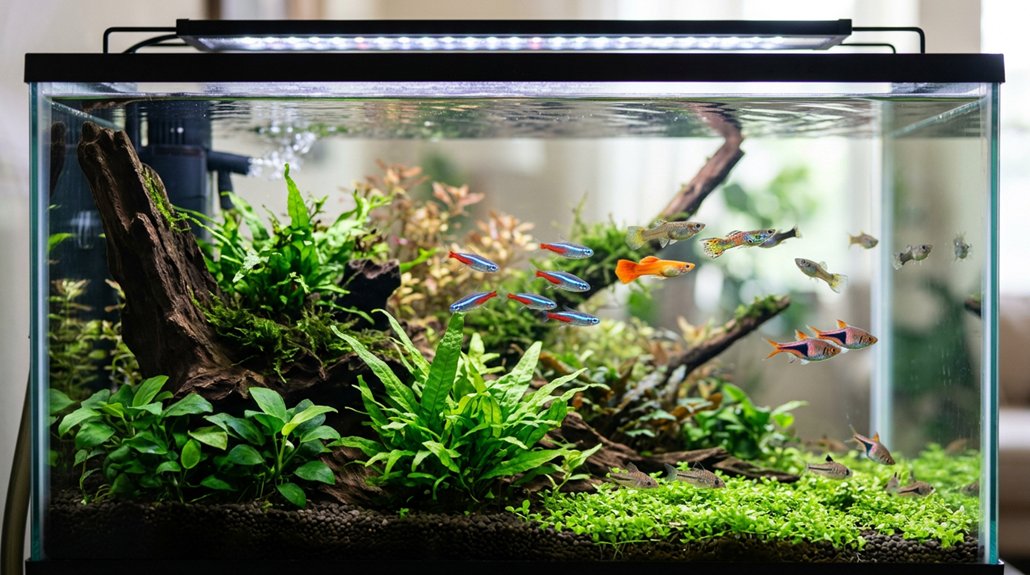
Before you add more fish, verify that your filter can process the tank’s bio-load, not just hold water; a unit rated for 30–40 gallons or cycling 6–10× per hour is the safer benchmark. If your filtration is weak, you’ll need to reduce stocking density and increase maintenance, because ammonia and nitrite control depends on biological media, surface area, and stable waste removal. Test ammonia, nitrite, and nitrate after each addition, and only stock more if those values stay stable with your current water-change schedule.
Filtration Capacity Limits
Because filtration, not tank volume alone, sets the safe biomass limit, a well-maintained 30-gallon tank with strong biological and mechanical filtration can often support about 25 small fish, and sometimes up to 30 with excellent filtration. You should judge capacity by turnover, media surface area, and species behavior, not by headcount alone. For livebearers such as mollies or for larger-bodied tetras, increase filtration margin.
- Aim for 4–10× turnover per hour.
- Use filter redundancy and media optimization to expand nitrifying surface.
- Add a canister, HOB, or sponge prefilter before stocking more.
If ammonia or nitrite rises, your filtration’s at its limit. Reduce stocking or upgrade hardware; otherwise, even a stable 30-gallon system can become biologically overloaded.
Waste Load Management
Once filtration capacity is established, the next limit is waste load: in a 30-gallon tank, you can only add fish if the filter can process the extra ammonia and solid waste they produce. Use 1.5 inches of adult fish per gallon as a starting check, but adjust downward if your media, flow rate, or biological filtration is limited. Because substrate, plants, and decor reduce effective volume by 5% to 10%, your real waste-processing margin is smaller than the nominal tank size. With strong filtration, you may support about 25 to 30 small fish; with weak filtration, keep closer to 12 to 15. Live plants and snails can assist with detritus removal and toxin mitigation, but they can’t replace adequate biofilm accumulation capacity in the filter.
Maintenance and Water Changes
Regular maintenance determines whether a 30-gallon tank can sustain the higher end of stocking estimates. You should treat filtration capacity as the limiter, not raw fish count. For small tetras, rasboras, and livebearers, keep ammonia at 0 ppm, nitrite at 0 ppm, and nitrate below 20–40 ppm.
- Change 20–30% weekly, or 10–15% twice weekly under heavier load.
- Rinse sponges and biomedia in tank water to preserve nitrifying bacteria.
- Verify oxygenation tactics and dhcp scheduling before adding more fish.
If test kits show rising ammonia, nitrite, or fast nitrate accumulation, reduce stocking or increase maintenance immediately. Before stocking to 1.5 in/gal or higher, confirm strong circulation, surface agitation, and adult size compatibility.
Factor in Plants and Decorations
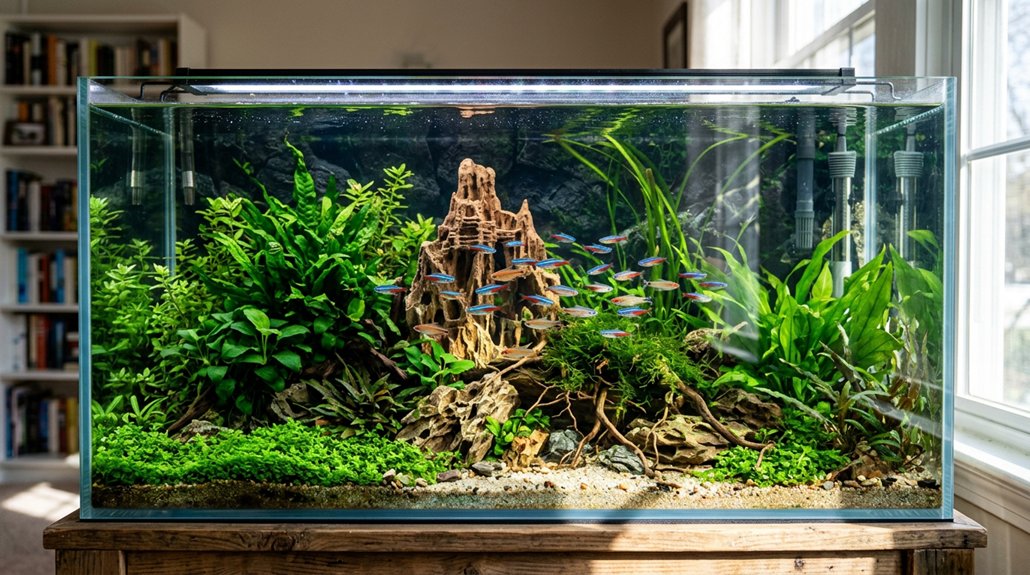
Plants and décor can change a 30-gallon tank’s usable stocking volume more than many aquarists expect. Your aquascape layout and seasonal planting choices may displace 5–10%, so stock it like 27–28.5 gallons. Large rocks, driftwood, and dense stems also compress swim lanes and territory.
| Feature | Effect |
|---|---|
| Dense plants | Less usable volume |
| Tall décor | Fewer open lanes |
| Live plants | Better oxygenation |
| Cover zones | Lower stress |
If you use a 1.5 in/gal rule, 45 inches becomes closer to 40–43 inches after displacement. In heavily planted setups, you can support slightly more biomass if filtration is stable. Shy cichlids, gouramis, and territorial species need cover; active schoolers need open water. Match structure to species, then stock conservatively.
Choose Small Fish for a 30-Gallon Tank
With usable volume reduced by décor and planting, a 30-gallon tank is usually best stocked with small-bodied species rather than large individuals. You can use about 1 inch of adult fish per gallon for nano species, so roughly 30 inches total is realistic when filtration is strong.
- Tetras and rasboras need school sizes of 5–6.
- Danios also work best in full groups, not singles.
- Snails or Amano shrimp add grazing function in micro habitats.
Base every estimate on adult length, not juveniles. A 3.5-inch molly quickly consumes stocking room, so you’d need fewer fish than with ember tetras or celestial pearl danios. Because plants, hardscape, and cleaner invertebrates improve welfare while reducing effective volume by 5–10%, you should always stock conservatively and leave margin for growth.
Pick Peaceful Community Fish
A 30-gallon tank can support a peaceful community of about 20–30 small fish when filtration is strong and décor provides cover. You should select species with documented temperaments, such as neon tetras, guppies, and platies, and verify adult size before stocking. Use compatibility charts to match water parameters, fin shape, and aggression risk, then keep schooling fish in groups of 5–6 minimum. If you add livebearers, limit mollies unless you can control breeding; a 9-female-to-3-male ratio helps reduce stress. Include one cleaner, such as an otocinclus, nerite snail, or small pleco approved for 30 gallons, and count it in biomass. Follow feeding schedules that prevent overfeeding and support stable water quality.
Best Schooling Fish for a 30-Gallon Tank
Once you’ve chosen peaceful community fish, the next step is narrowing down the best schooling species for a 30-gallon tank. You can keep 6–8 neon or cardinal tetras, 8–12 Harlequin Rasboras, or 8–12 White Cloud Mountain Minnows without crowding. Zebra or pearl danios fit in groups of 6–10, but they need strong filtration and open water. For the lower level, 6–8 small Corydoras, such as pandas, add schooling activity if your substrate is fine and your bioload stays controlled.
Choose compact schooling fish for a 30-gallon tank: tetras, rasboras, white clouds, or small Corydoras.
- Tetras: compact, midwater, visually cohesive
- Rasboras: stress reduction, strong group presentation
- White clouds: cool-water tolerance, seasonal schooling, breeding behavior
How Many Mollies, Guppies, or Platies?
In a 30-gallon tank, you can usually keep about 12–25 adult mollies, guppies, or platies, but you shouldn’t stock by count alone because full-grown size and filtration capacity matter. For guppies and platies, a practical starting group is about 12 fish total, often with more females than males to limit harassment; mollies are larger and need the lower end of that range. You should also add dense plants and at least one cleaner species, then use regular water changes to keep water quality stable if you’re aiming near the upper limit.
Molly Schooling Needs
Mollies do best in groups, and you shouldn’t treat them as single-feature fish for a 30-gallon tank. You should keep at least 5–6, but their adult size, 3.5–4.5 inches, means your practical ceiling is about 9–12 mollies total, depending on filtration and decor. A stable sex ratio, such as 3 females to 1 male, reduces breeding behavior and helps limit tank hierarchy stress.
- Add dense plants to interrupt chasing.
- Use strong filtration and frequent water changes.
- Include snails or another light cleanup crew.
If you mix species, reduce molly numbers because they’re bulkier than guppies and crowd the swimming zone faster. In a balanced 30-gallon setup, you’ll get better welfare from fewer mollies with open water than from maximizing count.
Guppy Group Sizes
For guppies and platies, a 30-gallon tank can usually hold about 20–25 small livebearers if filtration is strong and maintenance is consistent, but social welfare matters more than the raw count. You should keep guppies and platies in groups of at least 5–6, because small cohorts reduce stress and distribute male aggression. A practical layout is three groups of six, or a similar mix totaling about 18 fish, then adjust slowly after observing ammonia, nitrite, and behavior. Start with roughly 12 fish, such as 9 females and 3 males, if you want a conservative build. Watch tail genetics in guppies, since elaborate finnage can affect swimming and selection. Mollies need fewer spots than guppies, so don’t treat them identically.
Platy Stocking Limits
When it comes to platy stocking limits, the math is only a starting point: a 30-gallon tank can support roughly 45 inches of adult livebearer length, which works out to about 15–22 guppies, platies, or mollies by size alone, but a more realistic long-term range is 12–18 fish because these species are active, messy, and sensitive to crowding.
- Keep platies in groups of 5–6 or more to reduce stress.
- Use 2–3 males with several females to limit aggression and breeding behavior.
- Choose dense plants, hiding sites, and a snail or small pleco to manage waste.
You should match stock to adult size, filtration, and water tests. With platy color morphs, don’t overbuy; start with 9 females and 3 males, then add only if ammonia, nitrite, and aggression stay stable.
Add a Snail or Algae Grazer
Adding one or two algae grazers can help keep a 30-gallon tank clean without adding much bioload, but you should still count them in your stocking total. Nerite snails are 0.5–1 inch and don’t reproduce in freshwater, so snail breeding isn’t a concern; they target specific algae species on glass and hardscape.
| Grazer | Notes |
|---|---|
| Nerite snail | Small, low bioload |
| Zebra nerite | Effective on glass |
| Otocinclus | Keep 5–6 minimum |
| Mystery snail | Larger, more biomass |
You can also use Otocinclus in mature tanks with stable biofilm, but they need groups and consistent parameters. Avoid large plecos; they outgrow this volume. Grazers reduce maintenance, yet they don’t replace water changes or careful capacity planning around plants and decor.
Stock Slowly and Test Water Often
You should add fish gradually, starting with a modest starter group of small individuals and increasing the load in small increments over several weeks. After each addition, you’ll need to test ammonia, nitrite, and nitrate daily; any detectable ammonia or nitrite means you should stop stocking and correct the bioload. Watch each species closely for stress, reduced feeding, or abnormal behavior, since these signs often appear before water quality declines become severe.
Add Fish Gradually
Stock fish slowly so the 30-gallon biofilter can adapt without an ammonia or nitrite spike. Add one or two fish at a time, then wait 1–2 weeks before the next group. This acclimation timing lets you verify stable load and reduces disease transfer after quarantine procedures. Use the 1.5 inches-per-gallon rule only as a ceiling; in a 30-gallon tank, that’s about 45 inches total, but you should build toward it gradually.
- Drip-acclimate or float new arrivals for 30–60 minutes.
- Temporarily switch off carbon during introduction.
- Stop stocking if ammonia, nitrite, or nitrate destabilizes.
Test Water Frequently
Test water frequently during the stocking period so the 30-gallon biofilter doesn’t get overloaded. Use reliable test kits to measure ammonia, nitrite, and nitrate at least twice weekly, and daily for the first week after each addition. Start with 6–12 fish, depending on species and filtration, then add only 1–2 fish every 1–2 weeks. Keep ammonia and nitrite at 0 ppm; nitrates should stay below about 20–40 ppm. Check pH, temperature, and general hardness weekly, because shifts can follow new arrivals. If you detect ammonia spikes, nitrite, or rapidly rising nitrate, stop stocking immediately. Perform a 20–50% water change, improve biomedia or filtration, and resume only when readings stabilize. Use species-specific space limits as secondary guidance, not a substitute for testing.
Watch For Stress
Even after initial stocking, watch closely for stress and add fish slowly to a 30-gallon tank. Introduce no more than 2–3 small fish, then wait 1–2 weeks before the next addition. During this ramp-up, test ammonia, nitrite, nitrate, and pH at least twice weekly; any detectable ammonia or nitrite means you stop.
- Gasping, faded color, or clamped fins demand immediate testing.
- Hiding, rapid chasing, or nipped fins suggest overload or poor tank enrichment.
- Remove or isolate the affected fish and reassess filtration, decor, and water changes.
Maintain strong filtration and perform 25–30% weekly changes. Use a signs checklist for species-specific behavior, and base stock on adult size, not juveniles.
Frequently Asked Questions
What Fish Can Live Together in a 30 Gallon Tank?
You can keep a community tank with guppies, platies, neon tetras, ember tetras, harlequin rasboras, and nerite snails; a livebearer mix works best if you’re matching water parameters, temperaments, and adult sizes.
What Is the Biggest Fish You Can Keep in a 30 Gallon Tank?
You can keep, at most, one slim 10–12 inch fish, but not a large cichlid or juvenile arowana; they’ll outgrow 30 gallons. An adult angelfish or similar species is the practical upper limit.
What Can I Put in a 30 Gallon Fish Tank?
You can keep guppies, platies, tetras, small rainbowfish, live plants, and nano shrimp—if you stop there. Choose 5–6 of each schooling species, add snails, and avoid goldfish or large plecos.
Is 30 Gallons Enough for 2 Goldfish?
No, 30 gallons isn’t enough for two goldfish, especially common varieties. You’d risk poor growth and waste buildup. For fancy varieties, it’s still marginal; you’ll need stronger filtration, frequent water changes, and skip goldfish bowls.
Conclusion
In a 30-gallon tank, you can’t simply count fish—you need to match adult size, filtration capacity, and bioload. If you stock small species like neon tetras, guppies, platies, or harlequin rasboras, you can create a stable community, but only if you add fish slowly and test water regularly. Think of your aquarium as a living balance sheet: every fin, plant, and filter action affects the total load.