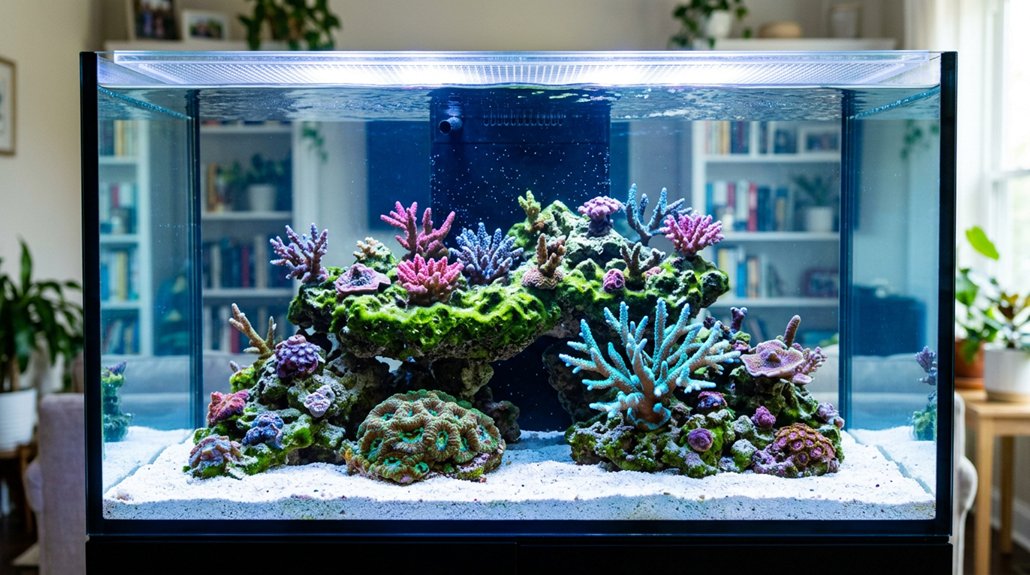
Your saltwater tank is ready for fish when ammonia and nitrite both test 0 ppm, while nitrate is present at low, detectable levels. Use a reliable reagent kit, not strips, and confirm the biofilter can process a 2 ppm ammonia dose to nitrate within 24 hours. If ammonia or nitrite rises above 0.25–0.5 ppm, the tank isn’t ready yet. Once those numbers hold steady, you’re set to stock carefully and avoid overloading the cycle.
Key Takeaways
- Ammonia and nitrite should both read 0 ppm consistently on reliable liquid test kits.
- Nitrate should be present at low, detectable levels, confirming nitrification is complete.
- A 2 ppm ammonia dose should convert to nitrate within about 24 hours.
- No signs of ammonia or nitrite toxicity should appear, and water conditions should remain stable.
- After adding fish, continue daily testing and add stock slowly to match biofilter capacity.
What a Finished Saltwater Cycle Looks Like
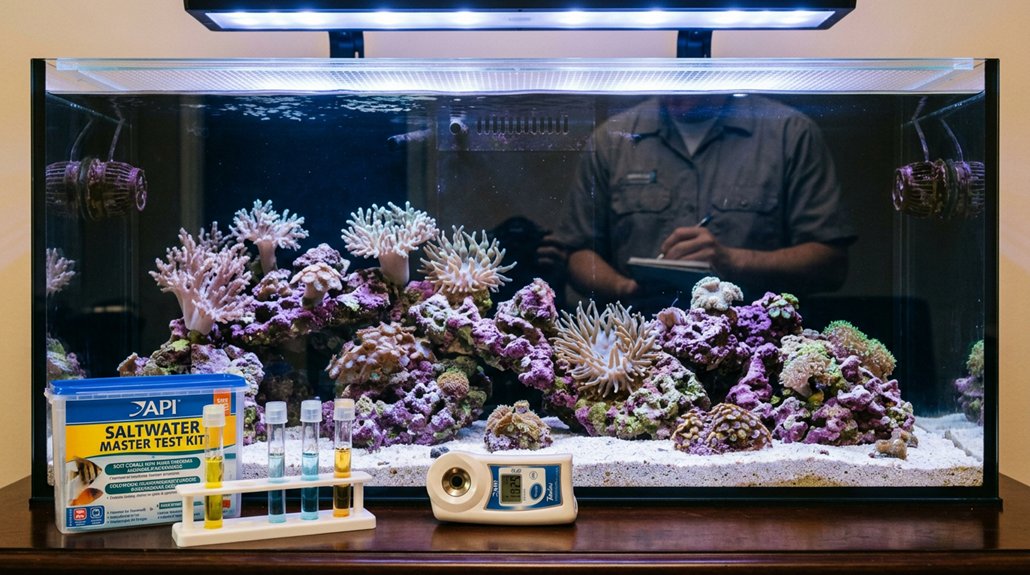
A saltwater cycle is finished when your test kits consistently read 0 ppm ammonia and 0 ppm nitrite, even after you’ve dosed the tank with up to 2 ppm ammonia and watched it convert fully to nitrate. At that point, beneficial microbes can process the expected bioload quickly, usually within about 24 hours. You should still see nitrate at low but detectable levels, which confirms ammonia-to-nitrate conversion is happening. Use stable salinity and temperature as supporting visual cues, not proof by themselves. If those readings stay steady and ammonia and nitrite remain zero for several consecutive days, your tank’s biofilter is ready for the current load. Before adding fish, plan a 30% water change to reduce nitrate and excess organics, then stock slowly.
Test Ammonia, Nitrite, and Nitrate
Use reliable reagent test kits—not strips—to measure ammonia, nitrite, and nitrate every day while the tank is cycling. In water testing, your kit choices affect reading results and interpretation methods, so follow the instructions exactly and record each value.
Use reliable reagent test kits—not strips—to test ammonia, nitrite, and nitrate daily during cycling.
- Ammonia should fall to 0 ppm.
- Nitrite should also stay at 0 ppm.
- Nitrate may appear at trace to a few ppm.
- After cycling, dose 2 ppm ammonia and retest in 24 hours.
If the system reduces that dose to near 0 ppm, your biofilter’s working. You can then add fish cautiously. Continue testing every few days after stocking, because this capacity only matches the current bioload, and extra fish can trigger new spikes.
Why Nitrate Matters More Than Nitrite
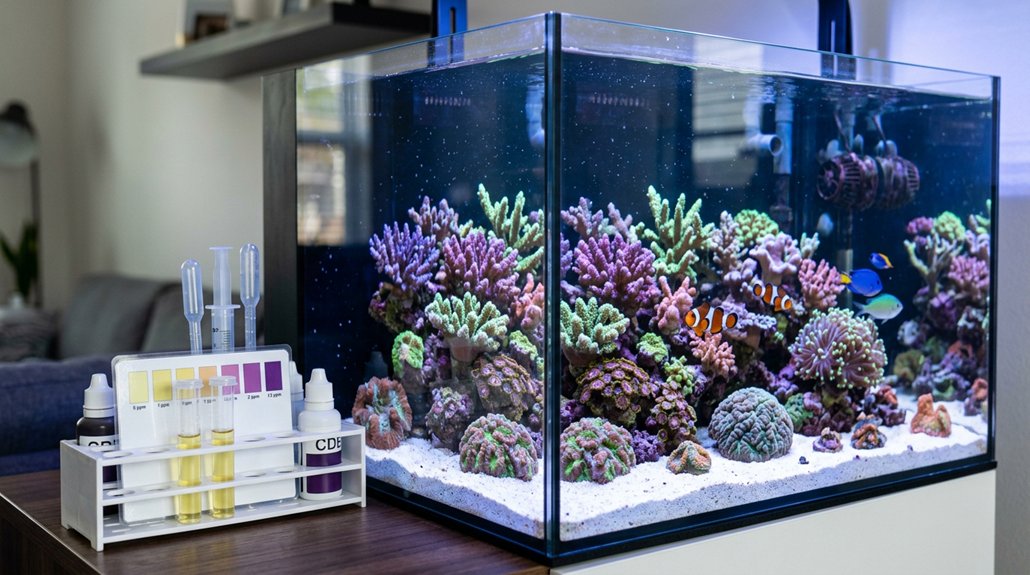
Nitrate is the number that tells you whether nitrification has actually finished: nitrite should be at 0 ppm because it’s far more acutely toxic and usually only appears transiently during cycling, while nitrate is the end product you expect to see once ammonia is being fully converted. You should treat a measurable nitrate rise as confirmation that nitrite-oxidizing bacteria are working. Test every few days, and watch for nitrate climbing after dosing ammonia or adding a fish/food source. Keep nitrate below about 20–40 ppm in most reef tanks, and under 10 ppm for sensitive corals. Track nitrate sources so you can limit buildup, and use denitrification methods, water changes, macroalgae, or a skimmer to control chronic elevation. Zero ammonia plus zero nitrite is your readiness marker.
Can Your Tank Clear 2 PPM Ammonia in 24 Hours?
If you want a practical readiness check, dose the tank to 2 ppm total ammonia with 100% pure ammonia or another measured fish-free source, then test again after 24 hours. Use reliable ammonia testkits and repeat the nitrite test too.
- Zero or near-zero ammonia means your biofilter handled the dose.
- Rising then falling nitrite shows normal conversion during cycling.
- >0.25–0.5 ppm ammonia after 24 hours means you’re not ready.
- Recheck after major changes to confirm bacterial regrowth matches the current load.
Clearing 2 ppm in a day suggests enough nitrifying bacteria for that challenge, but only for that exact bioload. It doesn’t guarantee safety for additional fish. If ammonia persists, wait, add biological media, or use bottled bacteria before stocking.
When Live Rock or Bottled Bacteria Speed Up Cycling
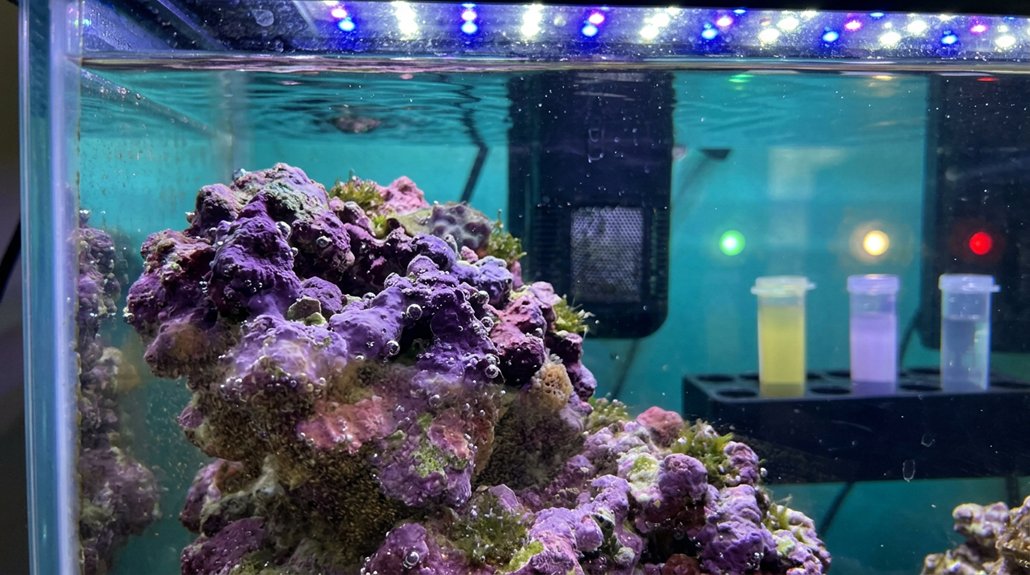
Live rock and bottled bacteria can jump-start cycling by seeding nitrifying microbes that would otherwise need weeks to establish, so detectable ammonia and nitrite may drop to zero in just a day or a few days. If you use bacterial supplements, follow the label and confirm the product isn’t expired or improperly stored, because performance varies. With genuine cured rock or live sand, you may see little or no spike at all. To verify function, dose 2 ppm ammonia and re-test after 24 hours; zero ammonia and nitrite with rising nitrate means the biofilter’s working. Even then, wait for repeated zero readings before stocking, then do a 25–30% water change. If rock was shipped dry, its microbiome may need time to recover fully.
What Can Throw Off a New Tank Cycle
During cycling, you shouldn’t overfeed or add fish too quickly, because the resulting ammonia spike can exceed what your nascent nitrifying bacteria can process. A heavy feeding schedule or an unplanned bioload increase can prolong ammonia and nitrite elevations, even if the tank looked stable days earlier. To keep the cycle on track, add livestock gradually and feed only what the system can immediately handle.
Overfeeding During Cycling
Overfeeding can quickly derail a new saltwater cycle by driving ammonia well above safe levels, sometimes into the several-ppm range where nitrifying bacteria can’t keep up. You should keep feeding frequency minimal and watch protein decomposition closely.
- Use tiny portions only.
- Feed only what’s consumed in about 2 minutes.
- Avoid repeated ghost feeding.
- Consider controlled 2 ppm ammonia dosing instead.
Excess food, especially shrimp or pellets, breaks down fast and adds ammonia faster than live rock alone can process. That extra organic load also fuels heterotrophic bacteria, which can cloud water and slow nitrite-to-nitrate conversion. If ammonia or nitrite climbs above 1–2 ppm, do a 20–50% water change, then stop or reduce feeding until both return to zero. This keeps your cycle stable and on track.
Unplanned Bioload Spikes
Even if you’ve kept feeding minimal, a new cycle can still be knocked back by sudden bioload changes. A single frozen shrimp, a forgotten overfeed, or adding several fish at once can push ammonia to 5–10+ ppm in a young tank because nitrifying bacteria aren’t built yet. Large, high-waste species can overwhelm biofiltration within 24–48 hours, so stock slowly and test daily. Inspect new live rock for dead hitchhikers or decaying macroalgae; they can release delayed ammonia pulses. Also avoid untreated additives, chlorinated tapwater, and overdosed products, which can suppress microbes. Heavy gravel vacuuming, skimmer changes, or cleaning biological media may strip bacteria and trigger brief ammonia or nitrite rises. Keep temperature swings tight and maintain a stable lighting schedule.
How to Add Fish Without Overloading the Tank
You should stock slowly, adding only 1–2 small fish at a time and waiting at least 7–10 days, or until repeated tests still show 0 ppm ammonia and 0 ppm nitrite. Match each addition to your established biofilter capacity, not tank volume alone, and verify that a 2 ppm ammonia dose converts to nitrate within 24 hours before adding more. If ammonia or nitrite rises above 0.25 ppm, stop stocking, reduce feeding, and use partial water changes until levels stabilize.
Stock Slowly
Once your test results hold at 0 ppm ammonia and 0 ppm nitrite with a detectable nitrate reading, your biofilter is ready for a cautious increase in bioload. Use gradual introductions, and verify species compatibility before any purchase. Add only one to three small, hardy fish, or about 10–20% of your long-term plan, then wait 7–10 days and re-test.
- Quarantine each new fish first.
- If you dose ammonia, confirm 2 ppm drops near zero within 24 hours.
- Perform a 25–30% water change before the first major stock-up.
- Repeat water changes if ammonia or nitrite rises.
This pacing lets nitrifying bacteria multiply without a spike. Don’t add more fish until the tank’s readings stay stable after the last addition, and keep observing every new arrival for stress or disease.
Match Bioload
Bioload matching is the key to adding fish without overrunning the tank’s filtration capacity. You should only stock after your tank holds 0 ppm ammonia and 0 ppm nitrite after a 2 ppm ammonia dose or observed cycling. Add fish by fish biomass, not headcount: introduce one small specimen, or the equivalent biomass, then wait 7–14 days. During this period, nitrifying bacteria can expand to match the new waste load. Test ammonia and nitrite daily for at least a week after each addition. If either rises above 0.25–0.5 ppm, cut feeding and perform a 25–30% water change. Avoid multiple medium or large fish at once; several gradual additions keep the tank cycled for the current bioload.
Frequently Asked Questions
How to Tell if a Saltwater Tank Is Cycled?
You’ll know it’s cycled when ammonia and nitrite test 0 ppm, but nitrate accumulation remains detectable. After bacterial colonization, dose ammonia to 2 ppm; if it’s gone within 24 hours, you’re ready.
How to Cycle a Saltwater Tank in 24 Hours?
You can’t truly create an instant cycle in 24 hours, but you can test live bacteria. Dose bottled nitrifiers, add pure ammonia to 2 ppm, then check that ammonia and nitrite’re 0 ppm with rising nitrate.
Can I Add Fish to a New Tank After 3 Days?
No, you shouldn’t add fish after 3 days. You need beneficial bacteria established, with ammonia and nitrite at zero. Then verify the cycle, stabilize salinity and temperature, and use careful stress acclimation.
How Long Should I Let My Fish Sit in Salt Water?
How long should you let your fish sit in salt water? You shouldn’t leave them there long; use acclimation techniques and temperature equilibration for 15–30 minutes, then add them. Why risk stress by delaying?
Conclusion
When your saltwater tank clears ammonia and nitrite to zero and leaves only a trace of nitrate, you’re looking at a stable foundation, not just clear water. The cycle is the reef’s silent anchor: unseen, but holding everything in place. Test again before adding fish, then introduce them slowly so the biological filter can adjust. If you rush, the balance can collapse; if you wait, your tank becomes a steady harbor for life.