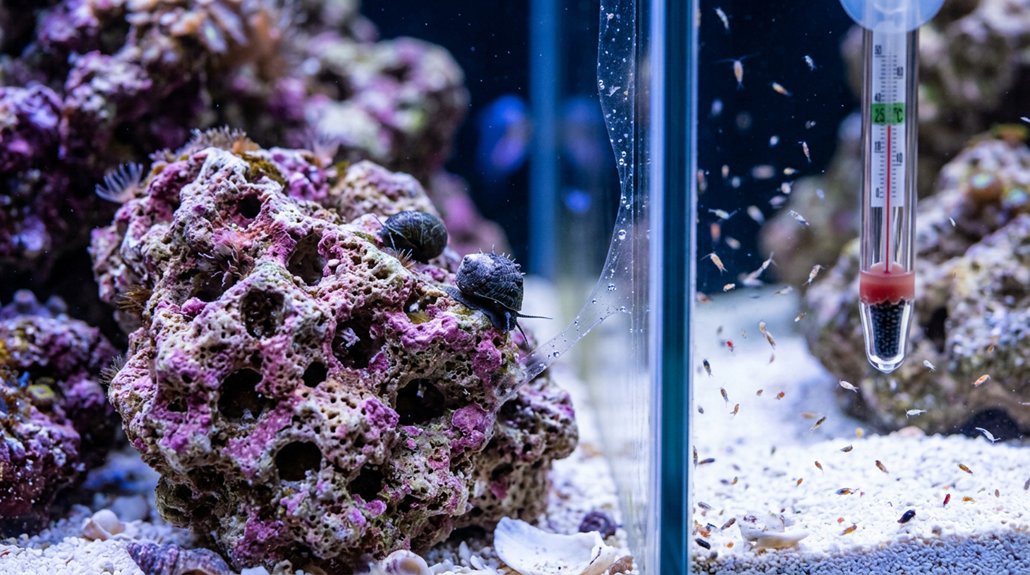
In your saltwater tank, the nitrogen cycle is the biological process that turns toxic ammonia from waste and uneaten food into nitrite, then into nitrate. Beneficial nitrifying bacteria colonize rock, sand, and filter media on oxygen-rich surfaces. A tank is fully cycled when ammonia and nitrite stay at 0 ppm and nitrate is present. You should test regularly, manage spikes with water changes, and stock slowly so your biofilter can stay stable as conditions change.
Key Takeaways
- The nitrogen cycle converts toxic ammonia from waste into nitrite, then into less toxic nitrate.
- Beneficial bacteria grow on rock, sand, and filter media in well-oxygenated saltwater tanks.
- A tank is cycled when ammonia and nitrite stay at 0 ppm and nitrate is detectable.
- Fishless cycling uses an ammonia source to feed bacteria until tests show a full conversion chain.
- Regular testing and water changes help control ammonia, nitrite, and nitrate during cycling.
What Is the Nitrogen Cycle?
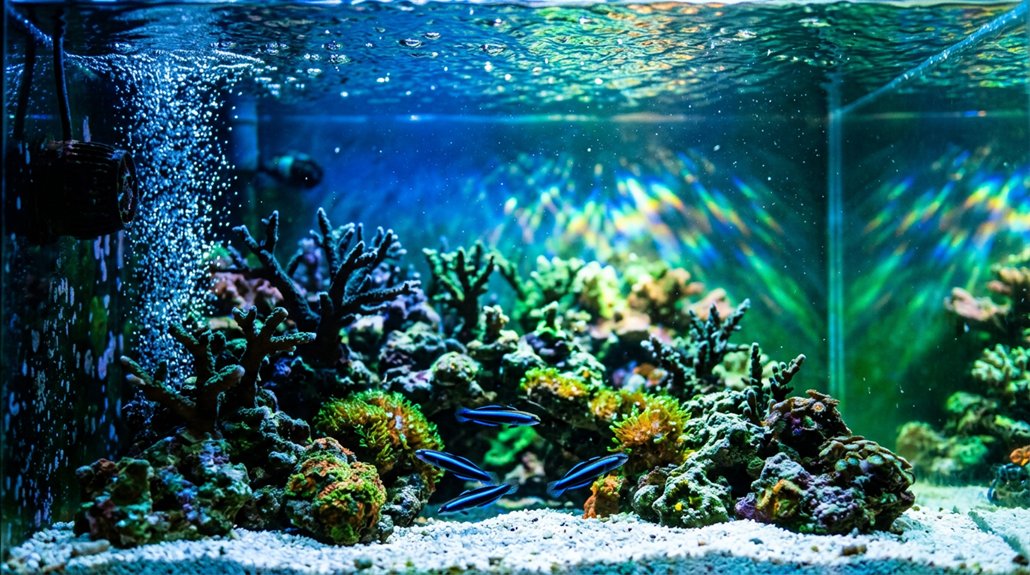
The nitrogen cycle is the biological process that keeps a saltwater tank from building up toxic waste: beneficial bacteria convert ammonia from fish waste, uneaten food, and decaying matter into nitrite, then into nitrate. You’re managing a microbial succession in which Nitrosomonas-type bacteria oxidize ammonia to nitrite, then Nitrobacter-type and related nitrite-oxidizers convert nitrite to nitrate. This process develops across oxygen gradients on rock, sand, and filter media, where nitrifiers colonize stable, well-oxygenated surfaces. A tank is considered cycled when ammonia and nitrite consistently test zero and nitrate is detectable, confirming established nitrification. Because nitrate is the end product, it’ll accumulate unless you remove it with partial water changes or other biological export methods.
How Ammonia Starts the Nitrogen Cycle
You’ll start the nitrogen cycle when ammonia from fish waste, uneaten food, and decaying organics enters the tank as NH3/NH4+. The balance between toxic NH3 and less toxic NH4+ depends on pH and temperature, so you’ll need to monitor those conditions closely. In a fishless cycle, you can target about 2–4 ppm ammonia to feed nitrifying bacteria while avoiding levels that inhibit their growth.
Ammonia Sources
Ammonia enters the cycle when organic waste begins to break down, so the first job is to establish a reliable ammonia source. In your tank, that ammonia usually comes from fish waste, uneaten food, dead shrimp, detritus buildup, and rock die off from dying live rock. During fishless cycling, you can dose pure ammonium chloride or add a measured portion of fish food every 12 hours to keep the substrate consistent. Live rock or live sand may also release ammonia as organisms die off, often creating a brief spike. Remember that ammonia exists as NH3 and NH4+; higher pH shifts toxicity toward NH3. For effective bacterial growth, keep ammonia near 2–4 ppm, since excessive levels can slow or inhibit nitrifying bacteria.
Starting The Cycle
Once ammonia enters the tank—whether from fish waste, decaying food, a shrimp piece, or dosed ammonium chloride—it provides the fuel that starts the nitrogen cycle. You should aim for about 2–4 ppm during fishless cycling, since this range feeds nitrifying bacteria without overloading them. Levels around 0.25–5.0 ppm support growth, but sustained concentrations above 5 ppm can slow development, and 10–15 ppm can become harmful. Nitrosomonas-type bacteria colonize rock, sand, and filter media, then oxidize ammonia into nitrite. Your substrate choice affects where they settle, and lighting effects are minimal because these bacteria don’t depend on light. To speed things up, you can add live rock, seeded media, or bottled nitrifiers so ammonia begins to decline sooner.
Ammonia, Nitrite, and Nitrate Stages
As the cycle progresses, the nitrogen compounds in your saltwater tank shift in a predictable order: ammonia rises first from fish waste, uneaten food, and decaying organics, and because NH3/NH4+ is highly toxic even at very low ppm, it should stay at 0 in an established tank; during a fishless cycle, though, it’s typically dosed to about 2–4 ppm to feed the developing bacteria. Next, Nitrosomonas oxidize ammonia to nitrite, so you’ll see nitrite peak after the ammonia spike. Even if your livestock shows some ammonia tolerance, nitrite inhibition still matters because NO2− remains toxic. Then Nitrobacter and related bacteria convert nitrite to nitrate, driving nitrite toward zero while nitrate accumulates. Nitrate is less toxic, but keep it below about 40 ppm in reef systems. When ammonia and nitrite both read zero, your tank’s biologically cycled.
Why the Nitrogen Cycle Matters in Saltwater Tanks
What the ammonia, nitrite, and nitrate readings tell you is more than just where your tank stands in the cycle—they determine whether your fish and corals can live safely in it. Ammonia and nitrite are acutely toxic, so you need them at 0 ppm before stocking heavily. In a mature saltwater system, nitrifying bacteria in live rock, live sand, or seeded media convert waste into nitrate, which is less toxic but still must stay controlled. Keep nitrate below about 40 ppm for reef stability, especially with coral sensitivity. Your substrate buffering can help stabilize chemistry, but it doesn’t replace bacterial processing. Regular testing shows whether the cycle is complete and whether partial water changes are needed to reduce nitrate. Patience matters because stabilization takes time.
How to Start a Fishless Cycle
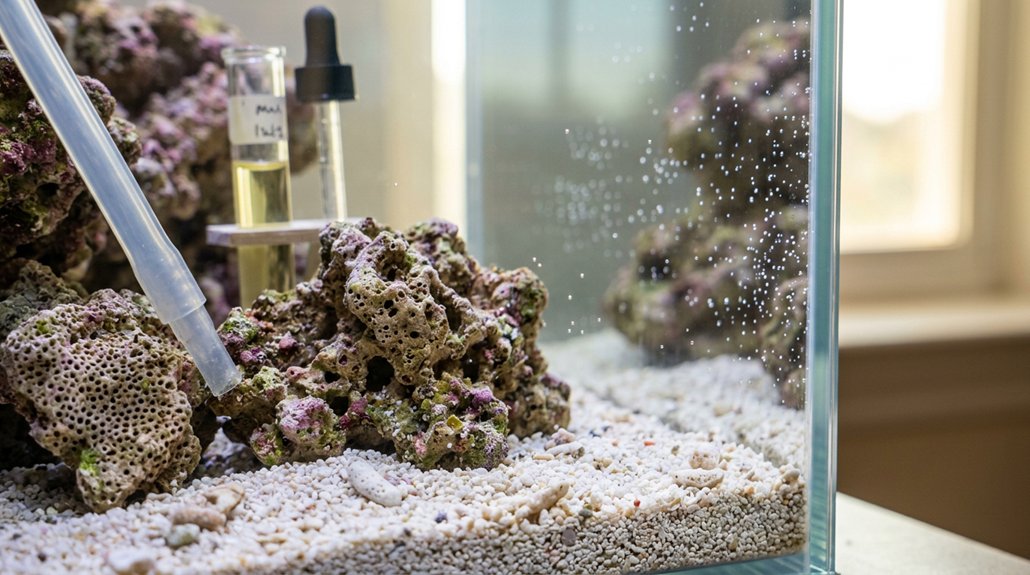
Start by adding an ammonia source to the tank, such as 100% pure aquarium-safe ammonium chloride or a small piece of shrimp, and aim for about 2–4 ppm while keeping it below 5 ppm. If you want to shorten the cycle, you can also add a bottled nitrifying bacteria product or seed the tank with established filter media, live sand, or rock. Then test ammonia every few days and nitrite after about a week, and keep going until both read zero and nitrate is present.
Start Ammonia Source
To kick off a fishless cycle, dose a pure ammonia source such as 100% ammonium chloride or unscented household ammonia with no surfactants until you reach about 2–4 ppm. This gives nitrifying bacteria substrate without exposing fish to toxic waste. If you’re using dry rock, expect a slower start; live sand can add trace ammonia and seed bacteria from die-off.
| Source | Effect | Note |
|---|---|---|
| Ammonium chloride | Precise | Best control |
| Household ammonia | Fast | Verify purity |
| Dry fish food | Organic | Decomposes gradually |
If you add bottled bacteria, keep ammonia present so they can establish. Test every few days; if levels climb above 5 ppm, dilute or change water to keep growth on track.
Add Bacterial Booster
Add a commercial nitrifying bacteria product, such as Dr. Tim’s One & Only, Fritz-Zyme TurboStart, or Brightwell MicroBacter7, at the label dose for your tank volume. This seeds Nitrosomonas and Nitrobacter during your fishless cycle and shortens startup. Keep your ammonia source near 2–4 ppm so the culture has substrate, then redose bacteria as directed, often weekly or after water changes. Under dosing can slow establishment; overdosing is usually safe if you follow instructions and respect bacterial shelf life. Use this workflow:
- Dose bottled bacteria at startup.
- Maintain ammonia input consistently.
- Add live rock, seeded media, or borrowed gravel for faster colonization.
Probiotic alternatives can help, but you still need test kits to track progress.
Test Until Zero
Begin your fishless cycle by dosing a controlled ammonia source, such as pure ammonium chloride or a small amount of fish food every 12 hours, until the tank tests at about 2–4 ppm ammonia; this gives nitrifying bacteria enough substrate to establish. Use reliable liquid test kits, and set your test frequency to every few days at first. Once ammonia starts dropping, begin checking nitrite too. Expect an ammonia peak, then a nitrite peak within 1–3 weeks. Follow maintenance schedules that keep ammonia near 2–4 ppm until both ammonia and nitrite read zero on repeated tests. When nitrite hits zero and nitrate appears, change 20–30% of the water. Confirm ammonia and nitrite stay at zero for 2–3 consecutive tests before adding livestock slowly, with 1–2 week intervals.
Best Test Kits for Cycling
For reliable cycling results, you’ll want a liquid master test kit that measures ammonia, nitrite, nitrate, and pH, since these are the core parameters that track the nitrogen cycle in a saltwater tank. For most tanks, API Master Test Kit handles basic monitoring, while Hanna or Triton photometers improve accuracy.
- Test ammonia and nitrite every few days during cycling.
- Prefer kits with 0.25–0.5 ppm resolution for low-level readings.
- Use digital photometers or continuous monitors if you need repeatable, automated data.
Keep reagents in date and stored correctly. If a result looks off, confirm it with a second kit or ICP before changing water or adding livestock. Once nitrite drops, begin nitrate checks and continue weekly manual testing for steady verification.
How to Test Ammonia, Nitrite, and Nitrate
Test ammonia every few days during cycling with a reliable liquid master kit, since precise readings are critical for tracking bacterial growth in a saltwater tank. Use colorimetric comparison carefully; strips can drift, so liquid reagents and sensor calibration checks give you tighter control.
| Test | Target timing |
|---|---|
| Ammonia | Every few days; keep fishless ammonia near 2–4 ppm, then track it to zero. |
| Nitrite | Start about a week after ammonia appears; watch for a peak, then zero. |
| Nitrate | Begin when nitrite drops; confirm conversion and note when it rises. |
Record all three readings together. Once ammonia and nitrite stay at zero for 2–3 consecutive weeks, you’ve verified stable nitrification. Keep nitrate under about 40 ppm during cycling by monitoring, not guessing.
When to Change Water During Cycling
You should change water during cycling when ammonia climbs above about 5 ppm, or when nitrite has dropped to zero and nitrate is starting to accumulate. Use partial changes only, typically 20–30% at a time, and match the replacement saltwater for salinity and temperature so you don’t shock the biofilter. Once nitrate becomes detectable in a fishless cycle, a 30% change can reset nitrogen levels, and you’ll keep doing routine changes later whenever nitrate rises above about 40 ppm.
Watching Nitrate Levels
Once nitrite drops, nitrate will usually rise, so keep testing ammonia, nitrite, and nitrate weekly during cycling, then more often as nitrite declines. You’re watching for nitrate to stay below about 40 ppm in reef tanks; many reefkeepers target under 20 ppm for sensitive corals. Use the results to guide algae control and nutrient export.
- If nitrate climbs above 40 ppm, do a partial water change of 20–30%.
- Keep the change moderate so you don’t disrupt established bacteria.
- After ammonia and nitrite stay at zero, change 20–30% before adding livestock.
Regular, moderate water changes plus skimming, macroalgae, deep sand, or live rock help prevent repeated nitrate spikes that can stress fish and corals.
Water Change Timing
As nitrate climbs during cycling, water changes become a tool for controlling toxicity without slowing the biofilter’s establishment. Use water change timing when nitrate tops about 40 ppm or ammonia exceeds roughly 0.5 ppm; then replace 10–20% of volume. Keep seasonal timing in mind only for practical handling, not the cycle itself.
| Trigger | Action | Goal |
|---|---|---|
| Nitrate >40 ppm | Partial change | Lower waste |
| Ammonia >0.5 ppm | Partial change | Reduce toxicity |
| Cycle complete | 20–30% change | Prep livestock |
Match temperature, salinity, and pH during fish-in cycling, and avoid frequent swaps that strip media-bound bacteria. If you must clean filter media, rinse it in tank water only. After ammonia and nitrite read zero for 2–3 weeks, a larger reset helps before stocking.
Safe Change Percentages
During cycling, keep each water change modest—generally 20% to 30% or less per event—to reduce ammonia or nitrate without stripping too much beneficial bacteria. When livestock are present, stay at 20% or below so salinity, temperature, and pH don’t swing hard.
- If ammonia climbs above ~5 ppm or nitrite spikes, change 20% immediately and repeat as needed.
- In fishless cycling, once nitrates appear and the cycle’s confirmed, do a 30% change before adding animals.
- After cycling, use 10%–20% weekly or 20%–30% biweekly to keep nitrates under 40 ppm.
Watch for salt creep and substrate turnover, since both can alter water quality and mask trend data during testing.
When Is a Saltwater Tank Fully Cycled?
A saltwater tank is fully cycled when test results consistently show 0 ppm ammonia and 0 ppm nitrite, with nitrate present, confirming that nitrifying bacteria are converting waste through the full ammonia → nitrite → nitrate pathway. You should verify stability with consecutive zero readings for at least 2–3 weeks, not just a single test. Once nitrite stays undetectable and nitrate appears, the biofilter is established. Continue weekly testing, because equipment upgrades, lighting impacts, or other system changes can alter biological demand. Before adding sensitive fish or corals, do a 20–30% water change to reduce nitrate. Then stock slowly, one or a few animals at a time, with 1–2 weeks between additions so bacterial populations can adjust without triggering ammonia or nitrite spikes.
How to Add Fish After Cycling
Once your saltwater tank has stayed at 0 ppm ammonia and 0 ppm nitrite for 2–3 consecutive weeks and nitrate is present, you can begin adding fish slowly. Follow strict quarantine procedures before transfer, then use careful fish acclimation to reduce stress.
- Add one small fish, or one or two very small species, at a time.
- Wait 1–2 weeks between additions so nitrifying bacteria can expand with the new bio-load.
- Choose hardy, captive-bred species first, such as clownfish, and test ammonia, nitrite, and nitrate after each addition.
If ammonia or nitrite appears, or nitrate rises above about 40 ppm, do a partial water change of 20% or less. If you’ve used bottled bacteria or seeded media, still test frequently; don’t assume instant capacity.
Frequently Asked Questions
Can Fish Survive the Nitrogen Cycle?
Yes, but only if you keep ammonia and nitrite near zero with frequent testing, water changes, and careful stocking strategies. Beneficial bacteria must establish first; otherwise, you’ll expose fish to toxic spikes and losses.
How to Tell When a Nitrogen Cycle Is Done?
You’ll know your cycle’s done when ammonia and nitrite stay at 0 ppm for 2–3 weeks, while nitrate’s detectable. After ammonia spikes and bacterial succession, keep testing; stable readings mean you’re ready.
How to Speed up the Nitrogen Cycle in a Tank?
You can speed it up by seeding live rock or bio media, dosing bottled bacteria, keeping ammonia around 2–4 ppm, maintaining 80–82°F with strong oxygenation, and testing often; don’t let levels spike.
Conclusion
Your saltwater tank’s nitrogen cycle is the engine that keeps toxic waste from building up. Like a clean-up crew working behind the scenes, beneficial bacteria convert ammonia to nitrite, then nitrate, making the aquarium safe for fish. You need to monitor water parameters, perform water changes when needed, and wait until ammonia and nitrite stay at zero. Once the cycle’s complete, you can add fish slowly and keep your system stable.