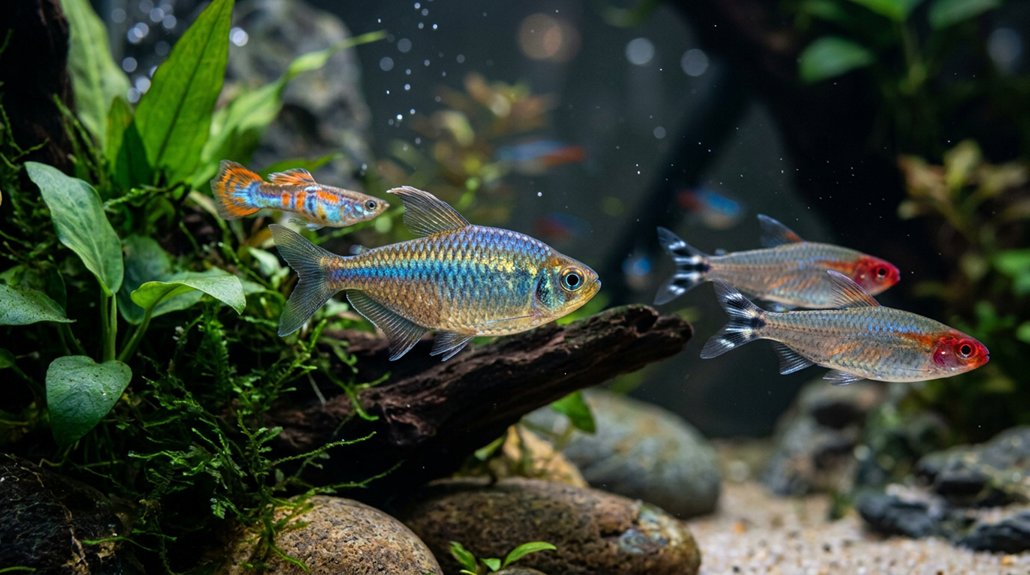
Your fish may be stressed if you notice rapid or erratic swimming, darting, surface hovering, gasping, hiding, loss of appetite, faded color, torn fins, or isolation from the group. Check breathing, because rapid gill movement and mouth-at-surface gasping are urgent signs. Then test ammonia, nitrite, pH, temperature, and dissolved oxygen right away. Fix low oxygen, unstable temperature, overcrowding, or aggression quickly, and quarantine sick fish if needed. More clues can help you narrow the cause.
Key Takeaways
- Rapid, erratic swimming, surface gasping, or hovering near the top often signals acute distress or low oxygen.
- Loss of appetite, refusing preferred foods, or eating only when alone can indicate stress from social conflict or illness.
- Hiding more than usual, isolation from the group, or sudden schooling changes often mean your fish feel threatened or unwell.
- Torn fins, ulcers, white spots, or faded color suggest aggression, disease, or chronic stress.
- Check ammonia, nitrite, temperature, pH, and dissolved oxygen immediately when stress signs appear.
What Fish Stress Signs Look Like
Fish can show stress in several clear, observable ways. You’ll often notice behavioral cues first: rapid, erratic, or darting swimming; sudden shifts from a species’ normal pattern; reduced feeding; or hiding more than usual. Aggression from tankmates can also accompany these changes. Physiological indicators may include persistent surface gasping, staying near the top, rapid opercular movements, pale or faded coloration, and loss of vibrancy. These signs can point to low dissolved oxygen, gill damage, toxic water chemistry, or elevated stress hormones. You may also see visible injuries, frayed fins, or wounds that don’t heal quickly, which suggest immune suppression and a higher risk of secondary infection. Watch for combinations of signs, since one symptom alone isn’t always diagnostic.
Check Swimming and Breathing First
You should first watch for changes in swimming, such as rapid darting, sudden erratic motion, lethargy, or lying on the side, because these often indicate water-parameter shock, disease, or chronic stress. You should also assess breathing closely; gasping at the surface or rapid opercular movement can signal low oxygen, poor circulation, or gill damage from ammonia or nitrite exposure. If either pattern changes abruptly, you’ll want to test ammonia, nitrite, nitrate, temperature, pH, and dissolved oxygen right away.
Swimming Changes
Watch swimming and breathing first, because changes here are often the earliest sign that something’s wrong. If your fish suddenly dart, pace, or abandon normal schooling dynamics, treat it as acute stress; if they grow sluggish over days, suspect chronic water-quality problems. Environmental enrichment can reduce routine stress, but it won’t mask a new illness.
| Behavior | Likely meaning | Action |
|---|---|---|
| Frantic darting | Acute stress | Check recent tank changes |
| Lethargy | Chronic issue | Test water |
| Surface hovering | Serious abnormality | Investigate immediately |
| Side-lying | Buoyancy or parameter problem | Isolate and assess |
| Pattern change | Early warning | Review all conditions |
Check temperature, pH, salinity, ammonia, nitrite, and nitrate first. If injuries or disease signs are present, quarantine the affected fish.
Breathing Distress
Rapid or labored breathing is one of the earliest and most useful stress signals to check, especially when it appears alongside changes in swimming. You’ll notice rapid opercular beats, often above the normal 20–80 breaths per minute range, when dissolved oxygen is low, ammonia or nitrite is elevated, or respiratory parasites are present. If your fish is gasping at the surface or lingering there, suspect poor circulation and low oxygen; act at once with aeration and water testing. Sudden darting, frantic swimming, or listing can follow abrupt shifts in temperature, pH, or salinity. Reddened, frayed gills suggest impaired gas exchange and possible chemical injury; gill histology can confirm damage. If lethargy, fading color, or poor appetite accompanies these signs, test parameters immediately and isolate affected fish.
Spot Appetite Loss and Hiding
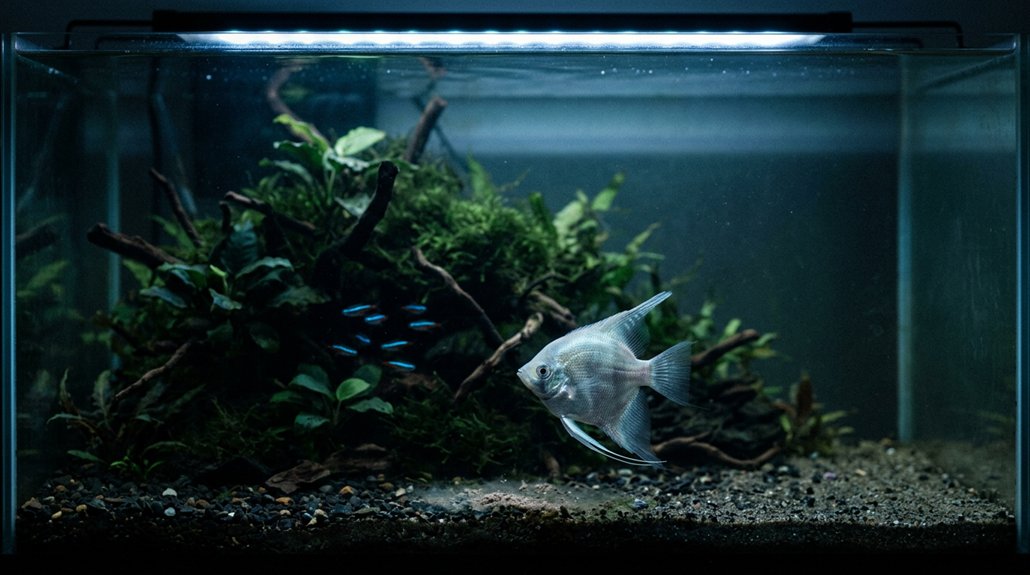
You should treat a sudden drop in feeding over 24–48 hours as a clear stress or illness sign, especially if your fish no longer eats at its usual feeding times. You may also notice selective eating, refusal of preferred foods, or a fish that only feeds when alone, which can point to social stress or an improper diet. Frequent hiding during feeding, particularly in species that normally forage openly, often signals overcrowding, aggression, inadequate cover, or poor tank conditions.
Loss Of Appetite
A sudden drop in feeding is often one of the clearest early signs of stress in fish. If your fish refuse foods they normally eat for 24–48 hours, review water quality, illness signs, and social conflict. Persistent anorexia for several days can weaken immunity, slow healing, and raise mortality risk. Adjust feeding schedules carefully, and don’t rely on dietary supplementation to mask an environmental problem.
| Observation | Likely meaning |
|---|---|
| Eats alone, not in tank | Social stress or bullying |
| Stops preferred food | Water-parameter or environmental stress |
| New fish + poor intake | Acclimation stress |
If a finicky species, such as a dragonet, suddenly rejects natural foods, suspect stress rather than pickiness. When reduced appetite occurs with lingering concealment in new arrivals, quarantine and stable tank conditions are often warranted.
Hiding Behavior Changes
Sudden or prolonged hiding is often a stress signal, especially in species that normally swim openly, such as tangs or active midwater fish. If you notice this change, check water quality, recent tank changes, and tankmate aggression first. When hiding lasts more than 24–48 hours and appetite also drops, you should suspect parasitic infection, ammonia or nitrite exposure, or social stress. Compare behavior with normal patterns: schooling fish that isolate, or solitary fish that hide constantly, aren’t acting normally. Consider nocturnal habits and substrate preferences, since some species hide by day or bury themselves; the issue is deviation from baseline. Hiding with faded color or weight loss suggests chronic stress, weakened immunity, slower healing, and higher disease risk. After new tankmates or water changes, monitor closely for acute stress.
Read Color Changes and Body Damage
Color changes and visible body damage can reveal a great deal about fish stress. If your fish look paler or faded, think beyond color genetics or pigment disorders; elevated stress hormones often cause this shift. A sudden loss of vibrancy after a tank change usually points to water-chemistry or temperature stress, not natural color cycling. Don’t confuse diffuse fading with white pinpoint spots on the skin or fins, which are classic ich lesions and need prompt treatment. Inspect for torn fins, ulcers, or open wounds; these injuries raise stress and increase secondary bacterial or fungal infection risk, so quarantine’s appropriate. If discoloration persists, fins don’t regrow, or lesions remain, chronic stress, poor diet, or suboptimal water quality may be suppressing immune function.
Watch for Gasping at the Surface
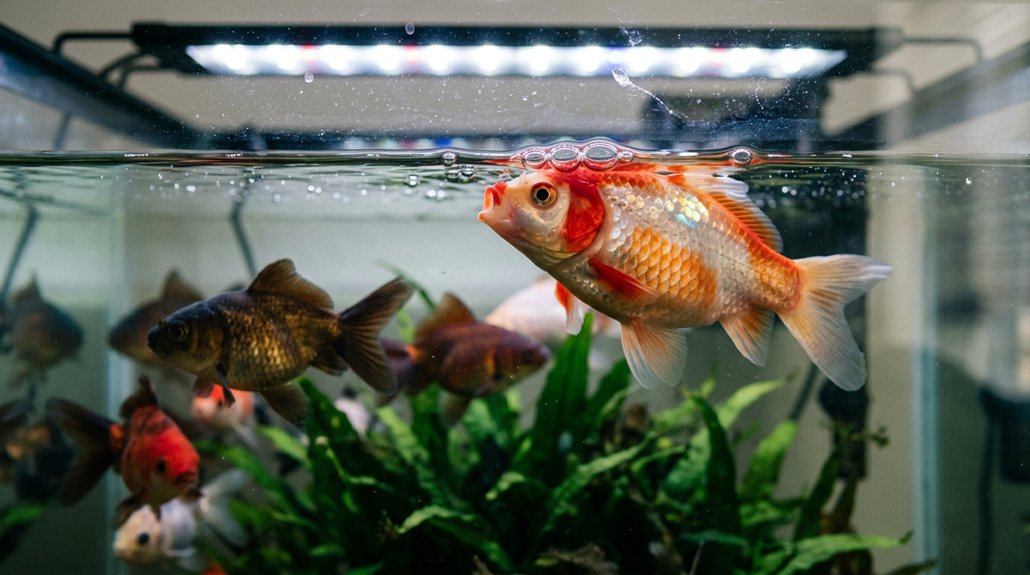
Another clear warning sign is gasping at the surface: if your fish stay at the air-water interface with their mouths working hard, suspect low dissolved oxygen or impaired gill function and check water quality right away. You should test ammonia, nitrite, pH, and temperature immediately, because abrupt tank changes can trigger oxygen drops, toxic spikes, or temperature stress. Warm water holds less oxygen, so compare the reading with your species’ preferred range. Rapid opercular movement means severe respiratory distress and may reflect ammonia burn or parasites. Increase aeration or surface agitation, and do a partial water change while you investigate. Watch for surface mucus or nocturnal surfacing, since both can accompany chronic oxygen stress and tell you the problem isn’t resolving.
Notice Aggression or Social Withdrawal
Watch for changes in behavior between tankmates: rising chasing, nipping, or prolonged fin-tucking often points to territorial aggression and stress, especially if you see repeated attacks or torn fins. You should also note social withdrawal in fish that normally school or interact; if one starts hiding constantly or sitting alone near the bottom, that’s a clear distress signal. Poor group dynamics, too few schooling fish, or incompatible introductions often trigger both aggression and retreat. After rearranging the tank or adding new fish, check whether a specific individual stops feeding while others eat; targeted refusal can indicate bullying. In breeding aggression, minor injuries may persist, with nicked fins or scale loss failing to heal. If these signs continue, separate or rehouse the affected fish promptly.
Check Water Quality for Hidden Stress
You should test ammonia and nitrite immediately if your fish act abnormally, because even trace levels can cause respiratory distress and stress. Check pH, salinity, temperature, and dissolved oxygen together, since rapid shifts or low oxygen can trigger acute stress, especially when warmer water holds less oxygen. Keep these water parameters stable and within species-appropriate ranges to reduce hidden, ongoing stress.
Ammonia and Nitrite Levels
Test ammonia and nitrite any time a tank is new, recently cleaned, or recently medicated, because unstable biological filtration can quickly expose fish to hidden stress. You should use reliable kits to measure total ammonia, pH, and nitrite together, since pH and temperature change the un-ionized fraction and affect ammonia detoxification. In healthy biological nitrification, ammonia should stay at 0 ppm; even 0.02 ppm NH3 can injure gills, and 0.5 ppm total ammonia-nitrogen often causes obvious distress. Nitrite should also remain at 0 ppm; levels above 0.2–0.5 ppm can cause brown blood, rapid breathing, lethargy, and surface gasping. After changes, test daily until stable, then correct problems with water changes and biofilter support. Chronic exposure can fade color, suppress appetite, and slow wound healing.
Stable pH and Salinity
Even when ammonia and nitrite read zero, fish can still be stressed by unstable pH or salinity. You should do pH monitoring daily after setup, then weekly in mature tanks, because a 0.5-unit swing can disrupt gill function and metabolism. Maintain Salinity stability within species-specific limits; many marine fish need 1.025 ±0.002 specific gravity, and rapid shifts trigger osmoregulatory stress. Treat tap water for chlorine or chloramine before use, since untreated water can also alter pH and hardness. Avoid large or frequent water changes that change parameters abruptly; use 10–20% weekly and match new water within measured tolerances. Undersized or immature filters can let drift develop, so monitor pH, specific gravity, ammonia, nitrite, and nitrate to catch hidden stress early.
Temperature and Oxygen Checks
When fish are stressed, hidden water-quality problems often show up first in breathing and swimming behavior, so check temperature and oxygen immediately. Watch for rapid gill movement or surface gasping; these signs often mean dissolved oxygen is low. Use oxygen meters to confirm DO, and treat values below 4 mg/L as urgent; most tropical fish need above 5 mg/L. Check temperature with a reliable thermometer, because a 2–3°C shift can trigger thermal stress. Keep many tropical community fish near 24–27°C. Test ammonia and nitrite too; any detectable amount can worsen gill damage. Reduce heat gradually, increase aeration, correct low flow, and inspect for thermal stratification that traps warm, oxygen-poor layers. Visible surface movement should restore circulation and oxygen exchange.
Fix Temperature, Oxygen, and Flow
If fish are gasping at the surface or lingering in the upper layer, dissolved oxygen is likely too low, so increase aeration and surface agitation with an air stone or powerhead and aim for DO above 6 mg/L for most tropical species. Keep temperature stable within ±1°C of the preferred range; verify heater placement with a thermometer, and use aeration redundancy if water warms.
- Match flow to species behavior.
- Provide calm zones for slower fish.
- Cool only gradually, no more than 1°C per hour.
Warmer water lowers oxygen and increases demand, so boost circulation when temperatures rise. After water changes, match replacement water for temperature and salinity, then add it slowly to reduce shock. Strong, filtered flow suits open-water swimmers; gentler flow prevents exhaustion in reef species.
Review Tank Size and Stocking Levels
Overstocking can quickly tip a tank from stable to stressful, so review whether your fish have enough species-appropriate space rather than relying on gallons-per-fish alone. Your stocking density should reflect behavior, not just water volume. A cramped tank layout can limit schooling and intensify territorial conflict.
| Species | Minimum size | Notes |
|---|---|---|
| Clownfish | 30 gal | Small groups, moderate swimming space |
| Tangs | 70+ gal | High-swim demand, often larger systems |
| Large tangs | 250+ gal | Need extensive open area |
Use these minimums as a baseline, then adjust for décor, breeding zones, and active swimmers. If you see lethargy, hiding, or persistent injuries, your tank may be too crowded. Higher density also raises ammonia and nitrite risk, so reduce numbers or increase maintenance.
Use Quarantine to Prevent Worsening Stress
To prevent stress from escalating, quarantine new or sick fish in a separate tank for at least 2–4 weeks. This limits transport stress and keeps disease from entering your main aquarium. Follow quarantine protocols with a dedicated heater, sponge filter, and hiding places so you can stabilize water quality and reduce aggression.
- Match tank size to species needs.
- Check appetite, gill rate, and spots daily.
- Keep ammonia and nitrite near zero.
Measure ammonia, nitrite, nitrate, pH, and temperature each day. Use small 10–20% water changes every 2–3 days to avoid sharp swings. Don’t medicate unless you’ve confirmed a problem such as ich; some drugs can crash beneficial bacteria in small quarantine systems and worsen stress.
Frequently Asked Questions
How to Fix a Stressed Fish?
Test water, correct ammonia, nitrite, pH, and temperature, then do partial water changes and boost aeration. You’ll improve diet, reduce overcrowding, quarantine sick fish, and monitor daily until breathing, appetite, and behavior normalize.
How Long Does Stress Last in Fish?
Stress duration can be hours to years: about 70% of acute cases resolve in 1–3 days if you act fast. Your recovery timeline depends on cause; chronic stress won’t fade without correcting water, tankmates, or toxins.
Can a Stressed Fish Recover?
Yes, your stressed fish can often recover if you correct water quality, stabilize temperature, and improve aeration. Good husbandry supports immune response, and targeted behavioral therapy, plus quarantine, can help healing within days to weeks.
How to Tell if Fish Are Stressed in a Tank?
You can tell your fish are stressed by observing rapid color fading, erratic surfacing, darting, rubbing, hiding, or refusal to eat. Your theory is likely correct if these signs persist; test water and watch gill movement closely.
Conclusion
If you watch your fish closely, you can catch stress before it becomes a serious problem. Sluggish swimming, rapid breathing, loss of appetite, hiding, color changes, and surface gasping all signal that something is wrong. Test water quality, correct temperature, oxygen, and flow, and confirm your tank isn’t overcrowded. Quarantine new or affected fish when needed. With prompt action, you can restore balance before your aquarium feels like a pressure cooker.