
Your puppy might ignore commands due to distractions, unfamiliar environments, or inconsistent training methods. Puppies often struggle to focus when overwhelmed by sounds and smells. It’s essential to tailor techniques to their personality, offering gentle encouragement to shy puppies and interactive games for energetic ones. Guarantee positive reinforcement and consistent practice in various settings to solidify command associations. Recognizing emotional cues can enhance training effectiveness. Discover ways to better communicate with your furry friend.
Key Takeaways
- Puppies may ignore commands due to overwhelming stimuli like unfamiliar sounds and smells.
- Inconsistent reinforcement or delayed rewards might confuse puppies and weaken command compliance.
- Lack of focus could result from training in overly stimulating environments.
- Ignoring personality traits may lead to ineffective training methods and reduced responsiveness.
- Emotional overload from fear or anxiety can decrease a puppy’s ability to follow commands.
Understanding Puppy Learning and Environmental Distractions
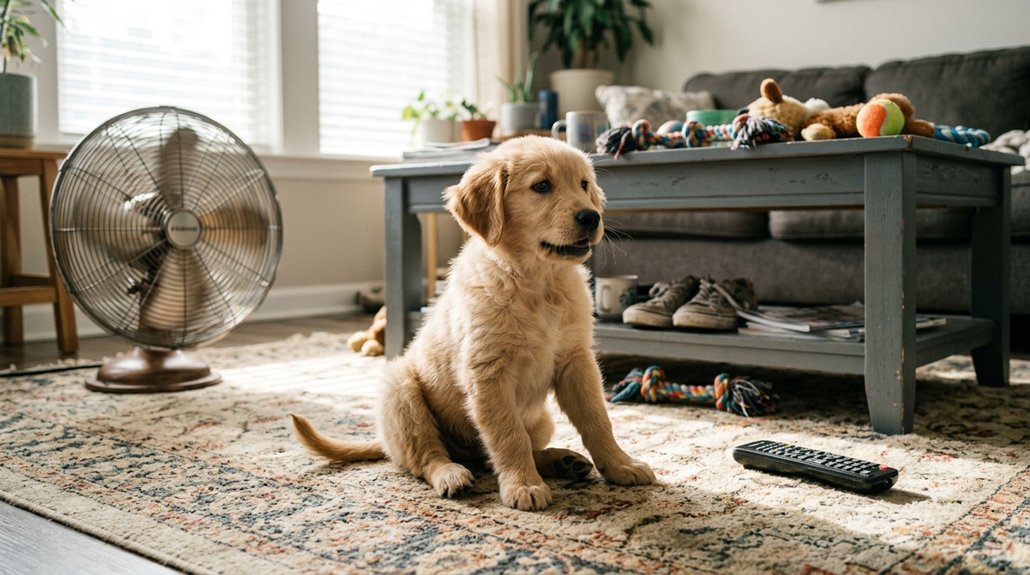
When training your puppy, understanding their learning process and how environmental distractions play a role is vital. Puppies often ignore commands because overwhelming stimuli, like sounds and smells, capture their focus. Developing effective focus techniques is key. Start with familiar, quiet spaces, gradually introducing more challenging environments. Reward their small attentiveness gestures, reinforcing the ability to filter distractions and hone in on your presence.
Distraction management involves recognizing elements that trigger anxiety or excitement, such as unfamiliar surroundings. Competing noises like lawnmowers or barking dogs can overload their senses. To combat this, patience is vital. Consistent, positive reinforcement helps them adjust. Empower your puppy by creating progressive learning stages. Celebrating incremental successes builds confidence, allowing focus even amidst chaos.
Adapting Training to Puppy Personality Traits
Recognizing how environmental distractions affect your puppy is only one piece of the training puzzle; understanding their unique personality traits is just as important. Tailored methods start with a thorough personality assessment, focusing on individual differences. Puppies with energetic engagement needs might love training variations such as interactive games. Meanwhile, a shy pup may require gentle reinforcement and bonding techniques to build confidence. Here are three strategies to take into account:
- Energetic Engagement: For high-energy breeds, use interactive toys or exploration play to hold their attention.
- Gentle Reinforcement: Offer calming encouragement for sensitive puppies needing a boost in confidence.
- Training Variations: Explore different methods for curious pups to keep them intrigued and focused.
Encouraging Command Compliance Through Positive Reinforcement
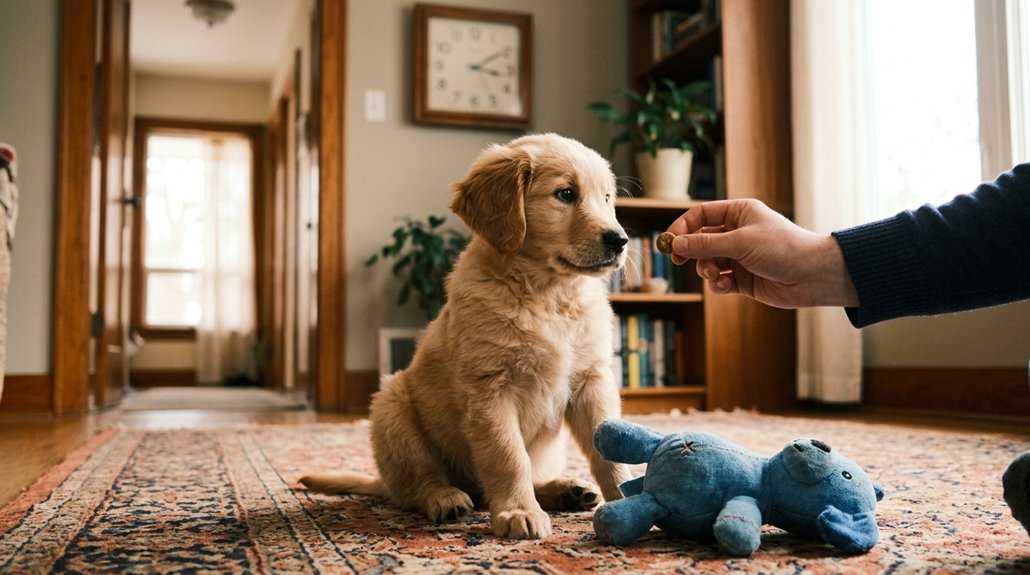
Positive reinforcement is a cornerstone technique for encouraging command compliance in puppies. To make this method effective, use a reward variety, such as high-value treats and enthusiastic praise, which motivates them and fosters positive associations. The timing of your treat is critical; deliver rewards immediately after they obey to reinforce the desired behavior clearly. By consistently celebrating their successes, you strengthen your bond, ensuring they stay engaged and learn commands quickly. Introducing gradual difficulty in training helps your pup generalize commands across different environments while maintaining consistency in rewards. Focus more on rewarding good behavior rather than on punishments, and you’ll find that your puppy responds better to commands, transforming training sessions into enjoyable experiences for both of you.
Maintaining Positive Command Associations
To guarantee your puppy keenly responds to commands, focus on reinforcing positive connections by consistently using rewarding strategies like treats and praise. Be mindful of avoiding any negative experiences attached to commands, as this can create reluctance and “poisoned cues.” Don’t forget to adjust your rewards to match the environment, ensuring they remain enticing, while also being cautious not to overuse commands, which can lead to them being ignored.
Reinforce Positive Command Connections
When shaping your puppy’s behavior, reinforcing positive command connections is essential to nurturing long-term compliance. To achieve this, consider:
- Reward Variety: Utilize a mix of high-value treats and enthusiastic verbal praise to keep your puppy engaged. Different rewards maintain their interest and make them more responsive.
- Timing Importance: Deliver rewards immediately after your puppy successfully follows a command. Quick reinforcement strengthens the association between the behavior and its positive outcome, enhancing learning retention.
- Consistent Practice: Regularly use positive reinforcement in various settings. This consistency helps your puppy associate commands with positive outcomes even amid distractions, ensuring they remain reliable in different environments.
Avoid Negative Associations
Ensuring your puppy forms positive associations with commands is essential for effective training and long-term obedience. Commands followed by positive reinforcement prevent poisoned cues, which occur when commands are linked to negative experiences. Such cues can seriously undermine your puppy’s willingness to comply, making training efforts fruitless. By immediately rewarding your puppy with treats or praise upon command execution, you enhance emotional impact in a favorable way. Gradually desensitizing puppies to possible negative triggers while maintaining rewarding practices fosters a positive environment untainted by stress or anxiety. This thoughtful approach encourages your puppy’s desire to adhere to commands, ensuring consistent obedience over time.
| Positive Action | Avoidance Tactic | Emotional Impact |
|---|---|---|
| Reinforcement | Avoid punishment | Positive emotions |
| Treats/Praise | Eliminate triggers | Compliance |
| Rewarding Cycle | Stress Reduction | Long-term benefits |
Consistent Reward Strategies
Building on the importance of fostering positive associations with commands, implementing consistent reward strategies solidifies your puppy’s obedience and enthusiasm for learning. When you’re training, focus on the immediacy and desirability of rewards such as treats or praise. Your puppy will respond better when reinforcements are prompt and satisfying.
- Reward types: Varying between treats, toys, and affection keeps training exciting. High-value rewards are especially effective in distracting environments.
- Training timing: Offer rewards immediately after the desired behavior. Delays might confuse your pup about which action is being reinforced.
- Celebrate successes: Regularly acknowledge small achievements. This ongoing reinforcement strengthens the command and positive experience link, bolstering long-term obedience.
A thoughtful approach to rewards guarantees that your puppy learns effectively.
Ensuring Command Consistency Everywhere
To guarantee your puppy reliably responds to commands, it’s essential to practice in various environments. Start in a calm area and gradually introduce more distractions, keeping your commands and gestures consistent across locations. This approach helps your puppy understand what’s expected, whether at home or in a busy park.
Establishing Consistent Training Environments
When training your puppy, establishing consistent environments is critical for developing reliable command obedience. Puppies often struggle with commands in new places, as they fail to generalize what they’ve learned in familiar settings to areas with varying distraction levels. To enhance your puppy’s responsiveness, consider these steps:
- Start Training in Low-Distraction Locations: Begin in quiet, familiar areas where your puppy can focus without overwhelming stimuli.
- Gradually Introduce Diverse Training Locations: Slowly expose your puppy to different environments, steadily increasing distraction levels to build confidence and adaptability.
- Ensure Command Consistency and Reward: Use consistent commands and rewards, regardless of the surroundings, to reinforce your puppy’s understanding.
Ensuring Reliability Across Locations
Although your puppy might master commands at home, achieving command consistency in various locations poses a unique challenge. Dogs don’t always generalize commands from familiar settings to those filled with distractions. Begin training in low-stimulus areas, then gradually introduce real world practice into diverse environments. This progression enhances adaptability and understanding across settings. Incorporate social training by involving different friends during sessions so your pup can respond to various voices and contexts. Distraction management is key; regular practice in places like parks or on walks will guarantee your dog responds outside controlled settings. Always apply consistent reinforcement and rewards, regardless of the location. This approach strengthens your dog’s reliability in listening to commands in diverse circumstances.
Addressing Mental and Emotional Challenges in Training
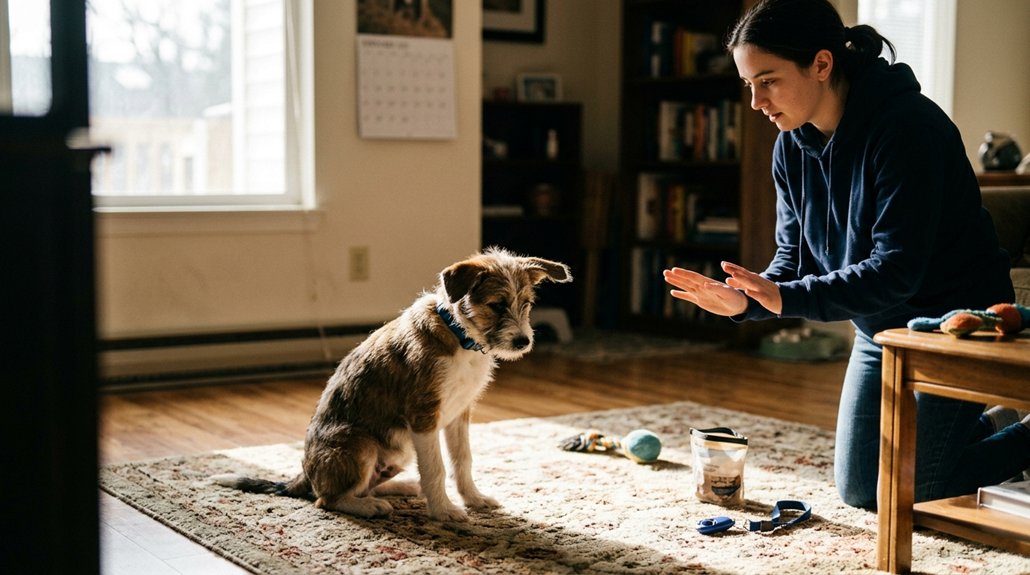
Recognizing and addressing the mental and emotional challenges in your puppy’s training is essential for successful behavior development. Puppies can experience emotional overload, struggling to focus in environments rich with loud noises and unfamiliar scents. Here’s how to tackle these challenges:
- Read the Body Language: Observing your puppy’s body language helps identify signs of fear, anxiety, or excitement, allowing you to adjust training based on their emotional state.
- Increase Reward Value: Using higher-value reinforcers can sustain your puppy’s focus, effectively combating the lure of distractions.
- Employ Desensitization Techniques: Gradual exposure to feared stimuli with counter-conditioning can help your puppy manage anxiety, improving command compliance.
Approaching training with patience and understanding guarantees a more productive, responsive experience for both you and your puppy.
Frequently Asked Questions
Why Does My Puppy Ignore My Commands?
Your puppy’s ignoring commands might be due to distractions, inconsistent puppy training, or unclear behavior cues. Be patient and consistent with cues and rewards. Understand your puppy’s emotional state and adapt your approach to enhance learning.
What Is a Red Flag Puppy’s Behavior?
If your puppy acts like it’s gained a mind sharper than Einstein’s, beware! Exhibiting extreme independence or ignoring training consistency can signal a red flag. Consistent training helps them understand boundaries while nurturing their growth confidently.
What Is the 7 7 7 Rule for Puppies?
The 7 7 7 Rule for puppy training suggests practicing commands for seven minutes, seven times a day, over seven days. This guarantees command consistency, capitalizes on your puppy’s attention span, and fosters effective learning and obedience.
What Are the 4 Signs Your Dog Thinks of You as a Parent?
Your dog thinks of you as a parent when it seeks your comfort in distress, follows you everywhere, shows separation anxiety, and engages in bonding activities like playful interactions. Using consistent training techniques strengthens this parent-like bond.
Conclusion
So, your puppy’s ignoring commands like a seasoned teenager? Welcome to the prestigious club of perplexed puppy parents! Remember, mastering the art of puppy training is akin to deciphering a cryptic crossword puzzle—frustrating, yet absurdly rewarding. With patience, and perhaps a touch of humor, you’ll sculpt your furry bundle of chaos into an obedient companion. Just keep calm, carry treats, and embrace the chaos. After all, you didn’t think a dog would be easier than quantum physics, did you?