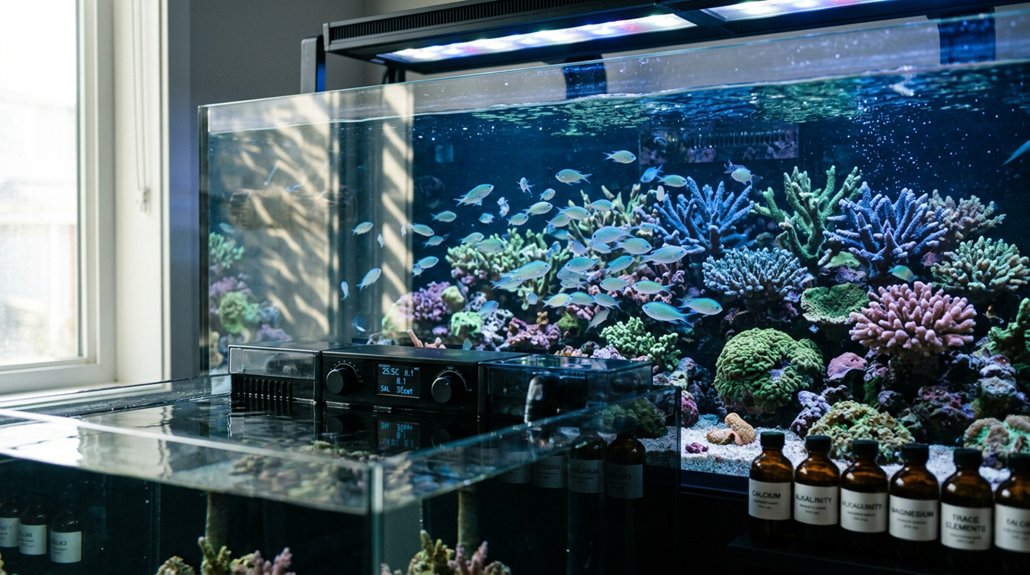
Keep your saltwater aquarium stable by holding temperature at 77–80°F with tiny daily swings, salinity near 1.026 SG, and alkalinity between 8–11 dKH. Test alkalinity, calcium, nitrate, and phosphate at least weekly, log every result, and make only small dosing or top-off changes. Match new saltwater to tank temperature and salinity before water changes, and leave lighting and flow settings alone. A steady routine keeps the system predictable, and there’s more to refine.
Key Takeaways
- Test and log alkalinity, calcium, nitrate, phosphate, salinity, and temperature weekly to catch trends early.
- Keep temperature at 77–80°F with minimal daily swings, using heaters, controllers, and backup redundancy.
- Maintain salinity near 1.026 SG with RO/DI top-off, a reliable ATO, and calibrated refractometer checks.
- Make changes slowly: adjust only one parameter at a time, and correct alkalinity in small daily increments.
- Use consistent maintenance, lighting, and flow schedules, plus regular water changes and equipment calibration.
What Makes Reef Tank Water Stable?
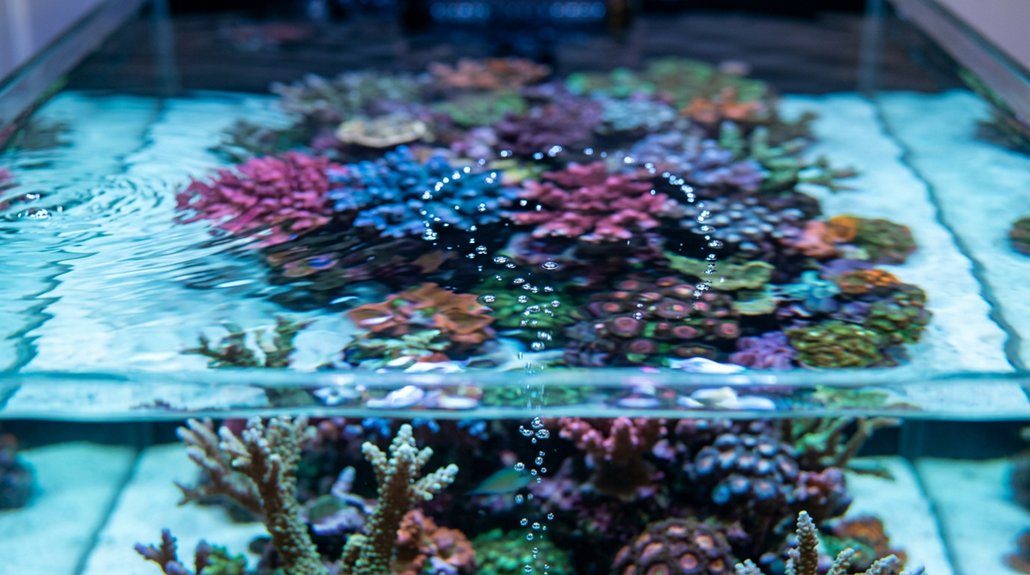
Reef tank water is stable when you keep the core parameters—temperature, salinity, alkalinity, calcium, and magnesium—within narrow target ranges and make only slow, deliberate adjustments. You should hold salinity near 1.026 SG, alkalinity at 8–11 dKH, calcium at 390–425 ppm, and magnesium around 1300–1400 ppm. Test and log these values weekly, and check temperature and salinity more often so you can spot trends before they become swings. Use small, consistent maintenance, including 15–20% weekly water changes and predictable dosing, to keep nutrients and trace elements steady. Your equipment layout should support redundancy: an ATO with safety shutoff, a quality refractometer, and maintained skimmer or reactor. This protects microbial balance and prevents sudden instability.
Keep Reef Tank Temperature Stable
Keep your tank temperature steady at 77–80°F (25–27°C), with daily swings no greater than about ±0.5–1.0°F, because even small fluctuations can stress corals and fish. Use an external temperature controller, and set your heaters a few degrees above the target so the controller can act as a fail-safe. For heater redundancy, run multiple heaters in separate sump zones to distribute heat evenly and reduce single-point failure risk. Pay attention to probe placement: put the controller sensor in a high-flow area away from heater outputs. Verify temperature with two independent thermometers or a backup thermometer alongside the controller probe. Before water changes, warm new water to within 1–2°F of tank temperature. Check equipment regularly, and keep a backup heater on a separate circuit or an aquarium-grade UPS.
Keep Reef Tank Salinity Stable
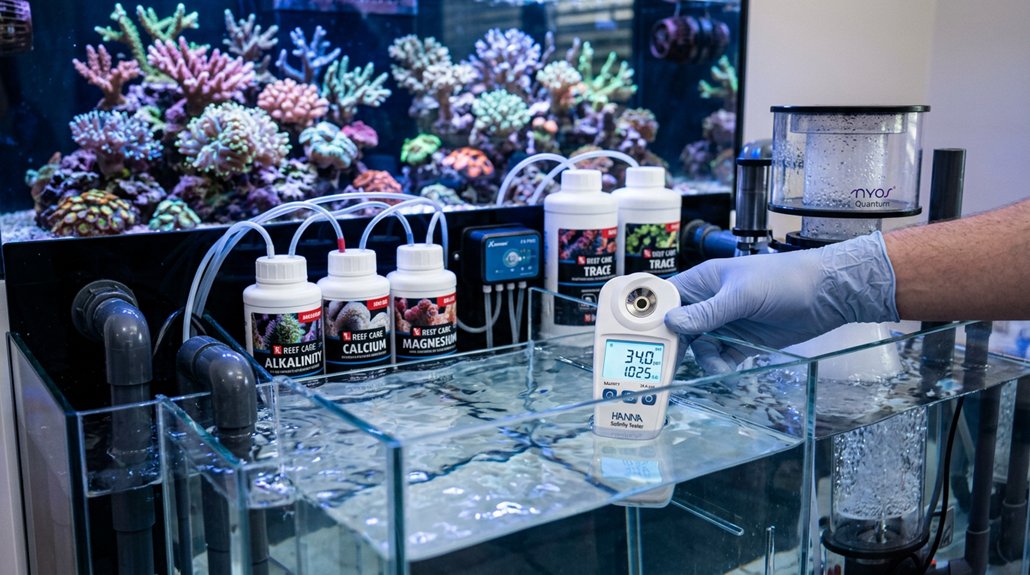
Keep your reef salinity near 1.026 specific gravity (35 ppt) by controlling evaporation with a reliable ATO that adds only freshwater and includes shutoffs plus an overflow sensor. Measure salinity with a calibrated refractometer before each water change and after any ATO adjustment, and recalibrate it every 1–2 changes using a 35 ppt standard; don’t rely on inexpensive hydrometers. Match replacement water to the tank within 1–2°F and about 0.000–0.002 sg, check salinity weekly, and correct any drift gradually with partial water changes.
Prevent Evaporation Swings
Evaporation steadily raises salinity because only water leaves the system, so you need to replace every bit of lost freshwater with RO/DI water to hold your reef at about 1.026 specific gravity (35 ppt). Use an ATO with optical sensors and reservoir monitoring to keep top-off volume consistent and catch failures early.
- Keep the reservoir filled with RO/DI water.
- Add redundant shutoff protection.
- Measure salinity with a quality refractometer.
- Pre-mix water-change water to tank salinity.
- Make only tiny manual corrections.
Check salinity after temperature and evaporation changes, and don’t rely on a hydrometer for fine control. If you top off by hand, log daily readings and adjust in ≤0.002 SG steps, waiting between corrections so you can see the effect before changing anything else.
Calibrate Salinity Tools
Even with stable top-off habits, your salinity readings are only as good as the tool you’re using, so calibrate your refractometer with a 35 ppt solution every 1–2 water changes or at least monthly. Use a calibration schedule and record the date, device, and standard value.
| Task | Action |
|---|---|
| Calibrate | Match 35 ppt / 1.026 sg |
| Measure | Sample, wait 30 seconds |
| Maintain | Prism maintenance: rinse, dry |
Place a few drops of well-mixed, temperature-equilibrated water on the prism, close the cover, then read. Rinse the prism with RO/DI water and dry with a lint-free tissue between tests to prevent residue errors. Prefer a quality digital meter or refractometer; hydrometers can drift by several points. Recalibrate immediately if readings shift by more than 0.002 sg.
Keep Alkalinity From Swinging
You should test alkalinity at least twice a week with a reliable kit and log each result so you can spot drift before it turns into a swing. Keep your dosing rhythm steady by splitting daily additions into small increments, aiming for changes of less than 0.2–0.5 dKH per dose instead of large bolus corrections. Match replacement water to your display’s alkalinity and adjust only after a week or more of logged trends, not after a single reading.
Steady Dosing Rhythm
Test alkalinity at least twice a week with a reliable kit, such as the Hanna Alkalinity Checker or Salifert, and log each result so you can identify true weekly consumption before changing your dose. Use consistent dosing and dosing automation to keep KH changes tiny and predictable.
- Split doses into many small events.
- Keep each rise under 0.1–0.2 dKH.
- Separate alkalinity and calcium by 30–60 minutes.
- Stagger two-part additions to limit precipitation.
- Use a slow kalkwasser or top-off drip if needed.
After a water change, recheck KH a few hours later and again before the next change to verify net use. If you must adjust, spread the change over days or weeks, then retest after a month.
Test, Log, Adjust
Regularly test alkalinity at least twice a week with a reliable kit or digital checker, then log each result so you can track the trend instead of reacting to a single reading. Keep your target between 8 and 11 dKH, and correct deviations slowly, no more than 0.5–1.0 dKH per day. Use your log entries to calculate consumption: measure before and a few hours after water changes, then compare the shift to your weekly demand. If alkalinity drifts, make dosing adjustments in small increments, not large dumps. Split additions into hourly micro-doses or run a dosing pump to reduce swings and precipitation. When you change salt, kalkwasser, reactor settings, or a dosing product, ramp it gradually and test daily for 1–2 weeks so you can catch adverse changes early.
Test Nitrate, Phosphate, and pH on Schedule
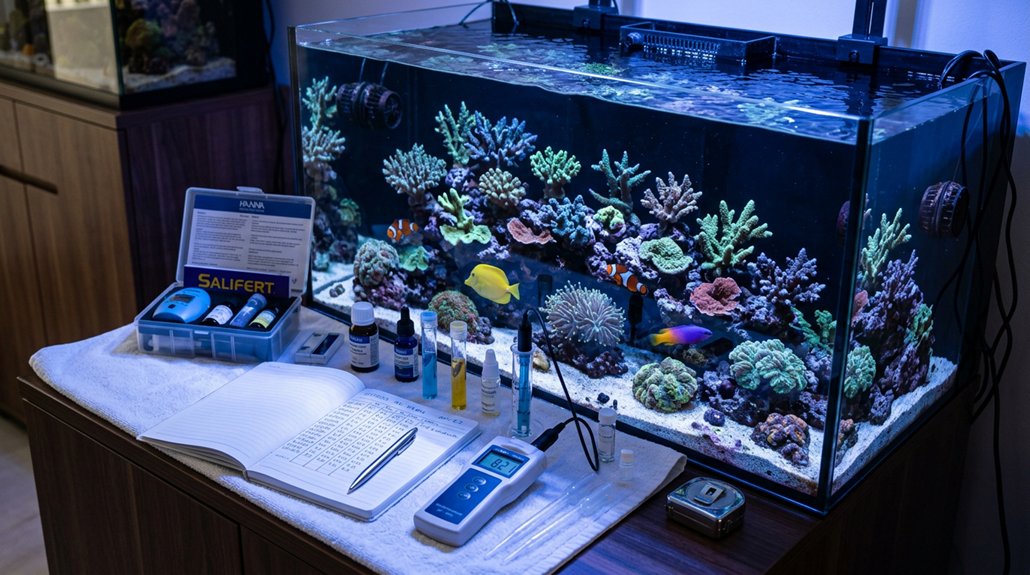
Weekly testing of nitrate (NO3) and phosphate (PO4), plus frequent pH checks, is essential for keeping reef chemistry within a stable range. You should use nitrate logging to track trends and confirm your phosphate targets with each test.
- Test NO3 at least weekly with a reliable kit.
- Keep NO3 below about 5 ppm, or 5–10 ppm if you run higher nutrients.
- Measure PO4 weekly with Salifert, Elos, or a digital checker.
- Hold PO4 near 0.02–0.05 ppm to limit algae and support coral growth.
- Check pH daily if you can; aim for 8.1–8.3.
If values drift, make one small correction, then wait 1–4 weeks before retesting. Log date, time, kit, and result, so you can verify whether your change worked.
Match Salt Mix to Your Tank
Choose a salt mix that lines up closely with your tank’s target alkalinity, calcium, and magnesium so water changes don’t bump those parameters up or down; for example, if your system runs around 8–11 dKH alkalinity and 390–425 ppm calcium, pick a mix that’s labeled in that range. Check the salt composition and trace elements on the label, but verify every batch yourself. Mix with RO/DI water, then test salinity at 1.026 sg or 35 ppt, temperature within 1–2°F of your tank, and alkalinity and calcium before you add it. If you’re changing brands, phase in the new salt over several water changes and track weekly alkalinity, calcium, and magnesium. Keep the same lot when you can, or log batch numbers so you can spot any shift.
Set Lighting and Flow, Then Leave Them Alone
Once your salt mix and baseline chemistry are dialed in, set your lighting and flow and resist the urge to keep changing them. Use a fixed photoperiod, and program gradual ramp up/down so corals get stable light cycles and better light acclimation.
- Hold 8–10 hours for most reefs
- Use 10–12 hours for SPS tanks
- Ramp lights 30–60 minutes
- Keep alternating, turbulent flow
- Make one change, then wait weeks
Choose flow consistency: aim for 10–20× turnover, with varied velocities across the tank, then leave pump settings alone so corals can orient and grow. If you replace LEDs, bulbs, or hardware, increase intensity or flow slowly over days to weeks—about 10% per day for light, and small steps for flow. Avoid abrupt swaps and daily tweaks.
Follow a Weekly Stability Routine
With lighting and flow now set, the next step is to lock in a repeatable weekly maintenance routine that keeps chemistry from drifting. Pick one day for your weekly rituals: change 15–20% of the water with RO/DI mixed to tank salinity and warmed within 1–2°F. Test alkalinity, calcium, nitrate, and phosphate at least once, ideally twice, and log every result. Measure alkalinity before and a few hours after the change to calculate true consumption. Keep dosing steady, and change only one parameter at a time, then wait about a month. Check salinity with a calibrated refractometer, confirm ATO level and shutoffs, and use an equipment checklist for heater, return pump, skimmer, ATO, and dosing pumps. Clean dosing tubing monthly.
Frequently Asked Questions
Are Salt Water Aquariums Hard to Keep?
Yes—saltwater aquariums can be hard to keep because you’re managing tighter stability, more equipment upgrades, and strict stocking guidelines. If you test regularly, automate top-off, and make small corrections, you’ll handle them well.
How to Keep a Saltwater Tank Crystal Clear?
Want crystal-clear water? You’ll need reef filtration: run protein skimming, mechanical socks, activated carbon, and GFO, avoid overfeeding, and maintain nitrate below 5 ppm. You should also clean media regularly and test often.
How Long Can Saltwater Fish Go Without Being Fed?
You can usually leave healthy saltwater fish unfed 7–14 days; many tolerate 2–3 weeks. You’ll need shorter feeding intervals for juveniles or sensitive species, and emergency plans if you’re away beyond a week.
How to Stabilize a Reef Tank?
You stabilize a reef tank by perfecting reef cycling, then keeping temperature, salinity, alkalinity, and nutrients rock-steady—because your corals apparently enjoy drama less than a spreadsheet. Use disciplined flow management, test often, adjust slowly, and document everything.
Conclusion
Stable reef water is like a tightrope: tiny shifts matter. In your tank, a 0.2 salinity swing or a 1°F temperature change can stress corals fast. I once saw a healthy reef lose color after a week of skipped testing, then recover only when routine returned. If you keep temperature, salinity, alkalinity, nitrate, phosphate, and pH steady, you’ll build a system your livestock can tolerate and thrive in.