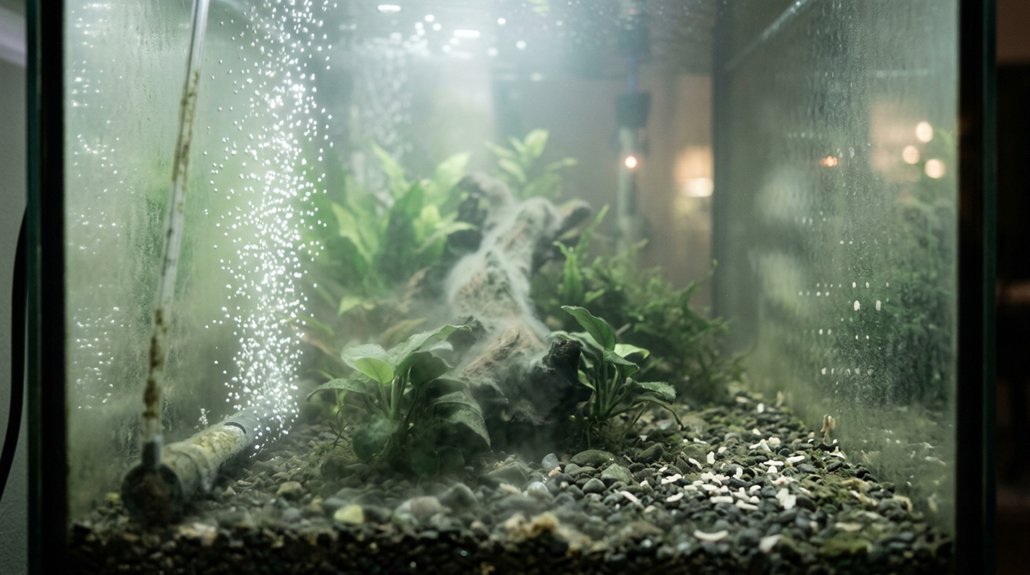
Your fish tank water is usually cloudy because of a bacterial bloom, algae growth, tannins, or suspended debris from waste or disturbed substrate. Test ammonia and nitrite first; any detectable level needs a partial water change and reduced feeding. If it’s milky, keep the filter running and aeration high. If it’s green, reduce light and nutrients. If it’s brown or yellow, use carbon and routine maintenance, and you’ll see the cause more clearly next.
Key Takeaways
- Milky-white cloudiness usually means a bacterial bloom from a new tank, excess waste, or overfeeding.
- Green water comes from algae blooms caused by too much light and excess nitrates or phosphates.
- Brown or yellow tint often comes from tannins, dissolved organics, driftwood, or decaying plant matter.
- Test ammonia, nitrite, nitrate, and pH immediately; ammonia or nitrite above 0.25 ppm needs action.
- Fix cloudiness with partial water changes, reduced feeding, better filtration, and appropriate light control.
Why Is My Fish Tank Cloudy?
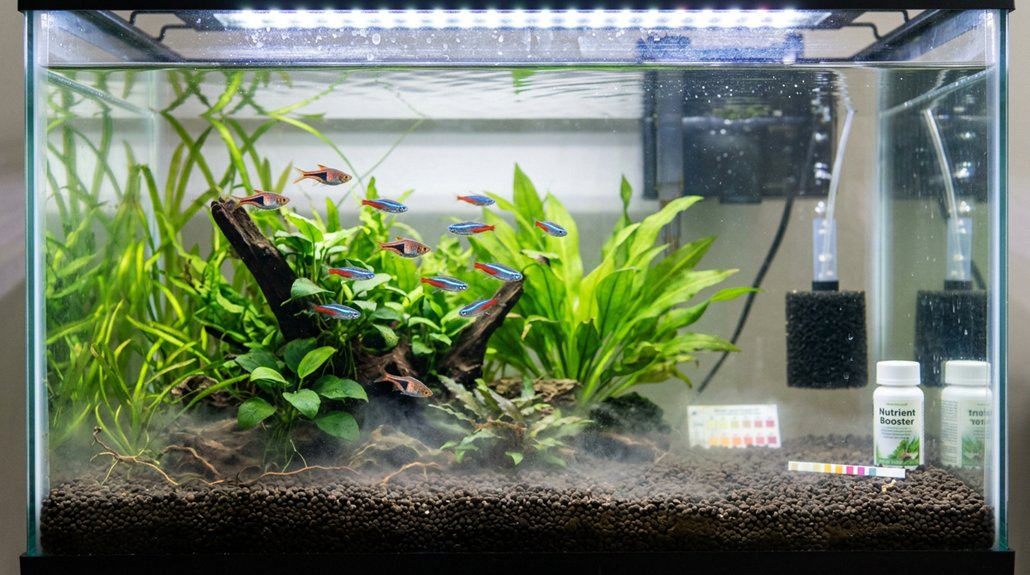
If your fish tank water has turned cloudy, the cause usually falls into one of a few distinct categories. You may be seeing a milky-white bloom in a new aquarium, a green haze from algae, or a brown tint from tannins. Fine suspended particles often indicate disturbed substrate or detritus. Sudden cloudiness with elevated ammonia or nitrite suggests a filter problem or excess waste loading. You should inspect water chemistry, measure ammonia, nitrite, and nitrate, and assess the light spectrum, feeding, and nutrient input. In new systems, the cloudiness often resolves as the biological filter stabilizes. In planted or brightly lit tanks, reducing light and nutrients can suppress algae. Mechanical filtration and partial water changes usually clear particulate or tannin-related cloudiness efficiently.
Bacterial Blooms in New Aquariums
In new aquariums, a milky-white bacterial bloom is a common feature of “new tank syndrome,” as heterotrophic bacteria rapidly multiply on dissolved organics and minerals in the water. You may see this haze within days, before cycling bacteria colonize filter media and starter substrates. During this phase, ammonia and nitrite often still test 0 ppm, yet the water stays opaque. Excess feeding, too many fish, or decaying matter can intensify the bloom by increasing available nutrients. Reduce feeding to tiny portions or skip 1–2 days. Your response should stay minimal: keep the filter running, increase aeration, and don’t replace all media. If ammonia or nitrite rise, use 10–20% water changes every few days. Live plants, seeded gravel, carbon, or UV can speed clarification.
What Brown, Green, and Yellow Water Mean
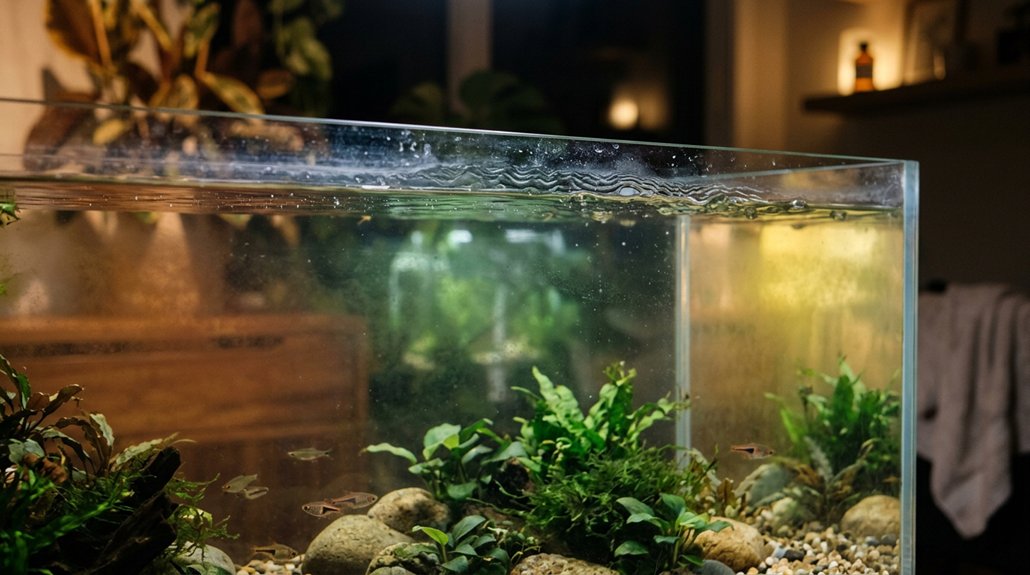
Brown, green, and yellow water usually point to different problems: brown water often comes from tannins leaching out of driftwood or decaying plant matter, yellow water usually reflects dissolved organic carbon from fish waste, uneaten food, or new wood, and green water indicates a planktonic algae bloom driven by excess light and nutrients. You’ll often see tannins effects in brown water, including mild pH reduction and tea-like staining. Driftwood leaching can persist until the source is exhausted. Yellow water suggests DOC accumulation from organic decay. Green water is usually linked to high phosphates or nitrates plus too much light. In each case, the color tells you the dominant contaminant, so you can target the cause instead of treating all cloudy water the same.
How to Test Cloudy Aquarium Water
Start with water chemistry: test ammonia and nitrite immediately with a reliable kit, because a benign bacterial bloom should still show 0 ppm for both, while any detectable level at or above 0.25 ppm is a warning sign. Then check nitrate and phosphate; nitrates should usually stay below 20–40 ppm, and elevated values can support algae or bacterial growth. Measure pH and temperature, since pH swings greater than 0.5 units, tannins, or sudden shifts can accompany cloudiness. Inspect filter media and run a clarity test: place tank water in a clear container and observe settling over 24 hours. If you’re uncertain about contamination, use source testing on tap water or ask a local fish store for professional analysis. Rapid kits help you confirm toxic metals or chlorine quickly.
How to Fix Cloudy Water Safely
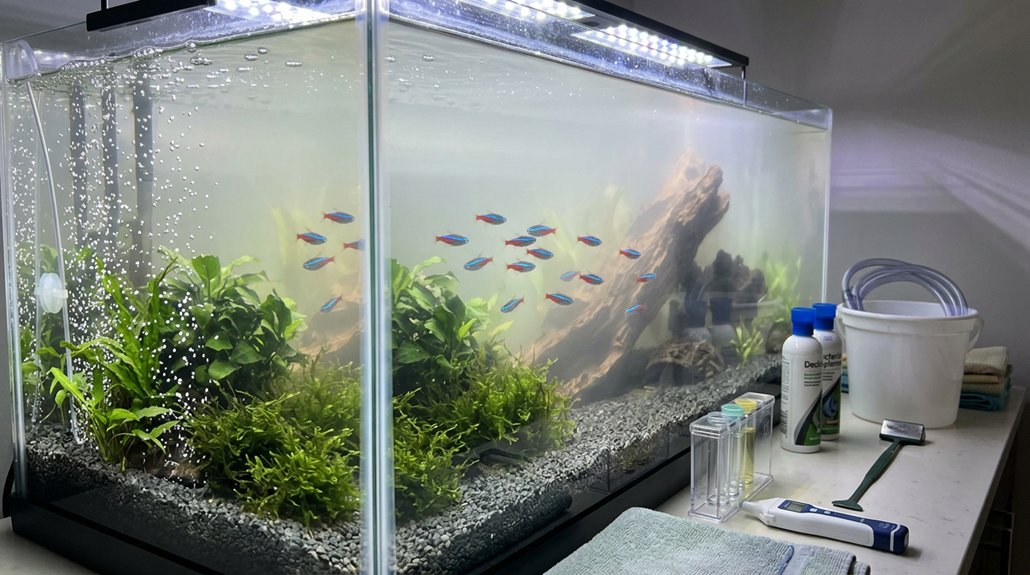
Before treating cloudy water, you should test ammonia and nitrite immediately, since values above 0 ppm require a 25–30% water change with temperature- and dechlorinator-matched water. You can then correct the cause gently: pause feeding for 24–48 hours in a new tank with bacterial cloudiness, avoid cleaning filter media, and use seeded media to support nitrifying bacteria. To maintain clarity, you can use activated carbon for dissolved organics, fine floss or a filter sock for particulates, and short-term light and nutrient reduction if algae is present.
Test Before Treating
Even when cloudiness looks harmless, you should test ammonia, nitrite, nitrate, and pH first, because the right fix depends on whether you’re seeing a temporary bacterial bloom or a true water-quality problem. In water testing and aquarium diagnostics, target 0 ppm ammonia, 0 ppm nitrite, and nitrates ideally below 20–40 ppm. If ammonia or nitrite is above 0.25 ppm or rising, do a 20–30% partial water change and condition the new water immediately. If tests show 0 ppm ammonia and nitrite with normal pH, the cloudiness is likely a bacterial bloom; avoid unnecessary filter scrubbing. If you suspect green water, measure phosphate and nitrate, then note whether activated carbon changes color, but don’t let it hide toxic spikes.
Fix Causes Gently
Once you’ve identified the cause, correct it with the least disruptive method: if a new-tank bacterial bloom is present, don’t deep-clean the filter or replace all media; instead, feed only tiny pinches every 1–2 days and keep checking for 0 ppm ammonia and nitrite. Use natural remedies and gradual adjustments.
| Cause | Gentle fix | Aim |
|---|---|---|
| Bacterial bloom | Reduce feeding | Stabilize cycling |
| Particles | 100–200 micron floss | Trap debris |
| Green water | 0–2 h light | Limit algae |
For substrate dust, use fine filtration and 10–15% water changes, not aggressive vacuuming. For tannins, add activated carbon and change 25% with conditioned water. If green water persists, lower light and nutrients; a temporary UV or diatom filter can help. Seed bio-media from a healthy tank to speed recovery safely.
Support Clear Water
To support clear water safely, match the fix to the cloudiness: if it’s a new-tank bacterial bloom, reduce feeding to once every 1–2 days or skip 24–48 hours, and test ammonia and nitrite daily while the biofilter stabilizes; if it’s particulate haze, use fine filter floss or a filter sock and vacuum small sections of substrate during 10–30% water changes. For dissolved discoloration or persistent haze, add chemical filtration with activated carbon or carbon pads, and replace them every 2–4 weeks. You can also seed beneficial additives by moving healthy gravel, bio-sponges, or filter media from an established aquarium to accelerate bacterial colonization. If the water is green, limit light, change 25% daily, verify phosphate and nitrate, and use a UV sterilizer.
How to Clear Dust and Suspended Debris
Dust and suspended debris are usually mechanical, not biological, and you can clear them by removing the source and trapping the particles already in the water. Use gravel rinsing before setup, then install filter socks or fine floss to capture fines. Replace or inspect them daily.
| Action | Purpose |
|---|---|
| Rinse substrate | Removes dust |
| Use filter socks | Traps particulates |
| Vacuum small sections | Prevents resuspension |
During water changes, vacuum only about 12 square inches at a time. Run circulation continuously, and if outflow is violent, redirect it or add a spray bar to limit turbulence. Several 10–30% changes with temperature-matched, conditioned water can clear suspended matter without abrupt disturbance. Sand often needs repeated rinsing; gravel clears faster. Each measure reduces the particulate load, improves water clarity, and lets your filter process remaining debris efficiently.
How to Prevent Cloudy Aquarium Water
You can prevent cloudy water by avoiding overfeeding; offer only what your fish consume in 2–3 minutes and remove any uneaten food promptly. Stock your aquarium gradually so nitrifying bacteria can stabilize ammonia and nitrite processing before bioload rises. Maintain the system with regular 10–30% water changes, selective substrate vacuuming, and timely filter-media replacement without disrupting the full biofilter at once.
Avoid Overfeeding
Overfeeding commonly drives cloudy aquarium water by increasing dissolved organics and leaving uneaten food to decompose, which fuels bacterial and algal blooms that can turn the tank milky or green. You can prevent this with strict portion control and a consistent feeding schedule. Feed adult community fish only what they consume in 2–3 minutes, once or twice daily. Remove any food remaining after 5 minutes. If cloudiness appears, or nitrate rises, reduce portions or skip feeding for 24–48 hours. For fry or species needing frequent meals, give very small amounts several times daily and increase water changes by 10–20% more often. A feeding chart based on tank biomass, about 1–2% of total fish weight per day, helps you avoid chronic overfeeding and preserve water clarity.
Maintain Balanced Stocking
A balanced fish load is essential for clear water, because too many fish raise bioload, ammonia output, and dissolved waste faster than the filter can process them, leading to bacterial or algal cloudiness. You should practice stocking balance by choosing fewer, appropriately sized fish and researching adult size, behavior, and territorial needs before purchase. For small-bodied species, the 1 inch per gallon guideline can help, but species-specific limits are better for bioload planning. Add new fish gradually, no more than 10–20% of final stock over several weeks, so nitrifying bacteria can expand without a nutrient surge. Heavy waste producers need lower density and stronger filtration. Quarantine newcomers to prevent sick animals from increasing organics and turbidity.
Keep Up With Maintenance
Even with balanced stocking, cloudy water often develops when maintenance lets dissolved waste and suspended particles accumulate faster than the aquarium can process them. Your scheduled maintenance should include 20–30% weekly water changes, or 25% in heavily stocked tanks, plus feeding only what’s eaten in 2–3 minutes. During each change, vacuum 10–20% of the substrate and rinse one filter element in tank water; this filter upkeep limits debris without killing beneficial bacteria. | Task | Frequency | Effect |
| — | — | — |
|---|---|---|
| Water change | Weekly | Lowers organics |
| Filter rinse | Each change | Preserves clarity |
| Feeding control | 1–2× daily | Reduces waste |
Keep light at 6–8 hours/day, avoid sunlight, and test nitrate below 20 ppm. Add live plants, and seed new tanks with established media to accelerate cycling.
Frequently Asked Questions
How to Clear up Cloudy Water Fast?
Test ammonia and nitrite now; if they’re zero, you’ve likely got a bacterial bloom. Cut feeding, change 10–30% water, use fine floss or carbon, and skip chemical treatment unless toxins’re confirmed.
Will Cloudy Water Harm Fish?
Usually, you won’t see direct harm, but cloudy water can lower oxygen levels and raise stress indicators, especially if it’s persistent or severe. If ammonia or nitrite rise, it’s an emergency requiring immediate correction.
Will a Cloudy Fish Tank Clear Itself?
Yes, it often clears itself—how delightfully unhelpful. During tank cycling, beneficial bacteria blooms usually fade in days. You’ll improve outcomes with aquarium filtration, not DIY remedies, unless ammonia or nitrite rise, then test immediately.
How Do I Make My Fish Tank Water Crystal Clear?
Test ammonia and nitrite, then reduce feeding, stock appropriately, and add water polishing with fine floss plus carbon. Seed beneficial bacteria, use light control, and perform small water changes; you’ll get clearer, more stable water.
Conclusion
Cloudy tank water is often your aquarium’s warning light, signaling bacterial blooms, suspended debris, or chemical imbalance. By testing water parameters, improving filtration, and avoiding overfeeding, you can restore clarity safely and quickly. Think of your tank as a living laboratory: when conditions shift, the water speaks first. With careful observation and consistent maintenance, you’ll keep your fish healthier and your aquarium clearer, turning a murky problem into a stable, controlled environment.