Ich in fish is a highly contagious parasitic disease caused by Ichthyophthirius multifiliis in freshwater and Cryptocaryon irritans in marine tanks. You’ll usually see small white salt-like spots, flashing, clamped fins, rapid gill movement, lethargy, or loss of appetite. It spreads through new fish, contaminated equipment, and poor quarantine. Treat it fast with proven ich medication, heat if safe, and strong aeration, because the free-swimming stage is the one you can target most effectively, and there’s more to know.
Key Takeaways
- Ich is a contagious protozoan parasite causing white, salt-like spots on freshwater and marine fish.
- Symptoms include flashing, clamped fins, rubbing, lethargy, reduced feeding, and rapid gill movement or surface gasping.
- It spreads through new fish, contaminated water, equipment, plants, substrate, and poor quarantine practices.
- Treat the free-swimming stage with ich medications, repeated dosing, heat if species-safe, and strong aeration.
- Prevent outbreaks with quarantine, clean equipment, stable water quality, and avoiding shared tools between aquariums.
What Is Ich in Fish?
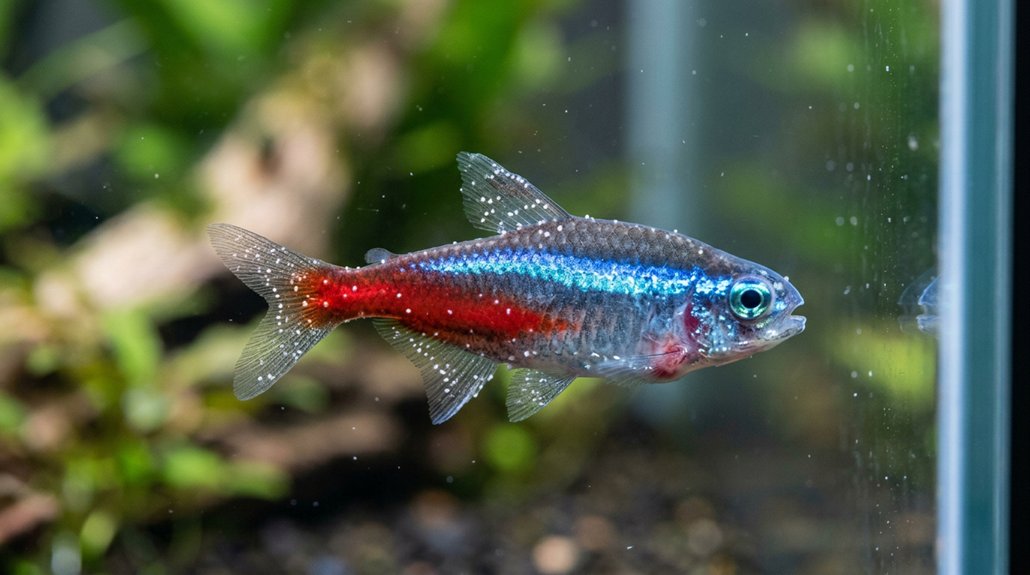
Ich in fish is a highly contagious parasitic disease caused by single-celled ciliated protozoa—*Ichthyophthirius multifiliis* in freshwater and *Cryptocaryon irritans* in marine systems—commonly known as white spot disease. You’re seeing a parasite that attaches to skin, fins, and gills, where it feeds on cells and body fluids while forming visible white cysts about 0.5–1.5 mm wide. Its parasite morphology supports a three-stage life cycle: trophont on the fish, tomont on surfaces, and free-swimming theront, the stage most vulnerable to treatment. Because infection spreads easily through unquarantined fish, contaminated equipment, plants, or water, your aquarium’s biosecurity matters. Stress and poor water quality weaken the host immune response, making outbreaks more likely and harder to control.
Ich Symptoms in Fish
You’ll usually notice ich as small, bright white, salt-like spots on the skin, fins, or gills. Your fish may also flash against surfaces, hide, clamp its fins, or stop eating. If the gills are involved, you might see faster breathing, surface gasping, or rubbing before the spots become obvious.
White Spot Signs
White spot disease usually shows up as small, visible white, salt-like raised spots about 0.5–1.5 mm across on the body, fins, or gills. You’ll often see them on several fish at once, which helps with visual differentiation from isolated injuries or fungus. Because the spots can be tiny early on, microscopic diagnosis with skin or gill scrapes can confirm motile trophonts or tomonts before you rely on appearance alone. If the gills are affected, you may notice rapid gill movement or gasping before body spots become obvious. Secondary signs can include scale loss, bruising from rubbing, clamped fins, and reduced appetite. In severe outbreaks, fish may become lethargic, swim erratically, or die suddenly if you don’t act quickly.
Behavioral Changes
Behavior often changes before the classic white spots are easy to see, so it’s worth watching fish closely for early warning signs. You may notice flashing, where the fish scrapes against rocks, decorations, or substrate because the skin’s irritated. Lethargy, hiding, and reduced appetite often show up early, and you might see less interest in feeding routines. As Ich progresses, fish can become isolated, clamp their fins, or respond poorly to tankmates and handling. Erratic swimming, darting, rolling, or lingering near the surface may also occur. Use tank enrichment carefully, since extra décor can help you observe scraping behavior, but it won’t reduce infection. These changes suggest worsening parasite burden and declining condition, so monitor behavior closely and act promptly.
Breathing Distress
Respiratory distress is a common early sign of ich, especially when trophonts invade the gills before white spots appear on the body. You may notice rapid gill movements, labored breathing, flared gill slits, or gulping at the surface. As gill infestation worsens, oxygen uptake falls, and your fish can become lethargic, pale, or cyanotic. Clustering near the inflow or gasping at the surface often means hypoxia from gill damage. Higher treatment temperatures can further lower dissolved oxygen, so increase aeration right away. In severe cases, gill necrosis can develop, leading to sudden collapse and death if you delay treatment. Prompt intervention, stable water quality, and oxygen therapy help support breathing while antiparasitic treatment clears the infection and gill function recovers.
What Causes Ich in Fish?
You’ll usually bring ich into the tank on new, unquarantined fish, contaminated plants or decor, or shared equipment and water. Once present, the parasite spreads through free-swimming stages in the water and then attaches to your fish’s skin, fins, and gills. Stress from poor water quality, sudden temperature changes, overcrowding, or shipping can lower immunity and make your fish more likely to get sick.
Common Entry Routes
Ich in fish most often gets a foothold when new, unquarantined fish are added to a tank, since apparently healthy carriers can bring in parasites and seed the display system. You can also move Ichthyophthirius multifiliis or Cryptocaryon irritans by sharing water, filters, nets, or decor without proper equipment disinfection. Live plants, live food, and infected substrate may carry tomonts or theronts into another system and start an outbreak. Good quarantine practices help you catch hidden carriers before they reach the main tank. Humans won’t get infected, but you can still mechanically transfer parasites on wet hands, arms, or tools if you don’t clean them between aquaria. Careful separation and sanitation are your best defenses against common entry routes.
Stress And Susceptibility
Even when a parasite is introduced, fish usually only develop visible ich when their defenses are already weakened. You lower that risk by keeping water quality stable: ammonia and nitrite should stay at 0 ppm, because even small spikes stress fish and reduce resistance. Avoid sudden temperature swings; they can suppress immunity and let ich multiply, especially in the 68–77°F range, where it grows well. New fish, plants, and equipment should follow strict quarantine protocols, since asymptomatic carriers often start outbreaks. Overcrowding, poor diet, rough handling, and shipping stress also make low-level infections flare. Bottom-feeding, burrowing, and gill-stressed fish are especially vulnerable because ich attacks skin and gills and can persist in substrate, where stressed fish encounter it again.
How Fish Get Ich
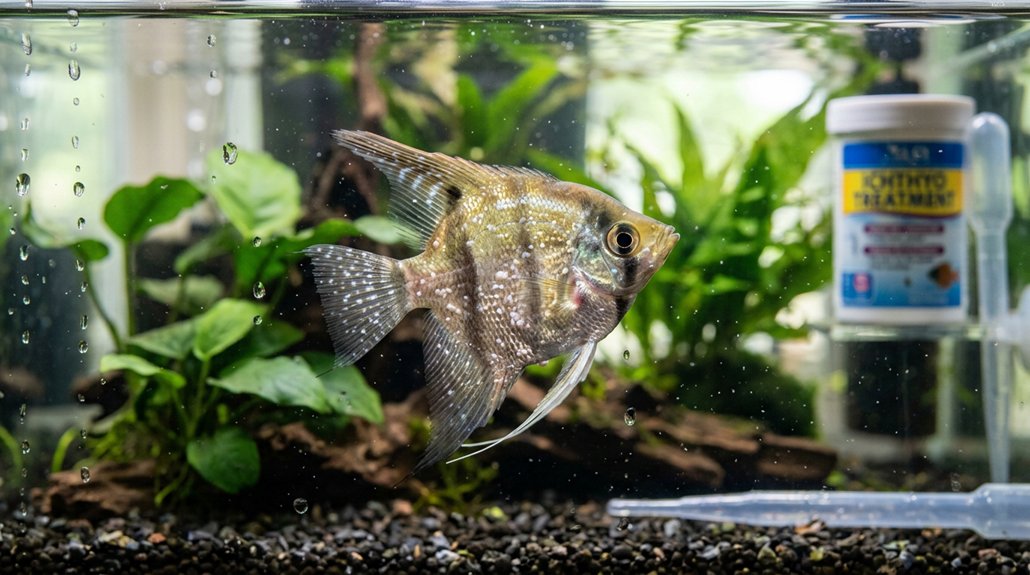
Fish usually get ich when the parasite is brought into the aquarium on new, unquarantined fish that already carry it without showing symptoms. You can also transfer it between tanks on shared water, nets, plants, or your hands, so washing before contact helps prevent cross-contamination. Good tank hygiene matters because the parasite survives in the environment and can spread more easily when conditions are poor. Stress from bad water quality, sudden temperature changes, overcrowding, or shipping lowers immune support and makes your fish more vulnerable. Ich infects best at about 68–77°F, though it can persist at cooler temperatures and cycle faster when it’s warmer. Bottom-dwelling or burrowing species and fish with gill involvement are at higher risk because the parasite lives on the substrate and attacks skin and gills.
What Looks Like Ich?
You’ll usually see ich as clearly defined, raised white spots about the size of salt grains on the body, fins, or gills, and your fish may also flash, clamp its fins, act lethargic, or eat less. If the gills are involved, you may notice rapid gill movement or breathing distress even when few or no spots are visible. It can be confused with velvet, columnaris/fin rot, or epistylis, so a skin or gill scrape is the most reliable way to confirm it.
Salt-Like White Spots
Those telltale salt grains are one of the clearest signs of ich: distinct, raised white spots about 0.5–1.5 mm across that can appear on the skin, fins, or gills. You may notice them as clustered or evenly spaced trophonts, each a parasite feeding under the surface. Their bright, uniform look helps you distinguish ich from velvet or fungal patches, and it isn’t just an aquarium aesthetics issue; it’s a clinical warning.
| Feature | Ich | Look-alike |
|---|---|---|
| Spot shape | Round, raised | Smudgy or dusty |
| Color | Bright white | Rusty, gray, or fuzzy |
| Location | Skin, fins, gills | Often broader areas |
If you see a salt particle on the eye or gill, treat it as urgent.
Behavioral Warning Signs
Not every ich case starts with obvious white spots; often, the first clues are behavioral. You may see your fish flashing, rubbing against rocks, substrate, or décor as the parasite irritates the skin. Watch for stress cues like hiding, lethargy, clamped fins, and reduced or stopped feeding. If the gills are involved, your fish might gasp at the surface, breathe fast, or linger near filter inlets. You could also notice erratic, jerky swimming and more restlessness, especially during nocturnal activity when theronts are released. When several tankmates show the same signs within days, the problem is likely spreading. If this started after adding new fish, treat the situation as an active ich outbreak and act quickly.
Lookalike Skin Conditions
Several fish diseases can mimic ich, so it’s worth checking the pattern of the spots before assuming the parasite is present. You’ll get a better velvet diagnosis by looking for dust, not dots, and lymphocystis identification by noting wart-like clusters.
| Condition | Key clue |
|---|---|
| Velvet | Fine gold/rust dust |
| Epistylis | Translucent tufts on eyes or gills |
| Columnaris | Smudgy white-gray lesions |
| Costia | Diffuse cloudiness, flashing |
| Lymphocystis | Large, immobile nodules |
Ich usually causes evenly spaced, raised white specks about 0.5–1.5 mm across. If you see ragged fins, tissue erosion, or a film instead, ich’s less likely. Check lighting, magnification, and behavior, then compare lesion shape, distribution, and speed of progression before treating.
Ich Life Cycle in Fish
Ich has a three-stage life cycle that alternates between the fish, the environment, and a free-swimming infectious phase. You’ll first see trophonts as white spots on the skin and gills; they feed within the epithelium, so most medications can’t reach them. When they mature, they leave the fish and become tomonts on substrate or tank surfaces, where they divide into many tomites inside a cyst. The cyst then ruptures, releasing theronts, the only stage reliably vulnerable to treatment. Theronts must find a host within about 48 hours, or longer at low temperatures, and they die if they can’t. Temperature effects strongly influence how fast the cycle completes, and host immunity may limit how many parasites establish. Near 24–26°C, the cycle can finish in 4–6 days; near freezing, it can take weeks.
How to Treat Ich in a Fish Tank
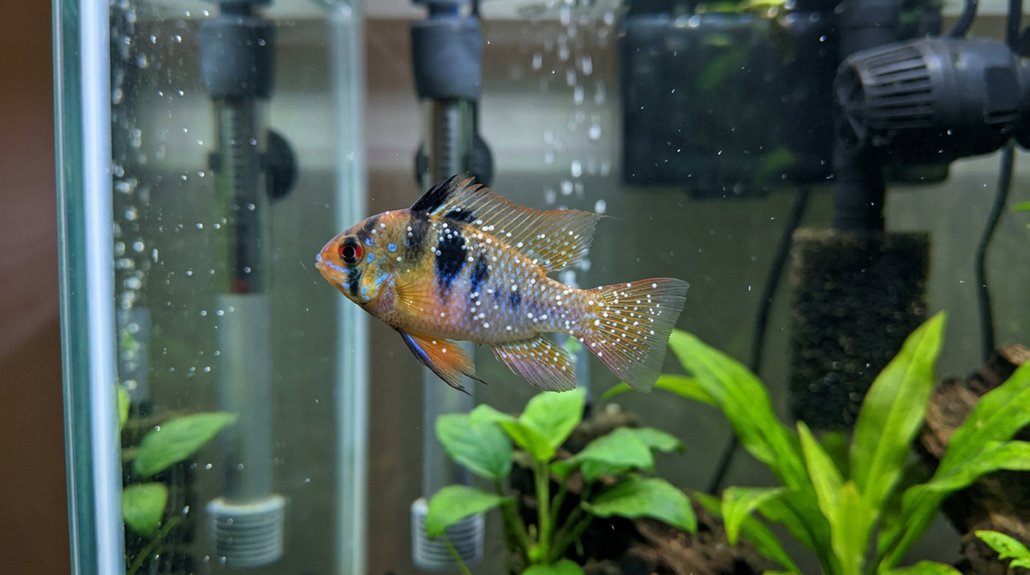
Act quickly at the first sign of white, salt-like spots, flashing, or lethargy, because treatment only kills the free-swimming theront stage and delayed action lets the infection spread. You should raise water temperature gradually to 78–80°F if your species can tolerate it, using extra aeration to offset lower oxygen. This heat cycling speeds the parasite’s life cycle, so theronts appear sooner and medicines can reach them. Use a proven ich medication exactly as labeled, and remove activated carbon and shut off UV sterilizers during treatment. Continue dosing through at least 3–4 life cycles, or every 48–72 hours as directed, because tomonts keep releasing new theronts. In small systems, quarantine sick fish and leave the main tank empty and heated for about 4 days. Medication rotation may be needed if directed by the product or species constraints.
Copper and Malachite Green Treatments
Copper-based medicines and malachite green can be effective against ich because they kill the parasite’s free-swimming theront stage, but they’re not safe for every aquarium. Use them only after checking species tolerance and water hardness, and follow a quarantine protocol if you can.
- Remove activated carbon and UV sterilizers before dosing.
- Use copper monitoring test kits to keep levels therapeutic.
- Dose malachite green exactly as labeled.
- Avoid copper with invertebrates and sensitive fish.
- Increase aeration during treatment.
Because ich’s lifecycle is temperature-dependent, you’ll need repeated dosing or continuous treatment to catch new theronts. At 78–80°F, the cycle is faster, so timing matters. Treat sensitive species cautiously, and consult an aquatic veterinarian if the fish are valuable or unusual.
Supportive Natural Remedies for Ich
While natural measures won’t reliably cure an established ich infection, they can support recovery by lowering stress and improving the fish’s ability to cope. You can use garlic pellets to encourage eating; allicin may modestly support immunity. Indian almond leaves add almond tannins, which can create a calmer, more natural environment. A small salt dose in freshwater may reduce osmotic stress, but only if your species tolerates it. Keep conditions steady, since poor water quality worsens disease.
| Supportive measure | Practical note |
|---|---|
| Garlic pellets | Feed to improve appetite |
| Almond tannins | Add catappa leaves |
| Salt | Check species tolerance first |
| Temperature | Hold the recommended range |
| Water quality | Keep ammonia and nitrite at 0 |
These steps help, but they’re not a substitute for proven treatment.
How to Prevent Ich in Fish
Preventing ich starts with keeping the parasite out of your aquarium in the first place. Use a strict quarantine protocol for new fish, plants, and décor, and observe them 2–4 weeks before transfer.
- Keep ammonia and nitrite at 0 ppm.
- Maintain low nitrates and steady 77–80°F temperatures.
- Don’t share nets, siphons, filters, or water.
- Watch for flashing, white spots, and breathing changes.
- Support immune boosting with varied foods, less crowding, almond leaves, or garlic.
If you handle multiple tanks, wash your hands and forearms between systems. For high-risk arrivals, your quarantine protocol can include prophylactic treatments or short dips. A UV sterilizer can add another barrier against free-swimming parasites, but it doesn’t replace good husbandry.
Frequently Asked Questions
How Do I Get Rid of Ich on My Fish?
You’ll need to quarantine affected fish, raise temperature gradually, and use an ich medication per label; do water change, remove carbon, add salt treatment if species-safe, and repeat treatments until spots disappear.
Can Fish Get Rid of Ich on Their Own?
Yes, you might sometimes see your fish clear tiny ich burdens on their own, like specks fading in a tank’s glow, if their immune response is strong and environmental factors stay ideal, but treatment’s safer.
Can Humans Get Ich From Fish?
No, you can’t get ich from fish; it doesn’t cause human infection or a public health risk. You should still wash hands, disinfect gear, and protect cuts, since fish handling can spread other pathogens.
What Are the First Signs of Ich?
You’ll usually first notice tiny white spots and early flashes; about 80% of early cases also show gill irritation, causing rapid breathing. You may see rubbing, hiding, clamped fins, or reduced appetite, too.
Conclusion
You can keep ich from taking hold by watching for early signs, quarantining new fish, and maintaining clean, stable water. If you notice white spots, flashing, or appetite loss, act quickly with proven treatment before the issue becomes a larger concern. Support your fish with good husbandry, not wishful thinking. With steady care, you’ll reduce stress, limit exposure, and give your aquarium a much better chance at staying healthy and clear of this pesky invader.