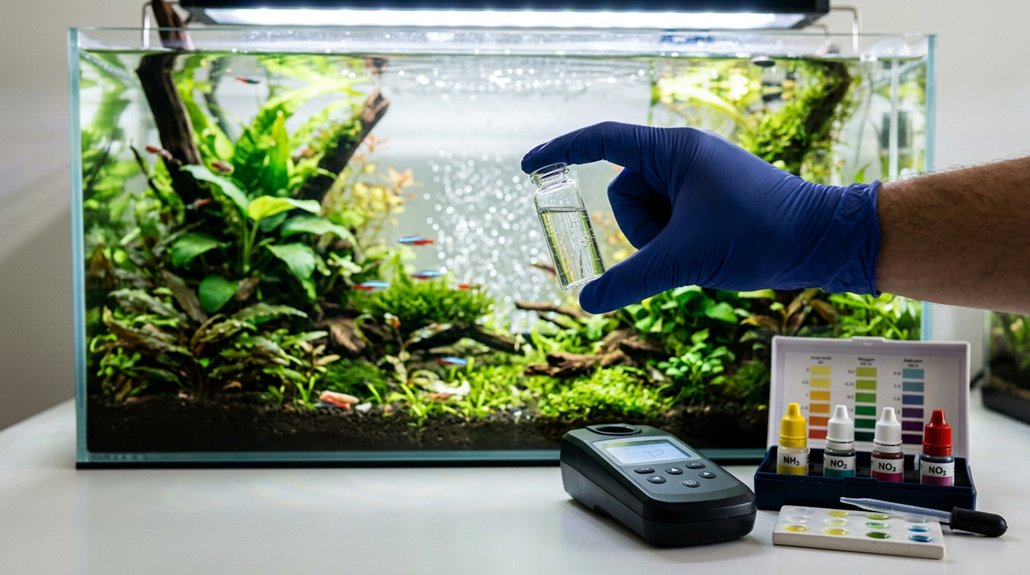
Test your aquarium water by checking ammonia first, then nitrite, nitrate, pH, GH, KH, chlorine, and salinity if needed. Use test strips for fast screening, but confirm abnormal results with liquid reagent kits for better accuracy. In a new tank, test ammonia and nitrite daily; in established tanks, test every 2–4 weeks. Read results at the stated time, and act quickly if ammonia or nitrite is above 0 ppm, because the next steps matter.
Key Takeaways
- Test ammonia first, then nitrite and nitrate; any ammonia or nitrite above 0 ppm needs immediate action.
- Use liquid reagent kits for precise results, especially in new tanks, and strips for quick routine screening.
- Check pH, GH, and KH regularly; stable values matter more than a single reading, and low KH can cause pH swings.
- Test chlorine and chloramine in tap water before water changes, and neutralize them with a conditioner if present.
- In established tanks, test every 2–4 weeks, and test immediately after changes, stress, medication, or filter problems.
Choose Between Test Strips and Liquid Kits
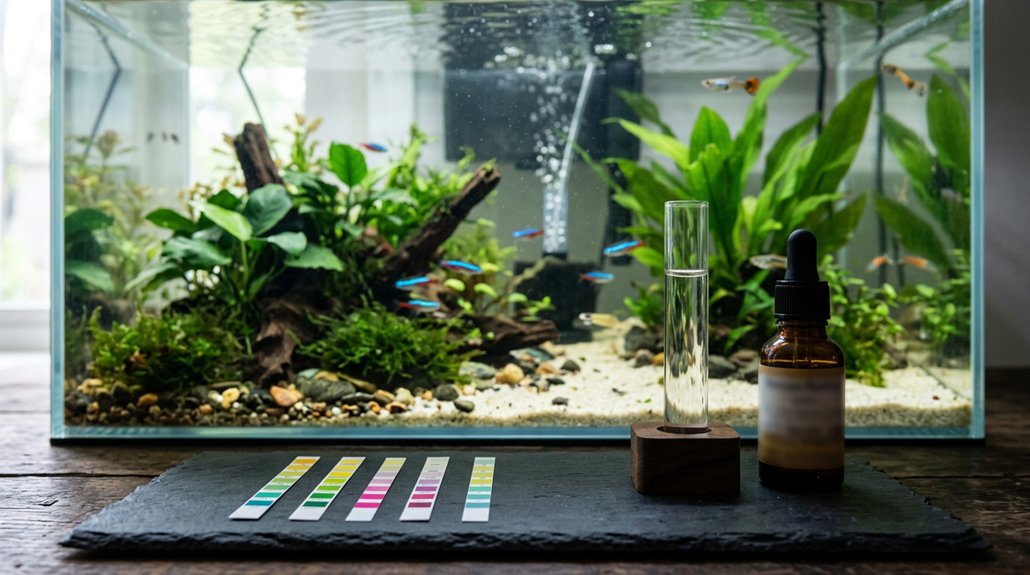
When you’re choosing a water-testing method, start with the tradeoff between speed and accuracy: test strips provide a fast multi-parameter screen for pH, ammonia, nitrite, nitrate, hardness, and chlorine/chloramine in about 15–30 seconds, and they’re inexpensive, but liquid reagent kits are generally more accurate and sensitive for critical measurements such as ammonia, nitrite, nitrate, and GH/KH. Use strips for routine screening every 2–4 weeks in established tanks, but confirm any out-of-range result with a liquid kit before major interventions. In new tanks, rely on liquid ammonia and nitrite tests during cycling, since test strip limitations can miss low but hazardous concentrations. Specialized liquid kits can measure phosphate, copper, GH/KH, or CO2. Follow kit maintenance tips: store reagents tightly closed, check expiration dates, and keep vials clean for reliable readings.
Test Ammonia, Nitrite, and Nitrate First
You should test ammonia first, because any reading above 0 ppm is toxic to fish and indicates an immediate water-quality problem. In the nitrogen cycle, ammonia is converted to nitrite, so you’ll check nitrite next and keep it at 0 ppm as well. Then measure nitrate, which should stay below about 50 ppm in most tanks.
Ammonia First
Ammonia is the first parameter to test because any detectable level above 0 ppm is toxic and needs immediate correction; measure nitrite alongside it during cycling or emergencies, since nitrite must also remain at 0 ppm to avoid impairing oxygen transport, and then check nitrate, keeping it below about 50 ppm in most tanks and responding with water changes if it rises above 75–100 ppm. If you detect ammonia toxicity, test with a liquid reagent kit or high-quality strip, then begin source identification immediately. You should verify feeding, waste accumulation, filter performance, and recent additions. If ammonia or nitrite is above 0 ppm, perform a partial water change, reduce feeding, and support biological filtration; an ammonia neutralizer can help temporarily. Test daily in new tanks or whenever fish show stress.
Nitrogen Cycle Basics
The nitrogen cycle sets the testing order: check ammonia first and keep it at 0 ppm, since even trace amounts are highly toxic and signal waste buildup or incomplete cycling. You should then test nitrite, which should also remain at 0 ppm because it disrupts oxygen levels. Nitrate is the final marker of microbial succession; keep it below 50 ppm, or lower in planted systems. Beneficial bacteria in the biofilter convert ammonia to nitrite, then nitrate, so test daily in a new tank and every 2–4 weeks once stable.
| Analyte | Target | Action |
|---|---|---|
| Ammonia | 0 ppm | Test first |
| Nitrite | 0 ppm | Test second |
| Nitrate | <50 ppm | Change water |
Use reliable liquid kits, and condition replacement water to avoid chloramine.
Check pH, Hardness, and Alkalinity
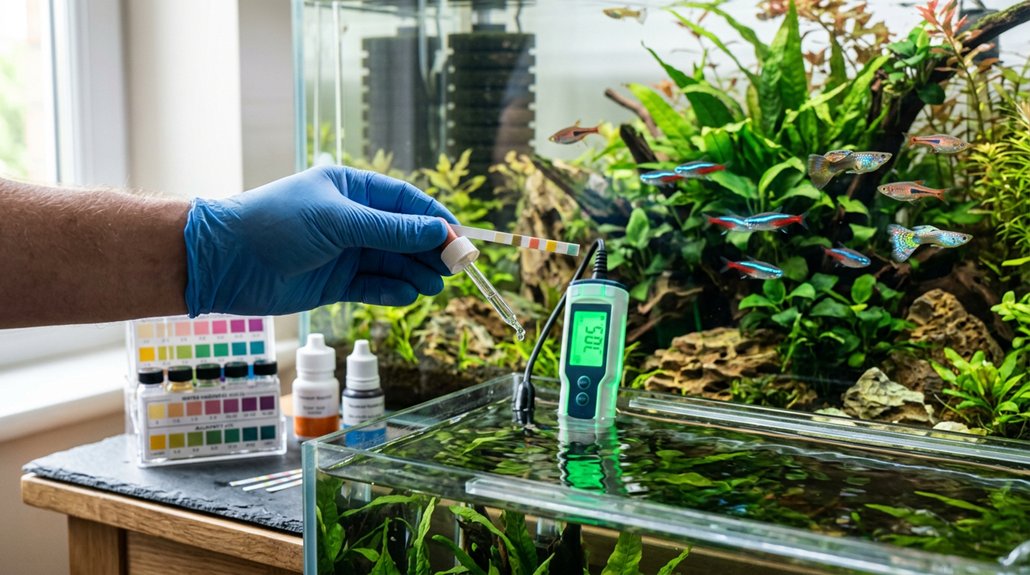
You should check pH, GH, and KH with 6-in-1 or 7-in-1 test strips by dipping them for about 2 seconds and reading the color change after 15–30 seconds. Your pH should stay stable for the species you keep, with most tropical freshwater fish doing best around 6.8–7.8, and KH should generally be at least 3 dKH to limit abrupt swings. You’ll also need to verify GH for adequate mineral content, and if values are off, adjust them gradually and retest after each change.
pH Balance Basics
Stable pH is essential for freshwater fish health, so you should test pH regularly with multi-parameter strips or a liquid pH kit, aiming for roughly 6.8–7.8 for most tropical community tanks. You’ll get the most reliable data by following the manufacturer’s timing exactly, then logging each reading to detect drift. pH isn’t static; CO2 effects can depress values, especially after lights out or heavy respiration. Consistent acid buffering helps resist rapid shifts, which is critical because abrupt change stresses fish gills and osmoregulation. If results move outside the target range, correct them slowly with conditioned water and retest after each adjustment. Avoid making large corrections in a single day, since unstable chemistry can be more harmful than a slightly imperfect pH. Precision matters more than chasing an exact number.
Hardness And Alkalinity
Beyond pH, freshwater stability also depends on hardness and buffering capacity, so it’s important to test GH and KH alongside pH. You should use multi-parameter strips or dedicated liquid kits to quantify each value accurately. Aim for pH 6.8-7.8, GH 4-8 dGH, and KH at least 3 dKH to reduce swing risk. Weekly testing is appropriate in new systems; established tanks can be checked every 2-4 weeks, or sooner if fish show stress.
- GH reflects dissolved mineral sources in the water.
- KH measures buffering against acid spikes.
- Substrate effects can alter both readings over time.
- If values drift, change water slowly, then retest after 24-48 hours.
Use conditioned water, driftwood, or crushed coral only when needed.
Test Chlorine, Chloramine, and Salinity
Test the incoming water for chlorine and chloramine before it enters the tank, using a chlorine/chloramine kit or a multi-parameter strip that includes chlorine to confirm a reading of 0 ppm; chloramine does not dissipate by standing and requires a water conditioner that explicitly neutralizes it. For rapid chlorine detection, you can use Aqueon 7-in-1 or API 5-in-1 strips in about 30 seconds, or a liquid kit for finer resolution. If your supply contains chloramine, dose a de-chlorinator labeled to neutralize chloramine, then retest until residuals are 0 ppm. In saltwater or brackish systems, perform salinity monitoring with a refractometer or calibrated hydrometer. Target specific gravity near 1.025 for marine tanks or 1.005–1.020 for brackish water. Recheck after water changes before adding sensitive livestock.
Read Aquarium Water Test Results
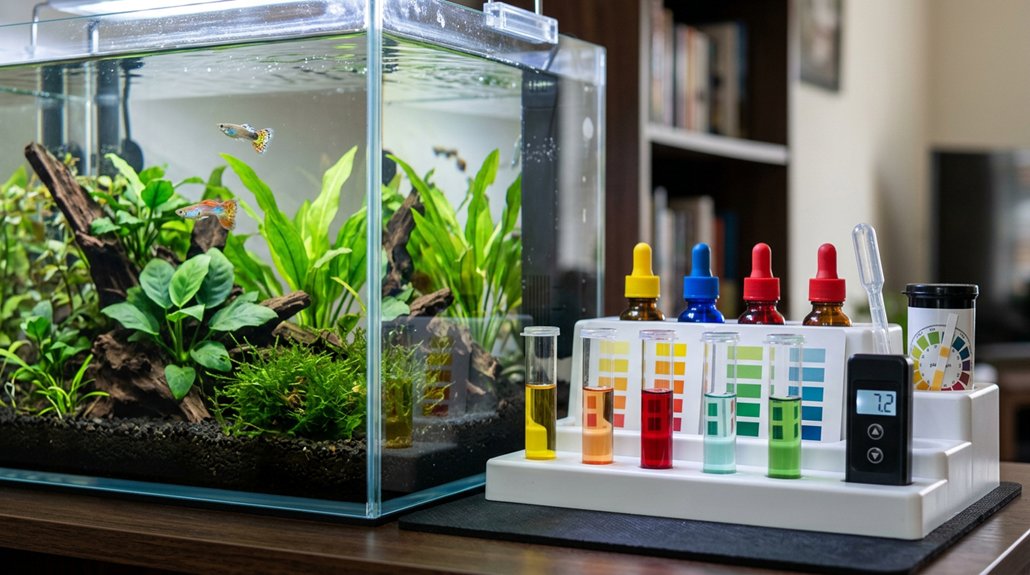
Once your chlorine, chloramine, and salinity checks are complete, read the remaining aquarium test results immediately after the kit’s specified wait time, because strip colors and reagent pads can drift and lead to misreads. Your strip handling should stay consistent: dip, time, compare, and discard. Use careful color interpretation against the manufacturer’s chart, not memory or lighting guesses.
- Ammonia: 0 ppm only; any non-zero reading is urgent.
- Nitrite: 0 ppm only; any detectable value is unsafe.
- Nitrate: target ≤50 ppm, or 20–50 ppm in planted tanks; ≥75–100 ppm is high.
- GH, KH, and pH: confirm mineral content, buffering, and species range; low KH means pH can swing.
For pH, judge change over time, not one number, and keep adjustments gradual.
Fix Common Aquarium Water Problems
To fix common aquarium water problems, you need to identify the parameter that’s out of range and correct it quickly but safely.
Test ammonia, nitrite, nitrate, chlorine, phosphate, pH, GH, and KH with appropriate kits.
| Problem | Action |
|---|---|
| Ammonia or nitrite >0 ppm | Change water; verify filtration; retest daily. |
| Nitrate >50 ppm | Perform partial water changes; reduce feeding. |
| Chlorine present | Dose dechlorinator before refilling. |
If phosphate stays high, remove algae, reduce feeding, and adjust stocking to lower nutrient input. Keep pH near 6.8–7.8 and stabilise KH and GH slowly with buffers, substrate, or rock. Use liquid tests or reliable multi-test strips for confirmation, and don’t make abrupt corrections. After each intervention, retest to confirm the parameter has returned to target and the tank remains stable.
When to Test New and Established Tanks
New aquariums should be monitored daily for ammonia and nitrite during the nitrogen cycle until both read 0 ppm, then every 2–3 days, and finally weekly as readings stabilize. In new setups, your monitoring schedule should also include nitrate every few days once nitrite appears, keeping it below 50 ppm. In established tanks, test ammonia, nitrite, nitrate, and pH every 2–4 weeks, or sooner if fish show stress, after maintenance, or after major changes.
- New fish introduced
- Medication dosed
- Heavy feeding occurred
- Filter failure or large water change happened
Use test strips for routine screening and liquid kits for precise confirmation when conditions change or sensitive species need tighter control.
How Often to Test Aquarium Water
How often you test aquarium water depends on system maturity and bioload: new tanks should be tested daily for ammonia, nitrite, and nitrate during the nitrogen cycle until values stabilize, often over 2–8 weeks. In cycled systems, your ideal frequency is every 2–4 weeks for ammonia, nitrite, nitrate, pH, GH, and KH; increase nitrate checks if stocking or feeding rises. Test immediately after medication, new fish, cloudy water, odors, stress, or maintenance. After water changes, verify ammonia and chlorine/chloramine if using tap water.
| Parameter | Frequency |
|---|---|
| Ammonia/Nitrite | Daily in new tanks |
| Nitrate/pH/GH/KH | Every 2–4 weeks |
| Nitrate/Phosphate | Weekly in planted or CO2 tanks |
| Emergency checks | Immediate |
Make seasonal adjustments when temperature or evaporation changes alter water chemistry.
Frequently Asked Questions
How Do I Know if My Water Quality Is Bad in My Fish Tank?
You’ll know your water’s bad if you see cloudy water, an algae bloom, gasping, lethargy, or discoloration. Test immediately: ammonia and nitrite should be 0 ppm; elevated nitrate, chlorine, or unstable pH also indicate stress.
Does Petsmart Test Your Aquarium Water for Free?
Yes, you can usually get free aquarium water testing at PetSmart; about 4 key parameters are commonly checked. You’ll need to verify PetSmart policies locally, because Retail services vary, and some advanced analyses aren’t free.
What Is the Most Accurate Way to Test Aquarium Water?
Liquid reagent kits’re usually most accurate for you in routine aquarium testing, but spectrophotometric analysis and ion selective electrodes give you the highest precision. You’ll need calibration, however, and you should verify critical ammonia and nitrite results.
How to Check Aquarium Water Quality at Home?
You’ll check aquarium water at home with DIY strips: dip 2 seconds, wait 15–30, then match colors. Use Tap comparison to verify pH, ammonia, nitrite, nitrate, chlorine, and retest after water changes.
Conclusion
In your fish tank, you should prioritize routine water testing because water chemistry changes fast. Liquid kits usually give more reliable results than strips, especially for ammonia, nitrite, and nitrate. Importantly, ammonia can become toxic at concentrations as low as 0.02 ppm, so even small spikes matter. If you test regularly, you’ll catch problems early, correct them quickly, and maintain stable conditions. Consistent monitoring isn’t optional—it’s the most effective way to protect fish health.