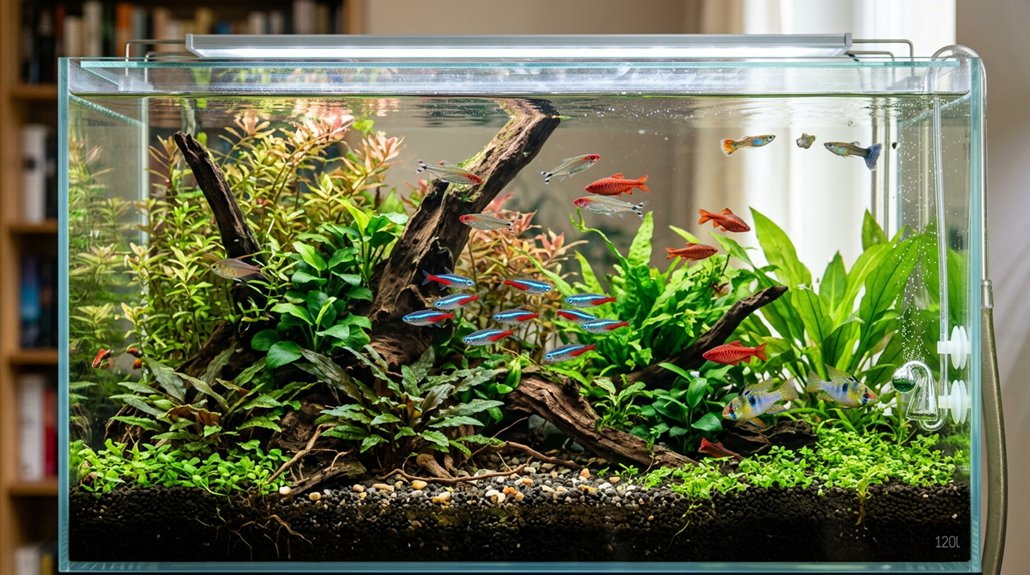
To maintain a freshwater aquarium the right way, you should choose a properly sized tank with a strong filter and heater, then fully cycle it before adding fish. Stock lightly, quarantine newcomers, and feed only what they finish in about two minutes. Keep hardy plants, test ammonia, nitrite, nitrate, and pH monthly, and do 15–25% water changes with dechlorinated, temperature-matched water. Clean the substrate and filter gently, and the details that make this easier come next.
Key Takeaways
- Cycle the tank fully, then add fish gradually and quarantine newcomers for about three weeks to protect water quality and fish health.
- Use a properly sized filter and heater, keep temperature stable, and place the tank away from direct sunlight and drafts.
- Feed sparingly, remove leftovers quickly, and avoid overstocking with small, low-bioload species for a more stable aquarium.
- Perform 15–25% water changes every 1–2 weeks, vacuum the substrate, and match dechlorinated replacement water to tank temperature.
- Test ammonia, nitrite, nitrate, pH, phosphate, and hardness monthly, then adjust maintenance if any values drift out of range.
Choose the Right Tank, Filter, and Heater
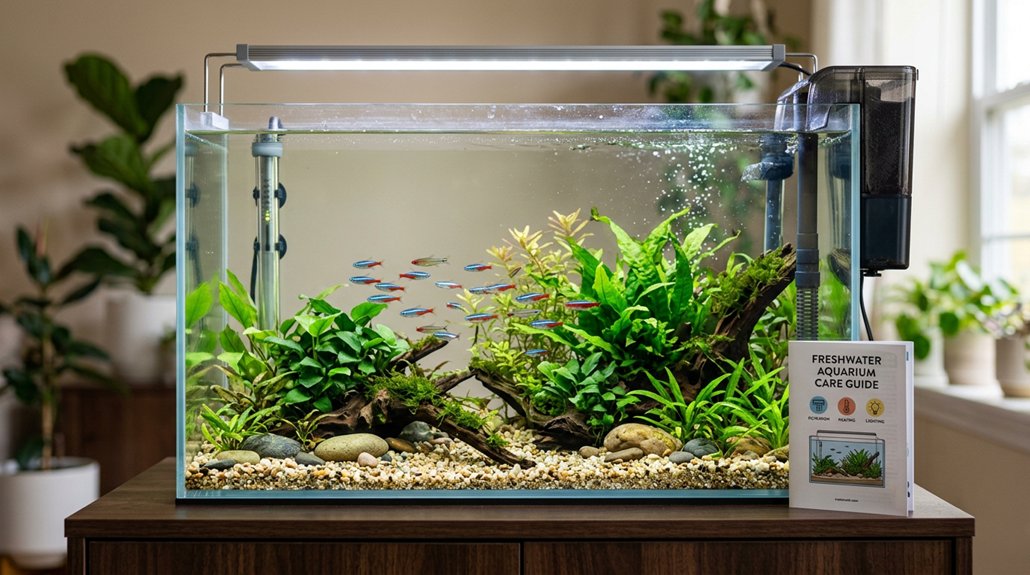
Choosing the right setup is the foundation of a stable freshwater aquarium. You should select the largest tank your space and stand can safely support; 20+ gallons gives you better thermal and chemical stability than a nano tank. For tank placement, keep it away from direct sunlight, doors, and vents, and set it on a sturdy stand near a grounded outlet. Choose a filter rated for 4–6x your tank volume per hour, with mechanical and biological media, plus chemical media if needed. Hang-on-back and canister filters offer strong performance and easy maintenance; sponge filters suit low-bioload shrimp or fry tanks. Size the heater at 3–5 watts per gallon and set it to 75–80°F. Good energy efficiency comes from matched equipment.
Cycle Your Freshwater Aquarium First
Before you add most fish, let the aquarium cycle for 4–6 weeks until ammonia and nitrite both test at 0 ppm and nitrate stays low, because this is when beneficial nitrifying bacteria establish in the filter and substrate. During aquarium cycling, you’ll supply an ammonia source, either pure ammonia for a fishless start or a few hardy fish, then test daily for ammonia, nitrite, and nitrate. The spike should rise, peak, and fall as bacteria establishment progresses. You can speed-cycle safely by transferring mature filter media, gravel, or water from a healthy established tank, or by using a reputable nitrifying bacteria product. After cycling, add fish gradually over weeks so you don’t overload the biofilter. Quarantine new fish separately for about 3 weeks before transfer.
Pick Low-Maintenance Aquarium Plants
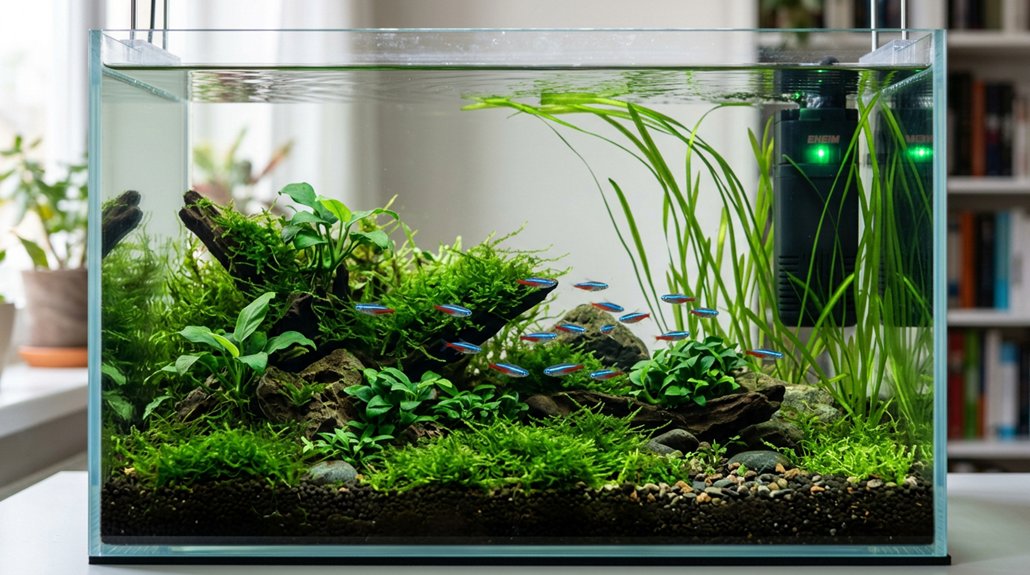
For a low-maintenance setup, you should start with slow-growing, low-light aquatic plants such as Anubias, Java fern, Bucephalandra, and Cryptocoryne, since they need less pruning and stay stable longer. Rosette plants and other substrate rooters do best with root tabs, while free-rooting species usually need only occasional liquid fertiliser. You can also add fast-growing floaters like Amazon frogbit to absorb nitrates and extend the time between water changes.
Best Low-Maintenance Plants
A few well-chosen plants can make a freshwater tank look established without adding much work. Start with Anubias and Java fern; both tolerate low light propagation and respond well to attachment techniques on wood or rock, so you won’t need substrate fertilization. Add Cryptocoryne if you want rooted structure; use root tabs, expect an occasional melt, then let it recover. Vallisneria and other runner plants are useful when you want passive nitrate uptake, because they spread by runners and fill space quickly with little intervention. For the lowest upkeep, consider Marimo moss balls or Bucephalandra: they grow slowly, need minimal trimming, and stay stable in low-tech setups. Choose a small group, then let the plants establish before adjusting your maintenance routine.
Easy Floating Plants
Floating plants are one of the easiest ways to lower maintenance in a freshwater aquarium because they take up dissolved nutrients directly from the water column. Choose Amazon frogbit for rapid nitrate uptake; in nutrient-rich tanks, it reproduces quickly and can extend water-change intervals. Duckweed also works, but frogbit’s larger leaves are easier to remove in bulk and less likely to clog filters.
- Use moderate light for Salvinia and water lettuce.
- Trim or harvest often to prevent surface shading.
- Add pothos or Scindapsus with roots in the tank.
- Treat these as nitrate sinks, not décor.
- For Marimo care, gently squeeze and rinse occasionally.
You’ll keep water clearer, reduce algae pressure, and stabilize nutrient levels with minimal effort.
Stock Fish and Cleanup Crew Lightly
You should stock conservatively, using a simple rule like tank length × width ÷ 30 for total fish inches, and add fish slowly so you don’t overload biological filtration. Choose small, low-bioload species and keep the cleanup crew modest, such as one to three nerite snails plus a few Amano or cherry shrimp, since they add useful grazing without much extra waste. Monitor ammonia, nitrite, nitrate, and phosphate monthly, and do 15–25% water changes every 1–2 weeks as needed to keep nutrient levels stable.
Light Stocking Basics
Stocking lightly keeps a freshwater aquarium stable, especially early on when filtration and plants are still adapting. Keep stocking density conservative: use (tank length × width) / 30 as a rough ceiling for adult fish inches, then make gradual additions one or two at a time.
- Choose nano rasboras, tetras, kuhli loaches, or small Corydoras.
- Avoid large-bodied fish and prolific breeders.
- Add a modest cleanup crew: 3–6 shrimp or 2–4 nerite snails.
- Match crew to conditions; nerites graze algae, but not hair algae.
- Test ammonia, nitrite, and nitrate weekly.
If levels rise, change up to 25% of the water more often. Don’t expect the cleanup crew to replace filtration; it only helps keep waste manageable.
Shrimp and Snail Helpers
A light cleanup crew can make a freshwater tank more stable without adding much bioload. Add 5–10 Amano shrimp in a 20–30 gallon tank for dependable algae control, and stock 1–2 nerite snails per 5–10 gallons for steady grazing; nerites won’t reproduce in freshwater, but they don’t eat hair algae. Keep nitrate under 20–40 ppm, and don’t do sudden water changes over 25%, since shrimp and snails stress fast. Leave some leaf litter, mopani or Indian almond leaves, and rough decor so biofilm grows and shrimp have molting shelters. Choose small nano fish, like tetras or rasboras, and avoid large or aggressive species. Light stocking reduces predation, waste, and nutrient spikes, helping your cleanup crew stay healthy.
Feed Sparingly and Avoid Overcrowding
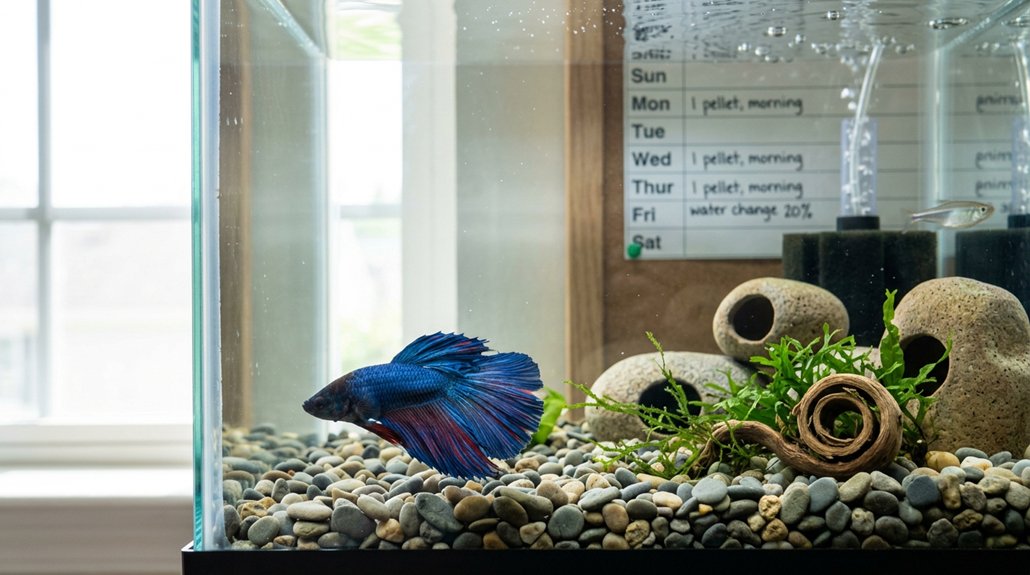
Feed sparingly to keep water quality stable: offer only what your fish can finish in about two minutes once a day, or just a small pinch for tiny species, and remove any leftovers after about five minutes. Tight portion control limits waste, ammonia, and filter load.
- Follow stocking limits based on tank dimensions.
- Research each species’ adult size before buying.
- Choose low-bio-load fish, shrimp, or snails.
- Avoid prolific breeders if you want low maintenance.
- Add a few fish at a time, with weeks between purchases.
Use conservative stocking rules, such as tank length × width ÷ 30 for total inches of fish, as a rough ceiling. Understocking keeps chemistry steadier, and fast-growing floaters can absorb some feeding byproducts.
Follow a Simple Water Change Routine
Regular water changes keep a freshwater aquarium stable by removing nitrates, detritus, and other dissolved waste before they accumulate. You should replace 15–25% of the water every 1–2 weeks, or about 25% every two weeks, to refresh minerals without disturbing biological filtration. Never exceed a 25% change at once, and always match temperature and treat replacement water with dechlorinator. Use staged changes if fish are sensitive, and choose plant safe conditioners when live plants are present. During each partial change, run a gravel vacuum to remove settled debris and limit phosphate buildup, which helps suppress algae. Between scheduled changes, top off evaporative loss with treated water. Once a month, perform a fuller partial change to restore trace minerals and remove concentrated waste products.
Test Your Water Each Month
Each month, you should test pH, ammonia, nitrite, nitrate, phosphate, and hardness with a reliable multi-test kit to catch gradual changes early. Keep ammonia and nitrite at 0 ppm, and hold nitrate below 40 ppm, ideally under 20 ppm for sensitive fish. Record each reading and any maintenance you’ve done so you can track trends and make timely corrections.
Monthly Water Testing
Test your aquarium water every month so you can catch toxic spikes early and confirm your biofilter is still stable. Test ammonia, nitrite, nitrate, pH, phosphate, and GH, then compare results with your test logs. If ammonia is above 0 ppm, nitrite exceeds 0.75 ppm, or nitrate tops 40 ppm, vacuum substrate, do a ≤25% water change, and boost aeration with beneficial bacteria.
- Use substrate sampling to check hidden waste.
- Keep phosphate near 0.2 ppm or lower.
- Add phosphate-absorbing media if phosphate climbs.
- Make hardness or pH corrections with no more than 25% water at once.
- Track trends so you can adjust feeding, stocking, plants, or water-change frequency.
Check pH And Nitrates
Once a month, check pH and nitrate with a reliable test kit, and repeat the test any time fish look stressed or you’ve made a major maintenance change. Use test strips for quick screening, then confirm with liquid tests if readings drift. Most community tanks stay near 6.8–7.8; goldfish need different conditions. Keep nitrate below 20–40 ppm, or under 10–20 ppm in sensitive or planted systems.
| Parameter | Target | Action |
|---|---|---|
| pH | Stable | Log monthly |
| Nitrate | <20–40 ppm | Increase water changes |
| Ammonia/Nitrite | 0 | Change ≤25% water |
If ammonia or nitrite appears, act immediately: partial water change, check filtration, add beneficial bacteria. Record results to catch trends. For controlled shifts, use buffer media or RO plus remineralization; never alter more than 25% at once.
Clean the Tank Without Causing a Spike
During routine maintenance, change only 15–25% of the water at a time, never more than 25%, so you don’t shock the biological filter or trigger ammonia and nitrite spikes. Vacuum the substrate well; it’s gravel less maintenance when you remove trapped debris and excess phosphate before they fuel algae.
- Use dechlorinated water that matches tank temperature and hardness.
- Mix RO water with remineralizer only if you’re adjusting GH/KH.
- Rinse filter media in removed tank water, not tap water.
- Stagger filter floss cleaning and replace no more than one-third of media.
- Test ammonia, nitrite, and nitrate before and 24–48 hours after major cleaning.
If ammonia or nitrite rises, do another ≤25% water change and boost aeration while you correct the cause.
Fix Common Water Problems
Monthly water testing keeps most freshwater issues from becoming emergencies, and if you notice fish gasping, clamped fins, or lethargy, check ammonia, nitrite, nitrate, pH, and phosphate right away. Correct anything above ammonia 0 ppm, nitrite 0.75 ppm, or nitrate 40 ppm with a 15–25% water change, never more than 25% at once. If ammonia or nitrite spikes, add aeration for oxygen management, dose beneficial bacteria, and review feeding and filtration. Keep phosphate below 0.2 ppm by vacuuming substrate, changing water, and using phosphate media. For high pH or hardness, adjust slowly with RO water, or use driftwood or peat for gradual acidification. Good algae identification helps you connect excess nutrients to water imbalance and target the cause, not just the symptom.
Keep Aquarium Plants Healthy Long Term
To keep aquarium plants healthy long term, match your care to their growth style: use root tabs for substrate feeders like crypts and swords, and dose a regular liquid fertilizer for free-rooting or floating plants according to the label to avoid nutrient deficiencies. Your substrate selection should support rooted species, while your lighting timer should hold 8–10 hours and stay gentle for anubias and java fern.
- Add CO2 only for demanding stems.
- Use liquid carbon in low-tech tanks sparingly.
- Remove melting leaves quickly.
- Do seasonal pruning before growth crowds the tank.
- Test ammonia, nitrite, nitrate, and phosphate monthly.
If nitrates climb, add Amazon frogbit or pothos. When you introduce new plants, do it one at a time; some melting’s normal, but prompt cleanup keeps algae and nutrient spikes down.
Frequently Asked Questions
How Long Should You Let Water Sit for a Fish Tank?
You should only let treated water sit long enough to match tank temperature; dechlorination methods handle chlorine/chloramine immediately. If you use RO or distilled water, add mineral supplementation first, then use it right away.
What Not to Do With a Fish Tank?
Don’t overfeed or overcrowd your tank; small mistakes create big problems. You shouldn’t use soap, rush stock additions, ignore cycling, or place decor that traps waste. Overfeeding consequences include ammonia spikes, algae, and stressed fish.
How to Maintain an Aquarium at Home for Beginners?
You’ll maintain it by cycling the aquarium first, then testing water weekly, doing 10–25% dechlorinated water changes, controlling algae, cleaning substrate, feeding sparingly, and quarantining new fish before adding them.
What Kills Fish in a Fish Tank?
You’ll lose fish to ammonia, nitrite, oxygen depletion, overcrowding, medication overdoses, sudden temperature shifts, and poor water quality. Test often, avoid overfeeding, maintain filtration, and change water gradually to keep them alive.
Conclusion
Keeping a freshwater aquarium healthy is like tuning a small ecosystem: every part has to work together. If you choose the right equipment, cycle the tank properly, stock lightly, and feed sparingly, you prevent most problems before they start. Test your water regularly, clean carefully, and correct issues fast so your fish and plants stay stable. With consistent, measured care, you’ll build an aquarium that runs smoothly and lasts long term.