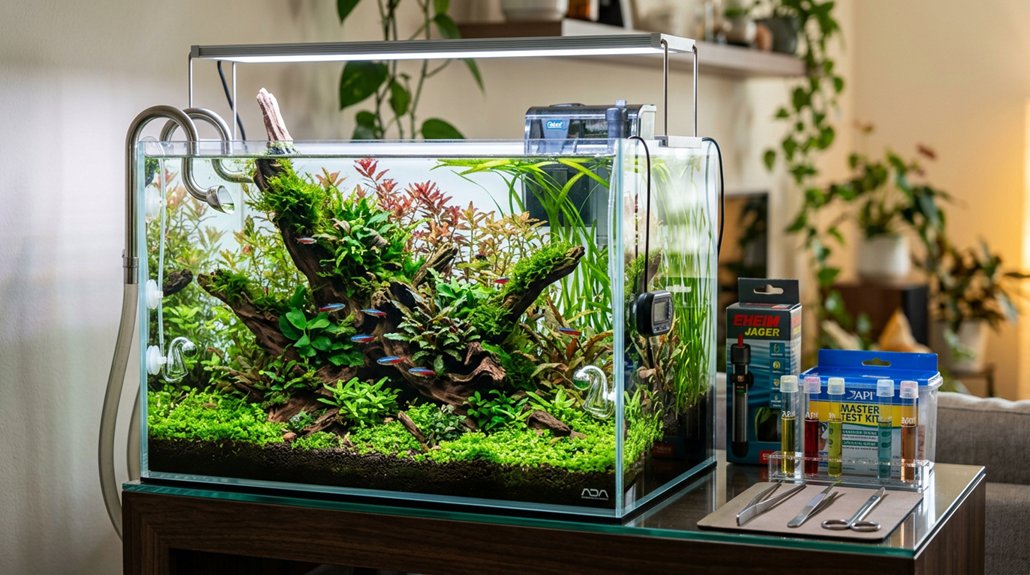
You can expect to spend about $130 to well over $1,000 to set up a freshwater aquarium, depending on tank size, material, and equipment quality. A basic 20-gallon system often runs $130 to $200, while a mid-range setup is usually $200 to $350. Your biggest costs are the tank, stand, filter, heater, lighting, test kit, and first fish. Plants, decor, and ongoing supplies add more, and the details matter a lot more than you might think.
Key Takeaways
- A freshwater aquarium setup usually costs about $130 to over $1,000, depending on tank size and equipment quality.
- A basic 20-gallon system typically costs $130–$200, while a mid-range setup is often $200–$350.
- Tank material matters: glass is usually cheaper for standard tanks, while acrylic costs more but is lighter and stronger.
- Starter kits can miss essentials like stands, heaters, and proper filters, adding $155–$305 or more to the real cost.
- Ongoing costs include electricity, filter media, food, test kits, and maintenance, often adding $10–$50+ per month.
How Much Does a Freshwater Aquarium Cost Upfront?
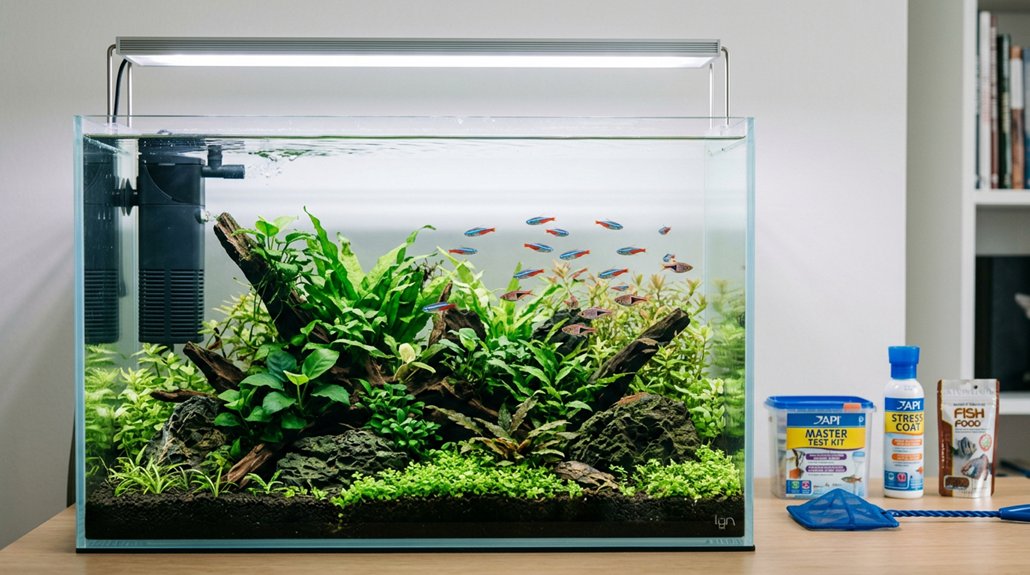
A freshwater aquarium can cost anywhere from about $130 to well over $1,000 upfront, depending on tank size and equipment quality. If you’re building a basic 20-gallon system, you might stay near $130–$200; a mid-range new setup often lands around $200–$350. A fully equipped 29-gallon setup is about $641, with the tank, stand, light/hood, filter, and heater taking the largest shares. Budget starter kits near $99 usually omit essentials, so your actual total can climb after you add a stand, heater, gravel, siphon, test kit, and water conditioner. Freshwater’s lower cost versus saltwater makes it the better beginner choice. You can cut expenses with used gear or sale kits, but don’t skimp on a reliable filter and liquid test kit for a minimal biofilter from day one.
Choose the Right Tank Size and Material
Your tank is typically the largest upfront cost, and its price rises quickly with size and material: a 20-gallon glass tank often costs about $50–$150, while a comparable acrylic tank is usually $100–$250. For most free-standing aquariums up to about 180 gallons, glass is the standard choice, but acrylic is lighter and better for very large or custom installations, even though it usually costs more. If you want maximum clarity, low-iron glass can improve visibility, but you’ll pay a premium for it.
Tank Size Costs
Choosing the right tank size and material is one of the biggest upfront cost decisions in a freshwater setup. For most free-standing builds, glass gives you better value and glass longevity, especially when stand placement is level and stable. A 29-gallon glass tank often lands around $90, while 10–20 gallon glass models usually run $50–$200.
- 50+ gallon glass tanks commonly cost $300–$1,000+
- Comparable acrylic tanks often cost $100–$300+ in small sizes
- Very large acrylic systems can reach $500–$2,000+ or more
You can cut costs by buying used through classifieds or club auctions, but you’ll need to inspect seams, scratches, leaks, and frame integrity before you commit.
Glass Versus Acrylic
Glass and acrylic each solve different aquarium problems, so the right choice comes down to size, placement, and budget. For most home free-standing tanks up to about 180 gallons and heights under 24 inches, glass is usually the most cost-effective option. You’ll often pay about $50–$200 for 10–20 gallons and $300–$1,000 for 50+ gallons. Glass is rigid, resists scratching, and supports straightforward maintenance; it’s also easier to assess for glass recycling at end of life. Acrylic costs more, but it’s lighter, stronger against impact, and better for tall, wall-mounted, or custom builds. Expect roughly $100–$300+ for 10–20 gallons and $500–$2,000+ for 50+ gallons. Acrylic bonding enables seamless fabrication, but scratches and stand requirements can raise total cost.
What Equipment Does a Freshwater Aquarium Need?
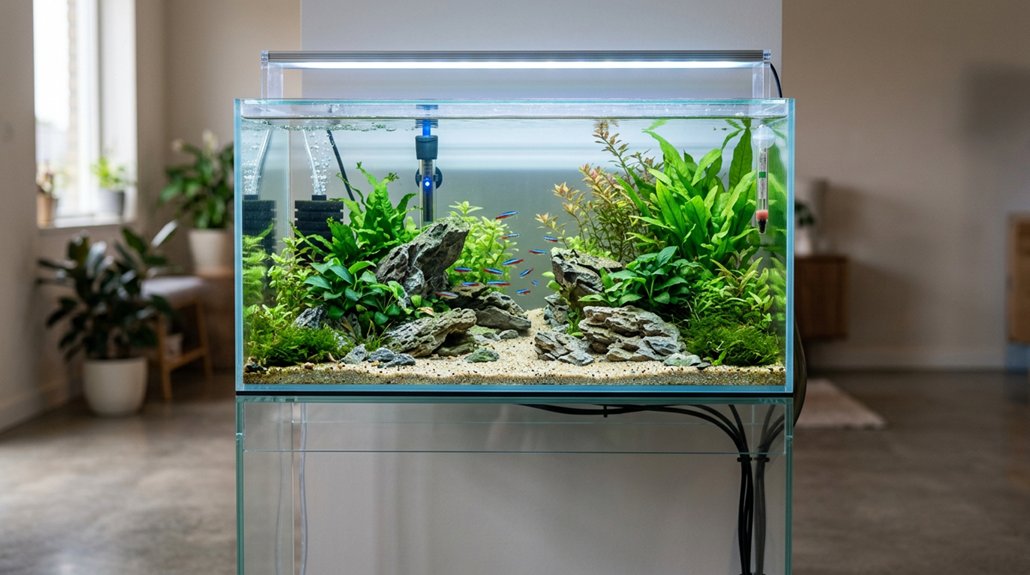
You’ll need the core hardware first: the tank, a properly rated stand, a filter sized for at least twice the tank volume, a heater for tropical species, and a hood/light. Filtration and heating are the most critical systems because they keep water quality stable and temperatures within the species’ required range. Once those are in place, you can add the substrate, decor, plants, and testing tools that support the aquarium’s biological function and maintenance.
Essential Tank Equipment
At minimum, a freshwater aquarium needs a properly sized tank, a sturdy stand, a filter rated for at least twice the tank’s volume, an adjustable heater for tropical species, and an appropriate hood or light. You’ll usually start with a 29-gallon tank, but size should match stocking plans. Add substrate and decor for biological surface area, fish welfare, and aquatic landscaping; gravel, planted substrate, driftwood, rock, and live plants often run $20–$100. For noise reduction, place the stand on a level surface and choose a fitted hood.
- Liquid test kit, conditioner, and basic medications
- Siphon, scraper, bucket, and net for maintenance
- Budget for media, food, and spare parts
Filtration And Heating
Reliable filtration and heating are the core systems that keep a freshwater aquarium stable and habitable. You should choose a filter rated for at least twice your tank volume; for a 29-gallon tank, that means 60+ gallons. This helps maintain proper flow rate and supports mechanical, chemical, and biological filtration. Cheap starter-kit filters are often undersized, which can trigger ammonia spikes and fish loss. Expect recurring media costs of about $44 per year for a 29-gallon setup. Replace carbon or ammonia absorbers every 1–3 months, rinse mechanical media regularly, and clean biological media gently. For tropical fish, use an adjustable heater, usually $15–$100, set to 75–78°F. Good heater placement improves circulation. Add an air pump, airstone, and liquid test kit to verify water quality.
What Starter Kits Leave Out
Most $99 starter kits cut corners in the places that matter most. You’re often left buying a stand, heater, and proper lighting separately, which can add $155–$305 before setup is complete. Kits also tend to ship with undersized filters; for a 29-gallon tank, you’ll want filtration rated for at least twice the volume, often costing $40–$200.
- Missing accessories drive hidden costs fast.
- Test kits, conditioner, and siphons aren’t optional.
- Small tools and filter media raise the real budget.
You’ll usually need a liquid test kit, water conditioner, a siphon, thermometer, net, and algae scraper, plus replacement media. Those missing accessories can trigger hidden costs and water-quality problems if you skip them.
How Much Do Plants, Decor, and Fish Cost?
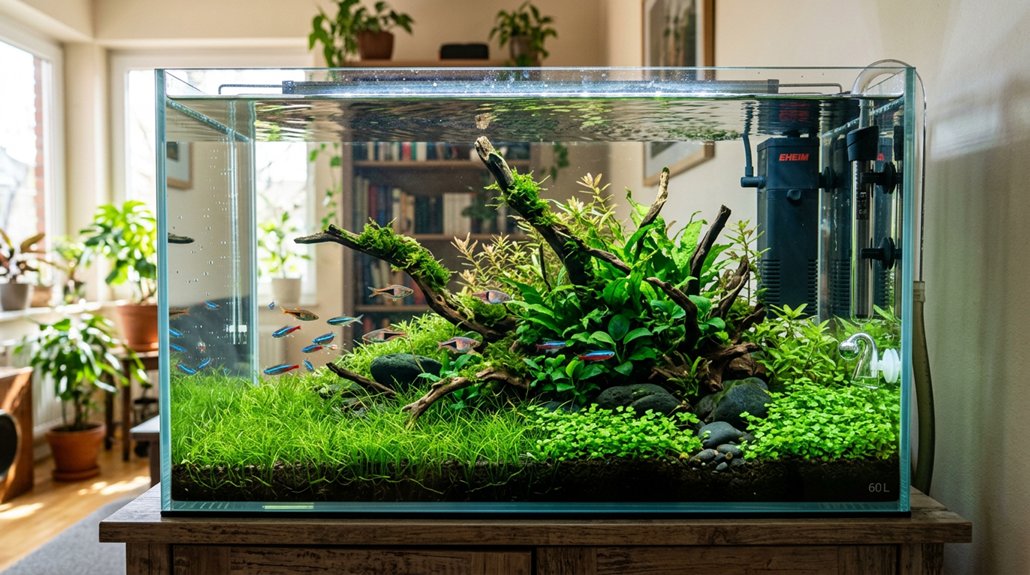
Plants, decor, and fish can quickly add $100–$300+ to a freshwater setup once you price out the basics. For live plants, you’ll usually pay $1–$5 each; a modest 20–30 gallon planted tank often totals $25–$100. Driftwood and rocks commonly run $10–$50 per piece, and specialty hardscape can exceed $100, so medium-tank decor often lands around $30–$100. Artificial ornaments typically cost $5–$50 each, adding $15–$100 if you want extra visual structure. Beginner fish are cheap individually—neon tetras and guppies are often $1–$5—but stocking a healthy community can still reach $30–$100+. Don’t forget $20–$50 for fertilizers, root tabs, sealants, and $10+ for food or quarantine supplies. Watch aquascaping trends and seasonal sales to lower your total.
Freshwater vs. Saltwater: Which Costs Less?
When you compare freshwater and saltwater aquariums side by side, freshwater usually comes out far cheaper to set up and maintain. Beginner budgets are easier to manage because a mid-sized freshwater tank often costs about $546–$641, while a comparable marine system can reach roughly $1,395.
- You’ll usually need standard filters, basic lighting, and simple substrate.
- Saltwater systems often require salt mix, live rock, skimmers, and stronger lighting.
- Freshwater setups can deliver long term savings with lower equipment and livestock costs.
For you, that means less specialized gear, fewer chemistry demands, and reduced risk of expensive losses. Saltwater tanks also need tighter testing and dosing, which raises complexity and cost. If you want a predictable, economical entry point, freshwater is the more efficient choice.
What Ongoing Aquarium Costs Should You Expect?
You’ll need to budget for recurring costs like filter cartridge or chemical media replacements, which can run about $44 per year on a 29-gallon tank, plus electricity that rises with tank size and equipment load. Monthly consumables such as fish food, water conditioner, and occasional medication usually add another $10–$30, while larger systems may cost $20–$50 per month to operate. Don’t overlook hidden maintenance expenses like test kits, siphon tools, and a small buffer for substrate, plant, or fish replacement.
Recurring Filter Replacements
Regularly, filter upkeep becomes one of the most predictable ongoing aquarium expenses. For a 29-gallon freshwater tank, you can expect about $44 per year for cartridge replacements, with chemical media swapped every 1–3 months. Your filter lifespan depends on brand, loading, and maintenance, so budget $20–$100 annually for small tanks, and more for canister or specialty systems.
- Chemical media: carbon, ammonia absorbers
- Mechanical media: rinse, replace when worn
- Media disposal: plan for used cartridge removal
Foam, floss, and other worn mechanical parts may need replacement as needed, while sponges and mesh usually need periodic rinsing only. These recurring costs are predictable, and they help prevent water-quality problems. Include them in your annual budget so hidden expenses don’t surprise you or contribute to fish illness.
Food, Conditioner, Medication
Food, conditioner, and basic medication are small but recurring aquarium expenses you should budget for from the start. You’ll usually spend about $10+ per year on staple foods for a small-to-medium freshwater tank, including flakes, pellets, and occasional frozen or live treats. If you use homemade diets, plan to match them carefully to your fish’s nutritional needs. Water conditioner is another routine buy; expect $5–$15 per bottle, with one bottle lasting several months, depending on tank size and water-change volume. Keep a modest first-aid stock: antibiotic, antifungal, anti-parasitic, salt, and stress relief products often total about $15 initially. Replenishing them as needed, plus occasional seasonal supplements, can add another $30–$50 if disease treatment’s required.
Hidden Maintenance Expenses
Beyond the startup price, an aquarium carries several hidden maintenance expenses that can materially affect your annual budget. You’ll need to plan for recurring filter cartridges and chemical media, which can total about $44 per year for a 29-gallon tank, with carbon often replaced every 1–3 months.
- Consumables: food, conditioner, and medications usually add $10–$50 yearly, plus a $30–$50 reserve for illness or replacements.
- Power: heaters, filters, and lights can cost a few dollars monthly for small tanks, or $20–$50 per month for larger systems.
- Supplies: test kits, algae scrapers, and gravel-vac parts may average $10–$20 per month.
Don’t ignore time valuation: weekly water changes, testing, and filter upkeep take labor. Poor maintenance also raises chemistry risks, fish loss, and unexpected repairs.
How to Cycle and Test a New Aquarium
Cycling a new freshwater aquarium means establishing the nitrogen cycle before adding fish, which usually takes at least 2–4 weeks, often 3–4, while the filter runs with no livestock so nitrifying bacteria can convert ammonia to nitrite and then nitrate. You can speed start-up with bottle cycling and bacterial supplements, but you still need to test frequently. Use a reliable liquid test kit every 2–3 days to track ammonia, nitrite, and nitrate; wait until ammonia and nitrite read 0 ppm and nitrate stays below about 20 ppm. If you’re filling with tap water, condition it first to remove chlorine and chloramine. If levels spike, do only partial water changes so you don’t disrupt the developing bacterial colony. Once cycled, add fish slowly and acclimate them carefully.
How to Save Money on Aquarium Setup
You can trim aquarium startup costs by spending strategically instead of cutting corners. Buy a quality used tank and stand on Marketplace or Craigslist; inspect seams for leaks and reseal if needed. Avoid $99 starter kits unless you’re on a strict budget, since they often exclude essentials and leave you near the true $641 cost of a fully equipped 29-gallon setup. Prioritize a filter rated at least 2x tank volume and a liquid test kit. These reduce fish loss and replacement costs.
- Consider DIY filtration only if you can verify flow and media capacity.
- Use Community trading for plants, driftwood, and rock.
- Buy consumables in bulk or on sale.
Choose freshwater over saltwater, and stock hardy guppies or tetras.
How to Keep a Freshwater Aquarium Worth the Cost?
Once you’ve trimmed startup expenses, the real question is whether the tank stays worth the investment over time. You keep value high by treating the aquarium like a controlled system: cycle it 2–4 weeks, test ammonia, nitrite, and nitrate, and stock only after parameters are stable. Use equipment that prevents failures and replacement costs.
| Action | Cost Impact |
|---|---|
| Oversized filter | Lower maintenance |
| Reliable heater | Fewer losses |
| Slow stocking | Less disease |
| Regular water changes | Better stability |
Plan long term maintenance around filter media, food, conditioner, and a small medication reserve. A $30–$50 buffer works as hobby insurance. Research compatible species first, then add fish gradually and avoid overstocking. With disciplined care every 1–2 weeks, you protect livestock, reduce surprises, and keep the tank economically defensible.
Frequently Asked Questions
Is It Cheaper to Build or Buy a Fish Tank?
Buying’s usually cheaper upfront, but a DIY setup can save you money if you source used gear. Custom aquascaping adds cost either way, though you’ll control quality, compatibility, and long-term maintenance better.
How Much Does It Cost to Start a Freshwater Tank?
You’ll usually spend $130–$350 on a basic freshwater tank, $500–$1,000+ on a planted one, and about $641 for a fully equipped 29-gallon setup; beginner stocking, aquascape design, and maintenance add recurring costs.
How Much Does It Cost a Month to Run a 20 Gallon Fish Tank?
You’ll usually spend about $15–$40 monthly on a 20-gallon tank, depending on filtration maintenance, aquarium placement, food, conditioner, test reagents, and electricity; high-power lighting or constant heating can push it toward $30–$50.
Is Owning a Fish Tank Expensive?
No, you don’t have to spend a fortune. A 29-gallon tank may cost $641 upfront, but tank maintenance averages about $44 yearly. If you skip quality gear, fish losses can make hobby time expensive.
Conclusion
In the end, your freshwater aquarium’s cost depends on tank size, equipment quality, livestock, and upkeep. If you plan carefully, cycle the tank properly, and buy only what you need, you can control your budget without sacrificing fish health. Start with reliable gear, test water regularly, and resist impulse purchases. That way, you’ll build a stable system that’s worth the expense—no crystal ball required. A well-managed aquarium can stay affordable and rewarding for years.