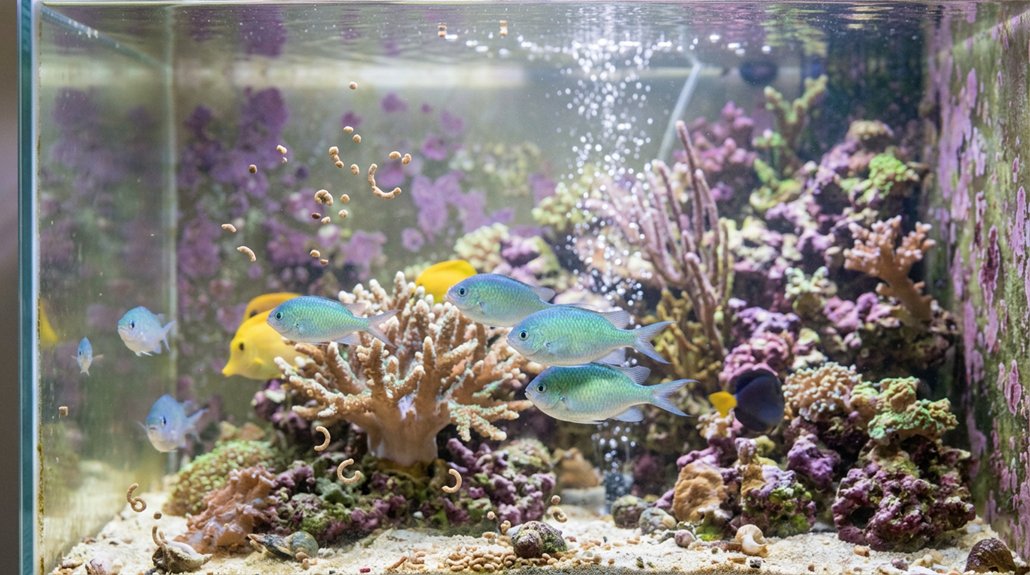
When you overfeed your fish, uneaten food and waste quickly break down, driving up ammonia and then nitrite while lowering dissolved oxygen and raising CO2. You may see cloudy water, surface film, algae growth, clogged filters, and gasping fish. Even brief spikes can irritate gills, suppress immunity, and stress metabolism. If you’ve already overfed, remove leftovers, test water, and consider a partial change; the details below show how to stop it happening again.
Key Takeaways
- Uneaten food decomposes into ammonia and nitrite, which can rise within hours and quickly pollute the water.
- Decay also lowers oxygen, raises CO2, and can make fish gasp, act lethargic, or flash.
- Extra waste fuels cloudy water, algae, bacterial films, and clogged filter media.
- Ammonia and nitrite damage gills, suppress immunity, and increase infection risk.
- Remove leftovers, test water, and feed only what fish eat in 1–2 minutes to prevent overfeeding.
Why Overfeeding Fish Causes Trouble
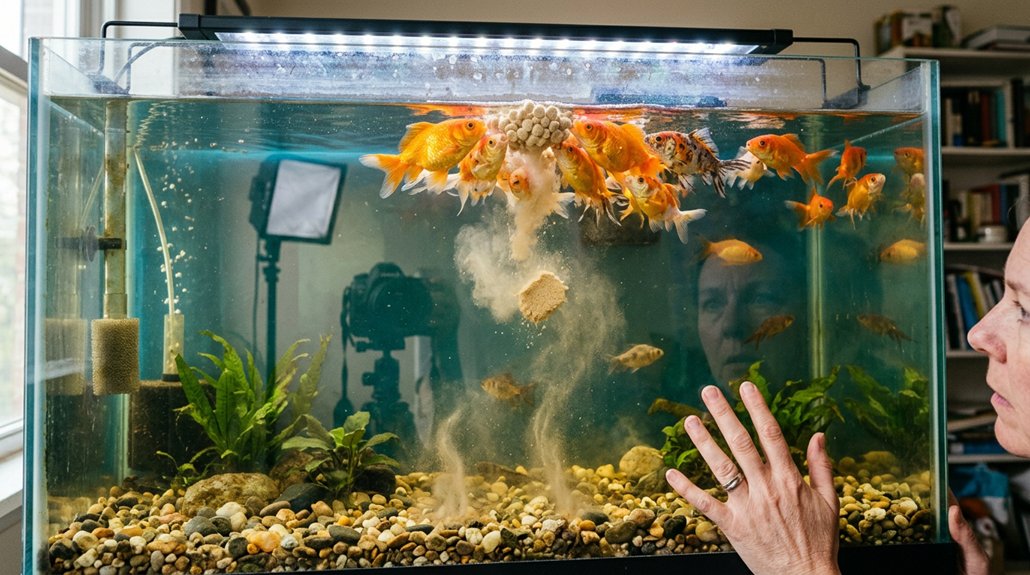
Overfeeding quickly destabilizes a tank because excess food and fish waste decompose into toxic ammonia and nitrite, which should remain at 0 ppm and can start rising within hours. When your feeding behavior exceeds what fish can consume promptly, surplus organic matter begins aerobic decay, lowering dissolved oxygen and raising CO2. That shift can stress fish and alter respiration. Decay acids may reduce pH, while added nitrates and phosphates can stimulate algae blooms, bacterial films, and blue-green scum. Long term, repeated excess feeding can promote hepatic lipidosis and weaken resistance to fin rot. Tight portion control helps you match rations to demand, limit waste, and keep water chemistry stable.
Signs You’ve Overfed Your Fish
If you’ve overfed your fish, you’ll often notice cloudy water and visible uneaten food remnants within 24–72 hours as decomposing organics raise nutrient levels. You may also see algae acceleration and white, cottony mold on décor or gravel, which indicate excess waste in the system. These changes are early, practical signs that your tank’s biological load is exceeding what it can process.
Cloudy Water
Cloudy, milky water often appears within hours to a couple of days after you’ve fed too much, as uneaten food and excess waste decompose and release fine particles and dissolved organic compounds into the tank. This haze signals altered water chemistry and may indicate filtration maintenance needs. Decomposition also consumes dissolved oxygen, releases CO2 and acids, and can destabilize pH, stressing fish.
- Test ammonia and nitrite; both should stay at 0 ppm.
- Keep nitrates under about 20 ppm to limit bacterial blooms.
- Watch for gray-green turbidity, surface film, or white cottony growth on décor.
If you notice this, stop feeding for 2–3 days, remove debris with a siphon or fine net, and perform a 25%–30% water change.
Uneaten Food Remnants
Uneaten flakes, pellets, or food scraps often show up as a surface film or settle on the gravel within minutes to hours, making overfeeding easy to spot. You’re seeing nutrient hotspots form as leftovers decompose, and ammonia and nitrite can rise from 0 ppm within hours. | Sign | Cause | Action |
| — | — | — |
|---|---|---|
| Surface film | Food floats | Skim promptly |
| Gravel debris | Sinking leftovers | Vacuum substrate |
| Gasping fish | Lower O2, higher CO2 | Improve aeration |
| Cloudy water | Bacterial load | Fast 2–3 days |
| Clogged filter | Excess organics | Rinse media in tank water and change ~25% |
Those leftovers can also trap leftover microplastics. If you keep feeding, you’ll reduce filtration efficiency and stress fish before chemistry stabilizes.
Algae And Mold Growth
As excess food breaks down, it releases nitrates and phosphates that can fuel algae blooms, turning the water green, blue-green, or red within days. You may also see white, cottony mold on gravel, decorations, and plants, especially in low-flow zones where organics accumulate. Decomposition lowers dissolved oxygen, so filamentous algae and cyanobacteria can expand quickly after a single heavy feeding.
- Watch for recurring green film on glass.
- Check for slimy mats and planaria on surfaces.
- Note any light biofilm that returns after cleaning.
Persistent overfeeding keeps nutrients elevated, so seasonal blooms can become chronic and require repeated water changes. If you keep feeding too much, you’re creating conditions that favor mold, biofilm, and unstable water quality.
How Overfeeding Fish Hurts Water Quality
When you overfeed fish, uneaten food and excess waste decompose quickly, driving ammonia and nitrite upward within hours; both should stay at 0 ppm. That same aerobic breakdown consumes dissolved oxygen and raises CO2, so you may see low-oxygen stress or fish gasping at the surface. As organic matter accumulates, the water can turn cloudy and filter performance may drop, making immediate debris removal and a partial water change important.
Ammonia and Nitrite Spikes
Even a single overfeeding event can quickly destabilize water quality, because excess food and added fish waste begin decomposing into ammonia within hours, often raising measurable levels that are toxic to fish. You may see an ammonia→nitrite spike as beneficial bacteria oxidize waste during microbial succession, testing your biofilter resilience. Both compounds can injure gills at very low concentrations, so target 0 ppm for each.
- Test water every few days after overfeeding.
- Remove debris and siphon substrate.
- Do a partial water change of up to 25–30%.
If your biofilter’s overloaded, don’t wait for symptoms. Rapid testing and cleanup can cut toxic exposure before nitrite rises further and compounds the stress on your fish.
Oxygen Loss and Cloudiness
Uneaten food and excess waste don’t just foul the tank—they fuel aerobic decomposition that can start stripping dissolved oxygen within hours of a single overfeeding event. As microbes break down protein-rich debris, they release ammonia, nitrites, acids, and carbon dioxide, so your fish face gill stress, higher metabolic demand, and reduced oxygen uptake. The water can turn cloudy in 24–48 hours as suspended particles and rapid microbial growth increase turbidity; if you stop feeding, it may still take 2–3 days to clear. Elevated nitrates and phosphates also drive algal and bacterial blooms, including cyanobacteria, which deepen nighttime oxygen dips. Watch for microbial stratification and, in severe cases, gas bubble disease risk from unstable water chemistry.
Ammonia, Nitrite, and Oxygen Spikes
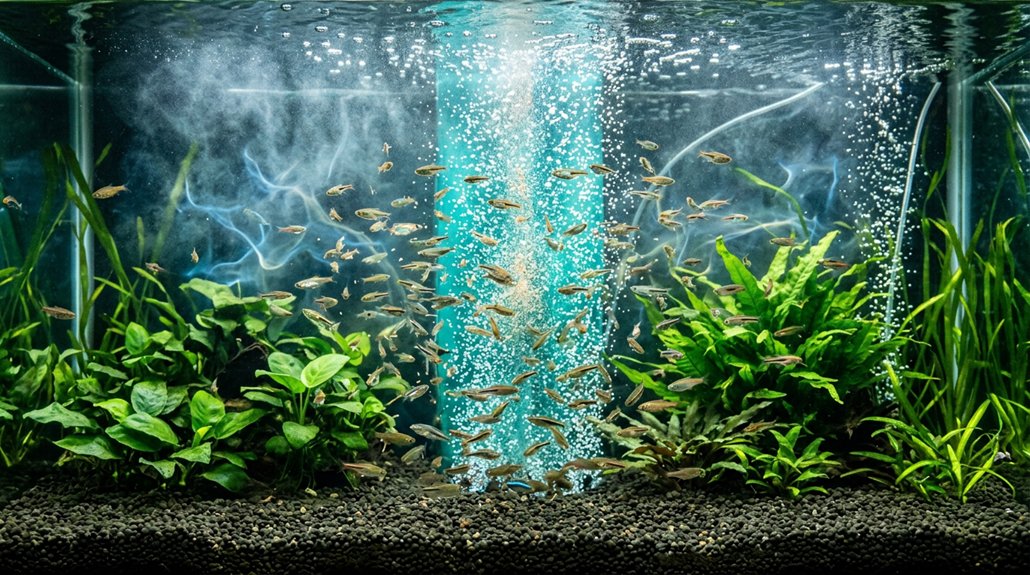
As excess food and waste break down, they quickly release ammonia, and even a small rise can stress or kill fish, so ammonia should stay at 0 ppm. In your tank, nitrifying bacteria convert that ammonia to nitrite, which must also remain at 0 ppm because it impairs respiration. A single feeding mistake can trigger spikes within hours, so start ammonia monitoring within 24 hours and continue daily during instability.
- Test ammonia and nitrite promptly.
- Increase oxygen supplementation if fish gasp.
- Remove debris and do partial water changes.
Aerobic decay also consumes dissolved oxygen and adds CO2, so levels can drop fast. If you see pH swings or surface breathing, act quickly, but don’t change more than 25–30% at once.
What Overfeeding Does to Fish Health
Overfeeding doesn’t just foul the water; it directly harms fish health. You create a dietary imbalance when excess calories and nutrients exceed metabolic needs, promoting obesity and fatty liver disease (hepatic lipidosis), especially in African cichlids and rainbowfish. As uneaten food decomposes, ammonia and nitrites can rise, while oxygen drops and CO2 climbs, so your fish may gasp, stress, and become more vulnerable to infection. Persistent exposure to poor water quality also contributes to immune suppression, making recovery from minor injuries and pathogens less effective. Meanwhile, shifting pH, elevated nitrates, and phosphates can trigger algae blooms and other microbial growth. In practice, overfeeding can clog filters, overload the nitrogen cycle, and leave you with chronic toxicity that quietly erodes long-term health.
How Much to Feed Fish Each Time
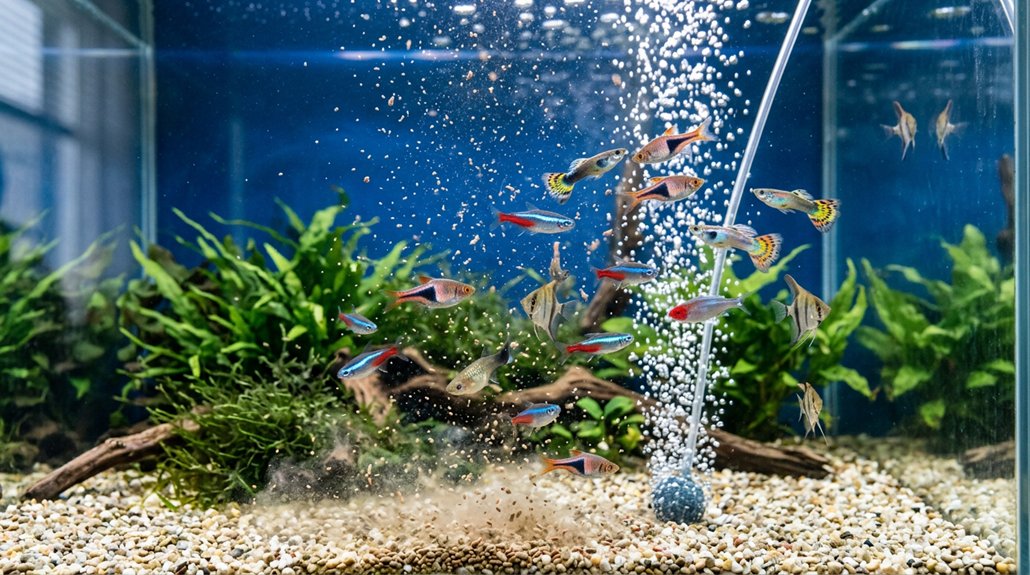
A practical feeding rule is to offer only as much food as your fish can fully consume within 1–2 minutes; if food remains after two minutes, you’ve given too much. Use portion control by counting fish, not tank size, and pre-measure servings so you can see whether they finish instantly or leave residue. Your feeding frequency should match species and size, but the amount per meal still must stay small and precise.
- 2–3 flakes per small fish
- 1 pellet per larger fish
- Reduce portions in cold water
If your tank drops below 60°F, cut amounts and use wheat-germ food; below 50°F, many species shouldn’t be fed. If you suspect excess, skip the next feeding, remove leftovers, and change about 25% of the water.
How Often Fish Should Eat
Most adult aquarium fish do best with one to two small feedings per day, while juveniles often need three or more meals daily to support growth. You should tailor feeding schedules to species, life stage, and digestive physiology. Goldfish and other fish without true stomachs usually do better with several small meals spaced through the day, not one large portion. Nocturnal or crepuscular feeders, such as many catfish and loaches, should get part of their ration shortly before lights-out. Herbivores and constant grazers, including some tetras, mollies, and plecos, benefit from frequent small feedings or plant access. As a practical rule, offer only what they can eat in 1–2 minutes, or up to 5 minutes for slow eaters, and adjust frequency accordingly.
What to Do After Overfeeding Fish
If you’ve fed more than your fish can finish, act quickly to limit water-quality problems: skip the next feeding, or fast the tank for 2–3 days if the fish are healthy, and remove any visible leftovers with a fine net while siphoning the substrate to pull out buried debris. Then keep your feeding schedule consistent and tighten portion control to reduce future waste.
Skip the next feeding, remove leftovers, and tighten portions to protect water quality.
- Perform a 20–30% partial water change with temperature-matched, conditioned water.
- Test ammonia and nitrite within 24 hours, then every few days until they stay at 0 ppm; keep nitrates below 20 ppm.
- Rinse filter media in removed tank water and watch flow; if fish gasp, act lethargic, or flash, contact an aquatic specialist.
How to Prevent Overfeeding Fish
Preventing overfeeding starts with portion control: offer only what your fish can fully consume within 1–2 minutes, or up to 5 minutes in some community tanks, and remove any uneaten food right away. Use a strict feeding schedule; most adult fish do best once or twice daily, while juveniles may need three small feedings. Pre-measure food by fish count and assign one caregiver or an automatic feeder with written portions. | Practice | Target | Benefit |
| — | —: | — |
|---|---|---|
| Portion control | 1–2 min | Limits waste |
| Feeding schedule | 1–2 daily | Stabilizes intake |
| Fasting day | 1/week | Reduces excess |
If you suspect overfeeding, skip a meal, siphon debris, and retest ammonia, nitrite, and nitrate after a 25% water change. Proper filtration, scavengers, and about 8 hours of light also curb nutrient buildup.
Frequently Asked Questions
How Do I Know if I Overfed My Fish?
You’ve overfed your fish if food’s left floating, water clouds, algae blooms, or fish gasp and act lethargic. Check feeding schedules and use water testing; ammonia, nitrite, or rising nitrate confirm excess.
What to Do if Your Fish Is Overfed?
Skip the next feeding, remove uneaten food, siphon debris, and change 25–50% of the water. You’ll need a consistent feed schedule and better portion control, then test ammonia, nitrite, and nitrate within 24 hours.
What Does an Overfed Fish Look Like?
You’ll spot a bloated appearance, faded coloration, and sluggish movement, as if your fish’s dinner budget’s gone union. It may gasp, float poorly, clamp fins, and ignore food, signaling digestive stress or fatty liver.
Will Fish Stop Eating When Full?
Not always; you’ll see some fish stop once they hit stomach capacity, but many keep eating if you offer food. Their feeding cues can be misleading, so you’ll need to portion carefully and watch behavior.
Conclusion
If you overfeed your fish, you can quickly turn a healthy tank into a chemical hazard. Uneaten food decomposes fast, and ammonia can rise in as little as 24 hours, stressing fish and reducing oxygen levels. In one feeding event, water quality can decline enough to trigger illness or death. To avoid this, feed only what your fish can finish in 2–3 minutes, and remove leftovers before they pollute the water.