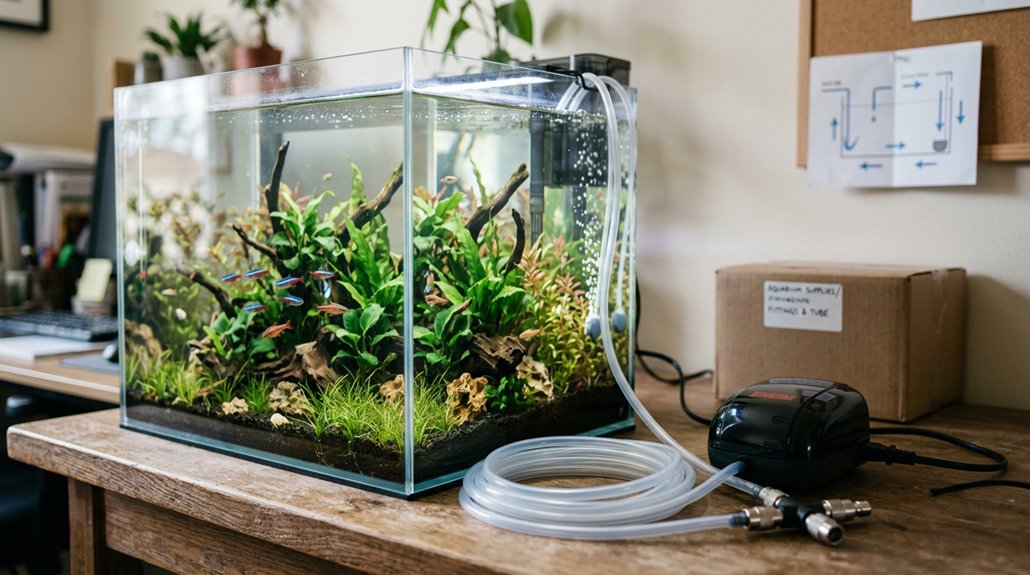
Choose an aquarium air pump by matching airflow and pressure to your tank size, depth, and devices. If your tank is lightly stocked and your filter already breaks the surface, you may not need one. For heavier stocking, warm water, sponge filters, or air stones, size the pump at about 1–2× tank volume per hour and add extra head for deep tanks. Use short tubing, a check valve, and adjustable flow to fine-tune it, and there’s more to dial in below.
Key Takeaways
- Match pump output to tank size, aiming for about 1–2× aquarium volume in air per hour.
- Choose higher-pressure pumps for deeper tanks, long airline runs, or multiple air-driven devices.
- Use adjustable, quiet models with enough head pressure for sponge filters and airstones.
- Keep tubing short and straight, with check valves and splitters to reduce backpressure and leaks.
- Mount the pump on foam or rubber feet, and replace worn tubing to reduce noise and failures.
Do You Need an Aquarium Air Pump?
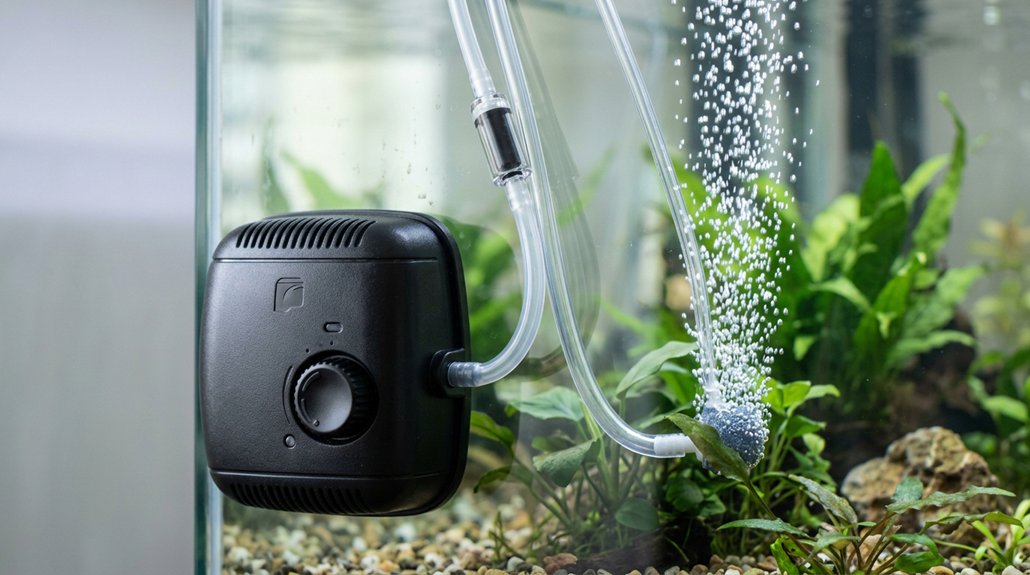
Not every aquarium needs an air pump. If you keep a lightly stocked freshwater tank and your filter creates strong surface agitation, you may already have enough oxygen exchange. In that case, an air pump is optional, not mandatory. You should add one when stocking is heavy, the tank is deeper than 50 cm, water is warm, or fish are sick and medication lowers oxygen tolerance. Air pumps boost surface movement, improve gas exchange, and help remove CO2 and other dissolved gases; they’re especially useful at night when plant respiration continues but photosynthesis stops. If your filter leaves no dead spots, you can rely on it, but an air pump still offers inexpensive backup against hypoxia and equipment failure. If the pump sits below waterline, use a non-return valve.
Choose the Right Aquarium Air Pump Size
You should size your air pump to match tank volume first, using roughly 1–2 times the aquarium’s capacity in air per hour as a practical starting point. If your tank’s deeper or you’re running multiple air-driven devices, you’ll need extra output to overcome backpressure and tubing resistance. Always match the pump to the specific equipment specs, since sponge filters and similar devices often need more than tank size alone suggests.
Tank Size Matters
Tank size is the first factor to match when choosing an air pump, since output needs to scale with water volume and resistance in the system. As a rule, aim for about 1–2× the tank’s volume in airflow per hour; a 20-gallon tank starts around 20–40 gallons/hour equivalent. If your aquarium is deeper than 50 cm, choose a higher-pressure piston or membrane pump so back-pressure doesn’t cut flow. For multiple air stones, sponge filters, or long airline runs, use a model with multiple outlets or extra capacity. Warm or heavily stocked tanks need output near the upper end. Check manufacturer specs and device ratings, then favor a slightly stronger adjustable pump; it’ll support your maintenance schedule and preserve visual aesthetics without undersizing issues.
Depth And Stocking
Matching depth and stocking to pump output keeps aeration reliable, especially when the water column gets taller or the bio-load increases. Use your tank’s depth profile to set pump type and pressure margin.
- Under 50 cm depth, a standard diaphragm pump usually works, sized for about 1–2× tank volume per hour.
- Above 50 cm, especially past 60 cm, choose a higher-pressure piston or pond pump so air reaches the bottom.
- If stocking density is high, move toward the upper flow range and favor adjustable output or multiple outlets.
- If you’ll split air to several devices or long airline runs, increase capacity; tubing losses cut delivered airflow.
Check max head and tank ratings, and don’t undersize if conditions may change.
Match Pump To Setup
To match the pump to your setup, start with a flow target of roughly 1–2× tank volume per hour in liters of air, then scale up for heavy stocking, warmer water, or air-driven gear that adds resistance. If you run a sponge filter and air stone, or two tanks, choose a multi outlet pump with combined rated output, or a noise reduction custom manifold that lets you balance flow without choking a weak unit. Check the device maker’s recommended size, then add margin for airline length, bends, and stone backpressure. For deeper tanks or long runs, pick a piston or high-pressure model; membrane pumps suit shallow setups. Favor quiet, adjustable pumps with verified airflow at depth, and keep them on a maintenance schedule.
Match Pump Pressure to Tank Depth
Because air has to push against water pressure, you need a pump whose output matches your tank’s depth: hydrostatic pressure rises by about 0.098 bar per meter of water, so shallow tanks under about 30 cm usually do fine with a small diaphragm pump, while tanks deeper than about 50 cm often need a piston or other high-head pump to keep bubbles steady.
- Check the manufacturer’s maximum head.
- Add tubing and accessory resistance.
- Allow 20–30% pressure safety margin.
- Verify flow with pressure testing.
For deep tanks, this head safety matters because nominal GPH/CFM falls as depth increases. If you split airflow or run long airline, increase pressure rating further. Choose the pump whose max lift exceeds your real setup, not just the water depth.
Pick an Air Pump for Air Stones and Sponge Filters
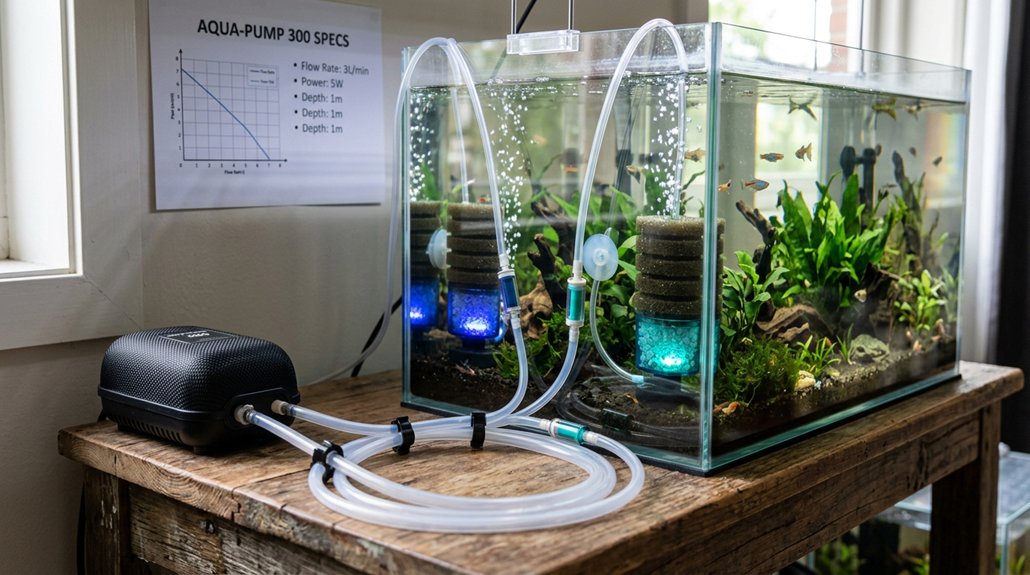
When you size a pump for air stones and sponge filters, start with a free-air output near 1–2× your tank volume per hour, since actual airflow drops once tubing, depth, and accessories add resistance. You’ll also need enough pressure to keep the stone bubbling and the sponge filter drawing steadily, especially if the tank’s deeper or you’re running multiple devices. Use a pump with multiple outlets or a manifold with valves so you can balance airflow between them instead of letting one device take all the air.
Air Stone Bubble Output
For reliable air stone bubble output, you should size the pump to the tank’s volume and depth, not just the stone’s label. Aim for roughly 1–2× tank volume in L/h at working head so you get steady airflow and consistent bubble size. Deeper tanks add back pressure, so you’ll need more pressure, not just more flow, to keep the whole stone active.
- Match output to liters and depth.
- Use high-pressure pumps above 50 cm.
- Size the pump to the full stone length.
- Allow spare capacity for tubing losses.
If you run multiple stones, split flow with a multi-outlet pump or valves. That also helps stone maintenance, since balanced flow reduces clogging and uneven wear.
Sponge Filter Airflow Needs
Sponge filters usually need more air than their label suggests, so you should size the pump for roughly 1–2× the tank’s volume in air-driven flow per hour as a starting point. For a 20-gallon tank, target about 20–40 gallons per hour equivalent, since sponge resistance cuts actual output. In deeper tanks over 50 cm, choose a higher-pressure piston or strong diaphragm pump to overcome backpressure. If you’re driving multiple sponge filters or air stones, use a multi-outlet pump or manifold so flow doesn’t take the easiest path. Adjustable airflow or airline clamps help you tune output for sponge maintenance and stable bacterial colonization. Install a check valve, keep the pump above water level when possible, and minimize tubing length and bends to preserve effective airflow.
Set Up Tubing, Check Valves, and Splitters
Run your airline tubing from the pump to the tank using 3–5 mm ID silicone line, keeping the path as short and straight as possible to minimize resistance and preserve bubble output. Use silicone maintenance to replace stiff or cracked tubing every 1–2 years so seals stay airtight.
Use 3–5 mm ID silicone airline tubing, keeping runs short and straight to preserve airflow and bubble output.
- Install an inline check valve with the arrow pointing toward the tank.
- Place it close to the pump if the pump sits below the waterline; otherwise, put it directly in the line.
- When you split airflow, use a rigid manifold or T/Y connector with individual flow-control valves for manifold balancing.
- Limit branches to 3–4 from one small pump, because each split reduces pressure.
Secure lines with clips or suction guides, and keep the pump on a dry, level surface.
Reduce Noise and Back-Siphon
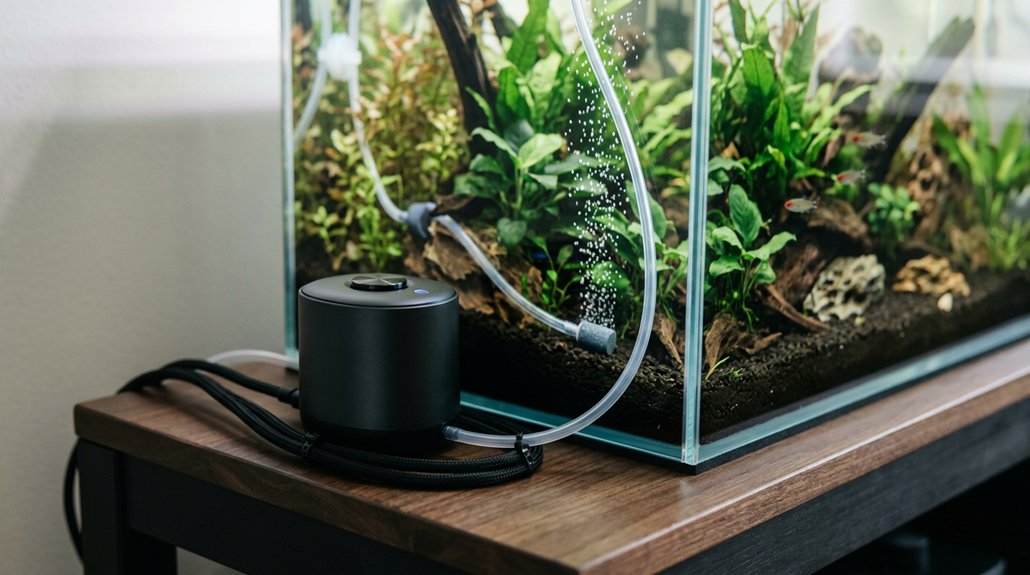
Once your airline tubing, check valves, and splitters are in place, the next step is keeping the system quiet and preventing back-siphon. Put the pump above the waterline when you can; if it sits below, use an aquarium-rated inline check valve with correct valve placement, arrow toward the tank.
| Control point | Action |
|---|---|
| Noise | Mount on foam, rubber feet, or a mouse pad |
| Backpressure | Keep tubing short, straight, and unbent |
| Reliability | Replace cracked tubing and secure fittings |
Choose silent models or piston/DC units with adjustable flow or built-in mufflers. Set the pump on a stable, level surface away from resonant cabinets. Clip tubing to stop rattling, and avoid long runs that add back pressure and noise.
Frequently Asked Questions
What Size Air Pump Do I Need for My Tank?
You’ll usually need an air pump rated near your tank’s gallons per hour—about 1× tank volume—then add 20–50% for depth, multiple devices, and tubing. Check air pump noise and oxygen circulation.
How Do You Choose the Right Air Pump?
You choose an air pump by matching output to tank depth and resistance, then selecting membrane, piston, or DC models accordingly. Check airflow controls, non-return valves, aquarium noise, and bubble patterns, plus durability and maintenance.
Do I Need an Air Pump for a 20 Gallon Tank?
Not always; if your 20-gallon tank has strong surface agitation and light stocking, you likely don’t need one. In my 20-gallon, fish behavior stayed calm. You’re judging aeration necessity by oxygen demand, not bubbles.
What Is the Best Air Pump for a Fish Tank?
The best air pump for your fish tank’s a quiet, appropriately sized model with adjustable flow, matched to tank depth and outlet needs. You’ll want silent operation, reliable pressure, and a check valve for safety.
Conclusion
Choosing the right air pump comes down to matching output, pressure, and equipment to your tank’s needs. If you have a 20-gallon tank with a sponge filter and air stone, a properly sized pump can keep flow steady without excess noise. Think of it like choosing the right bicycle pump: too weak and it won’t work, too strong and it’s inefficient. Check depth, use a check valve, and you’ll keep your system reliable.