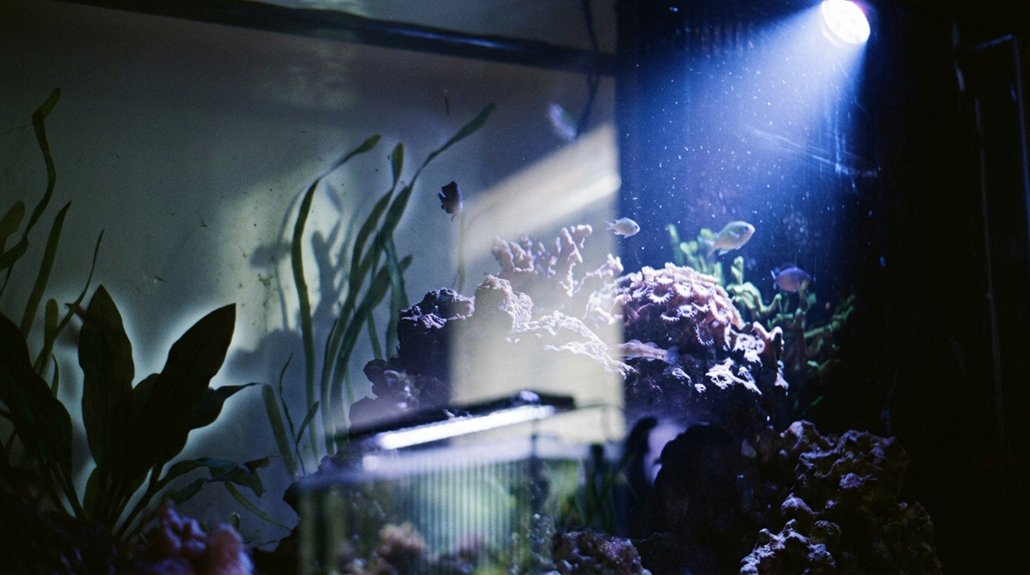
The biggest lighting mistakes are running lights too long, using the wrong spectrum, or pairing too much intensity with the wrong tank type. For most freshwater tanks, keep light on 6–8 hours; planted and reef systems usually need 10–12, but not much more. Use a timer, gradual dawn-dusk ramping, and the right color temperature to limit stress and algae. If you’re seeing weak growth or blooms, there’s more to fine-tune.
Key Takeaways
- Keep aquarium lights on a consistent timer; fish-only tanks need about 6–8 hours, planted and reef tanks about 10–12 hours.
- Avoid leaving lights on too long, since excessive photoperiods commonly trigger algae and cyanobacterial blooms.
- Match light intensity to the tank type and depth; overpowered fixtures or poor placement can stress livestock and fuel nuisance algae.
- Choose the right spectrum: use full-spectrum LED or fluorescent lighting, not incandescent or green-dominant bulbs.
- Replace aging bulbs on schedule, because weak or shifted light output causes poor plant growth and can worsen algae problems.
How Aquarium Lighting Affects Your Tank
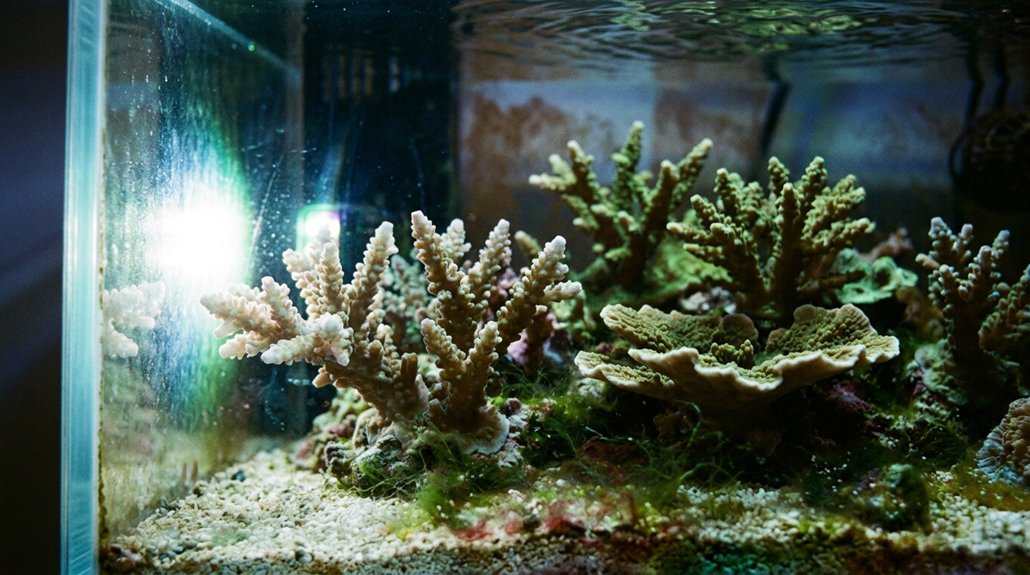
Aquarium lighting directly shapes tank health by controlling algae growth, plant photosynthesis, fish behavior, and even water temperature. When you run lights more than 12 hours daily, algae pressure rises, so use a timer and keep photoperiods near 6–12 hours. Your fish and plants rely on light perception to regulate circadian rhythms; abrupt on/off cycles can stress them, while ramping and low-intensity moonlight better mimic natural day-night change. If you use incandescent bulbs or oversized fixtures, tank temperature can climb and dissolved oxygen can drop, especially in small aquariums. In planted systems, weak spectrum or old fluorescent tubes cause leggy growth, so choose full-spectrum output and replace aging tubes on schedule. Match intensity to tank type, too.
Choose the Right Aquarium Light Type
Pick lighting that matches your tank’s needs, not just its size. Avoid incandescent bulbs; they dump heat into the water and can destabilize temperature, so choose fluorescent or LED fixtures that run cooler. For a basic freshwater setup, aim for lighting near 3 watts per gallon, or about 1–2 W Sunlite LED per gallon, to prevent excess algae. If you keep plants, use full-spectrum or tri-phosphor fluorescents, or adjustable-spectrum LED fixtures with strong blue and red bands, so photosynthesis and growth stay balanced. Reef and other high-light coral systems usually need much more output, around 5–8 watts per gallon, with 10,000–12,500K LEDs or metal halides. Prefer fixtures with timers, dimmers, or ramping controls, and track bulb lifespan so fluorescent tubes are replaced every 6–8 months.
Match Light Intensity to Your Aquarium
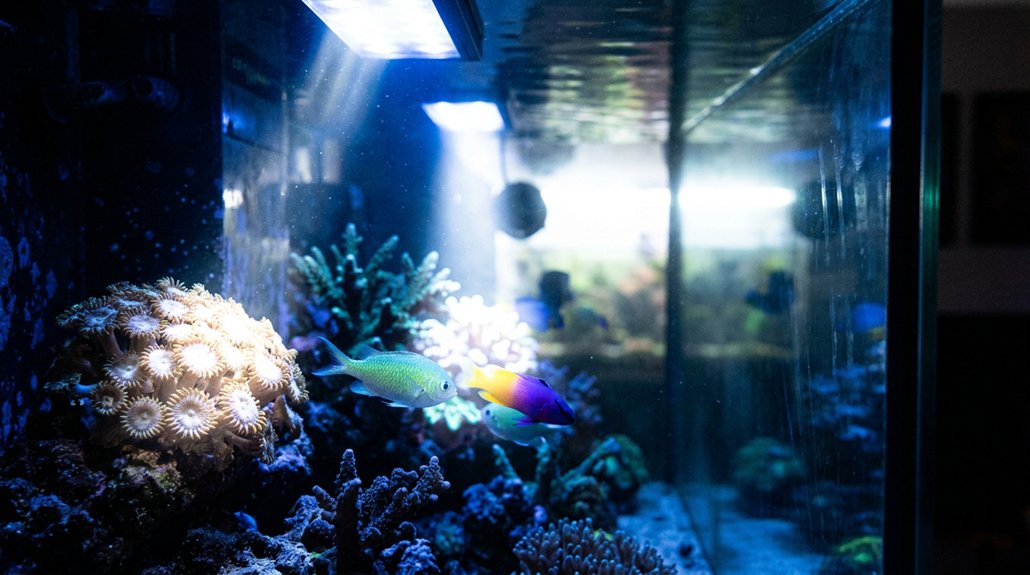
You need to match light intensity to your tank type: fish-only freshwater systems usually do well around 3 watts per gallon, planted tanks need stronger full-spectrum output, and reef systems generally require 5–8 watts per gallon or more. Start at a moderate level, especially in deeper aquariums, then adjust gradually over weeks so plants and corals can acclimate without shock. Watch for algae blooms, because excess intensity or overly long photoperiods often indicate that your lighting is too strong.
Tank Type Matters
Tank type should determine lighting output, because light that’s appropriate for one setup can be excessive or insufficient in another. In a fish-only freshwater aquarium, you’d usually target about 3 watts per gallon fluorescent equivalent, or 1–2 W Sunlite-type LEDs per gallon, to limit algae. Planted tanks need stronger full-spectrum or tri-phosphor light, often 10–12 hours daily, so weak output can cause poor growth or plant loss. Reef systems and light-demanding corals need much higher intensity, around 5–8 watts per gallon or 2–4 W Sunlite LEDs per gallon, plus 10,000–12,500K output. Account for tank depth, since deeper tanks need more power, and adjust light placement so penetration matches the livestock’s needs without stressing it.
Start Moderate, Adjust Gradually
Start with moderate lighting and adjust only as your aquarium’s response dictates: roughly 3 W/gal fluorescent-equivalent for freshwater fish-only tanks or 4–5 W/gal for planted tanks, then increase intensity only if plants stay pale and leggy or coral species clearly need more light. Use starter intensity and gradual acclimation over 2–8 weeks.
| Parameter | Recommendation |
|---|---|
| Fish-only | 6–8 h/day |
| Planted/reef | 10–12 h/day |
| Change method | Increase duration first |
| Output checks | Reassess depth and bulb age |
Don’t crank watt-equivalent to fix growth issues; extend runtime with a timer instead. If fixtures are aging, the effective light at depth drops, so replace fluorescent bulbs every 6–8 months or follow LED depreciation guidance.
Watch For Algae
Even with a good starting schedule, algae often shows up when light is too long, too intense, or poorly matched to the aquarium. For algae prevention, keep freshwater tanks near 6–12 hours daily; planted and reef systems usually need 10–12, but pushing past 12 hours sharply raises bloom risk. Match intensity to livestock: about 3 W/gal for fluorescent fish-only tanks, and don’t exceed plant or coral requirements, since extra watts per gallon feed algae. Use the correct spectrum, such as full-spectrum or tri-phosphor for plants and 10,000–12,500K for reefs, while avoiding strong red/blue imbalances. Replace aging fluorescent tubes every 6–8 months, or follow LED depreciation. Good light scheduling also means no direct sunlight, plus a timer and, if needed, dimming or siesta periods.
How Long Should Aquarium Lights Stay On?
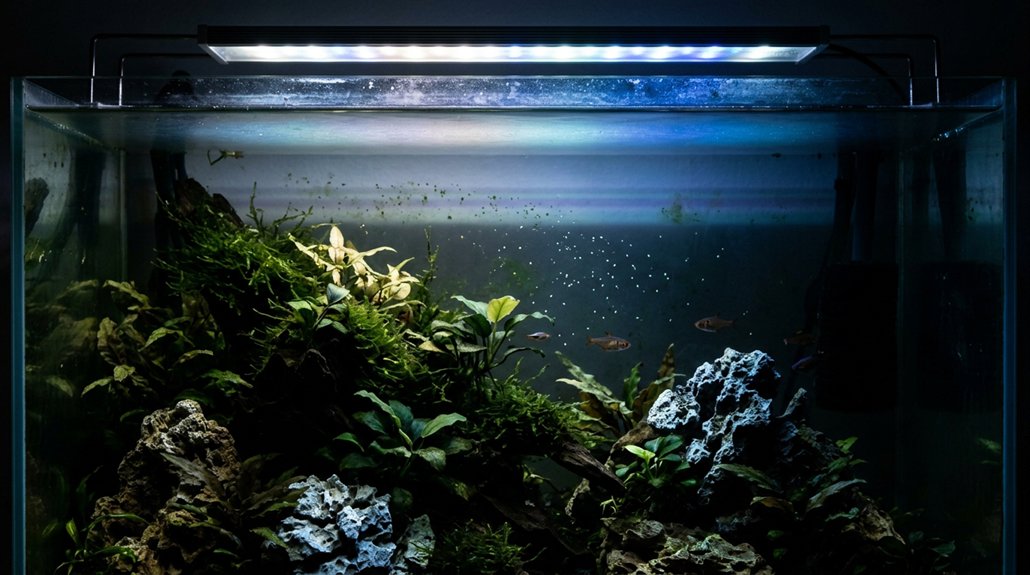
You should set your aquarium lights to match the tank type: most freshwater fish-only systems do well at 6–8 hours per day, while planted and reef tanks usually need 10–12 hours to support photosynthesis. Use a timer so the schedule stays consistent, because irregular lighting can stress fish and disrupt normal day–night cycles. Don’t keep lights on longer than 12 hours routinely, since prolonged light exposure raises the risk of algae blooms.
Ideal Daily Light Duration
For most planted or reef aquariums, lights should stay on about 10–12 hours per day to support photosynthesis without encouraging algae, while fish-only tanks can often run on 6–8 hours. You shouldn’t exceed 12 hours, because prolonged illumination raises the likelihood of persistent algae blooms and can destabilize photoperiod sequencing. Use seasonal simulation only if you’re intentionally matching a natural habitat.
- Planted/reef tanks: 10–12 hours daily
- Fish-only tanks: 6–8 hours daily
- Avoid continuous high-intensity lighting
You can also use dawn/dusk ramping or a brief mid-day siesta to soften exposure. If your fluorescents are aging, replace tubes on schedule, since declining output changes the effective light dose. Consistent duration matters more than peak brightness alone.
Use a Timer
A reliable timer is the simplest way to keep aquarium lighting on a consistent photoperiod, which helps maintain stable plant growth and reduces stress on fish and invertebrates. You should target 6-8 hours/day for most freshwater tanks and 10-12 hours/day for planted or reef systems. Never exceed 12 hours, or you’ll increase stress and algae risk.
| Tank type | Daily light | Notes |
|---|---|---|
| Freshwater | 6-8 h | Standard photoperiod |
| Planted | 10-12 h | Supports photosynthesis |
| Reef | 10-12 h | Matches coral demand |
| Mixed | 8-10 h | Adjust cautiously |
| Temporary change | Gradual | Shift over several days |
Use dawn/dusk ramping or a dimmer when you can. Put timers on surge protectors and battery backups, and replace fluorescent bulbs every 6-8 months.
Avoid Overlighting Risks
Even with a reliable timer, aquarium lighting can cause problems if the photoperiod runs too long. For most planted or reef tanks, you should keep lights on 10–12 hours daily; fish-only systems often need only 6–8 hours. This light scheduling supports photoperiod optimization, limits nuisance algae, and preserves natural day/night rhythms. If you exceed 12 hours, you’re increasing the chance of algal and cyanobacterial blooms.
- Use a timer for consistent daily onset and shutdown.
- If algae appears, cut 1–2 hours and add a mid-day siesta.
- Replace fluorescent bulbs every 6–8 months, or follow LED guidance, to prevent spectrum loss and overcompensation.
Set a Timer for Consistent Lighting
Set a timer to keep your aquarium’s photoperiod consistent every day. You should target about 10–12 hours for planted or reef systems, or 6–8 hours for fish-only tanks, so your lighting doesn’t vary with your schedule. Human inconsistency can disrupt circadian rhythms, raise stress, and contribute to disease or spawning problems. A programmable timer with dawn simulation and dusk ramping over 15–60 minutes better matches natural light cycles and lowers abrupt stress. Don’t exceed 12 hours daily, because longer exposure can destabilize lighting output and encourage nuisance growth. Use maintenance reminders to replace fluorescent bulbs every 6–8 months, and follow LED manufacturer guidance. When you install new bulbs, reset the timer so your photoperiod stays accurate and stable.
Avoid Overlighting and Algae Blooms
Overlighting can quickly tip an aquarium into an algae bloom, so keep your photoperiod within 6–12 hours per day, with 10–12 hours for planted or reef tanks. Excess intensity also matters: if you exceed about 3 W/gal in fish-only freshwater or 5–8 W/gal for most corals, you’re likely feeding nuisance algae. Match output to livestock and avoid direct sunlight, which raises light load and substrate heating.
Keep aquarium lighting within 6–12 hours daily and match intensity to livestock to prevent nuisance algae blooms.
- Maintain stable diurnal rhythms with a timer.
- Replace weak fluorescent tubes every 6–8 months.
- Use fixtures with proper reflectors to prevent hot spots.
Inconsistent cycles stress fish and destabilize algae control. When you choose the right watt-equivalent and schedule, you’ll limit growth pressure without sacrificing visible clarity or normal animal behavior.
Prevent Underlighting and Weak Growth
Underlighting can be just as damaging as too much light, because plants need enough intensity, duration, and spectral quality to photosynthesize normally. If you run lights for less than 10–12 hours a day in a planted tank, you’ll stunt growth, and pale leaves can fail within weeks. Weak or inappropriate bulbs, especially standard fluorescent tubes, often miss the red and blue wavelengths plants use most efficiently. Keep output near the recommended wattage or LED equivalence for your system, and replace aging fluorescent tubes every 6–8 months before seasonal dimming reduces usable light. Use a timer so you don’t create irregular daily exposure; stable plant specific photoperiods matter. Inconsistent schedules, underpowered fixtures, and poor maintenance all limit vigor, coverage, and long-term plant health.
Pick the Right Spectrum for Fish and Plants
Spectrum choice matters as much as brightness, because your plants don’t use all colors equally and your fish will look different under different Kelvin ratings. For planted tanks, use full-spectrum or tri-phosphor lamps with blue around 430–475 nm and red around 640–662 nm; that spectral tuning supports chlorophyll and compact growth. Aim for a red-to-blue balance near 2:1 and a correlated color temperature of 6,500–10,000 K. Avoid green-dominant lights, since visible brightness isn’t the same as photosynthetic output.
- 5,000–6,000 K suits most freshwater fish-only setups.
- 10,000–12,500 K gives stronger blue for demanding reef systems.
- Replace fluorescents every 6–8 months, and monitor LEDs for output drift to keep plant photoperiods effective and algae in check.
Aquarium Lighting Needs for Planted and Reef Tanks
For planted tanks, you’ll usually want 10–12 hours per day of full-spectrum, tri-phosphor fluorescent or LED light with a balanced red:blue ratio near 2:1 to drive photosynthesis and prevent leggy growth, while most common freshwater plants thrive around 3 W per gallon in fluorescent-equivalent output. If you keep demanding species, measure LED PAR instead of judging by wattage alone, because intensity at the canopy matters more than input power. In reef tanks, you’ll need far higher output, often 5–8 W per gallon equivalent or high-PAR LEDs, plus spectrum tuning toward 10,000–12,500K to support coral symbionts. Keep photoperiods within 10–12 hours, use a timer, and replace fluorescent tubes every 6–8 months; LEDs last longer, but output still declines over time.
Fix Common Aquarium Lighting Problems
Fixing aquarium lighting problems starts with controlling duration, spectrum, and heat. Set lights on a timer for 6–12 hours daily; if algae persists, add a midday siesta. Match light placement to tank depth and plant coverage, and make seasonal adjustments if room temperature or daylight changes affect output. Replace incandescent bulbs or overpowered fixtures with LEDs or fluorescents, and verify temperature regularly—without a thermometer, you’re guessing. If you use fluorescent tubes, change them every 6–8 months so output and spectrum don’t drift. Choose fixtures with red and blue peaks near 430–662 nm and 453–642 nm to support photosynthesis. Use gradual dawn/dusk dimming so fish don’t face abrupt on/off stress.
- Timer control
- Heat monitoring
- Spectrum replacement
Frequently Asked Questions
Can LED Lights Harm Fish?
Yes, your LED lights usually won’t cause LED toxicity, but intense, poorly timed, or overheating fixtures can stress fish. If you’ve got flicker sensitivity issues, use dimmers, timers, and proper cooling to protect oxygen levels.
Can Too Much Light Hurt Aquarium Plants?
Yes, too much light can hurt your aquarium plants. You’ll see algae overgrowth, pale growth, and stress, especially with substrate heating or poor CO2. Keep photoperiods near 10–12 hours and acclimate intensity gradually.
Do Lights in Fish Tanks Bother Fish?
Yes, fish tank lights can bother you fish if they’re too bright, abrupt, or hot. They can disrupt diurnal rhythms and trigger stress responses, causing hiding, erratic behavior, reduced feeding, and poorer oxygen conditions overall.
Can Bright Lights Hurt Fish?
Yes—bright lights can hurt fish indirectly, like a spotlight on a nervous actor. High light intensity can trigger a stress response, raise tank temperature, and encourage algae blooms, reducing oxygen and stressing your fish.
Conclusion
In the end, your aquarium lighting setup can make or break tank health. If you choose the right fixture, match intensity and photoperiod to your livestock, and use a timer, you reduce stress and prevent algae spikes. Keep the spectrum appropriate for fish, plants, or coral, and watch for underlighting or overexposure. Small adjustments now can save you a lot of trouble later, so don’t let poor lighting throw a wrench in your system.