No, you do not need to keep aquarium lights on at night. Fish need a dark period to rest, maintain circadian rhythms, and support normal feeding, hormone release, and immunity. A stable 10–12 hours of light followed by 12–14 hours of darkness is a good target for most tanks. Continuous light can increase stress, reduce appetite, and cause abnormal behavior. If you keep going, you’ll see how plants, species, and timers change the ideal schedule.
Key Takeaways
- Fish do not need light at night; they need darkness to rest and maintain normal behavior.
- Keep aquarium lights off about 10–12 hours nightly to support natural circadian rhythms.
- Continuous light can stress fish, reduce appetite, disrupt sleep, and weaken immunity.
- Brief room light or moonlight-style LEDs are okay, but avoid bright full-spectrum lighting overnight.
- Use a timer and stable day-night schedule to prevent overexposure and reduce algae growth.
Do Fish Need Light at Night?
Fish don’t need aquarium light at night, and in most cases, they actually need darkness to rest properly. You should keep illumination off for about 10–12 hours so you’re approximating a natural photoperiod and reducing stress indicators. Continuous light can elevate activity, disturb sleep, and trigger abnormal behavior, including altered nocturnal behavior in species that prefer dim conditions. If you keep live plants, maintain a separate daytime schedule of about 8–10 hours rather than extending light into the night; that supports photosynthesis without unnecessary exposure. Brief ambient room light or moonlight-style LEDs can help you observe fish without fully interrupting rest, but avoid bright full-spectrum lighting overnight. A timer helps you keep a stable cycle, and you should check species-specific requirements.
Why Fish Need a Day-Night Cycle
A stable day-night cycle helps aquarium fish regulate circadian rhythms that control feeding, hormone release, and sleep-like rest states. You’re supporting behavioral rhythms and hormonal regulation by giving diurnal species predictable light and darkness, typically about 10–12 hours of light and 12–14 hours of dark for many tropical fish. Nighttime darkness lets them enter low-activity rest states, while continuous light can suppress melatonin, increase stress, reduce appetite, and impair immunity. If you keep live plants, you also need to balance their photosynthetic light demands with the fish’s need for dark periods. Inconsistent schedules can confuse fish, elevate aggression, and raise disease risk, so a timer is a practical safeguard. Nocturnal or crepuscular species may need dim or red-shifted night conditions instead of full-spectrum light.
How Long Should Aquarium Lights Stay On?
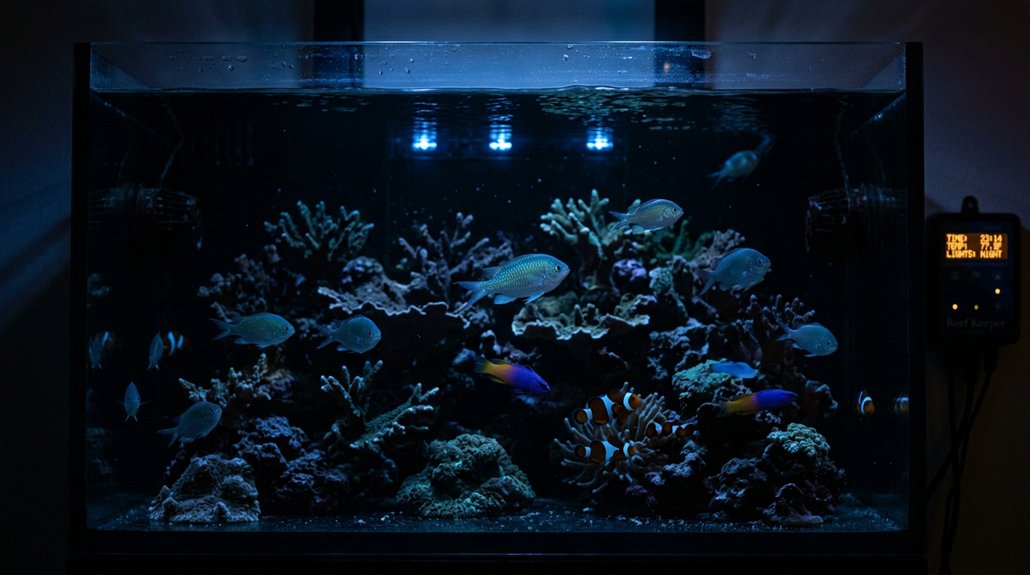
Most tropical freshwater aquariums do best with a consistent photoperiod of about 8–12 hours of light each day, because that range most closely supports natural day/night cycling and normal behavior. You should use an automatic timer so the schedule stays stable; for example, 9:00–21:00 gives a 12-hour cycle without guesswork. If you keep a planted tank with low-light species, 6–8 hours can be more appropriate and may help limit algae. Your fish still need a fully dark period at night, so the lights should switch off completely, not just dim. Adjust duration for your stock, plant demand, and shading. Some aquarists also use night sensors and seasonal adjustments to fine-tune exposure while preserving consistency and minimizing stress.
What Happens If Tank Lights Stay On All Day?
Leaving aquarium lights on all day disrupts normal day-night cycling, so your fish can’t follow a healthy circadian rhythm and may become stressed, less active, and more vulnerable to disease. You’ll often see behavioral changes, including reduced feeding, erratic swimming, and hiding more than usual. Persistent sleep disruption can also elevate stress indicators such as rapid respiration, faded coloration, and suppressed immunity. In some species, continuous illumination contributes to visual fatigue, because they’re exposed to unbroken brightness without recovery periods. If the light is intense or generates heat, tank temperature may rise, adding extra physiological stress. Constant lighting also promotes nuisance algae, especially in fish-only tanks. For most setups, you should provide a consistent dark period with a timer to protect welfare and stabilize conditions.
How Do Live Plants Change the Light Schedule?
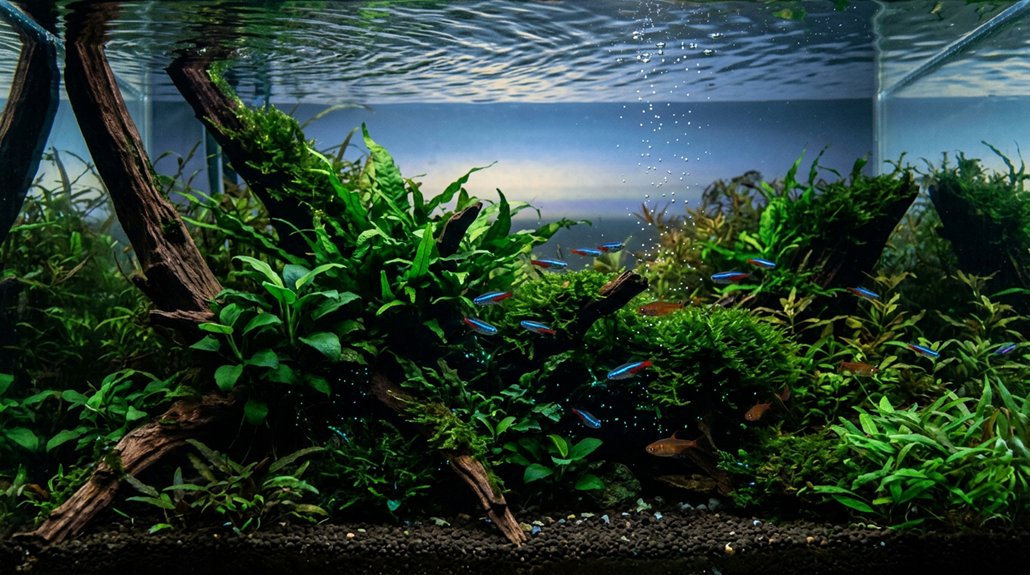
If you keep live aquatic plants, you’ll need a longer, species-specific light cycle because they photosynthesize best with about 6–12 hours of quality light per day, depending on whether they’re low-, medium-, or high-light plants. You shouldn’t run the lights 24/7, since plants still need a dark period for normal CO2 and O2 exchange, and continuous light can also push algae growth. A timer helps you maintain a consistent photoperiod, which supports plant growth and keeps the aquarium’s light-dark balance stable.
Plant Light Needs
Live plants do change the lighting schedule because they need enough daily photosynthetic energy to grow without triggering algae outbreaks. You should match light duration to species: Java fern, Anubias, and Cryptocoryne usually perform best with 8–10 hours, while carpeting plants may need 10–12+ hours of intense, full-spectrum light and CO2. Keep photoperiod adjustments small and consistent; irregular schedules disrupt plant rhythms and can favor algae. A timer helps you maintain a stable daily cycle. You also need a dark period, because plants respire and recover when lights are off; 24/7 lighting harms health. In low-tech tanks, 6–8 hours may be enough, but you should increase intensity or duration only when nutrients, CO2, and algae control support it.
Longer Day Cycles
When you add live plants, the lighting schedule usually needs more than a simple on/off setting. You’re managing photosynthesis, algae risk, and fish stress at once. Most plants do best with 8–10 hours of stable light; some high-light species need 10–12, but extended photoperiods can quickly favor nuisance algae. Use a programmable timer to hold a consistent dark period, often 6–16 hours, so you preserve a predictable day/night cycle. For better seasonal simulation, you can add ramping or dimming at dawn and dusk instead of abrupt changes.
- Match duration to plant demand.
- Adjust spectrum and PAR, not just hours.
- Avoid excessive intensity to limit algae.
Which Fish Prefer Dim Aquarium Lighting?
Many aquarium fish prefer dim lighting, especially nocturnal species such as Corydoras catfish, kuhli loaches, and many other catfish, which are most active in low light and may hide or become stressed under bright illumination. You’ll also see species with nocturnal behavior or from shaded habitats respond best to subdued conditions. Crepuscular fish, including many rasboras, tetras, and gouramis, do better when lighting changes gradually at dawn and dusk, not with abrupt intensity shifts. Deepwater and cave-dwelling loaches and plecos are adapted to very low light, and sustained brightness can reduce feeding and increase hiding. Bettas, Apistogramma cichlids, and Amazonian tetras also prefer lower intensity, especially with floating plants or shaded refuges that limit stress and aggression.
How to Set a Simple Aquarium Light Timer
Set your aquarium light on a daily timer so it switches on and off at the same times each day, creating a stable photoperiod that usually runs about 8–12 hours of light and 12–16 hours of darkness. Use a plug-in or smart timer to reduce stress and preserve circadian cues.
Set your aquarium light on a daily timer for a stable 8–12 hour photoperiod.
- Place the timer where you can access it, but away from splashes; timer placement matters.
- Program gradual ramp-up and ramp-down if the fixture supports it.
- Match the schedule to room daylight so the tank gets one continuous dark period.
If you keep plants, target 8–10 hours of full-spectrum light; without plants, 6–8 hours often limits algae. Avoid night sensors that react to ambient room light, because they can interrupt darkness and distort the photoperiod.
What Aquarium Light Works Best?
You’ll get the best results with a full-spectrum LED fixture that covers white plus red and blue channels, since those wavelengths support photosynthesis and still give you accurate color rendering. For planted tanks, choose a light you can dim and program, because PAR at the substrate should match your plants’ needs and controlled peak intensity can help limit algae. A timer or app-based schedule lets you create consistent day/night cycles and gradual dawn/dusk shifts, which is more stable than leaving the light on continuously.
Full Spectrum Lighting
For a planted aquarium, a full-spectrum LED is usually the best all-around choice because it combines broad white light with targeted red and blue output, and those wavelengths are the most effective for chlorophyll-driven photosynthesis. You’ll usually want 6,500–7,500 K for balanced plant and fish viewing, with spectral tuning that keeps plant centric intensity in the blue and red bands. Consider:
- Blue 400–500 nm and red 600–700 nm drive the highest photosynthetic efficiency.
- Adjustable RGB + white fixtures let you fine-tune growth, color, and visibility.
- Dimming, thermal management, and PAR matching help maintain stable output.
For low-light plants, 20–50 µmol·m⁻²·s⁻¹ is often enough; medium-light species may need 50–150. Use 8–10 hours of full-spectrum light, or 6–8 for lower-demand plants.
Smart Light Scheduling
Smart LED aquarium fixtures with programmable RGB+white channels are often the best choice when you want both plant growth and fish comfort, because they let you precisely control intensity, color balance, and timing throughout the day. With smart lighting, you can run automated schedules that mimic sunrise and sunset, which lowers stress and supports normal activity. For planted tanks, target about 8–10 hours of light, with strong red and blue output and adaptive dimming at dawn and dusk to limit algae. Keep a stable 10–12 hour day and 12–14 hour dark period so fish can rest. Use cloud or storm modes sparingly; brief nocturnal enrichment is fine, but long or bright effects can disrupt sleep. Remote control and reminders also help prevent overheating and overexposure.
Frequently Asked Questions
Will My Fish Be Ok Without a Light?
Yes, your fish’ll likely be fine without a light if they get a normal day/night cycle. Keep tank decor for cover, maintain a consistent feeding schedule, and avoid 24/7 brightness to reduce stress.
Is It Okay to Leave a Fish in the Dark?
Yes, you can leave your fish in darkness overnight, and it often supports natural behavior and feeding cycles. Don’t keep it dark for days; they need a regular light/dark rhythm for health.
Do I Need to Turn off My Fish Light at Night?
Yes, you should turn off your fish light at night. You’ll support natural rest, reduce stress, and improve tank maintenance. Use light timers for a consistent photoperiod, while allowing complete darkness unless species need otherwise.
Do Fish Like to Sleep in the Dark?
Yes, you’ll usually find fish sleep best in darkness, because it supports normal rest cycles. Nocturnal species may prefer dim or shaded areas, but most fish need a consistent dark period to reduce stress.
Conclusion
So, do fish need light at night? Not really—what they need is darkness to complete their circadian rhythm. If you keep aquarium lights on continuously, you can disrupt sleep, stress fish, and encourage algae, even if you think brighter is healthier. A simple timer gives you a consistent day-night cycle, which is the evidence-based standard for most tanks. If you’re worried your fish seem “inactive” at night, that’s normal behavior, not a sign they need more light.