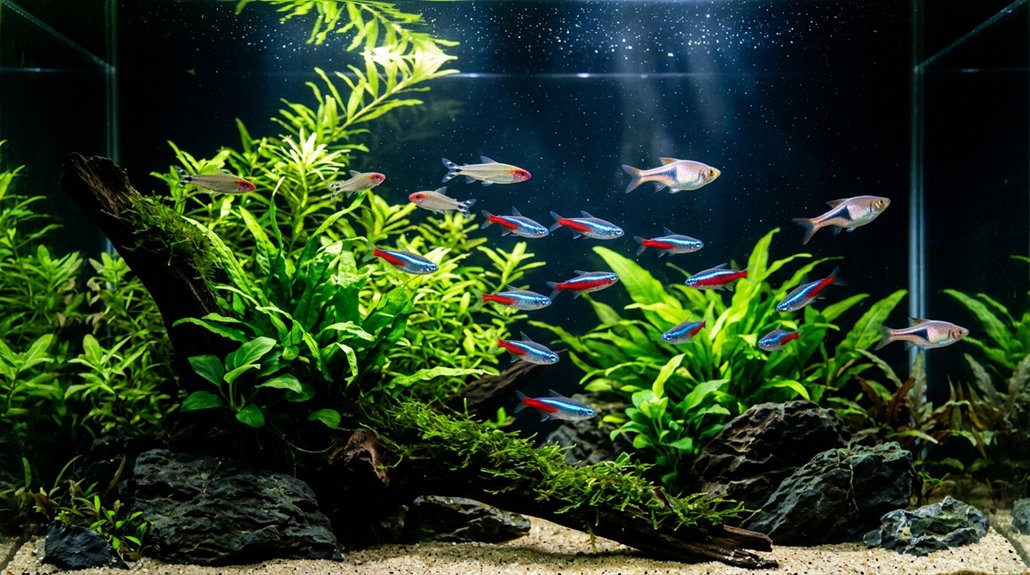
Aquarium lighting affects your fish and plants by controlling photosynthesis, circadian rhythms, and algae growth. You should use a full-spectrum LED, often around 5000–6500K for freshwater tanks, with moderate PAR and a consistent 8–12 hour photoperiod. Too much intensity or long light periods can stress fish, bleach plants, and fuel algae. Gentle dawn-dusk ramping and a dark night period help maintain normal behavior, and there’s more to optimize as you go.
Key Takeaways
- Light provides energy for plant photosynthesis, supporting growth, oxygen production, and water stability in freshwater aquariums.
- Consistent photoperiods regulate fish circadian rhythms, feeding, breeding, and immune function.
- Use 8–12 hours of light daily, with 15–60 minute dawn/dusk ramps to reduce stress and startle responses.
- Moderate full-spectrum lighting, around 5000–6500K, supports healthy plant growth and natural fish behavior.
- Too much light, long photoperiods, or sudden darkness can trigger algae, stress fish, and cause weak or stunted plants.
What Aquarium Lighting Does for Fish and Plants
What does aquarium lighting actually do for fish and plants? It supplies photons for photosynthesis, so your planted tank can convert light into oxygen and biomass while taking up nutrients that help stabilize water chemistry. You’ll usually need 10–12 hours of full-spectrum 5000–6500K light for freshwater plants, but duration matters: more than about 12 hours can extend algal growth. Your fish also depend on a consistent 8–12 hour photoperiod to regulate circadian rhythms, feeding, breeding, and immune function. Excess intensity can stress them, while under-lighting can dull coloration and stunt plants. Careful light placement and spectral tuning improve coverage, reduce abrupt brightness changes, and support natural dawn-dusk shifts, which lowers startle responses and helps both fish and plants acclimate.
Choose the Best Light Spectrum
Once you’ve set a consistent photoperiod, the next factor is spectrum, because the color of light determines how efficiently plants photosynthesize and how naturally fish are displayed. For freshwater planted tanks, you should choose a full-spectrum LED around 5000–6500K with strong peaks near 450 nm and 660 nm, since chlorophyll a and b absorb those bands efficiently. Blue light supports compact growth, deeper penetration, and better blue fish coloration, while red light drives photosynthesis and can influence stem elongation. In practice, balanced spectral tuning matters: a roughly 2:1 red:blue mix, or a white broad-spectrum lamp with both peaks, usually supports plant morphology and visual fidelity. Avoid narrow-band blue-only or red-only fixtures; broad-spectrum LEDs with some green improve color rendering and more even growth.
How Bright Should Aquarium Lights Be?
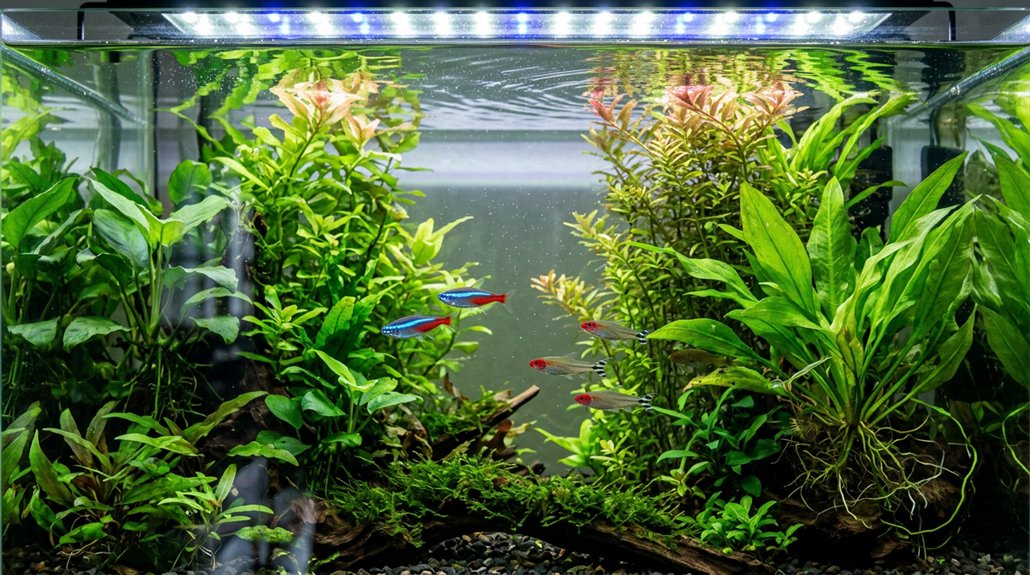
Aquarium light brightness should match the tank’s biological load and plant type: most freshwater planted tanks perform best at about 10–12 hours per day at roughly 30–60 µmol·m⁻²·s⁻¹ at the leaf level, while low-light plants can do well around 10–20 µmol·m⁻²·s⁻¹. You should use PAR mapping to verify intensity across the aquascape, because depth and shading alter delivered light. For fish-only systems, keep illumination closer to 10–20 µmol·m⁻²·s⁻¹ for 6–8 hours to limit stress and algae. If you run high-light substrates, increase brightness gradually over weeks. Adjust light positioning or dimming to reduce excess intensity, and use timers with dawn/dusk ramping. Watch for elongated leaves, pale growth, hair algae, and stressed fish as practical indicators of improper brightness.
Compare LED, Fluorescent, and Other Tank Lights
When you compare aquarium lighting, LEDs offer high energy efficiency, long service life, low heat output, and adjustable spectra that let you control plant photosynthesis precisely. Fluorescent T5/T8 fixtures give broad-spectrum light at lower initial cost, but their output and spectral quality decline, so you’ll need regular bulb replacement. Other options, such as metal halide, incandescent, and halogen lamps, can be very intense or inexpensive up front, but they’re usually less efficient, hotter, and more likely to raise algae risk or cooling demands.
LED Light Benefits
LED lighting offers the most efficient and controllable option for most aquariums, combining low heat output, long service life, and adjustable spectral output that lets you tune blue-to-red balance for plant photosynthesis and fish coloration. You can use spectrum tuning to match freshwater planted tanks or reef systems, improving photosynthetic performance without excess irradiance. Its thermal management is superior, so you’re less likely to heat the water or need auxiliary cooling. Dimmable drivers let you ramp brightness through dawn and dusk, which can reduce fish stress and better simulate natural photoperiods. Although LEDs cost more initially, their 50,000–500,000-hour lifespan and low energy demand usually lower total ownership costs. Properly tuned, they support growth while limiting heat- and spectrum-driven algae.
Fluorescent Light Traits
Fluorescent T5 and T8 tubes provide broad-spectrum illumination that’s suitable for many planted aquariums at a relatively low upfront cost, but their usable output and spectral quality decline within about 6–12 months, so you’ll need regular replacement to maintain consistent plant growth. You’ll get good light spread and moderate heat, but your lamp lifespan is shorter than LED systems, and spectrum stability drops as blue emission degrades. That drift can reduce photosynthetic efficiency and alter color rendering over time. Because dimming and spectral tuning are limited, you can’t target chlorophyll peaks as precisely as with LEDs. For stable plant health, plan for scheduled tube changes and account for ongoing energy and maintenance costs when comparing fixtures for your tank.
Other Light Options
Although several aquarium lighting technologies can support fish and plant health, each has distinct trade-offs in efficiency, spectrum control, heat output, and maintenance. You’ll usually get the best energy efficiency and spectral control from LEDs, which can be tuned from about 5,000–20,000K and run for tens of thousands of hours with minimal heat. T5/T8 fluorescents still provide even coverage for planted tanks, but their output and spectrum decline within 6–12 months, so you’ll need alternative bulbs on a regular schedule. Metal halide/HID lamps deliver intense light for deep or SPS reefs, yet they add heat, power draw, and cooling demands. Compact fluorescents are moderate performers, while incandescents aren’t recommended. For many systems, seasonal dimming is easier with LEDs.
Set a Healthy Light Schedule
You should target an 8–12 hour photoperiod for most freshwater planted tanks, or 6–10 hours for fish-only systems, and keep total daily light under 12 hours to limit algae growth and circadian disruption. A timer helps you maintain a consistent day-night cycle, which supports normal fish sleep, stress regulation, and immune function. If you can, program a 15–60 minute sunrise and sunset changeover with dimming or gradual LEDs, because abrupt light shifts can startle fish and increase stress.
Ideal Photoperiod Length
A healthy photoperiod is one of the most important controls on aquarium stability. You should match light duration to bioload and photosynthetic demand for seasonal mimicry and the fish sleepcycle.
| Tank type | Light hours |
|---|---|
| Freshwater fish-only | 8–10 |
| Planted freshwater | 10–12 |
| Reef/marine | 9–11 |
| Algae risk | >12 |
For fish-only systems, 8–10 hours usually preserves circadian cues without excess algae. In planted tanks, 10–12 hours supports photosynthesis; if algae appears, cut back toward 8–9 hours. Reef tanks need 9–11 hours of higher-intensity, blue-biased light to meet coral demand. Don’t exceed 12 hours long-term, because chronic exposure raises stress and algal growth. Use a timer, and add dawn/dusk ramping over 15–60 minutes to reduce startling shifts.
Consistent Day-Night Cycles
Once the photoperiod length is set, consistency becomes the next control point: fish and plants respond best to a stable day-night cycle with about 10–12 hours of light per day in planted freshwater tanks and 8–10 hours in fish-only systems. You should keep total effective light under ~12 hours to limit algae and support stress reduction.
- Use a timer so the schedule stays exact each day.
- Maintain an uninterrupted dark period; fish need regular rest.
- Avoid abrupt switching; gradual cycling over 15–60 minutes reduces startle responses.
Minor seasonal changes of 1–2 hours are fine, but chronic 16-hour lighting isn’t. Stable cycles protect immune function, support photosynthesis, and prevent the prolonged illumination that drives algal blooms.
Sunrise And Sunset Gradients
Gradual sunrise and sunset gradients help aquarium animals shift between active and resting states without the stress of abrupt lighting changes. You should ramp the dawn spectrum and dusk intensity over 15–60 minutes with timers or dimmers to reduce startle responses and schooling stress. Maintain a total photoperiod of 8–12 hours daily, or 10–12 hours in planted tanks, and don’t exceed 12 hours to limit algae and chronic stress. A low-intensity moonlight phase, using dim blue light around 450–470 nm for 1–2 hours, supports nocturnal orientation without disrupting sleep. Staggered schedules, such as 2 pm to 10 pm, are acceptable if you count ambient morning sun. Keep timing consistent with a programmable timer, and make ±1 hour seasonal adjustments to mimic natural photoperiod shifts.
How Aquarium Lighting Affects Fish Behavior
Aquarium lighting strongly influences fish behavior because light duration, intensity, timing, and spectrum all interact with circadian rhythms and species-specific activity patterns. You’ll see more stable schooling cues when photoperiods stay near 8–12 hours, not 12–16, because excessive light raises stress and disrupts sleep.
- Use gradual dawn/dusk ramps; instant on/off can trigger hiding or aggression.
- Match intensity to the species; overly bright, close lights increase avoidance and nocturnal hiding, while moderate levels support normal foraging.
- Keep the tank dark at night; even indicator LEDs can suppress resting and alter feeding or breeding cycles.
Blue-heavy light is often calmer, while stronger red or white light can increase daytime display and activity.
Keep Plants Growing Without Feeding Algae
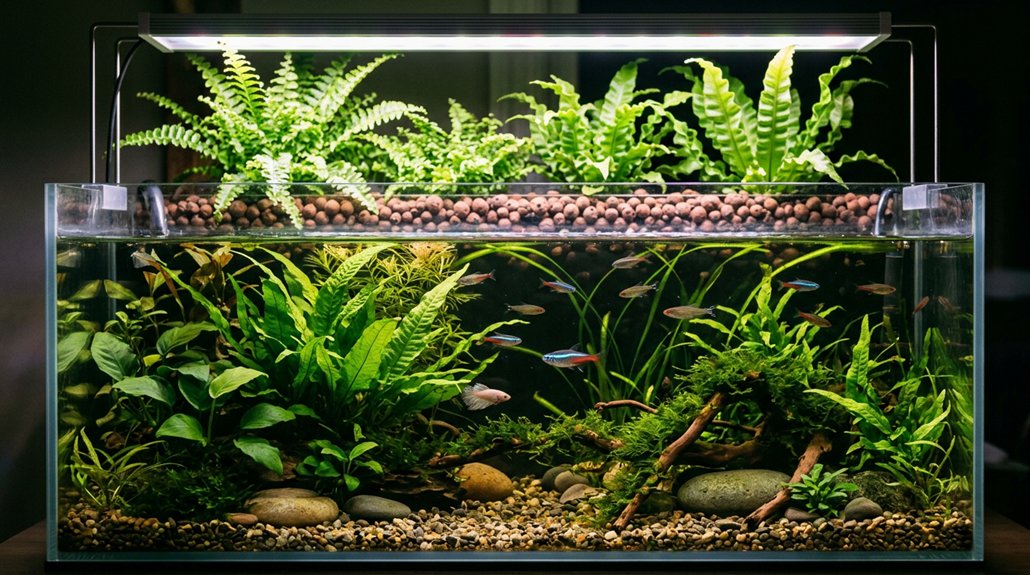
Balancing light is key to keeping plants vigorous without giving algae an advantage: for most planted tanks, aim for a total photoperiod of 8–10 hours daily, extending to 10–12 hours only in heavily planted setups, so plants get enough time for photosynthesis without leaving algae prolonged illumination. You should run a full-spectrum 5000–6500K LED, or a balanced 2:1 red:blue output, because it matches chlorophyll absorption without strongly biasing algae. Keep PPFD moderate by adjusting fixture height or power; low-light species usually need 20–50 µmol·m⁻²·s⁻¹. Use algae resistant substrates and plant shading strategies to reduce exposed surfaces. A reliable timer with dawn/dusk ramps can help. If you add strong light, you’ll need balanced fertilization, CO2, and circulation, or plants’ll stall and algae’ll exploit the excess energy.
Balance Ambient Light and Tank Lights
Even if your LED timer is set correctly, ambient room light still adds to the tank’s total photoperiod and photosynthetic photon flux, so you need to count morning and evening sun, nearby lamps, and reflected daylight when setting a planted-tank schedule to keep combined exposure under about 10–12 hours and avoid exceeding light levels that favor algae.
Ambient room light still extends your tank’s photoperiod, so count sun, lamps, and reflections—not just timer hours.
- Check window placement; direct sun can spike intensity, heat, and nutrient turnover, making algae blooms more likely.
- Use ambient shifts from dim room light or ramping timers to reduce fish startle responses without extending the effective day too far.
- Shield indicator LEDs and persistent night glow, because they can disrupt true darkness and sensitive behavior.
Track fixture PAR plus incidental ambient input, not hours alone.
Adjust Lighting for Freshwater and Reef Tanks
Freshwater planted tanks and reef systems need different light targets, so you should match spectrum, intensity, and photoperiod to the organisms you’re trying to support. For planted freshwater aquariums, you’ll usually use full-spectrum light around 5000–6500K for 10–12 hours at moderate intensity, roughly 1–2 W LED per gallon or 20–50 PAR at plant level. Fish-only freshwater tanks can run 6–8 hours at lower intensity to reduce plant and algae growth. Reef aquariums need stronger, bluer light, often 10000–20000K, with 9–11 hours and PAR set to coral type. Use spectral tuning and gradual light acclimation, including 30–60 minute dawn/dusk ramps, so you don’t shock fish or corals. Avoid direct sunlight, since it can overheat tanks and drive nuisance algae.
Maintain Aquarium Lights for Safety and Efficiency
Once you’ve matched light intensity and spectrum to your aquarium type, the next step is keeping the fixture itself efficient and safe. For fixture placement, mount lights securely, elevate electrical parts, and use drip loops, GFCI outlets, and waterproof connectors to reduce shock risk. Your safety checklist should also include:
Keep aquarium lights secure, use drip loops and GFCI outlets, and elevate electrical parts for safety.
- Replace fluorescent bulbs on schedule: linear T5s about every 6 months, compact fluorescents about every 12 months.
- Clean lenses and reflectors monthly; salt creep and dust can cut transmission 10–30%, forcing higher output.
- Prefer LEDs for long service life and lower heat; then monitor fixture heat and tank temperature, adding fans or raising the light if water exceeds species-safe limits.
Frequently Asked Questions
Do Fish Need Complete Darkness at Night?
No, you don’t need complete darkness, but you should provide a consistent night cycle with low or no light. This supports melatonin regulation, reduces stress, and helps fish maintain normal circadian rhythms.
Can Aquarium Lights Cause Fish to Stop Eating?
Yes, aquarium lights can stop you from seeing fish eat when 1 in 5 exhibit reduced feeding under intense illumination. Monitor stress indicators and adjust feeding schedules; excessive brightness can suppress appetite and alter normal behavior.
Should Lights Be Dimmed During Acclimation?
Yes, you should use gradual dimming during acclimation to reduce photostress and behavioral disruption. For effective light acclimation, you’ll want to lower intensity slowly over several days, letting fish adjust physiologically and behaviorally.
Do Different Plant Species Need Different Light Colors?
Yes—different plant species can have spectral preferences. You’re likely to see species-specific pigment expression under varied wavelengths, because chlorophylls, carotenoids, and anthocyanins respond differently, so tailoring color spectra can optimize growth and coloration.
Can Lighting Affect Fish Breeding Behavior?
Yes, you can influence fish breeding behavior with lighting; it affects mood cycles and mate cues by altering photoperiod, intensity, and spectrum. You’ll often see spawning changes when day length mimics seasonal conditions.
Conclusion
In your aquarium, lighting directly shapes photosynthesis, fish behavior, and long-term system stability. If you choose the correct spectrum, intensity, and photoperiod, you support healthy plant growth while limiting nuisance algae. For example, a 20-gallon planted tank can thrive under moderate LED light for 8 hours daily, but excessive brightness often triggers algae blooms and stress. Regularly monitor bulb output, adjust ambient light, and maintain fixtures so your fish and plants stay healthy.