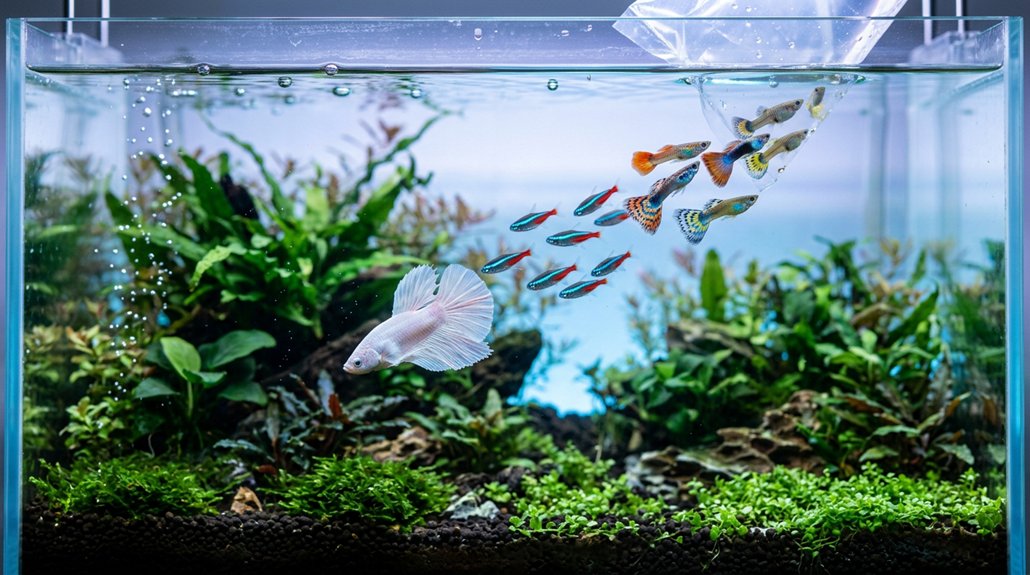
You should add fish in stages after your tank is fully cycled and ammonia and nitrite stay at 0 ppm. Start with hardy, peaceful schooling fish, then add other community fish, followed by bottom dwellers like Corydoras. Add clean-up crew fish or invertebrates only once the tank is stable, and save sensitive, territorial, or semi-aggressive species for last. Match adult size and temperament, keep testing water, and add plants to help buffer stocking. There’s more to tune if you keep going.
Key Takeaways
- Fully cycle the tank first and confirm ammonia and nitrite stay at 0 ppm before adding any fish.
- Start with a small group of hardy, peaceful schooling fish to help the biofilter adjust.
- Add midwater community fish next, then introduce bottom-dwellers like Corydoras in proper groups.
- Add clean-up crew species such as nerite snails or Amano shrimp only after the tank is stable.
- Save sensitive, territorial, or semi-aggressive fish for last, adding them in small batches with quarantine.
What Fish Should Go In First?
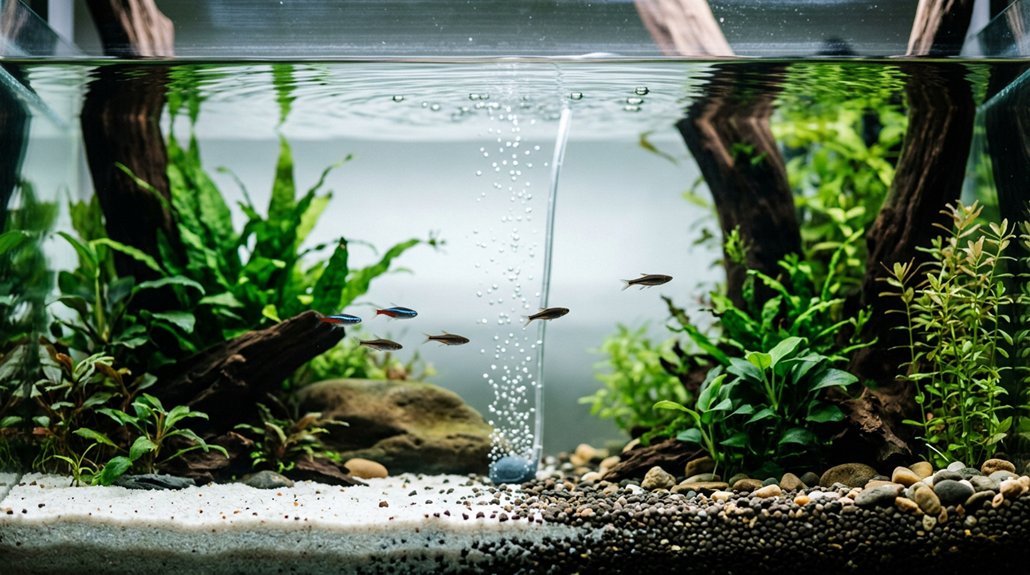
Start with the hardiest, least territorial fish first, since they’ll let the tank’s microfauna and maintenance routine settle before you add more sensitive species. You should begin with a small school of tetras or rasboras, added together so their social structure stays intact. After that, add bottom dwellers like 5+ Corydoras, giving them room to establish foraging areas and biofilm access before mid-water fish crowd them. Keep territorial or larger species, such as gouramis, loaches, or flagfish, for later, and add only one or two at a time. Slow-growing algae eaters, like bristlenose plecos or nerite snails, belong in the tank only after food sources develop. Use quarantine procedures for every batch, and consider breeding considerations before mixing species or stocking pairs.
Cycle and Test the Tank First
You should complete the nitrogen cycle first, then verify with a reliable test kit that ammonia is 0 ppm and nitrite is 0 ppm before you add any fish. Keep temperature, pH, and specific gravity stable for at least 24–48 hours, or 3–7 days for saltwater, so the tank’s baseline is consistent. Even if you’ve used seeded media or bottled bacteria, test the water and add fish in small batches only when the biofilter can handle the load.
Complete The Nitrogen Cycle
Before adding any non-hardy fish, complete a full fishless or fish-in nitrogen cycle and confirm with test kits that ammonia is 0 ppm and nitrite is 0 ppm; this usually takes 2–6 weeks, depending on tank conditions. During this period, you’re building biological filtration as beneficial bacteria colonize filter media and substrate, so don’t clean or replace the media for the first 4–6 weeks. If you’re fish-in cycling, stock only a few very hardy starters and use frequent partial water changes to limit toxic spikes. Water testing should be routine, and bacterial supplements can help speed colonization, but they don’t replace patience. Keep nitrate as low as practical, ideally under 20–40 ppm, and plan regular changes after cycling to maintain stable conditions for future additions.
Test Water Before Stocking
Once the nitrogen cycle is complete, don’t stock the tank on timing alone—verify the water with test kits first. Use reliable water testing for ammonia, nitrite, nitrate, and pH; you want ammonia at 0 ppm, nitrite at 0 ppm, and only measurable nitrate, preferably low. Check temperature, too, and make sure it matches your species’ target range, such as 72–82°F for many tropical fish. Before adding livestock, confirm parameter stabilization: pH and temperature should hold steady for 24–48 hours. In saltwater or brackish setups, measure specific gravity with a refractometer or hydrometer and let it settle for several days. After each stocking step, retest over the next week, then wait 1–2 weeks, or until ammonia and nitrite stay at 0 ppm, before adding the next small batch.
Start With Hardy Starter Fish
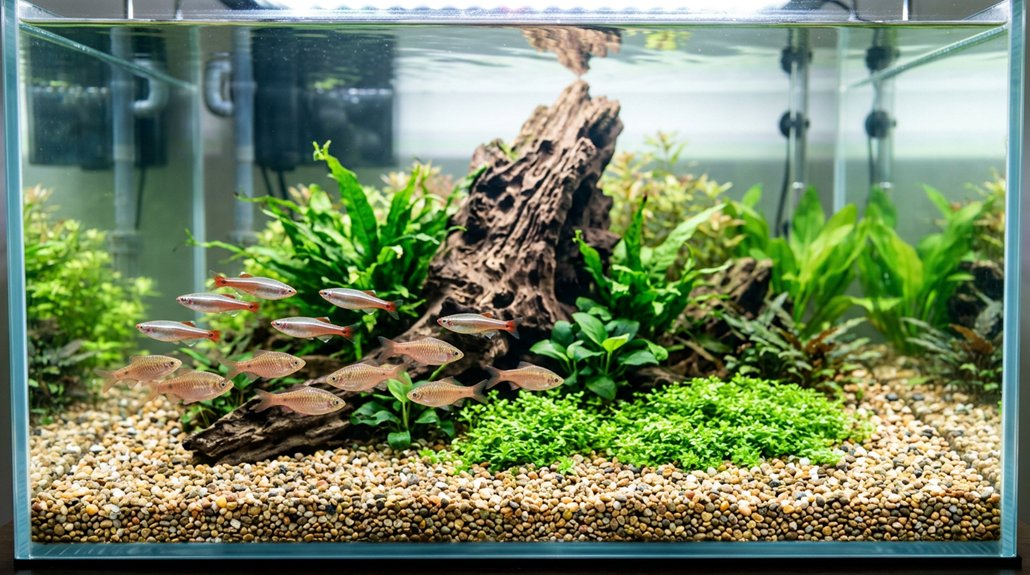
Start with a small group of hardy, schooling fish—such as 4–6 neon tetras, harlequin rasboras, or cherry barbs in a 100-gallon planted tank—so they can settle in with less stress and establish normal social behavior. Add only a few fish at a time, keeping each step to 10–20% of the final stock. After each addition, wait 7–14 days and test ammonia and nitrite until both stay at 0 ppm. That gap lets nitrifying bacteria catch up and lowers spike risk. Quarantine and acclimate every new fish before release, and keep temperature and pH stable. These hardier starters also make feeding schedules easier to track and support disease prevention by letting you spot appetite loss, flashing, or abnormal swimming early. Once they’re stable, you can layer in the next group.
Add Peaceful Community Fish
With the tank fully cycled and ammonia and nitrite holding at 0 ppm, you can add the first peaceful community fish: a low-bioload schooling group such as 8–12 neon tetras or 8–12 harlequin rasboras to establish a stable, stress-tolerant core. This peaceful schooling group helps you test aquascape integration without overloading the biofilter. Keep additions in one batch, then wait 1–2 weeks before the next stock.
- Acclimate with lights off.
- Float the bag 15–60 minutes.
- Use drip or gradual water mixing.
- Recheck ammonia and nitrite daily.
Choose species that occupy midwater, stay calm, and accept the existing layout. If numbers are too low, they may school tightly and act stressed; proper group size improves behavior, color, and stability.
Add Bottom Dwellers and Clean-Up Crew
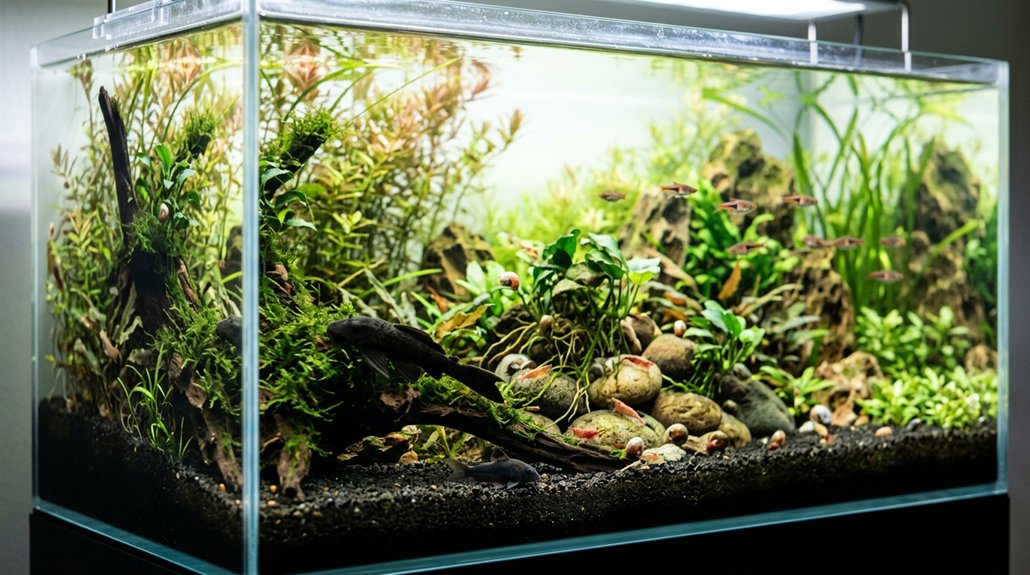
Once your tank’s fully cycled and ammonia and nitrite are at 0, you can add bottom-dwellers first, such as 5–6 Corydoras, since they’re hardy and help clean uneaten food from the substrate. If your tank is at least 30 gallons and has plenty of cover, you can also consider 1–2 bristlenose plecos, which are better at grazing biofilm and some algae than broad-spectrum algae control. After water temperature, pH, and stable hardness have settled, you can add a small clean-up crew like 3 nerite snails and 6–10 Amano shrimp, but only if no fish in the tank will eat them.
Bottom Dwellers First
Before you add schooling fish, introduce your bottom dwellers and clean-up crew so they can establish their territories and help seed beneficial bacteria in the substrate and filter media where they’ll spend most of their time. You’ll improve substrate microbiome development and territory mapping while the tank stabilizes. Confirm ammonia and nitrite are 0 ppm, and let planted areas settle for 24–48+ hours first. Stock gradually to avoid bio-load spikes, then watch for buried waste and correct it with 10–25% water changes.
- Add 5+ Corydoras first.
- Use 1 bristlenose pleco per 30–50+ gal.
- Introduce nerite snails or Amano shrimp early.
- Keep bottoms acclimated before mid- and top-level fish.
This sequence lowers stress, supports cycling, and gives you cleaner, more predictable water chemistry.
Clean-Up Crew Choices
After your bottom dwellers have settled in, choose the rest of the clean-up crew based on tank maturity and livestock compatibility. Add algae grazers only when nitrate is stable and biofilm is present; a bristlenose pleco needs 30+ gallons, while Nerite snails fit smaller systems. For shrimp, wait until parameters stay steady for several weeks, then drip acclimate and confirm no aggressive tankmates. Use invertebrate quarantine for any snail or shrimp addition to catch hitchhikers and losses early. For algae growth management, introduce cleaners gradually, never more than a few at once, and test ammonia and nitrite after each round. If you’re using burrowers or sand sifters, place them before delicate hardscape and heavy planting so they can establish territories without uprooting new growth.
Save Sensitive Fish for Last
You should usually save sensitive fish for last, letting hardy, fast-adapting species like danios, platies, or mollies establish the biofilter first.
Wait 1–2 weeks between additions so ammonia processing can stabilize before you add delicate stock. Use stress acclimation and isolation observation for new arrivals.
- Add sensitive fish only after ammonia and nitrite read 0 for at least a week.
- Confirm temperature, pH, GH, and KH stay within their preferred ranges for several days.
- Quarantine them, then use a drip or slow floating method to limit shock.
- Introduce one sensitive species at a time, with 1–2 week intervals, so you can monitor disease signs closely.
This staged approach reduces losses and helps fragile fish settle into a stable, mature environment.
Match Fish by Adult Size and Temperament
Once the tank is stable and the sensitive species are ready, stock by adult size and temperament so each group can settle in without being bullied or outcompeted. Start with hardy, similarly sized schooling fish, such as 8–12 neon tetras or 10–14 harlequin rasboras, so their hierarchy forms first. Next, add bottom-dwellers like Corydoras in groups of at least five; they’ll establish substrate space after midwater traffic is already set. Introduce peaceful cleaners, including bristlenose plecos, nerite snails, or Amano shrimp, only when bio-load and algae are predictable, and check size compatibility at adult size. Keep semi-aggressive species, like larger barbs or loaches, for last so adult temperament and territory pressure don’t disrupt smaller tank mates.
Add More Plants to Support Stocking
As stocking increases, add more live plant mass to help absorb ammonia and nitrates while buffering the water chemistry; stem plants, Java fern, and Vallisneria are especially useful because they establish quickly and scale well with bioload. You’ll get better stability if you add them several weeks before new fish so roots and shoots can develop.
- Use Fast growers like Hornwort and Water Sprite for early Nutrient export.
- Target 50–70% hardscape coverage to give timid fish cover.
- Dose fertilizer and match CO2 with lighting so uptake doesn’t stall.
- Test ammonia, nitrite, nitrate, and pH weekly; remove decaying trimmings promptly.
That extra plant mass helps your tank process waste more efficiently as stocking rises.
Avoid Overcrowding and Compatibility Mistakes
Even with extra plant mass helping with waste handling, stocking still needs to stay conservative so the biofilter and oxygen demand don’t get pushed past safe limits. Add fish in small batches—4–6 small schooling fish or 1–2 larger specimens—then wait 7–14 days, testing ammonia and nitrite to keep both at 0 ppm. Start with hardy, peaceful species like tetras, rasboras, danios, and Corydoras so they settle before you add sensitive or territorial fish. Check adult size against your tank’s real filtration capacity; the rough 1 inch per gallon rule helps, but goldfish need special planning. Match temperature, pH, and temperament exactly, because aggression and breeding behavior can trigger stress. Quarantine every new arrival 7–14 days first.
Frequently Asked Questions
What Order Do You Add Fish to a Tank?
You’ll add fish by stocking strategies: first hardy schoolers, then bottom-dwellers, then semi-aggressive species, and delicate inverts last. Ignore cycling myths; add only a few at once, testing ammonia, nitrite, nitrate, and pH.
What Fish to Add to a Tank First?
You should add hardy, compatible species first—think 8–12 neon tetras or harlequin rasboras—after ammonia and nitrite hit zero. Your stocking strategies should start small, because a tiny misstep can crash the whole cycle.
Do I Have to Wait 24 Hours Before Adding Fish?
Not always, but you should usually wait at least 24–48 hours so temperature and water stabilize. You’ll also need water testing and proper acclimation methods, plus a fully cycled tank, before adding fish safely.
How Many Fish Should I Add to a New Tank?
Start with 4–6 hardy small fish in your new tank—yes, not a finned metropolis. That keeps stocking density low, lets bio-load ramp slowly, and gives you time to follow quarantine protocol before adding more.
Conclusion
When you add fish, you should think of your tank like a small working system: cycle it first, test water parameters, and stock it slowly. Start with hardy fish, then add peaceful community species, bottom dwellers, and finally sensitive fish once the environment is stable. Match adult size and temperament, and don’t overcrowd. A watched pot never boils, and a well-planned aquarium won’t crash if you give it time, balance, and proper load sequencing.