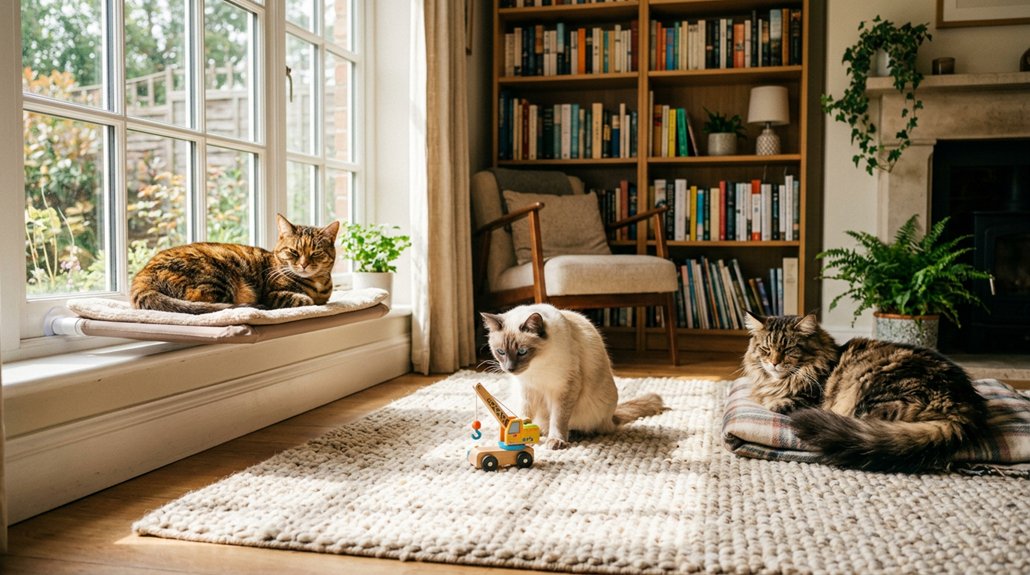
Choosing the right cat for your lifestyle involves evaluating work commitments, available space, and personal preferences. Busy professionals might prefer independent, low-energy breeds, while families benefit from gentle, adaptable ones. Consider your home’s size and whether you’ll offer outdoor access. Decide between high-energy kittens or calmer mature cats. Examine grooming needs, breed predictability, and choose between breeders or shelters for adoption. Aligning these factors guarantees a harmonious relationship, and further insights will guide you in making an informed decision.
Key Takeaways
- Assess your work schedule to select a cat breed with independence or social needs that match your lifestyle.
- Consider your home’s size to determine if a low-energy or active breed will thrive in the available space.
- Decide between a kitten’s energy and training needs or a mature cat’s calmer, established behavior.
- Compare purebred predictability with mixed-breed diversity to see which aligns with your preferences and living conditions.
- Prepare essentials and create a safe, comfortable space to support your new cat’s confidence and adaptation.
How Your Lifestyle Dictates Cat Compatibility
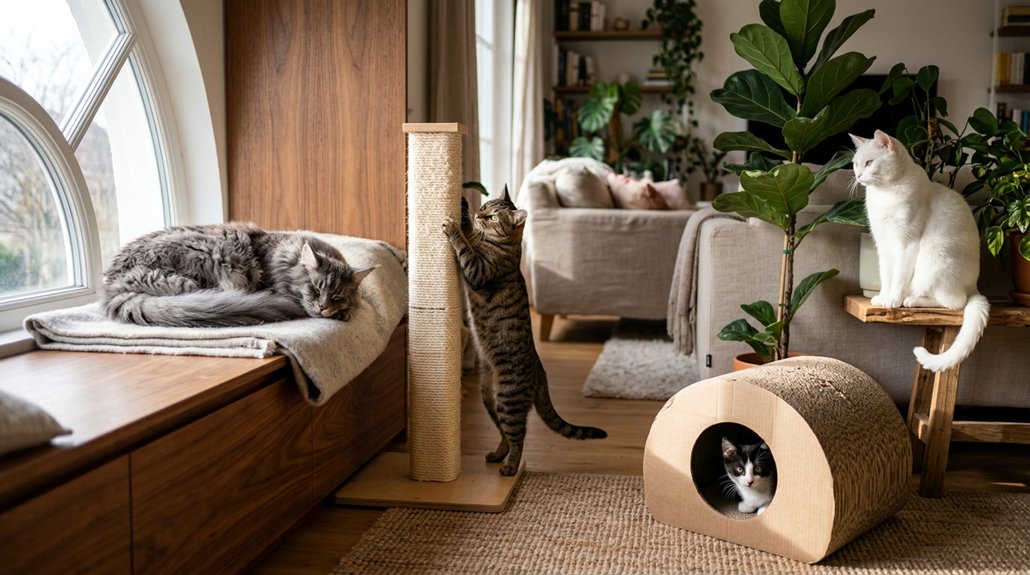
When considering a cat, your lifestyle is essential in determining compatibility. Your work commitments and activity levels directly impact the type of cat that suits you. If you’re a busy professional, an independent breed with lower social demands might align with your cat behavior preferences. For families with children or pets, selecting a breed known for its adaptability and gentle nature guarantees harmonious integration. High-energy cat breeds require significant playtime and interactions; therefore, understanding your available time is vital. Socialization tips include introducing your new feline friend gradually to family and other pets to reduce stress. Grooming tolerance plays a role too; if your schedule is packed, a shorthaired breed, requiring less maintenance, might be ideal for you.
Evaluating Your Living Space for Feline Friendship
Before welcoming a feline friend into your home, it’s important to evaluate your living space to guarantee it’s conducive to feline happiness and well-being. Start by considering the size of your home: small apartments benefit from adopting low-energy cats, while larger spaces suit active breeds that enjoy exploring. Integrate cat friendly furniture, such as scratching posts and cat trees, which provide essential vertical space enrichment for climbing and resting. Creating safe nooks allows inquisitive cats to thrive. Decide if your future cat will remain indoors or have outdoor access; this impacts safety measures you need. Furthermore, consider any children or other pets, as feline compatibility varies. Tailor your environment to cater to your future feline’s activity level, maximizing comfort and happiness.
Matching Your Activity Level to the Ideal Cat
How do you guarantee your feline companion aligns with your lifestyle? First, assess whether you’re seeking playful companions or quiet coexistence. High-energy breeds like Bengals and Siamese demand regular playtime and thrive on mental stimulation, making them ideal for active individuals. Conversely, if you prefer laid-back interactions, low-energy breeds like British Shorthairs or Ragdolls might suit your relaxed environment.
Consider your daily routine: kittens are inherently more active and require constant engagement, while adult cats often settle into established energy levels, adapting well to quieter lifestyles. Busy professionals should lean towards independent cats that handle solitude well, whereas stay-at-home folks can enjoy more social felines. Your home’s layout is vital too—active cats need space, while calm cats appreciate snug spaces.
Exploring Breeds: Aligning Personality to Preferences
When evaluating cat breeds to match your lifestyle and preferences, it’s crucial to take into account the specific personality traits inherent to each breed. Recognizing that Maine Coons tend to be sociable and engaged while British Shorthairs display a more reserved independence can guide your decision. By aligning these breed characteristics with your own temperament and daily routines, you can form a harmonious and fulfilling bond with your feline companion.
Matching Cats to Owners
Selecting the perfect feline companion involves more than just an aesthetic preference; it requires aligning a cat’s breed and personality traits with the owner’s lifestyle and environment. Cat personality varies greatly, affecting compatibility with owner lifestyles. High-energy breeds like Bengals thrive in active homes needing regular play and stimulation, while calm breeds like British Shorthairs suit relaxed settings. Consider sociability: Siamese cats are ideal for those cherishing companionship, being vocal and engaging, while Scottish Folds, more independent, fit solitary preferences. Grooming plays a part; Ragdolls demand regular upkeep, contrasting the lower maintenance of shorthaired breeds. Housing size is essential; larger homes welcome active breeds, whereas smaller spaces suit low-energy, adaptable cats, including mature, seasoned companions fitting dynamic households.
Personality and Breed Selection
Understanding the dynamics between a cat’s personality and an owner’s preferences requires a nuanced approach, adaptable to individual scenarios. Cat temperament factors play an essential role in aligning a feline friend with your lifestyle. Different breeds exhibit distinct behavior nuances:
- Ragdolls: Perfect for those desiring affection, they’re renowned for their loving temperament.
- Siamese: Vocal and social, ideal for interactive environments needing regular companionship.
- Maine Coons: Their sociable and playful nature suits families seeking a friendly, engaging cat.
- Bengals: With high-energy and intelligence, they necessitate environments rich in stimulation.
Balance is key when selecting a breed. Consider energy levels and compatibility; high-energy breeds like Bengals may overwhelm a tranquil home, whereas the calm British Shorthair offers serene companionship.
Grooming: Short vs. Long Hair
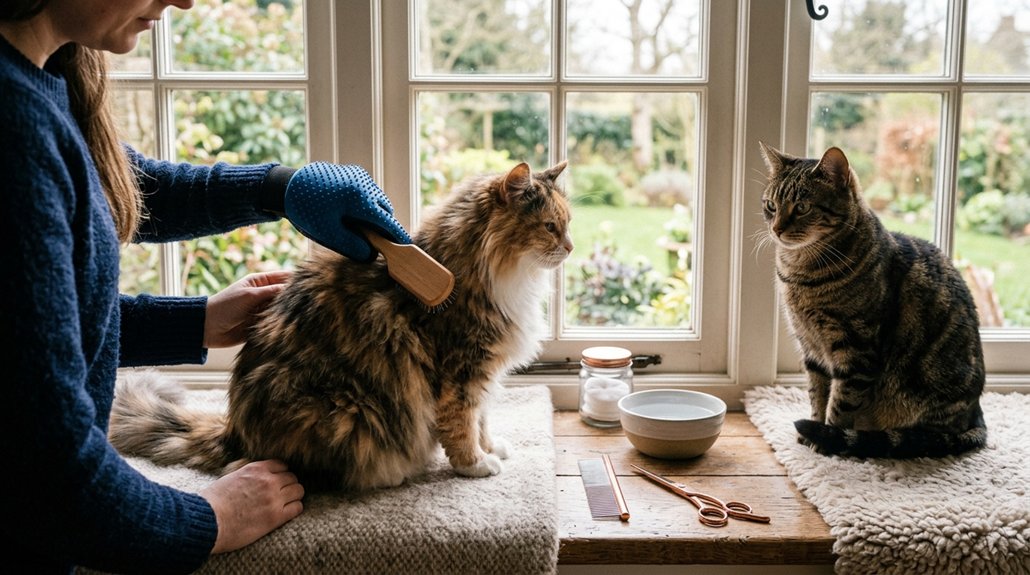
When choosing between shorthaired and longhaired cats, consider the time you’re willing to commit to grooming, as shorthaired cats require less frequent attention, making them suitable for busier schedules. Longhaired breeds necessitate regular grooming to prevent fur matting, thereby impacting your weekly routine and requiring specialized tools. In addition, your aesthetic preferences might influence your decision, as the luxurious coats of longhaired cats can appeal visually but demand a greater maintenance commitment.
Grooming Time Commitment
Choosing the right cat often boils down to evaluating the time you can devote to grooming, particularly when deciding between shorthaired and longhaired breeds. Shorthaired cats demand minimal grooming, making them suitable for busy folks or feline newcomers. However, longhaired cats like Persians necessitate daily attention to prevent fur matting and tangles. To maintain their coats, it’s crucial to use appropriate grooming tools tailored to the cat’s fur type. Regardless of length, all cats benefit from regular brushing to manage shedding effectively and promote skin health.
Consider these points:
- Short hair: Less frequent grooming, easier shedding management.
- Long hair: Requires daily grooming, prevents matting.
- Grooming tools: Essential for varied fur types.
- Routine grooming: Benefits skin health and reduces hairballs.
Hair Maintenance Needs
How do the hair maintenance needs of shorthaired and longhaired cats differ? Shorthaired cats typically require less frequent cat grooming, making them ideal for those with a busy lifestyle. Their maintenance routine is less demanding, as breeds like the American Shorthair don’t need daily attention. However, longhaired cats, with their dense fur, demand a more rigorous grooming regimen. Regular, often daily, grooming is essential to prevent matting and minimize hairballs, necessitating a more dedicated maintenance routine.
Regardless of hair length, all cats benefit from regular brushing. This not only reduces shedding but also promotes healthy skin and coat. If you’re considering a longhaired cat, invest in quality grooming tools and establish habits early to keep your feline companion comfortable and mat-free.
Aesthetic Preferences Impact
Although time constraints might lead many toward shorthaired cats for their low-maintenance grooming, others are captivated by the allure of longhaired breeds. Your aesthetic preferences certainly impact your grooming choices. Shorthaired cats typically require less frequent brushing, making them practical for busy lifestyles. In contrast, longhaired breeds boast a luxurious aesthetic appeal but demand more diligent care routines, usually involving daily brushing. This commitment helps prevent matting and tangling, essential for maintaining their plush appearance. Consider the following factors:
- Time commitment: Daily vs. occasional brushing needs.
- Home maintenance: Increased shedding may require more cleaning tools.
- Bonding opportunity: Grooming promotes health and connection.
- Personal preference: Balancing aesthetics with your dedication level.
Ultimately, your aesthetic leanings should align with your willingness to invest effort in grooming.
Deciding Between a Kitten and a Mature Cat
When contemplating whether to bring home a kitten or a mature cat, what considerations should guide your decision? Kittens demand significant kitten care, including training and patience for socialization. They’re delicate and packed with energy, making them ideal if you have time to nurture their playful side. However, adult behavior in mature cats often means less training is needed. They’re adaptable and have established routines—ideal for busy or first-time owners.
| Aspect | Kitten | Mature Cat |
|---|---|---|
| Energy Level | High, playful | More settled, calm |
| Training Need | Significant (kitten care) | Minimal (adult behavior) |
| Adaptability | Requires time for socialization | Generally adaptable |
| Care Routine | Developing routines | Established routines |
Mature cats face longer shelter waits but offer companionship enriched by their characteristic settledness.
Purebred vs. Mixed Breed: What Fits Your Life?
Have you ever considered the unique advantages of purebred versus mixed-breed cats when deciding which may fit best into your lifestyle? Purebred cats offer specific traits and behaviors due to breeder motivations to maintain particular characteristics like energy levels and sociability. This predictability can be ideal if you have precise lifestyle needs. On the other hand, shelters provide mixed-breed cats that embody diverse personalities with shelter benefits, offering companionship that may be less predictable but equally rewarding. Health-wise, mixed breeds generally benefit from genetic diversity, decreasing certain breed-specific issues seen in purebreds. Deciding between these options requires evaluating:
Purebred cats offer predictability, while mixed breeds boast genetic diversity and unique personalities; each presents distinct companionship benefits.
- Your living space constraints
- Available time for care and socializing
- Personal preferences in cat behaviors
- Potential long-term health considerations
Finding Your Perfect Cat: Breeders, Shelters, and More
When you’re searching for your ideal feline companion, it’s crucial to weigh the benefits of breeders versus shelters, considering that reputable breeders offer health certificates and allow you to interact with the kitten’s parents for assurance. Meanwhile, shelters present a plethora of mixed-breed cats, showcasing unique traits and temperaments often shaped by diverse genetics, making them intriguing adoptees. Utilize global resources like Petfinder to efficiently browse potential options and engage with local rescue organizations that can facilitate a smooth adoption process by matching you with the right cat.
Breeder vs. Shelter Options
Are you puzzled about whether to adopt a cat from a breeder or a shelter? Let’s clear the confusion by examining your choices. Breeder ethics guarantee that purebred cats come from responsible breeders, often offering health assurances and a chance to meet parent cats. This provides the purebred advantages with specific breed characteristics, ideal for those having precise requirements. Conversely, shelters offer substantial shelter benefits. They present a vast array of mixed breed charm, with cats having undergone extensive compatibility screening and fostering. Plus, the adoption process is often straightforward and fulfilling, saving numerous feline lives.
Consider where your priorities lie:
- Breeder ethics vs. Shelter benefits
- Breed characteristics vs. Mixed breed charm
- Purebred advantages vs. Diverse personalities
- Structured adoption process vs. Saving lives
Evaluating Mixed-Breed Cats
While weighing the options between breeders and shelters, it’s important to appreciate the charm and potential of mixed-breed cats. These feline companions often boast unique traits, resulting from the blend of various breeds, which contribute to their adaptable personalities. Such adaptability makes them suitable for diverse living situations, whether you’re in a bustling city apartment or a serene suburban home.
Mixed-breed cats come in a fascinating array of sizes, colors, and temperaments, offering something for everyone. Adopting from shelters or rescue organizations not only provides you with a feline friend but also supports the critical mission of alleviating shelter overpopulation. Typically, mixed-breeds are lower maintenance, having acclimated to family settings, making their adjustment into your home seamless and rewarding.
Adoption Resources Worldwide
Initiating the journey to find your ideal feline companion can be both thrilling and overwhelming, given the breadth of adoption resources available worldwide today. Engaging with global adoption options requires exploring various avenues, each offering unique benefits. Explore the wealth of shelter resources and discover over 11,500 rescue organizations in the U.S., as well as rehoming centers like Australia’s RSPCA.
To streamline the process:
- Embrace online platforms such as Petfinder for locating cats nearby
- Connect with rescue organizations that provide essential personality insights
- Consider international adoption for a broader selection of felines
- Investigate responsible breeding practices offering health guarantees
These community connections enhance your understanding of each cat, ensuring a harmonious addition to your household.
Preparing Your Home for a New Cat
How do you best prepare your home for the arrival of a new feline companion? Start by gathering essential cat supplies, creating a safe and stimulating environment. Designate a secluded space equipped with food, water, and a litter box to help acclimate your cat. Invest in interactive toys and plan bonding activities to foster closeness. Science shows that environmental enrichment and interactivity considerably influence feline adjustment.
| Essential Cat Supplies | Safe Space Setup | Furniture & Safety |
|---|---|---|
| Food and Water Bowls | Comfortable Bedding | Scratching Posts |
| Litter Box | Quiet Corner | Cat Trees |
| Interactive Toys | Limited Noise | Secured Cords |
| Treats | Gradual Introduction | Remove Toxic Plants |
| Grooming Tools | Hiding Spots | Absent Small Objects |
Cat-proofing your home guarantees safety, while cozy retreats encourage your cat to explore at their pace.
Smooth Transition Tips for Your New Feline Family Member
After setting up your home for a new feline arrival with the necessary supplies and environment, you can focus on facilitating a harmonious introduction to their new world. To navigate the adjustment period smoothly, create a safe, comfortable space with litter, food, and water in a quiet corner. Limit initial space to a small room to avoid overwhelming your cat. Allow exploration of the house gradually, ensuring they move at their own pace to build confidence. Consistent routines in feeding, play, and litter box upkeep promote security and stress reduction. Finally, manage the introduction to existing pets carefully, ensuring interactions are gradual and positive.
Create a serene space and introduce new environments gradually to ease your cat’s transition into your home.
- Provide a quiet sanctuary with essentials
- Introduce new spaces gradually
- Maintain consistent daily routines
- Facilitate calm, positive pet interactions
Frequently Asked Questions
How Do I Pick the Right Cat for Me?
Start by evaluating personality traits you’re comfortable with. Consider breed compatibility based on your experience, living space, and schedule. Consider cat’s needs against your grooming preferences and household dynamics. Confirm harmony by selecting a cat that matches your lifestyle.
What Is the 3 3 3 Rule for Adopting a Cat?
The 3 3 3 Rule symbolizes a blooming bud in cat adoption, highlighting behavioral expectations: three days hidden in the soil, three weeks of sprouting exploration, and three months blossoming into adjustment and comfort with new surroundings.
Do Cats Help Children With Autism?
Yes, cats offer therapeutic benefits and emotional support for children with autism. Petting and cuddling reduce stress, improve social interaction, and bolster sensory experiences, enhancing emotional and cognitive development in a non-demanding, comforting environment.
What Is “I Love You” in Cat Language?
In cat communication, “I love you” is expressed through feline affection like slow blinking, purring, and head butting. Each behavior signals trust and contentment, demonstrating their unique way of bonding and expressing deep emotional connection with you.
Conclusion
Choosing the right cat is like finding the perfect puzzle piece for your lifestyle. With expertise and consideration, you’ll discern how factors like living space, activity levels, and grooming needs fit into your daily life. By evaluating whether a purebred or mixed breed suits your preferences and exploring adoption options, you set the stage for a harmonious feline companionship. Prepare your home thoughtfully, and you’ll guarantee a seamless shift, enriching your life with a new, fitting family member.