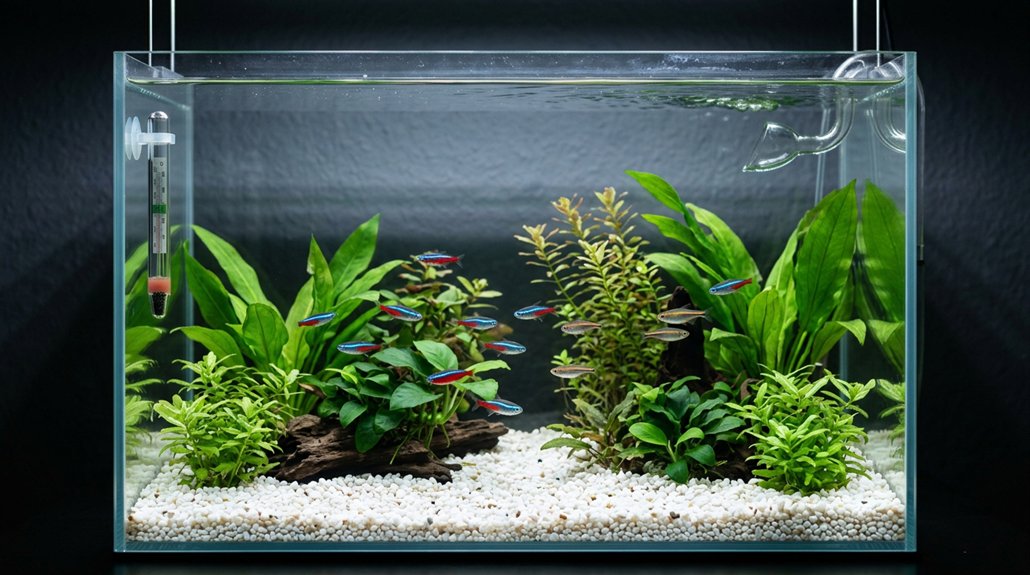
To cycle your freshwater aquarium properly, you should establish nitrifying bacteria that convert ammonia to nitrite, then nitrate. Set up a filtered, heated tank with good oxygenation, dechlorinated water, and a stable pH near 7.0–7.8. Either dose pure ammonia to about 2–4 ppm for a fishless cycle or stock very lightly and test ammonia, nitrite, and nitrate every 1–2 days. When ammonia and nitrite stay at 0 ppm and nitrate rises, your tank’s ready, and there’s more to learn.
Key Takeaways
- Set up the tank with a filter, oxygenation, heater, dechlorinator, and beneficial bacteria media before adding fish.
- Fishless cycling is safest: dose ammonia to 2–4 ppm and test ammonia, nitrite, and nitrate every 1–2 days.
- Keep temperature around 77–86°F and pH near 7.0–7.8 to support nitrifying bacteria growth.
- The cycle is complete when ammonia and nitrite are 0 ppm within 24 hours, while nitrate becomes measurable.
- Do regular water changes and add fish slowly once the biofilter is stable to avoid ammonia or nitrite spikes.
What the Aquarium Nitrogen Cycle Does
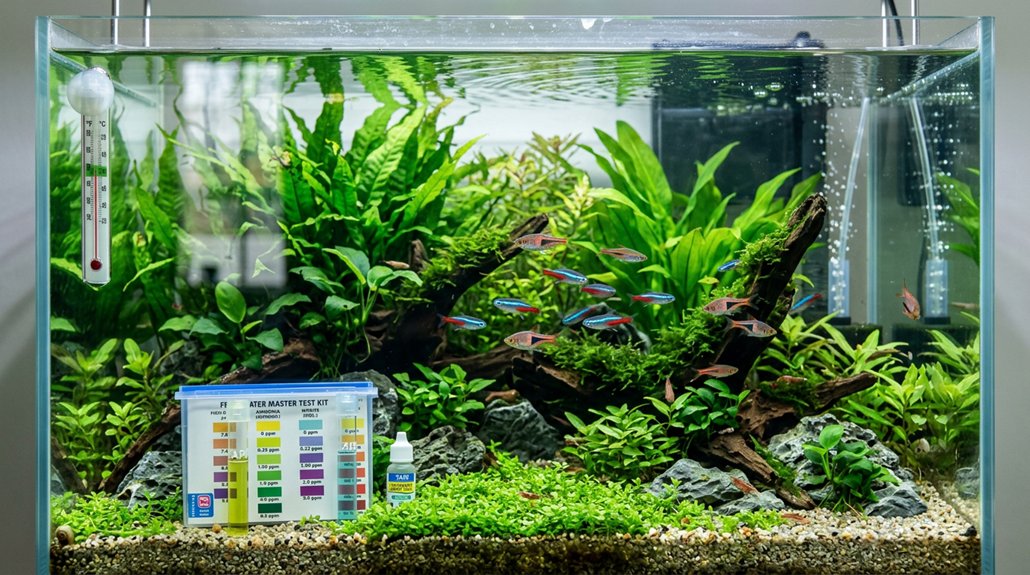
The aquarium nitrogen cycle breaks down the toxic wastes that build up in your tank: nitrifying bacteria convert ammonia from fish waste and decaying food into nitrite, then into less-toxic nitrate. You’ll see microbial succession as ammonia rises first, nitrite peaks next, and nitrate increases while the earlier compounds fall. This process depends on oxygen diffusion because nitrifying bacteria need a constant oxygen supply to oxidize waste products efficiently. When the cycle’s complete, you should test 0 ppm ammonia and 0 ppm nitrite, with detectable nitrate, often 5–40 ppm. Beneficial bacteria colonize filter media, substrate, and decorations, so you shouldn’t disrupt those surfaces. Live plants can also absorb ammonia and nitrate directly, which can speed nutrient removal and show progress through healthy new growth.
Set Up Your Tank for Cycling
Start by rinsing the substrate and hardscape with tap water only, then fill the tank, add dechlorinator, and set the heater to 78–84°F for efficient bacterial growth. Run the filter continuously, because the biological media is where nitrifying bacteria establish, and add an air stone if you can to keep oxygen levels high. If you’re using live plants, add them now with proper lighting and fertilizers, and seed the tank with used media or a quality bacteria product while you prepare to test ammonia, nitrite, and nitrate every 1–2 days.
Tank Equipment Setup
Set your tank up for cycling by installing a properly sized filter and running it continuously with both mechanical and biological media, such as sponge or ceramic rings, so nitrifying bacteria have a stable surface to colonize. Place it for efficient filter placement, then confirm your lighting setup stays minimal to limit unnecessary algae growth. Keep water at 78–86°F and pH near 7.0–7.8. Use a conditioner to dechlorinate tap water before any livestock enters. Guarantee strong oxygenation with an air stone or high flow. Prepare test kits and seed media.
| Parameter | Target | Purpose |
|---|---|---|
| Filter | 1x tank volume | Bacteria habitat |
| Temp | 78–86°F | Faster colonization |
| pH | 7.0–7.8 | Stable nitrification |
| Oxygen | High | Aerobic bacteria |
| Testing | Daily–2 days | Track cycle progress |
Water Preparation Steps
Begin by filling the tank with dechlorinated tap water, using a dechlorinator to neutralize chlorine and chloramine, then bring the water to your target species’ temperature, typically 24–27°C (75–80°F). This tap dechlorination prevents disinfectants from damaging future nitrifying bacteria. Next, verify temperature stabilization with a reliable thermometer and let the heater hold the set point continuously. If you’re adding substrate or live plants, install them now and provide appropriate light and root or water-column fertilizer so plants can use available nitrogen. You should also keep strong circulation and aeration in place to maintain dissolved oxygen. Once conditions are stable, you can add your chosen ammonia source and begin daily testing. Avoid adding livestock at this stage; your goal is to prepare a controlled, oxygen-rich environment for cycling.
Filter And Bacteria Start
Install your filter and keep it running continuously before any fish are added, because the filter media—foam, ceramic rings, bio-wheels, or similar surfaces—is where nitrifying bacteria will colonize and process waste. During filter startup, seed bacteria establishment by transferring used media from a disease-free tank or dosing a reputable live-bacteria product exactly as directed. Keep temperature at 77–86°F and pH near 7.0–7.8 to support Nitrosomonas and Nitrospira growth.
- Make certain strong flow
- Preserve media surface area
- Don’t replace cartridges
- Rinse only in dechlorinated water
- Test ammonia, nitrite, nitrate every 1–2 days
Your filter is cycled when ammonia and nitrite stay at 0 ppm and nitrate rises above 5 ppm consistently.
Cycle a Fish Tank Without Fish
To cycle your tank without fish, add a pure ammonia source or a measured amount of fish food to maintain about 2–4 ppm ammonia, or seed the filter with established media or a bottled nitrifying bacteria product to speed colony growth. Keep filtration and aeration running continuously at 75–86°F and pH 7–8 so nitrifiers can establish efficiently. Test ammonia, nitrite, and nitrate every 1–2 days, and do 10–30% water changes if ammonia or nitrite get too high until both read 0 ppm and nitrate remains present.
Ammonia Source Setup
Set up your ammonia source by dosing pure, non-iodized household ammonia with no surfactants or scents until the tank reads about 3 ppm on a reliable test kit, then keep that level up daily until nitrite shows. Use careful ammonia delivery and dosage calibration so you don’t overshoot. If you’re using 10% bottled ammonia, start near 0.5–1 mL per gallon, then verify with testing.
- Test ammonia, nitrite, and nitrate every 1–2 days.
- Keep ammonia under 5 ppm; change water if it climbs.
- Add a pea-sized pinch of fish food per 10 gallons if preferred.
- Remove uneaten solids after 24 hours.
- Seed with established media or a live-bacteria product.
Continue dosing until ammonia and nitrite both reach 0 ppm and nitrate rises.
Bacterial Colony Growth
As the ammonia level stays steady at about 2–4 ppm, nitrifying bacteria begin colonizing the tank’s surfaces—especially the filter media, substrate, and decor—and converting ammonia into nitrite. You’re promoting surface biofilms, where cells attach, multiply, and organize through quorum sensing. Keep the water warm, roughly 25–30°C, and the pH near 7.0–7.8 so growth isn’t slowed. If you seeded the system with moist media from an established tank or a bottled nitrifying product, the colony should establish faster, but don’t let seeded media dry out. Within 1–2 weeks, nitrite usually rises as ammonia oxidizers dominate. With sustained ammonia availability, nitrite-oxidizing bacteria follow, and the community matures toward nitrate production over the next 1–3 weeks, completing the biological foundation for a fishless cycle.
Testing And Water Changes
During fishless cycling, test ammonia, nitrite, nitrate, and pH every 1–2 days with a reliable freshwater kit so you can track the progression from ammonia to nitrite to nitrate. Maintain 2–4 ppm ammonia by redosing a pure source or measured food when readings drop. Your test frequency should tighten to daily once nitrite appears, because bacteria can shift quickly.
- Watch for nitrite spikes.
- Confirm nitrate accumulation.
- Dose only after testing.
- Seed with established media.
- Make partial changes only when needed.
If ammonia or nitrite rises above about 5 ppm, perform 10–20% partial changes to protect the biofilter. Also use partial changes if nitrate exceeds 40 ppm. Keep dosing ammonia until a 24-hour test shows 0 ppm after dosing; that’s your endpoint.
Cycle an Aquarium With Plants
To cycle an aquarium with plants, add a variety of live, fast-growing water-column species such as hornwort, water sprite, anubias, or java fern immediately after setup so they can begin absorbing ammonia and nitrate while the tank establishes. Use nutrient-rich substrate, liquid fertilizers for feeders, and root tabs for rooted plants. Provide 8–12 hours of light, and consider CO2 supplementation for dense aquatic carpeting.
| Parameter | Target |
|---|---|
| Ammonia | 0 ppm |
| Nitrite | 0 ppm |
| Nitrate | Measurable |
| Temperature | 74–84°F |
| Testing | Every 1–2 days |
Keep water well oxygenated and warm. When leaves, runners, or new growth appear, the cycle’s progressing. Once tests stay at 0 ppm ammonia and nitrite, with nitrate present, add fish slowly and continue weekly 25–30% water changes to limit algae and excess nitrate.
Cycle an Aquarium With Fish
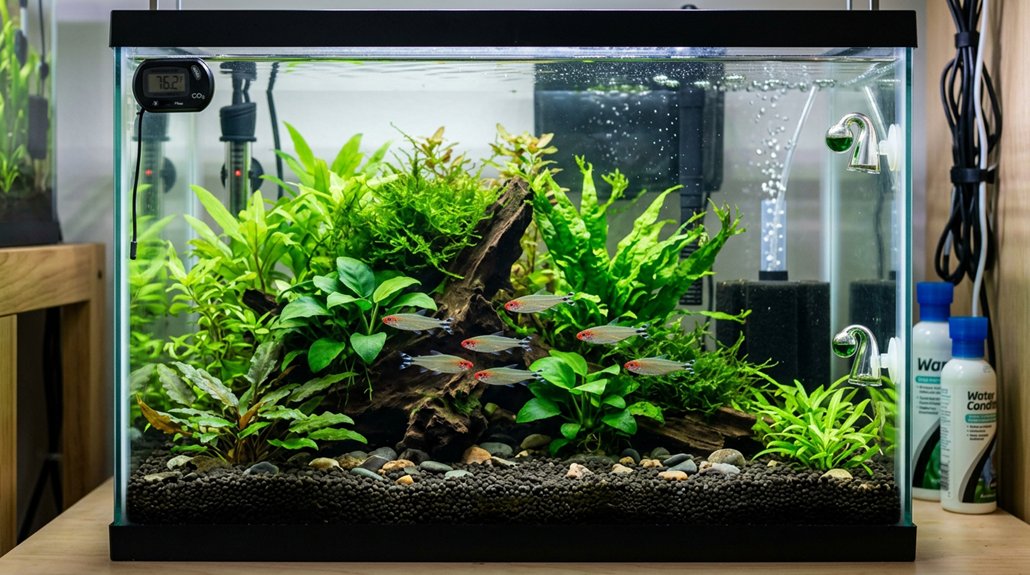
Cycling with fish means stocking the tank lightly at first—just 2–3 hardy small fish such as zebra danios or platies in a 20–30 gallon aquarium—and feeding only sparingly so you don’t overwhelm the developing biofilter.
- Test ammonia, nitrite, and nitrate every 1–2 days.
- Expect ammonia to rise first, then nitrite, then nitrate.
- Do 10–20% water changes twice weekly.
- Seed bacteria with used media or live cultures.
- Add more fish only after stable zeros.
This method is riskier than fishless cycling, so keep slow stocking as your rule. If ammonia or nitrite exceeds 0.2–0.5 ppm, change about 50% of the water immediately. Continue monitoring until ammonia and nitrite stay at 0 ppm for a week, with nitrate present and below 40 ppm.
How Long Aquarium Cycling Takes
A typical aquarium cycle takes about 2–8 weeks, with most tanks finishing in roughly 4–6 weeks. Your ideal timelines depend on whether you’re fishless cycling, using seeded media, or adding bottled ammonia. Seeded fishless systems can finish in 2–4 weeks, while unseeded setups often need 4–8 weeks. You’ll usually see an ammonia spike first, then nitrite rises several days to weeks later, followed by nitrate accumulation as both decline. To speed cycling, keep temperature near 83–87°F, maintain pH around 7.0–7.8, and use live plants or seeded filter media. Larger tanks may take longer. Seasonal impacts can matter too, because cooler room temperatures slow bacterial growth. Test ammonia, nitrite, and nitrate every 1–2 days during this period.
Know When Your Cycle Is Complete
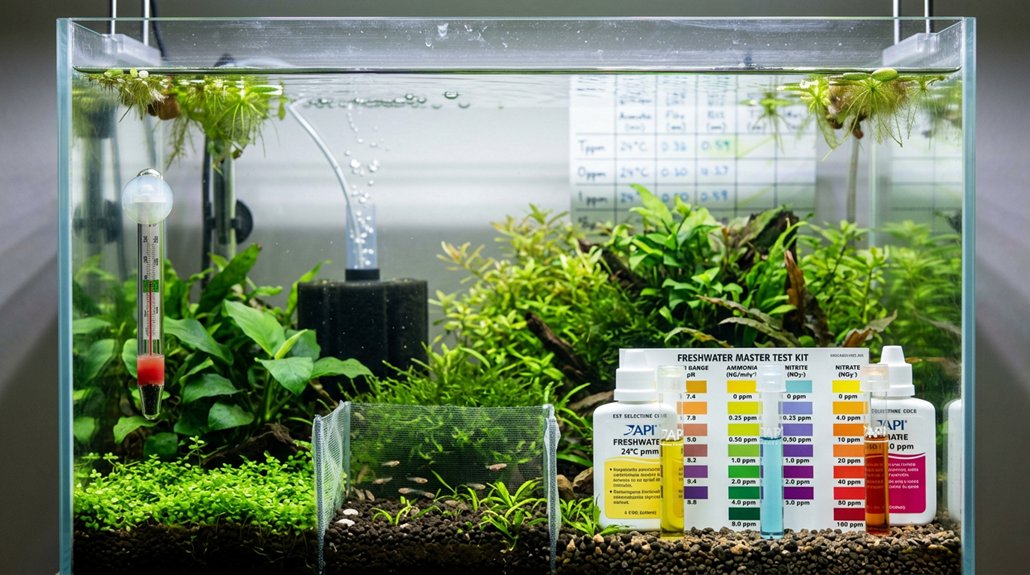
Once ammonia and nitrite both read 0 ppm for at least a full week and nitrate stays measurable, your cycle is effectively complete. Use an accurate liquid kit and keep your test frequency at every 1–2 days until that pattern is stable. You should see ammonia peak first, nitrite rise next, then both fall as nitrate accumulates. A cycled tank can handle about 1 ppm ammonia and return it to 0 ppm within 24 hours without nitrite spikes. Watch visual cues: clear water after the initial bloom, colonized filter media, and new plant growth in planted tanks.
- Confirm nitrate remains 5–40 ppm
- Add fish slowly, not all at once
- Keep testing after stocking
- Perform partial water changes as needed
- Maintain nitrate below 40 ppm
Frequently Asked Questions
What Is the Fastest Way to Cycle an Aquarium?
You’ll cycle fastest with fishless cycling: dose pure ammonia to about 3 ppm, add bottled bacteria or seeded media, keep it warm and oxygenated, and test daily until ammonia and nitrite hit zero.
How Long Should I Cycle My Freshwater Aquarium?
Typically, you’ll cycle your freshwater aquarium 2–8 weeks. Build beneficial bacteria for nitrogen stability; if you seed media and keep warm, it can finish sooner. Measure ammonia and nitrite until both stay 0 ppm a week.
How Do I Know if My Tank Is Properly Cycled?
Your tank’s properly cycled when water testing shows 0 ppm ammonia and 0 ppm nitrite for at least a week, with detectable nitrate. During fishless cycling, your readings stay stable and don’t spike again.
How to Properly Cycle a New Freshwater Aquarium?
Start fishless: you’ll dose ammonia, seed beneficial bacteria, and test water chemistry daily. Keep temperature warm, filtration strong, and wait until ammonia and nitrite hit 0 ppm while nitrate rises; slow and steady wins.
Conclusion
By cycling your freshwater aquarium, you build a stable, healthy environment for your fish. You test the water, you monitor ammonia, nitrite, and nitrate, and you wait for the beneficial bacteria to establish. You avoid rushing, you avoid overstocking, and you avoid unnecessary stress. When your cycle’s complete, your tank’s ready, your water’s balanced, and your fish can thrive. Follow the process carefully, and you’ll create an aquarium that’s safe, stable, and sustainable.