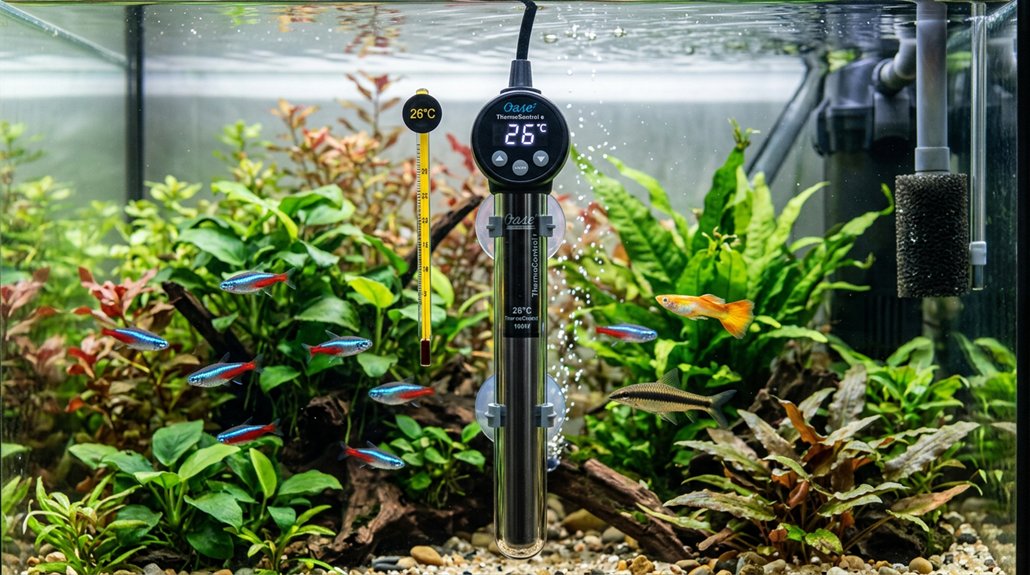
To prevent heater problems in fish tanks, place the heater in strong circulation near the filter outlet, not in a corner or dead spot, and keep it fully submerged. Use the correct wattage for your tank, and split heating with two units in larger setups. Check the water with a separate thermometer, not just the heater dial. Clean filters, impellers, and debris around the heater regularly, and you’ll keep temperatures steadier while uncovering better fixes.
Key Takeaways
- Place the heater near strong circulation, fully submerged, and away from corners, decorations, and stagnant spots.
- Size the heater correctly for the tank, and use two heaters in larger tanks for even heating and redundancy.
- Verify temperature with a separate thermometer, checking multiple tank areas after installation and whenever equipment changes.
- Clean debris, mulm, and plant roots around the heater so buildup does not insulate it or block heat transfer.
- Maintain filters, impellers, and air lines regularly to keep water moving and prevent low-flow heater problems.
Why Aquarium Heaters Overheat
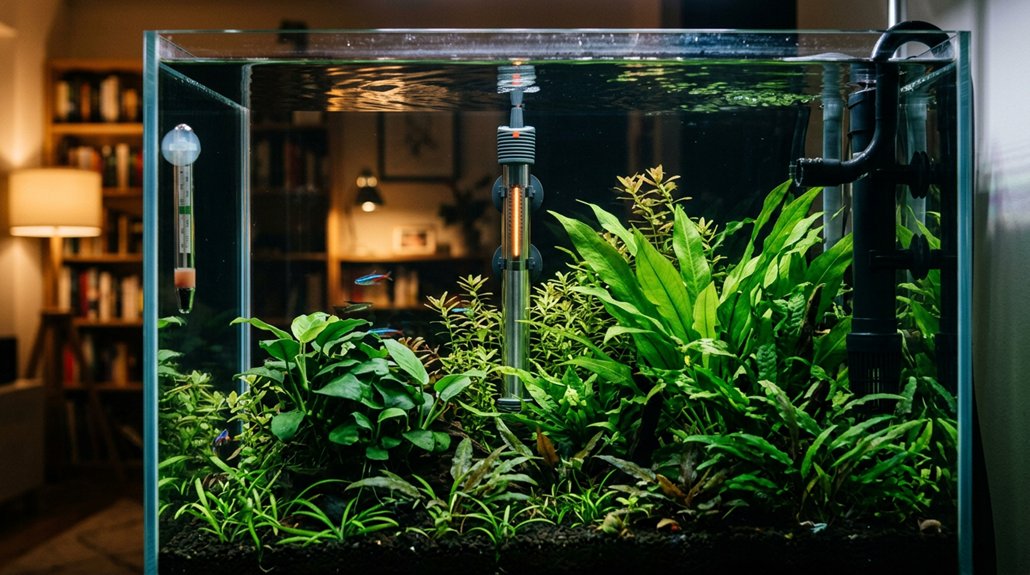
Aquarium heaters overheat when they’re exposed to air or placed where water movement is too weak, because the heating element loses convective cooling and can run hot enough to trigger a red “too hot” indicator or fail outright. You’ll also see this with air exposure in low-flow corners, behind decorations, or against substrate and roots, where trapped heat can’t disperse efficiently. If you use one undersized heater in a large tank, it may run continuously and overheat. Weak circulation from air-driven sponge filters can have the same effect. Debris buildup can insulate the heater and raise internal temperature. Thermostat failure makes the problem worse, so cross-check temperature with an independent thermometer and replace any unit that cycles erratically or reads inconsistently.
Place Your Heater in Moving Water
Set your heater where water moves steadily, ideally near a filter outlet or in a circulation current, so the element stays fully submerged and never sits in stagnant pockets or exposed air. Good heater placement keeps heat distributed and prevents the hot spots that trigger many flow sensors and low-flow warnings. You should aim for at least moderate movement across the heater, as your manual recommends; a small power filter or airstone can help if your sponge filter doesn’t move enough water. After relocating it, check temperatures at several points with an instant-read thermometer. If readings stay within about 0.5°F of the heater probe, your circulation is adequate. Avoid corners and tight enclosures; moving the heater to a better-flow side often stabilizes output.
Choose the Right Heater Size
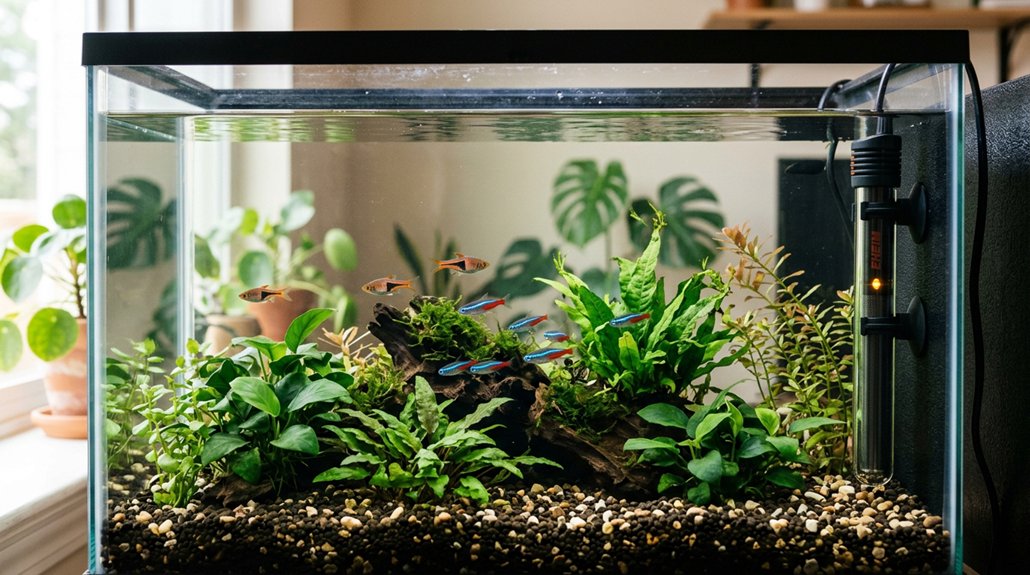
The right heater size matters as much as placement: match wattage to tank volume at about 3–5 watts per gallon, so a 75-gallon tank needs roughly 225–375 watts to hold temperature without running nonstop. Use this wattage calculation to avoid undersizing in drafty rooms or tanks with high surface area.
| Tank size | Watts | Setup |
|---|---|---|
| 20 gal | 60–100 W | Single heater |
| 75 gal | 225–375 W | One large or two smaller |
| 100 gal | 300–500 W | Two heaters |
If you use one heater, pair heater placement with strong flow; if you use two, split them across the tank for redundancy and even heating. Choose freshwater or marine models, submersible or inline, with accurate thermostats and safety features.
Check Heater Accuracy With a Thermometer
Use a separate, accurate aquarium thermometer to verify your heater’s setpoint instead of trusting the built-in dial alone. Check the readings regularly and compare temperatures at different tank locations after the heater’s been running for at least an hour. If you see a persistent gap of more than about 1°F, you’ll need to adjust flow, reposition the heater, or replace faulty equipment.
Use a Separate Thermometer
Regularly verify your aquarium heater with a separate, reliable thermometer placed 2–3 inches away from the heating element and near the tank’s middle, where it can reflect the water’s true temperature instead of the heater’s local reading. Make thermometer placement part of your calibration routine so you’re checking the water, not the heater casing. Use a waterproof digital probe or quality stick thermometer that reads to 0.1–0.5°F. During the first week after installation, and after any flow or equipment change, test daily. If the external reading differs by more than about 0.5–1.0°F, recalibrate or replace the heater. Also sample top, middle, and substrate levels; if lower zones stay cool, improve circulation with a powerhead or heater repositioning. Monthly, test the heater in a cup of water.
Compare Readings Regularly
Once you’ve set up a separate thermometer, compare it against the heater’s own digital display every day for the first week after installation, then at least weekly after that to catch drift early. Read at the top, middle, bottom, and near the outflow; heaters can create hot spots, so differences of several degrees aren’t unusual. After power changes or placement shifts, let the tank stabilize 30–60 minutes before judging accuracy.
- Acceptable variance: 0.5–1.0°F.
- If the heater stays >1°F off, recalibrate or replace it.
- Keep a $5–$15 reference thermometer on hand.
- Use data logging to track time, device, and location, especially during seasonal adjustments or flow changes.
Keep Filters and Impellers Clean
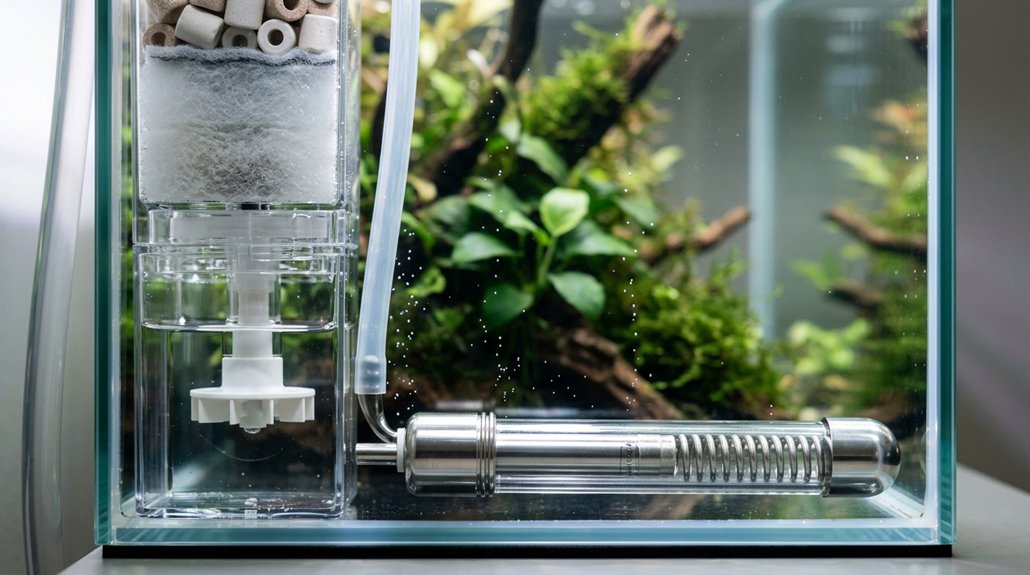
You should clean filter sponges and intake screens every 2–4 weeks, or sooner if flow drops, rinsing them in tank water during a water change so you don’t kill beneficial bacteria. Inspect the impeller monthly, remove it, and scrub the shaft and housing with a soft brush to prevent noise, binding, and reduced circulation. If you notice low flow, localized overheating, or a heater error, check for clogged media or a fouled impeller, since poor circulation can create heater problems.
Clean Filter Media Regularly
A clean filter is one of the simplest ways to keep a heater working safely, because restricted flow can create hot spots around the element. Follow routine timing: rinse sponges, pads, or floss every 2–4 weeks in a bucket of tank water, not tap water. Use media rotation so you can swap in a spare clean sponge or cartridge during deep cleaning and avoid a low-flow gap.
- Replace carbon or phosphate removers every 3–4 weeks.
- Check flow during maintenance by timing a floating paper’s travel.
- Clean sooner if current near the heater weakens.
- Keep debris from packing into mechanical media.
This preserves circulation, limits clogging, and helps the heater stay submerged and stable.
Clear Impellers and Intake
Check filter impellers and intake screens at least every 2–4 weeks, or sooner if flow drops, because restricted circulation can create localized hot spots around the heater. During partial water changes, rinse impellers and sponge media in tank water so you don’t kill beneficial bacteria while restoring flow. After heavy substrate disturbance or new media installation, clear algae, hair algae, and plant debris from intake grilles and impeller chambers. Verify impeller alignment; a misseated shaft or worn impeller can cut efficiency and trigger low-flow alarms. Keep a spare impeller and O-ring, and replace worn parts immediately. If air-driven sponge filters still underperform, check airline and diffusers for blockages or consider intake modification with a small internal power filter aimed at the heater.
Use a Second Heater in Large Tanks
In tanks larger than about 40–50 gallons, two heaters are often safer than one because they add redundancy: if one fails, the other can keep the water from dropping too quickly. Split wattage between them, such as two 100W units instead of one 200W heater in a 75–100 gallon tank. Use redundant thermostats and staggered placement to improve temperature stability without overworking a single device.
- Put one heater at each end.
- Keep both fully submerged.
- Choose models with indicator lights.
- Verify temperature with an independent thermometer.
This setup shares the load, can reduce cycling, and may extend heater life, especially when flow is limited by sponge or low-pressure filtration. After installation, monitor closely for several days and adjust only if your readings show a drift.
Eliminate Dead Spots Around the Heater
Position the heater where water moves continuously, such as near the filter outflow or along the tank’s strongest current, so stagnant water can’t form around the element and create hot or cold spots. Keep it fully submerged to the manufacturer’s minimum immersion mark, and mount it vertically or as directed so the whole heating tube stays in flow. If circulation is weak, add a small powerhead, in-tank filter, or an airstone beneath the heater to break up dead spots and stop low-flow alerts. Avoid corner mounts; moving it to the middle-right often improves temperature stability. Check for debris, mulm, and plant roots nearby, because buildup acts like heater insulation and blocks circulation. Trim plant placement and clean the area regularly.
Frequently Asked Questions
How to Keep a Heater in a Fish Tank?
You’ll keep it submerged, secured near strong flow, and clear of substrate insulation and plants. Choose proper heater placement, use suction cups, maintain the waterline, and verify temperature with an independent thermometer regularly.
Why Do Aquarium Heaters Fail?
You’ll see aquarium heaters fail from thermostat malfunctions, manufacturing defects, thermistor corrosion, incorrect wattage, power surge damage, age related degradation, sealant failure, and poor maintenance, especially when you run them dry or allow unstable water flow.
How Long Do Heaters Last in Fish Tanks?
Your heater’ll usually last 3–5 years, though quality units can reach 5–10; warranty lifespan varies with manufacturer variability. You’ll extend life by keeping it fully submerged, avoiding constant cycling, and checking monthly for cracks or drift.
How Can I Keep My Fish Tank Warm Without a Heater?
You can keep your fish tank warm with room heating, a fitted lid, and thermal mats under or beside the tank. Place it in a warm, draft-free room, use deeper water, and add heat-retaining décor.
Conclusion
To prevent heater problems in your fish tank, you need to manage placement, sizing, and maintenance carefully. Studies show that aquarium heater failures contribute to nearly 30% of avoidable temperature-related fish losses, which is a serious risk. You should keep your heater in moving water, verify its output with a thermometer, clean filters regularly, and use a backup heater in larger tanks. These steps help you maintain stable, safe temperatures and protect your fish.