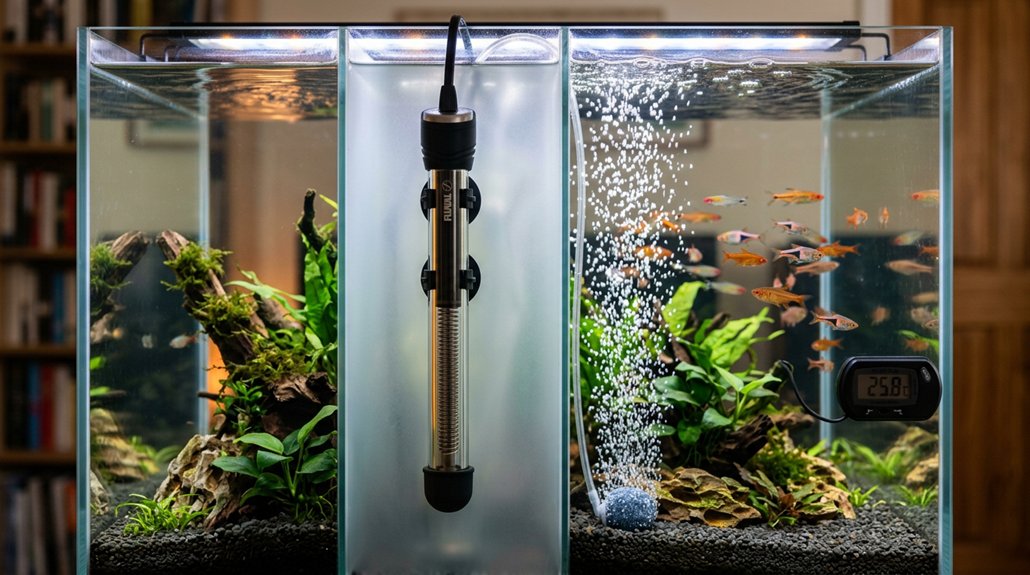
You need a heater if you keep tropical fish like bettas, tetras, guppies, gouramis, or discus, because they usually need stable water near 75–82°F. You may not need one for coldwater species such as white clouds, goldfish, or some danios if your room stays within their safe range. Thermal stability matters more than a perfect number, so monitor daily and match heater use to species needs. Keep going and you’ll see how to set it up right.
Key Takeaways
- Tropical fish usually need a heater to maintain 75–82°F and prevent stress or illness.
- Coldwater species can often live without a heater if room temperatures stay within their safe range.
- Stability matters more than exact temperature; avoid daily swings and chronic underheating.
- Large, stable tanks may need no heater if monitored and the room stays consistently warm enough.
- Use a heater when breeding, keeping sensitive species, or when room temperatures can drop into the 60s.
Do You Need a Heater for Your Fish Tank?
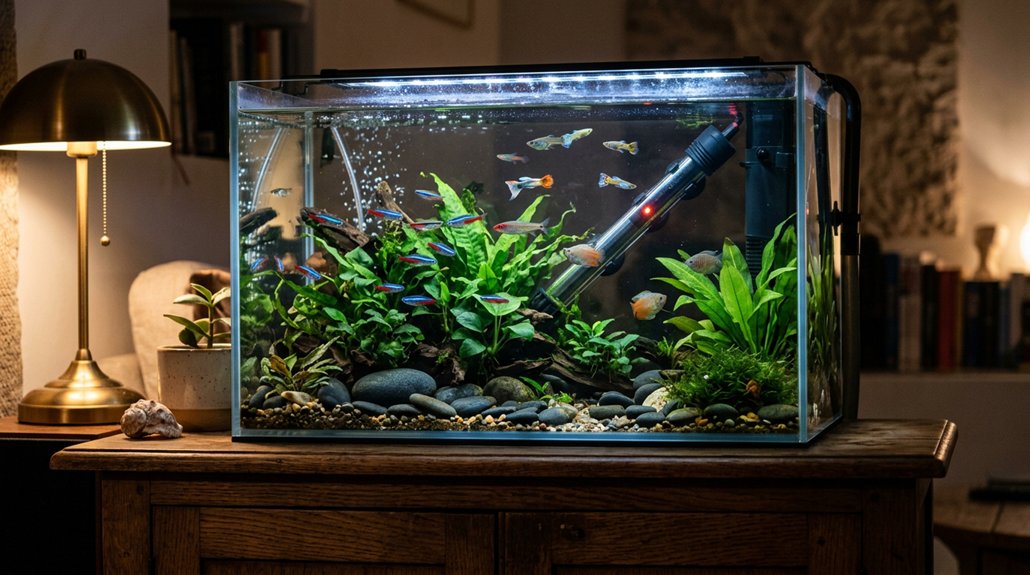
Whether you need a heater depends on the species you keep: tropical fish such as bettas, many tetras, discus, and guppies usually need 75–80°F, while coldwater species like white cloud mountain minnows, goldfish, and some corydoras can tolerate typical room temperatures, often down to about 65–70°F. In practice, thermal stability matters more than hitting an exact setpoint. You’ll reduce stress and lifespan loss by avoiding daily swings and chronic underheating. If your room varies seasonally, a heater is advisable. Consider tank location, insulation, lighting, and water source; exterior walls, doors, and basements cool faster. For omission, monitor temperature over several days, keep a spare heater ready, and only stock species that match your home’s seasonal acclimation limits and breeding temperature needs.
Which Fish Need an Aquarium Heater?
The need for an aquarium heater depends on the species you keep: tropical fish such as bettas, many tetras, guppies, gouramis, and discus generally need stable water in the mid-70s to low-80s °F (about 24–28 °C), so they do need one. For these tropical species, a heater helps maintain metabolic efficiency and reduces stress from temperature drift. Cold-water fish such as goldfish, white cloud mountain minnows, and some danios often tolerate cool-room conditions without added heat. Bottom-dwellers vary; many corydoras and some plecos can handle cooler water, but sensitive pleco species and breeding Corydoras strains may need tighter control. If you’re managing breeding triggers or fry development, precise heating matters. Always verify the species’ range, and use a heater if temperatures fall below it.
How Room Temperature Changes Tank Heat
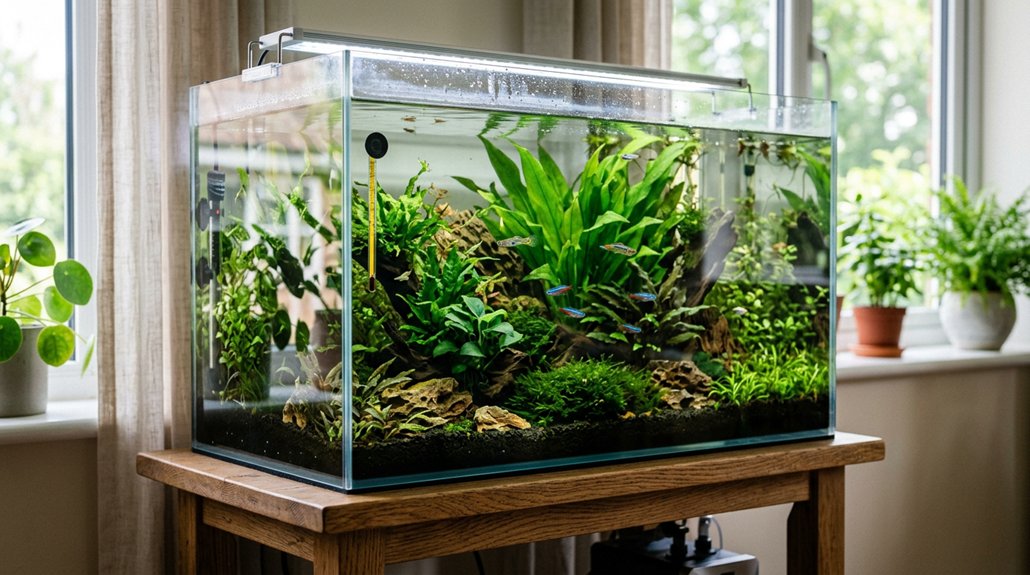
Your tank’s water temperature will usually track the room air temperature over time, so a 72°F room often produces a tank near 72°F if you don’t add heat. Drafts, exterior walls, open doors, and direct sunlight can shift that balance quickly, causing localized cooling or heating even when the average room temperature seems stable. Large tanks resist short-term swings more than small ones, but seasonal room changes or prolonged cold exposure can still push your fish outside a safe range.
Room Temp Effects
Room temperature strongly influences aquarium heat because water will gradually equilibrate with the surrounding air; in a well-covered, circulated tank, water often settles within about 1–3°F of ambient conditions, while larger volumes change more slowly. In your room microclimate, steady thermostat settings matter, but small tanks under 10 gallons can track HVAC swings quickly and vary 5–10°F across a day. That variability can stress sensitive fish. Temperature monitoring over several days lets you verify whether the tank stays within your species’ safe range, especially if your room is usually mid-70s for tropicals. If it doesn’t dip at night or during outages, you may not need a heater. Even so, insulation, lids, and tank volume all affect thermal stability and heat retention.
Drafts And Sunlight
Even if your room seems stable, drafts and sunlight can change tank temperature fast enough to matter. If you use draft prone placement near a back door, window, or exterior wall, cold air can drop water several degrees in winter, especially in small or lightly insulated tanks. With no hood or single-pane glass, heat loss accelerates. Direct sunlight can do the opposite, raising water 2-6°F or more in a few hours; that may reduce heater need temporarily, but it also increases algae and overheating risk. Your tank will tend toward room ambient, so 60-65°F rooms cool water, while 75-78°F rooms keep it warmer. Use sunlight mitigation, and monitor for HVAC cycling, night drops, and long door openings.
When a Heater Is a Must
A heater is essential whenever you keep tropical fish such as bettas, discus, many tetras, or guppies, since they need stable water temperatures in the roughly 75–82°F range to reduce stress and prevent immune suppression. You should also use one if your room can fall into the 60s, because chronic cooling slows metabolism, shortens lifespan, and raises disease risk. For species with narrow activity or breeding windows, such as discus, temperature stability within ±1–2°F isn’t optional; reliable equipment and thermal backups support successful tropical breeding. In planted systems, warmer water can improve growth and metabolic rate, typically around 72–78°F. If you keep mixed species, set a compromise target for the most sensitive fish and verify it daily with a thermometer, so your heater stays within the biologically appropriate range.
Where to Place Your Aquarium Heater
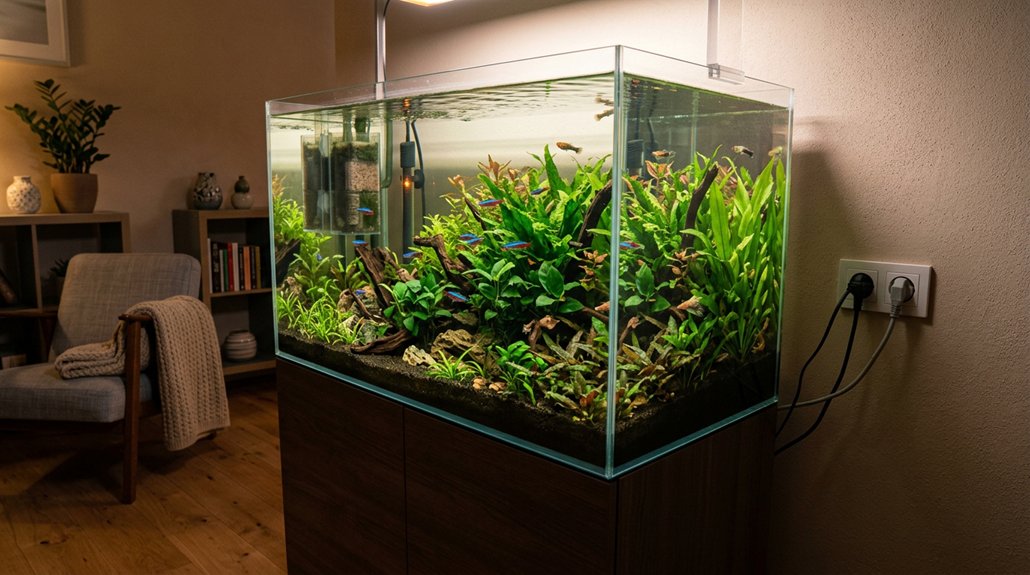
You should place your heater in the tank’s main flow, ideally near the filter inlet or outlet, so warmed water’s distributed rapidly and thermal gradients are minimized. In tall aquariums, mount it vertically near the bottom; in low-profile setups, a horizontal position along the lower back can improve convection, but you should always follow the manufacturer’s orientation. Keep it away from substrate, decorations, and fish hiding areas, and place your thermometer on the opposite side of the tank so you’re measuring the bulk water temperature, not the local heater zone.
Heater Placement Near Flow
Heater placement near water flow is critical for uniform thermal distribution, because circulated water rapidly carries heat away from the element and reduces localized hot or cold spots. You should exploit flow dynamics by placing submersible heaters near the filter inlet or outlet, where mixing is strongest. Position it horizontally near the bottom or vertically in a rear corner so the current sweeps heat upward through the water column. For in-line units, install them on the outgoing line, where pump flow delivers pre-warmed water throughout the tank.
- Maximize circulation.
- Prevent thermal stratification.
- Improve heater redundancy in large tanks.
Don’t bury the heater under substrate or conceal it behind decor, because restricted flow can overheat the element and distort temperature gradients. In irregular aquariums, two smaller heaters at opposite ends often stabilize temperature better than one oversized unit.
Safe Spots In Tank
With the flow set, the next step is choosing a safe spot inside the tank where the heater can work evenly without creating hot spots. You should place submersible heaters near the filter inlet or outlet, where circulation disperses heat and minimizes gradients. Mount it horizontally near the bottom for stability in planted and community systems, unless the manufacturer specifies vertical installation and space demands it. Avoid heater hiding spots behind décor or within plant safe zones; keep several inches of clear water around the element so substrate, ornaments, and dense growth don’t trap heat or distort sensing. Put a thermometer on the opposite glass wall at mid-depth to track representative temperature. In large or draft-exposed tanks, use two smaller heaters at opposite ends for redundancy and uniform thermal distribution.
Can You Run a Tank Without a Heater?
Yes, a tank can be run without a heater if the room temperature consistently stays within the species’ acceptable range, but only certain fish tolerate that setup well. You should verify this with temperature monitoring over several days, because stable readings matter more than brief peaks. 1. Cool-water species such as corydoras, danios, white-clouds, and some plecos often manage unheated tanks. 2. Tropical fish like bettas, discus, and many livebearers usually need mid-70s°F or warmer. 3. Seasonal planning is critical, since winter rooms can drop to 60–65°F and increase stress. If you choose no heater, place the tank away from drafts, use a hood, and insulate it to reduce fluctuation. Chronic thermal instability can shorten lifespan and impair immunity.
What to Do If Your Heater Stops Working
If your heater fails, act immediately to prevent rapid thermal stress: move in a thermometer-verified spare heater or restore the existing unit to operation, targeting a temperature change of no more than 1–2°F per hour. This emergency protocol limits shock and buys time while you assess the system. If you don’t have backup heaters, make several warm, not hot, water top-ups matched to the current tank temperature, then increase gradually so the tank rises no more than 2–3°F in an hour. Temporarily insulate the aquarium with a hood, blankets, or styrofoam, and reduce draft exposure. Watch for lethargy, clamped fins, or gasping. If needed, move sensitive fish like bettas or discus to a heated quarantine container. Replace the failed heater promptly.
How to Stabilize Aquarium Temperature
For aquarium health, stability matters more than chasing an exact number: most tropical setups do best at a steady 75–78°F (24–26°C), because frequent swings create more physiological stress than a slightly off-target but constant temperature.
- Size your heater to match volume, then place it near the filter inlet or outlet to distribute heat and prevent hot/cold pockets.
- Use a reliable thermometer opposite the heater, and log readings daily to detect ambient-driven fluctuations and night/day swings.
- Increase thermal inertia by insulating the tank, avoiding drafts, and keeping it away from exterior walls or doors.
This approach improves temperature stability and reduces metabolic disruption. Keep a spare heater or backup warming method available, since winter lows can drop quickly and prolonged chilling can impair tropical species.
Frequently Asked Questions
Can My Fish Survive Without a Heater?
Yes, your fish can survive without a heater if their temperature tolerance matches steady room conditions; seasonal acclimation helps, but only for suitable species. Monitor fluctuations closely, because unstable temperatures’ll stress tropical fish.
How Can I Warm My Fish Tank Without a Heater?
You can warm your tank by optimizing seasonal placement, adding room insulation, sealing drafts, and running lights and filtration continuously; use pre-warmed water changes, and monitor temperature closely, since small thermal shifts can stress fish.
Is It Expensive to Run a Fish Tank Heater?
Not usually; your heater cost depends on wattage and energy consumption. A 75W unit running continuously may cost about $8 monthly at $0.15/kWh, but cycling, insulation, and room temperature’ll reduce your actual bill.
Can You Cycle a Fish Tank Without a Heater?
Yes, you can cycle your tank without a heater. Like a slow-burning engine, tank cycling still supports beneficial bacteria at room temperature, but it’ll take longer in cooler water, so you’d monitor ammonia, nitrite, and nitrate closely.
Conclusion
So, do you need a heater for your fish tank? If your fish are tropical, yes—the heater is the steady sun that keeps their small world stable. If your species tolerate cooler water, you may not need one, but temperature still matters. You should monitor fluctuations, because even minor drops can stress fish. A properly placed heater, with backup plans for failure, helps you maintain a controlled, healthy aquarium environment.