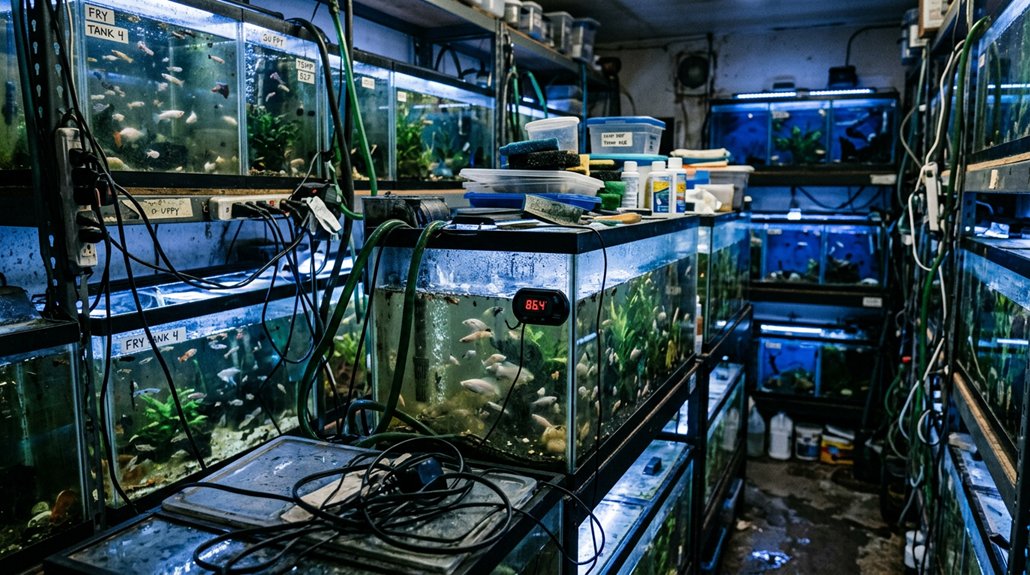
You may have an overstocked tank if your fish are gasping at the surface, breathing fast, hiding more, or chasing and nipping each other. Test the water too: ammonia or nitrite that won’t stay at zero, or nitrate staying above 40 ppm after changes, points to overload. Cloudy water, clogged filters, and rising waste also fit. If these signs show up, you’ll need to adjust feeding, filtration, and stocking fast, and there’s more to check next.
Key Takeaways
- Persistent ammonia, nitrite, or nitrates above 40 ppm after water changes suggest the tank is carrying too much waste.
- Fish gasping at the surface, rapid breathing, or clustering near filter outflows can mean oxygen is being depleted.
- Aggressive chasing, nipping, and constant hiding often show social stress from overcrowding.
- Cloudy water, quick filter clogging, and sulfur smells indicate the filtration system is overloaded.
- Excess visible waste and stalled plant or water quality improvements point to bioload exceeding tank capacity.
Spot the Signs of an Overstocked Tank

One clear sign your tank is overstocked is persistently high nitrate, especially readings above 40 ppm even after regular water changes, because that means your fish load is outpacing the tank’s ability to process and remove waste. If you keep seeing ammonia or nitrite spikes after feeding or partial changes, your nitrogen cycle can’t keep up. You may also notice cloudy water, algae overgrowth, and detritus collecting fast on substrate and décor even when filtration runs correctly. These signs mean your aquarium carrying capacity is exceeded. Check your stocking calculator against actual bioload, then reduce fish numbers or increase system volume. If your filter clogs quickly or can’t clear the water, it’s handling too much organic load for the current stocking level.
Check Fish Behavior for Stress Clues
Watch for rapid breathing, especially if fish are clustered near the surface, because that often points to low oxygen or excess ammonia from overcrowding. If you’re seeing more hiding, reduced feeding, or repeated chasing and nipping, the tank may not have enough space or shelter for normal behavior. These stress cues usually show up across multiple fish when stocking density is too high.
Rapid Breathing
Rapid breathing is one of the clearest stress cues in an overstocked aquarium: if your fish are showing rapid gill movements while otherwise staying still, or you notice them gasping at the surface, gulping air, or clustering near filter outlets, the tank may be short on dissolved oxygen or accumulating toxic waste. Watch each fish’s respiratory rate and gill coloration closely.
- Count opercular beats; 60–80 per minute in small tropical species is abnormal.
- Test dissolved oxygen and ammonia/nitrite; DO below 5 mg/L or detectable ammonia points to overload.
- Note whether fast breathing starts after feeding or lights-on, which can signal oxygen depletion.
If you also see lethargy, clamped fins, or reduced appetite, your bioload likely exceeds filtration and plant uptake, so act quickly.
Hiding And Chasing
If your fish are constantly darting between plants, decorations, and cave entrances or crowding into a few tight hiding spots, the tank may be overcrowded and lacking enough territory for each species’ social needs. Watch for persistent chasing, nip marks, torn fins, and prolonged harassment, especially after lights on or feeding. These behaviors usually mean competition for space and food, not normal play. When subordinate fish spend most daylight hours hidden or pinned to the bottom, eat less, or lose weight, stress is likely. A sudden rise in aggression after adding fish also points to exceeded carrying capacity. Repeated patrols by dominant fish and a clear schooling imbalance signal refuge scarcity. In that case, reduce stock or expand cover.
Read the Water for Overload Warnings
When your tank is carrying too much bioload, the water usually shows it first: a persistent rise in ammonia or nitrite on test kits within days, even when you haven’t added new fish, means the biological filter is being overloaded and your fish are already under stress. Track water chemistry and increase test frequency until readings stabilize.
Persistent ammonia or nitrite spikes after water changes signal an overloaded biofilter and stressed fish.
- Ammonia or nitrite that won’t stay at zero after water changes is an overload warning.
- Nitrate above 40–80 ppm between maintenance points shows waste is outpacing export.
- Cloudy water, algae blooms, morning gasping, or clustered illness mean dissolved oxygen and filtration can’t keep up.
If these signals appear together, your stocking level’s exceeding your tank’s processing capacity.
Why Tank Size and Fish Size Matter
Tank capacity has to be judged against the fish’s adult size, because a juvenile that seems small in the store may become a heavy bioload later, such as an Oscar that reaches 14–16 inches and needs far more space than its early appearance suggests. You should stock for maximum adult length, not current size, because biomass rises sharply as fish grow. Tank volume also matters beyond gallons alone: surface area improves oxygen exchange, and a long 55-gallon can support more schooling tetras than a tall 55-gallon. Bigger fish generate disproportionately more waste, so a few large cichlids can outload many small community fish. Account for behavior too; schooling species need group swimming room, while territorial fish need extra space even when small.
When Filtration Can’t Keep Up
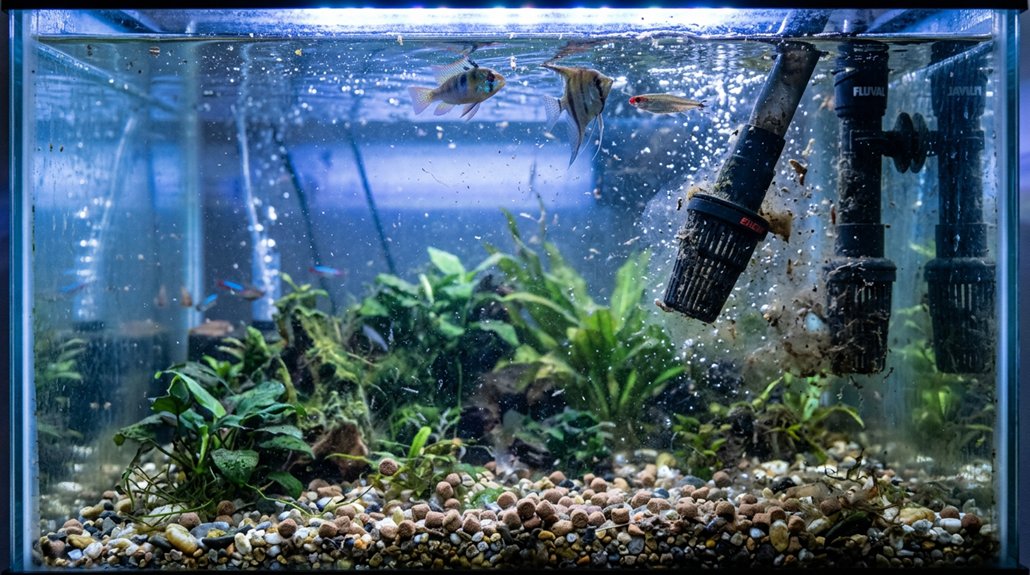
Even with the right tank size on paper, an overstocked aquarium shows up first in water quality and oxygen demand: persistent ammonia or nitrite above 0.25–0.5 ppm after water changes means your biofilter can’t process the waste fast enough, while nitrates climbing into the 40–80 ppm range and cloudy water point to a bioload that’s outpacing nutrient removal.
- Check filter capacity: if debris clogs media daily, your mechanical stage’s maxed out.
- Inspect bio media for sulfur odors; that suggests anaerobic zones and overload.
- Watch oxygenation boost needs: surface gasping, night drops below 6 mg/L, or poor flow mean you need better flow optimization, not just more food control.
When these signs stack up, filtration isn’t keeping pace with the biomass, and your tank’s margin is too thin.
How Plants and Water Changes Help
Dense live plants can absorb nitrate, and fast growers like hornwort or duckweed may cut it by 20–50% between weekly water changes. Rooted and high-leaf-mass plants also take up ammonia and nitrite, which helps buffer spikes after feeding or adding fish. Even so, you still need regular 20–33% water changes, because plants don’t remove detritus, phosphates, or dissolved waste fast enough.
Plant Uptake Helps
Well-established plant growth can meaningfully raise a tank’s waste-processing capacity. In a densely planted setup, your plant capacity improves because fast growers intercept nitrate, ammonia, and nitrite before they accumulate. That creates nutrient competition that limits algae and buffers fish waste. Use this framework:
- Add hornwort, vallisneria, or water sprite for rapid uptake.
- Keep lighting and CO2 stable so plants keep growing actively.
- Monitor nitrate; a healthy planted tank may hold safe levels with only 10–20% weekly changes, instead of 25–50%.
You can often support 20–50% more biomass than an equivalent bare tank, but only when plants are healthy. They don’t replace filtration, and detritus still needs removal.
Water Changes Reduce Waste
Plants can lower the waste burden in a stocked tank, but they don’t eliminate the need for routine water changes. You should still remove dissolved organics, nitrate, and fine debris before they build up and stress fish. In overstocked aquaria, 30% twice weekly often stabilizes chemistry better than 60% once weekly.
| Action | Effect |
|---|---|
| Water changes | Dilute waste |
| Plants | Uptake nitrate |
| Frequent top ups | Support volume |
| Mineral replenishment | Restore KH |
Heavily planted tanks can absorb several ppm of nitrate weekly, but filtration alone can’t clear all dissolved waste. Use water changes to prevent ammonia, nitrite, and nitrate swings, and to restore trace minerals and carbonate hardness for pH stability. Even with frequent top ups, you’ll still need scheduled changes to keep conditions predictable.
Fix an Overstocked Aquarium Without Panic
When an aquarium is overstocked, test ammonia and nitrite immediately; any detectable reading at or above 0.25 ppm means the bioload is exceeding biological filtration and you need to act fast. Then follow this sequence:
- Do a 20–50% water change now, then repeat 25% every 12–24 hours until readings stabilize.
- Cut feeding to a small pinch once daily, or skip a day, and siphon visible waste so bacteria can catch up.
- Use emergency rehoming, temporary quarantine, or a breeder box to remove fish; add fast-growing plants if you can.
If your filter’s undersized, upgrade or add another unit rated for 2–3× turnover, and baffle the outflow so you don’t create stress. Stay measured, test often, and don’t panic.
Frequently Asked Questions
How to Know if a Tank Is Overcrowded?
You’ll know your tank’s overcrowded when fish behavior turns stressed—gasping, aggression, hiding, or poor schooling—and tank filtration can’t keep ammonia, nitrite, and nitrate low despite regular maintenance, feeding, and water changes.
How to Tell if a Tank Is Overstocked?
Like a crowded elevator, your tank’s too full when ammonia, nitrite, or nitrate stay elevated, fish behavior shows gasping or crowding, and filtration needs outpace maintenance. You’ll also see rapid clogging, algae, odor, and stress.
What Happens if I Overstock My Fish Tank?
You’ll overwhelm filtration, spike ammonia and nitrite, drive up nitrate, and raise stocking density beyond safe limits. Oxygen depletion can trigger gasping, stress, disease, poor growth, algae, and sudden deaths unless you increase maintenance and filtration.
How Do Fish Act When There Is Too Much Ammonia?
Like a smoke alarm, your fish won’t stay calm: they’ll gasp at the surface, cluster by filters, show gill irritation, breathe fast, become lethargic schooling, lose appetite, hide, flash, and may rub against decor.
Conclusion
If you’ve suspected your tank is overstocked, you’re probably right: the signs usually show up as stressed fish, rising ammonia or nitrate, and filters that can’t process the waste load fast enough. To fix it, reduce bioload, increase maintenance, and improve filtration and plant cover. The theory is simple: more fish don’t just need more space—they need enough oxygen, stable chemistry, and waste control. When those limits are exceeded, the aquarium fails.