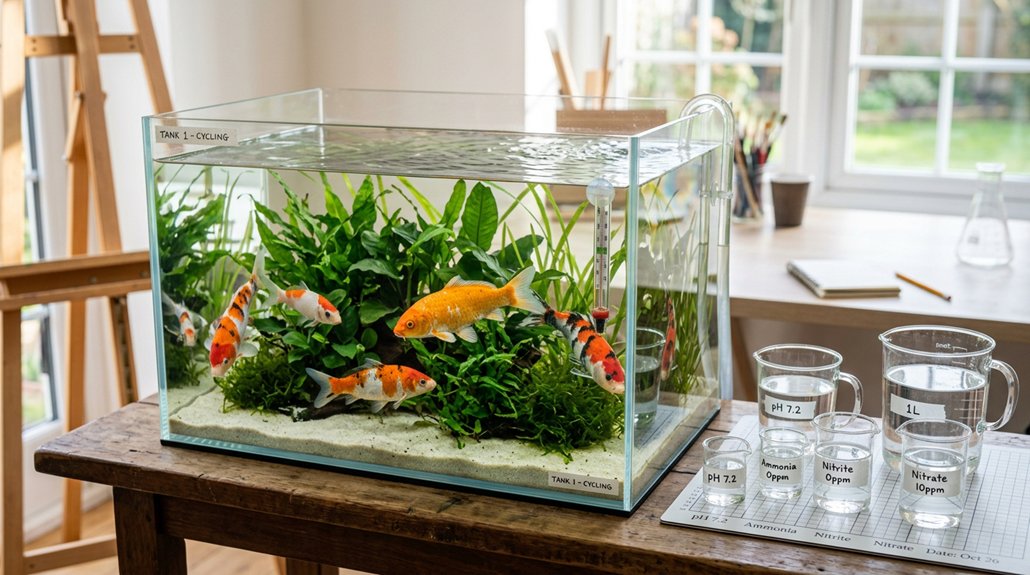
A freshwater tank usually takes 4 to 8 weeks to cycle, because nitrifying bacteria need time to convert ammonia into nitrite and then nitrate. If you start with seeded media, bottled bacteria, or a controlled fishless ammonia dose, you might finish in a few days to a few weeks. You’ll know it’s cycled when ammonia and nitrite stay at 0 ppm and nitrate appears. There’s more to optimizing the process and stocking safely.
Key Takeaways
- Most freshwater tanks take about 4–8 weeks to cycle naturally.
- Fishless cycling with 2–4 ppm ammonia usually finishes in 2–6 weeks.
- Seeded media or bottled bacteria can shorten cycling to a few days or about 2 weeks.
- A tank is cycled when ammonia and nitrite are 0 ppm for several days, with detectable nitrate present.
- Warmer, stable, well-aerated tanks cycle faster; heavily planted tanks may take 2–12+ weeks to stabilize.
How Long Does It Take to Cycle a Fish Tank?
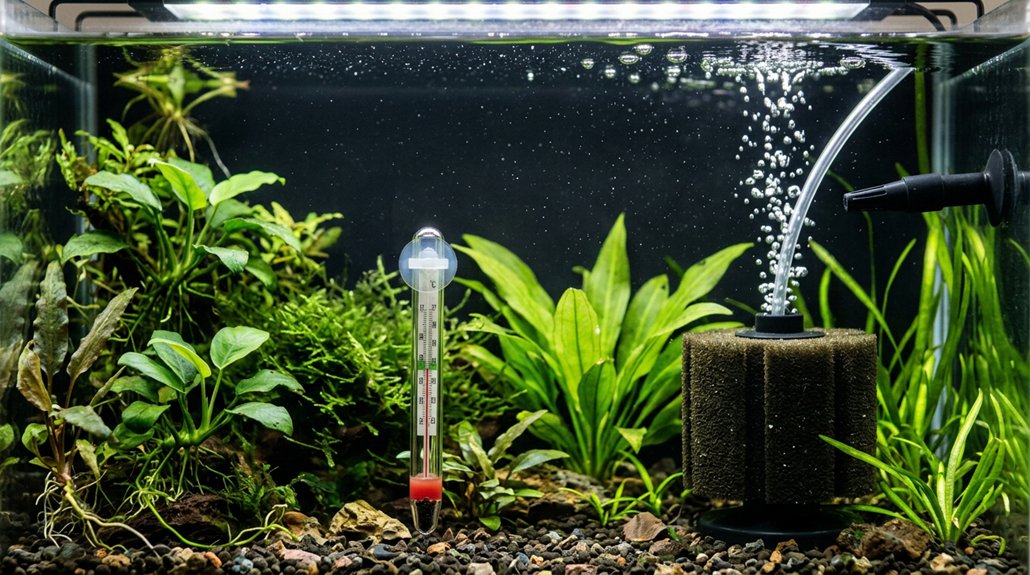
Cycling a fish tank usually takes about 4–8 weeks in a new freshwater setup, though the exact timeline depends on your method and conditions. In a typical cycling timeline, ammonia rises first, nitrite spikes around weeks 2–4, then both fall to 0 ppm as nitrate becomes detectable by weeks 4–8. If you use fishless cycling with pure ammonia at 2–4 ppm, you’ll often finish in 2–6 weeks. Adding seeded filter media or substrate from a healthy aquarium can cut that to a few days or 2 weeks. Faster bacterial colonization happens when you keep temperature warm, pH stable, aeration strong, and ammonia dosing consistent. You can confirm completion by dosing ammonia and seeing it clear to 0 ppm within 24 hours with 0 nitrite and rising nitrate.
What Aquarium Cycling Does for Fish
Once a tank finishes cycling, it’s no longer relying on chance to keep fish safe; it has an established nitrifying bacterial colony that converts toxic ammonia from waste into nitrite, then into far less toxic nitrate. You get real fish safety because ammonia and nitrite stay near 0 ppm under normal stocking, instead of climbing into dangerous ranges above about 0.25–0.5 ppm for sensitive species. In a healthy cycle, you’ll see ammonia rise and fall, nitrite spike and then drop, and nitrate become the main measurable end product. Those bacterial benefits protect livestock from New Tank Syndrome, where uncycled systems can trigger toxic spikes. You still need routine water changes or plant uptake to keep nitrate below about 20–40 ppm.
What Changes Fish Tank Cycling Time?
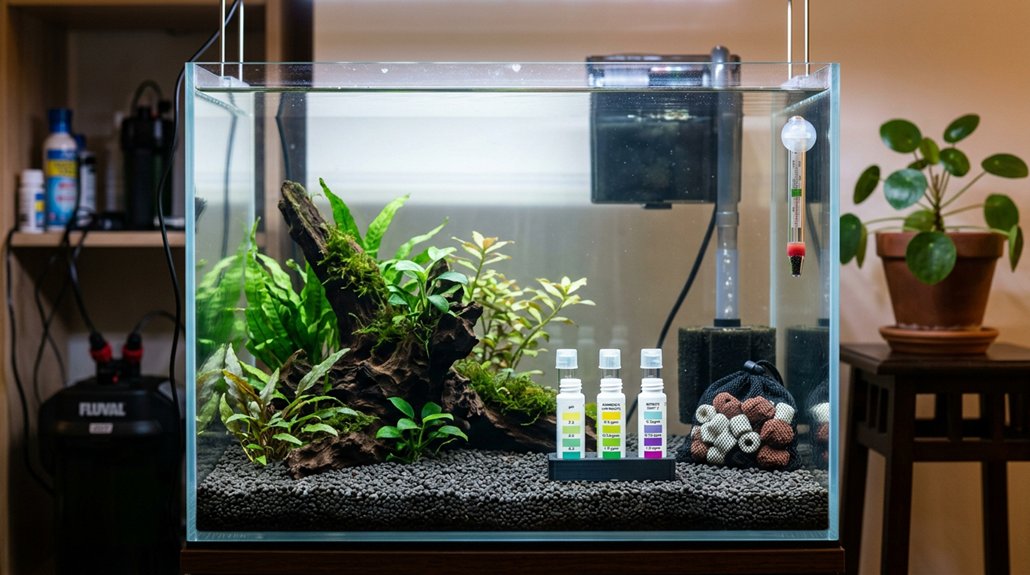
Your tank’s cycle time is driven less by gallons and more by bio-media surface area, so a well-filtered aquarium can mature faster than a larger tank with limited porous media. Water chemistry also matters: keeping ammonia at about 2–4 ppm, temperature around 24–28°C, and pH near neutral supports quicker nitrifying growth, while cold or extreme pH slows it. You can shorten the process further by seeding with established filter media or using reliable live-bacteria products, though heavy planting may hide nitrate changes and make the cycle look farther along than it really is.
Tank Size Effects
Tank size changes the pace and feel of cycling, but not in a simple “bigger is always slower” way. In smaller tanks under about 10–20 gallons, you’ll often see sharper ammonia and nitrite swings, so a detectable cycle may appear in 2–6 weeks, but dosing mistakes hit harder. A 20–50 gallon tank usually finishes a standard fishless cycle in about 4–8 weeks with steady 2–4 ppm ammonia. Very large systems can take weeks to months because you’re building enough bacteria for the eventual bio-load, and tank geometry affects surface area and maintenance scheduling. Seeding with mature media or reliable bottled bacteria can cut that to days or 1–2 weeks if conditions are ideal. After cycling, stock gradually; bigger tanks still need proportional bacterial capacity.
Water Chemistry Factors
Beyond tank size, water chemistry has a major impact on how fast a freshwater tank cycles. Your temperature management matters: nitrifying bacteria grow fastest at about 24–30°C/75–86°F, so cycling can drop from 6–8 weeks to roughly 2–3 weeks in warm water, while cooler conditions slow it. Keep pH near 7.0–7.8; once it falls below 7.0, especially under 6.5, nitrite oxidizers work poorly and the cycle drags. Maintain carbonate buffering with KH around 3–7 dKH (50–120 ppm as CaCO3) so nitrification doesn’t push pH into a stall. Also, chlorine or chloramine in source water can kill seeded bacteria, and a larger bacterial load on mature media or bottled starters gives you more colonization sites and faster ammonia and nitrite processing.
Speed-Up Methods
Several practical choices can dramatically change how long a freshwater tank takes to cycle. If you use biofilter seeding from a healthy tank, you’re adding established nitrifiers and may cut time to 3–10 days. Fishless cycling with pure ammonia at 2–4 ppm is predictable and usually finishes in 2–6 weeks. Bottled bacteria can help, but bottled bacteria efficacy varies, so test ammonia and nitrite, don’t assume success. Keep temperature at 24–28°C, provide strong aeration, and hold pH near 7.0–7.8 to support nitrifier growth.
| Method | Effect |
|---|---|
| Biofilter seeding | Fastest start |
| Bottled bacteria | Variable |
| Controlled ammonia | Predictable |
| Warm, oxygen-rich water | Faster |
| Overdosing or chlorine | Slower |
Avoid >5 ppm ammonia and dechlorinate water.
How to Cycle a Fish Tank Faster
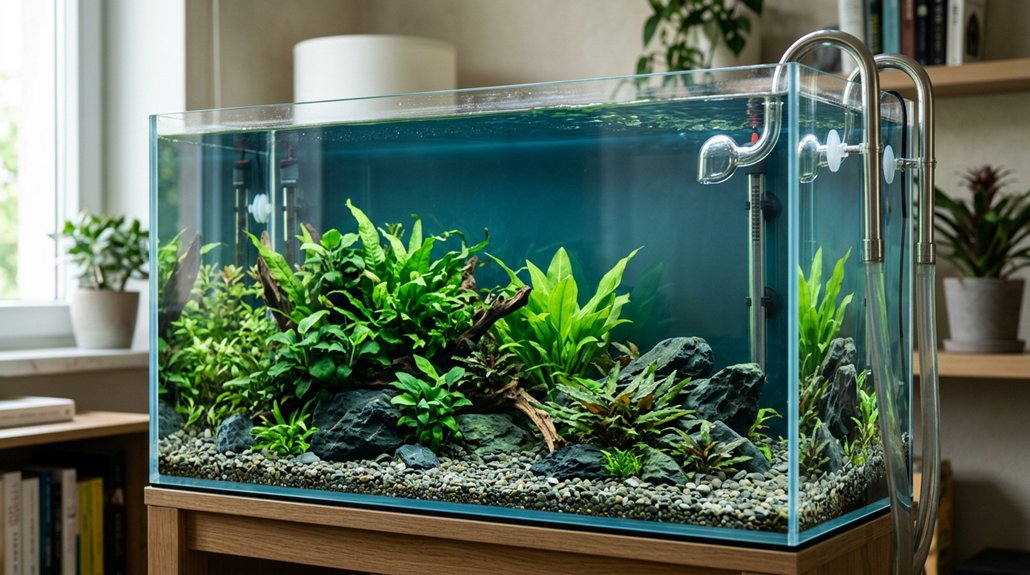
Speeding up a freshwater cycle comes down to giving nitrifying bacteria the right conditions from the start: seed your filter with media or sponge from a healthy, established aquarium, or use fresh filter media, then add a reputable live-bacteria product and dose pure household ammonia to about 2–4 ppm so the colony has a steady food source. Good seed sourcing cuts lag time, and temperature optimization matters: keep water at 78–86°F, pH near 7.0–7.8, and aeration strong. With fishless cycling, you’re feeding ammonia-oxidizers and nitrite-oxidizers directly, so growth is faster than with decaying organics. Test ammonia, nitrite, and nitrate daily, and keep dosing only as needed. If the tank can process 2–4 ppm ammonia to 0 ammonia and 0 nitrite within 24–48 hours, you’re ready.
How to Tell When a Tank Is Cycled
Once you’ve been feeding the bacteria and testing the water, the next question is how to know the tank’s actually cycled. You’re looking for 0 ppm ammonia, 0 ppm nitrite, and measurable nitrate for several days. Use this quick check:
| Test | Cycled result |
|---|---|
| Ammonia | 0 ppm |
| Nitrite | 0 ppm |
| Nitrate | Detectable |
| 24-hour dose test | Ammonia returns to 0 |
| Visual cues | Clear water, stable readings |
If you’ve got heavy planting, nitrate uptake can hide the signal, so don’t rely on nitrate alone. Dose about 2–4 ppm ammonia; if it’s gone in 24 hours and nitrite stays at 0, your biofilter’s working. Keep testing every 1–2 days, then follow a maintenance schedule of weekly checks for two weeks to confirm stability before adding livestock.
How to Cycle a Tank With Fish or Plants?
If you’re fish-in cycling, add only a few hardy fish, feed sparingly, and test ammonia and nitrite every 1–2 days while doing partial water changes to keep both near safe levels. If you’re using plants or going fishless, you’ll still need to verify the cycle with ammonia dosing or light-based tests and confirm that ammonia and nitrite return to 0 ppm. Once both stay at 0 ppm, you can stock slowly over several weeks instead of adding livestock all at once.
Fish-In Cycle Basics
A fish-in cycle uses a small number of hardy fish to produce ammonia while beneficial bacteria establish in the filter and substrate, so you’ll need to monitor the tank closely from day one. Keep stocking minimal—often 2–3 small fish in a 50-gallon tank, fewer in smaller systems—and feed sparingly to limit waste. Test ammonia, nitrite, nitrate, and pH every 1–2 days. Expect ammonia to rise first, then nitrite, then both to decline as nitrate accumulates. If ammonia or nitrite exceeds 0.5–1 ppm for sensitive fish, or 5 ppm acutely, change 10–30% of the water immediately. This approach can reduce fish stress when managed tightly, but ethical considerations matter because you’re exposing livestock to toxic compounds. Seeded media, warm stable temperatures, and strong aeration can help, yet you should still add fish only after readings stay at 0 ppm.
Plant-Only Cycling
Plant-only cycling relies on healthy aquatic plants to absorb ammonia while nitrifying bacteria establish, so progress can be slower and less obvious than in a standard fishless cycle. You’ll often see 2–12+ weeks before the tank stabilizes, because root nutrient uptake and plant respiration can shift readings through the day.
| Check | Target |
|---|---|
| Light | 8–10 hours/day |
| Temp | 24–28°C |
| pH | 7.0–7.8 |
Test early morning, when ammonia is usually highest. A practical endpoint is new plant growth plus the ability to drop an added 1–2 ppm ammonia to under 0.25 ppm in about 24 hours. Keep aeration strong. If you need faster verification, seed filter media or run a fishless ammonia challenge.
Safe Stocking Timeline
For safe stocking, you’ll want to match the timeline to the cycling method you’re using: in a fish-in cycle, start with only 2–3 hardy fish or an equivalent small biomass, then add no more than a couple more fish per week while testing closely for 4–8 weeks until ammonia and nitrite stay at 0 ppm; with a proper fishless cycle at about 2–4 ppm ammonia, nitrifying bacteria usually establish in 2–6 weeks, letting you stock more quickly once the biofilter is ready. If your tank is heavily planted, confirm 1–2 ppm ammonia drops below 0.25 ppm in 24 hours before heavy stocking. Use a stocking checklist, keep temperature 24–28°C, stabilize pH, and follow quarantine procedures. Even with seeded media or bottled bacteria, verify zero ammonia and nitrite after an ammonia challenge before adding sensitive species.
What to Do After Your Tank Is Cycled
Once your tank is fully cycled, wait until ammonia and nitrite both read 0 ppm for several consecutive days before adding significant livestock. Test every 24–48 hours to confirm stability. Then do a 20–50% water change, ideally around 30%, to lower nitrate, and refill with dechlorinated water. Add fish slowly: start with 1–3 small fish, or about 10% of your final stocking per week. For each addition, monitor ammonia and nitrite daily for 1–2 weeks. Keep a strict maintenance schedule: test weekly, change 10–30% of the water as nitrate rises, and clean mechanical filter media only in tank water to protect bacteria. Hold temperature, pH, and aeration steady, and make careful feeding adjustments so you don’t trigger ammonia spikes while the biofilter adapts.
Frequently Asked Questions
How Do I Know if My Freshwater Tank Is Cycled?
You’ll know it’s cycled when water parameter trends show 0 ppm ammonia and 0 ppm nitrite for several days, with nitrate present and rising. Confirm by beneficial bacteria testing after dosing ammonia and retesting in 24 hours.
How to Quickly Cycle a Freshwater Tank?
To quickly cycle your freshwater tank, you’ll seed bacteria with mature filter media, maintain 2–4 ppm ammonia, keep 26–30°C, stable pH, and strong aeration; carbon dosing can help, but you’ll still need daily testing.
Can a Tank Be Cycled in 1 Week?
Yes, you can sometimes cycle a tank in 1 week. For example, seeded media may establish beneficial bacteria fast, but you’ve still got to test water parameters; ammonia and nitrite should stay at 0 ppm consistently.
Conclusion
So, if you’ve ever wondered why your tank seems to stall just when your fish need it most, the answer is coincidence: the bacteria you need are growing right as waste starts rising. Most freshwater tanks cycle in 4 to 6 weeks, but temperature, media, and feeding can shift that timeline. You can’t rush biology, but you can support it with steady testing, patience, and controlled stocking. Once ammonia and nitrite stay at zero, you’re ready.