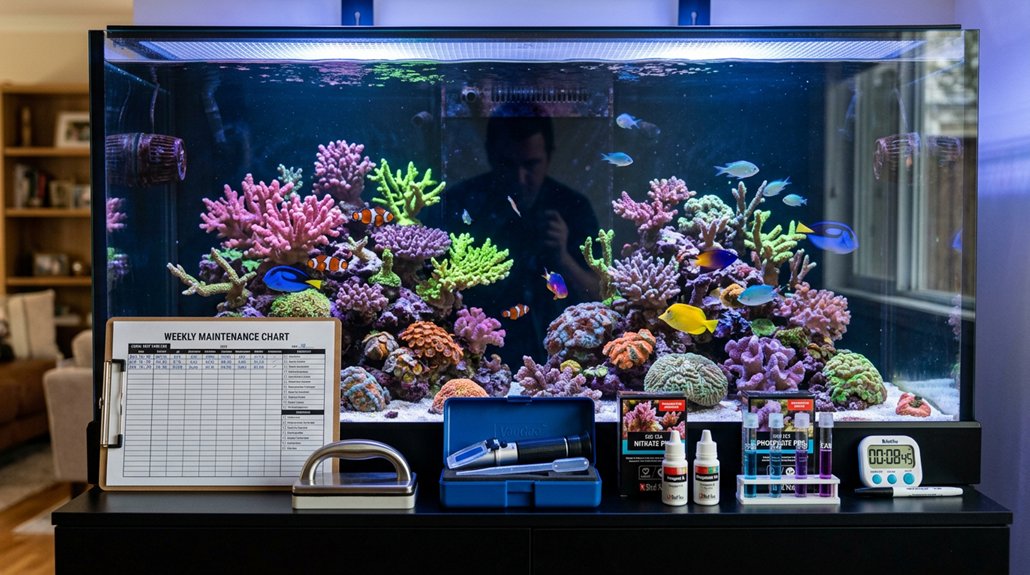
For a beginner saltwater tank, check your livestock, temperature, salinity, pumps, heater, ATO, and return flow every day. Weekly, test ammonia, nitrite, nitrate, and phosphate, then clean the glass, skimmer neck, socks, and detritus. Empty the skimmer cup daily to weekly, and change carbon about every 6–8 weeks. Once a month, test calcium, alkalinity, and magnesium, then do a 10–20% water change. As the tank matures, your routine should tighten, and there’s more to tune.
Key Takeaways
- Check fish behavior, temperature, salinity, pumps, heaters, and ATO daily; top off evaporated water with RODI water.
- Empty the protein skimmer cup, wipe salt creep, and inspect for leaks or unusual noises every day or two.
- Test ammonia, nitrite, nitrate, and phosphate weekly; keep ammonia and nitrite at 0 ppm.
- Clean filter socks, prefilters, glass, and skimmer neck weekly, and do a small water change.
- Perform a monthly deep clean and 10–20% water change; test alkalinity, calcium, and magnesium, then replace media as needed.
What Should You Check Every Day?
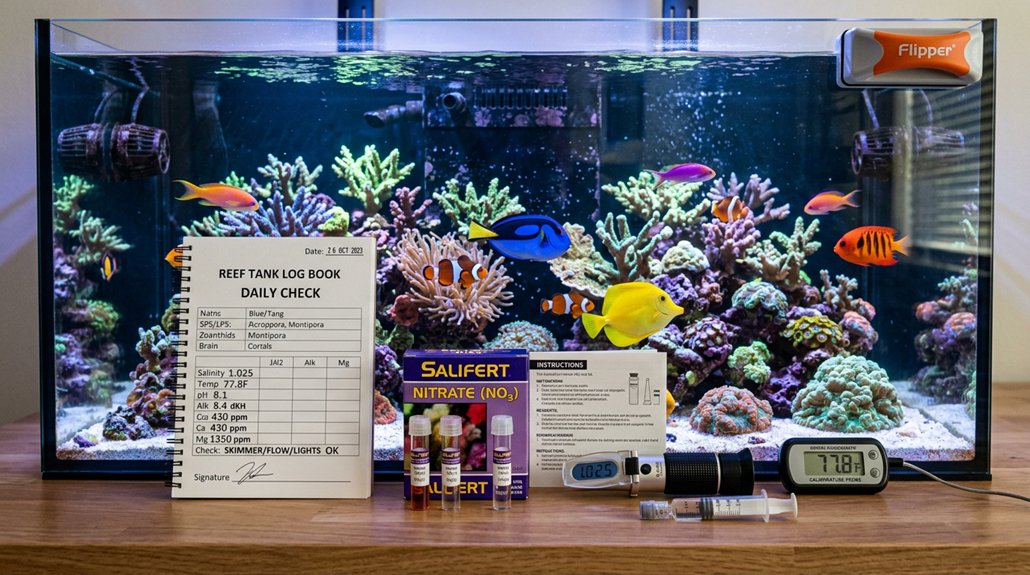
Every day, you should visually inspect all livestock during feeding time for normal behavior, feeding response, injury, or disease, then check and record temperature and salinity so you catch small shifts early; for most reef systems, aim for about 25°C/77°F and 35 ppt or 1.026 SG. Watch livestock behavior closely: sluggish movement, loss of appetite, or hiding can signal trouble. Top off evaporative loss with RODI water to preserve salinity stability. Verify pumps, heaters, lights, ATO, and return or air lines are operating, leak-free, and quiet; unusual equipment noise often comes before failure. Empty and rinse the protein skimmer cup as needed, and wipe salt creep from the rim and cords to support skimmer maintenance and electrical safety. Record anything unusual so you can respond before conditions worsen.
What Goes On Your Weekly Checklist?
Your weekly checklist should start with testing ammonia, nitrite, nitrate, phosphate, and, in reef tanks, alkalinity, calcium, and magnesium, then logging the results so you can spot trends early. You should also rinse prefilter media or swap filter socks, empty the skimmer cup, clean the glass, and spot-clean detritus from rockwork and substrate. Finish by inspecting heaters, pumps, return lines, ATO levels, livestock, and salt creep, then make a small water change and replace consumables on a staggered schedule as needed.
Weekly Water Testing
Each week, test ammonia, nitrite, and nitrate so you can confirm the biofilter is stable, keeping ammonia and nitrite at 0 ppm and nitrate below 10 ppm in reef systems or around 20–40 ppm in many fish-only tanks.
- Check reef chemistry: alkalinity 8–12 dKH, calcium 380–450 ppm, and magnesium 1200–1400 ppm.
- Verify test accuracy with fresh reagents and a clean sample vial before adjusting your dosing schedule.
- Measure phosphate for phosphate control; in reefs, keep it below 0.03 ppm, ideally 0.01–0.03 ppm.
- Confirm salinity near 35 ppt, temperature within ±0.5°C, and log every result with date, values, and actions.
Consistent weekly testing helps you spot drift early, keeping your system stable, efficient, and ready for precise corrections.
Cleaning And Inspections
Weekly inspections should cover livestock, equipment, and plumbing so you can catch stress, disease, leaks, salt creep, loose fittings, or abnormal operation before they become problems. Check heaters, pumps, and skimmer foam, then log anything unusual. Empty and rinse the protein skimmer cup, and wipe the neck clean to keep foam production efficient. Clean or replace filter socks, sponges, or floss weekly; rinse reusable sponges in tank water to protect bacteria. Scrub display glass and light shields, and use white vinegar on salt deposits when needed. For algae management, increase cleaning frequency if growth spikes. Blow detritus from rock crevices with a turkey baster or spare powerhead, and siphon substrate during water changes. Confirm equipment calibration during inspections.
How Often Should You Test Your Tank?
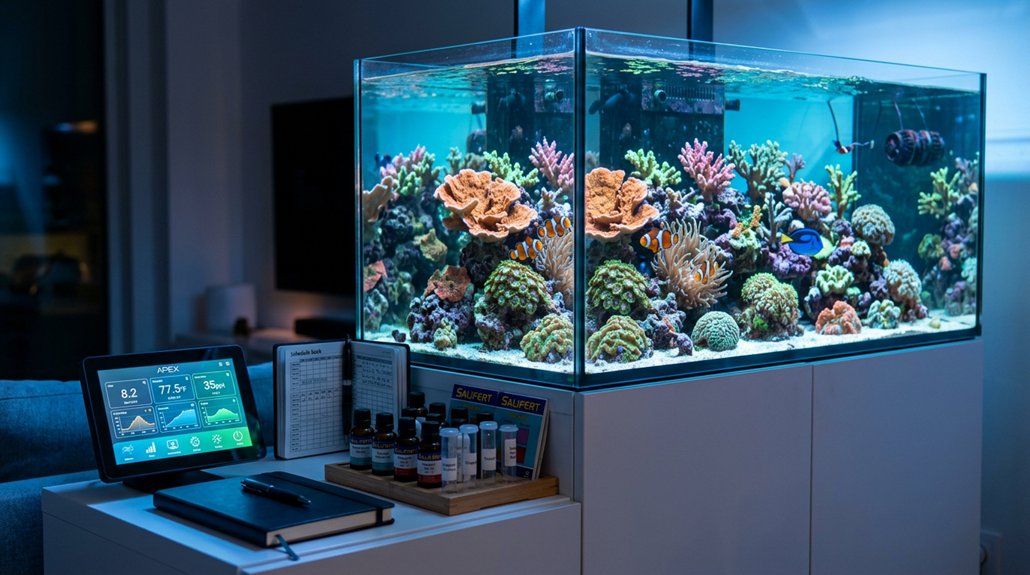
You should check salinity and temperature daily, using an ATO or probe when possible, so you can catch drift before it affects livestock. Test ammonia, nitrite, and nitrate at least weekly, and in new or unstable tanks every 3 days; reef systems should also get weekly alkalinity and calcium tests, plus monthly magnesium and weekly phosphate if needed. After major maintenance or equipment issues, re-test in 48–72 hours and adjust your frequency based on how stable your tank is.
Daily Quick Checks
Every day, test salinity or specific gravity first, since evaporation and top-offs can shift it quickly; aim for about 35 ppt or 1.026 SG, and retest whenever temperature swings or maintenance could have changed it. Then use quick daily checks to verify the tank’s baseline:
- Watch livestock during feeding observations for normal appetite, mucus, wounds, or bleaching.
- Confirm temperature stays near 24–26°C (75–79°F), especially after equipment checks.
- Inspect pumps, ATOs, skimmers, and probes for noise, flow loss, or drift.
- Log any anomaly in an app or notebook so you can trace patterns later.
These checks take minutes, but they catch problems before they escalate. Automation helps, yet you should still verify probe readings manually. Save full chemistry testing for your weekly schedule; daily care is about spotting change, not chasing every parameter.
Weekly Parameter Testing
Once a week, test the core water parameters that most directly affect livestock health and stability: ammonia, nitrite, and nitrate, with more frequent checks during cycling or after any disturbance. In stable tanks, you’re looking for 0 ppm ammonia and nitrite, with nitrate ideally under 5–10 ppm in reefs and under 20 ppm in many fish-only systems. For reefs, also test alkalinity, calcium, and magnesium weekly to confirm dosing is holding water chemistry in range. Check phosphate at the same interval, since excess can drive algae and weaken coral health. Use hobby tools like a refractometer for a precise weekly salinity check near 35 ppt. Record each result, date, and any changes in a log or app so trends stay visible and your decisions stay data-driven.
Adjusting Test Frequency
Test frequency should track tank stability rather than follow a fixed calendar. You’ll test more when the system is new, changing, or stressed, then scale back as parameters hold. Use this guide:
- Ammonia and nitrite: twice weekly during startup, after equipment changes, then weekly once stable.
- Reef chemistry: check alkalinity and calcium weekly; test magnesium monthly.
- Nutrients: measure nitrate and phosphate weekly, but move to every 2–3 days if they drift or after heavy feedings/additions.
- Salinity and temperature: verify daily, or use an ATO/monitoring probe for continuous reads.
When you dose trace elements or adjust a parameter, do dosing followups at 24–48 hours and again one week later. That confirms stability before you change your dosing rate.
When Should You Clean Skimmer Cups And Filters?
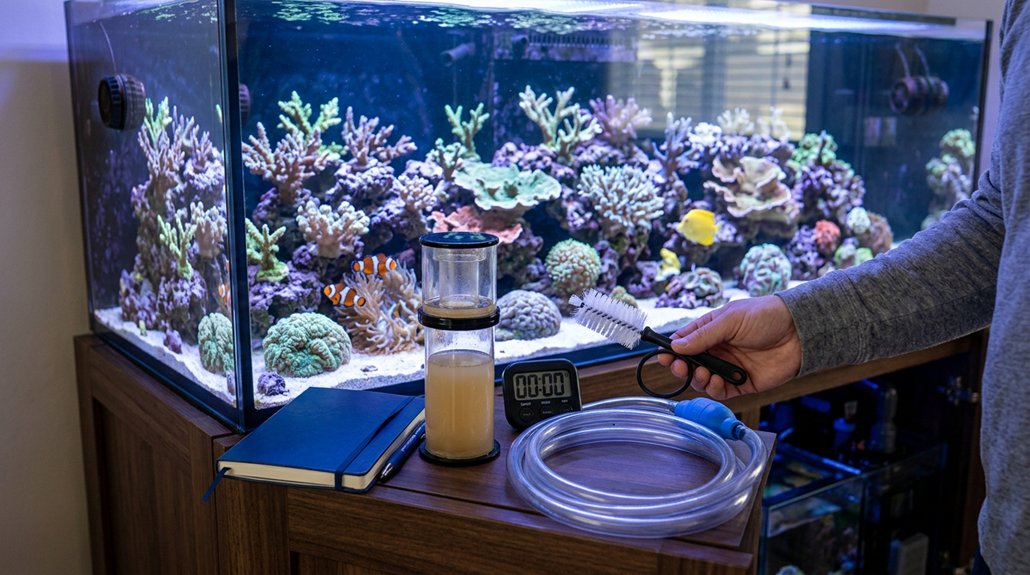
You should empty and rinse the protein skimmer collection cup daily to every other day in heavily fed or rapidly growing systems, and at least weekly in low-bioload tanks, since a full cup reduces skimmer efficiency and can dilute the skimmate. Clean the neck too, because residue lowers skimmer performance and can shorten filter lifespan by forcing the system to work harder. Replace or wash filter socks and floss every 2–3 days to weekly, or right before and after a water change, so flow stays open and mechanical trapping doesn’t overload biological filtration. Change activated carbon every 6–8 weeks, and GFO every 2–6 weeks, or sooner if phosphate rises above target. Check these media on schedule, not by appearance alone.
How Do You Deep Clean Equipment Safely?
Deep cleaning saltwater equipment starts with shutting everything down safely and working over a sink or bucket reserved for aquarium use. For electrical safety, unplug every device before you touch it, then wear gloves and keep cords dry. Follow this routine:
- Disassemble skimmers, pumps, reactors, and dosing parts.
- Use vinegar soaks on plastic parts, impellers, necks, and tubing to dissolve calcium and biofilm.
- Brush softened deposits with a soft toothbrush or aquarium brush, then rinse thoroughly with fresh water.
- Reassemble only after seals, fittings, and tubing are dry, aligned, and leak-free.
Use 1:1 vinegar and water for most parts; soak stubborn buildup longer, but avoid harsh chemicals unless they’re fully neutralized. Prime carefully to prevent air locks and dosing errors.
What Monthly Maintenance Does Your Tank Need?
Each month, your saltwater tank needs a focused set of upkeep tasks to keep water chemistry stable and nutrient levels under control. Test and log alkalinity, calcium, magnesium, nitrate, and phosphate, then adjust dosing or water-change frequency if values drift outside target ranges. Perform a 10–20% water change at least monthly with RODI saltwater matched for temperature and salinity; this supports trace replenishment and removes accumulated waste. Replace or rinse filter socks, prefilter sponges, and activated carbon about every 6–8 weeks to preserve clarity. Clean skimmer necks, light covers, and pump intakes, and soak hoses in vinegar if needed. Inspect refugium macroalgae, harvest chaeto for algae management, and top off reactor media or roller paper so nutrient export stays effective.
How Should You Adjust The Schedule As It Grows?
As your tank matures—typically around the 4–6 month mark—its maintenance schedule needs to tighten to match the increased biological load. Test alkalinity, calcium, and nitrate weekly if you add stony corals; calcifiers can drop alk by 0.1–0.2 dKH per day under heavy load.
- Shift filter socks or roller media to every 3 days.
- Empty the skimmer cup daily or every other day.
- Start one- or two-part dosing only when tests show steady alk or calcium decline.
- Inspect reactors, dosers, ATOs, and connections weekly, not monthly.
If nitrates top 10 ppm or phosphates exceed 0.03 ppm, move from monthly 10–20% changes to biweekly or weekly 5–10% changes. Tighten lighting schedules and nutrient budgeting as coral demand grows.
Frequently Asked Questions
When Should I Do My First Water Change in a Saltwater Tank?
You should do your first waterchange timing after the tank’s fully cycled and stable for 4–6 weeks; if you’ve seeded cured live rock/sand, you can do a small change sooner, then quarantine fish.
How to Maintain a Saltwater Tank for Beginners?
You’ll maintain it by checking livestock daily, topping off evaporated water, and removing waste. Test weekly, change 10% water biweekly, clean the protein skimmer, rinse media, and keep cycled lighting stable.
What Is the First Thing to Put in a Saltwater Tank?
You should put in properly mixed saltwater first, then add live rock to start biological filtration. Coincidentally, that same rock later supports a cleanup crew, so your tank stabilizes faster and stays practical, precise, and healthy.
How Much Maintenance Does a Saltwater Tank Need?
You’ll need modest upkeep: daily checks take 5–15 minutes, and weekly testing keeps chemistry stable. Add a weekly maintenance session, 10% water changes every 1–2 weeks, plus occasional media, skimmer, and pump cleaning.
Conclusion
Keeping up with your saltwater tank maintenance schedule doesn’t have to feel overwhelming if you break it into daily, weekly, and monthly tasks. For example, if your calcium drops from 430 ppm to 360 ppm over a week, you can catch it early, adjust dosing, and prevent coral stress. The key is consistency: check water, clean equipment, test parameters, and adapt as your tank matures so you’re always ahead of problems.