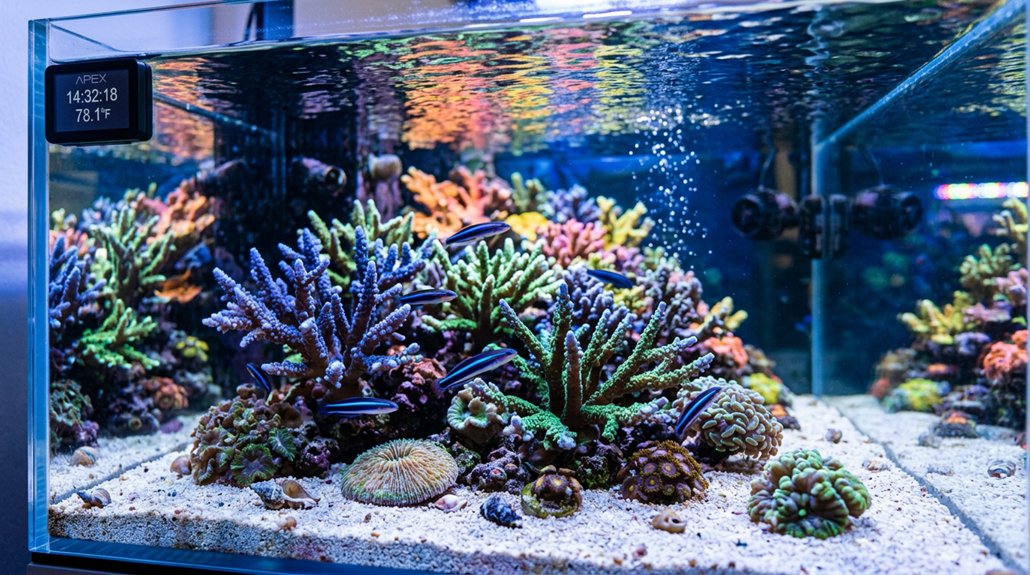
A saltwater aquarium usually takes 4 to 6 weeks to cycle, but you can shorten that with established live rock, live sand, or bottled nitrifying bacteria. Dry rock and fish-in cycling usually take longer and carry more risk. You’ll know the tank is ready when ammonia and nitrite stay at 0 ppm for several days, while nitrate is measurable and ideally below 20 to 25 ppm. Keep going, and you’ll see how to speed it up safely.
Key Takeaways
- A typical saltwater aquarium cycle takes about 4–6 weeks with standard fishless or live-rock methods.
- Established live rock or live sand can cycle in a few days to 1–2 weeks.
- Dry rock or dry sand usually takes many weeks to months to fully cycle.
- The cycle is complete when ammonia and nitrite both read 0 ppm for several days, with nitrate present.
- Fishless cycling with ammonia and bottled bacteria often takes 1–3 weeks, depending on seeding and conditions.
How Long Does It Take to Cycle a Saltwater Aquarium?
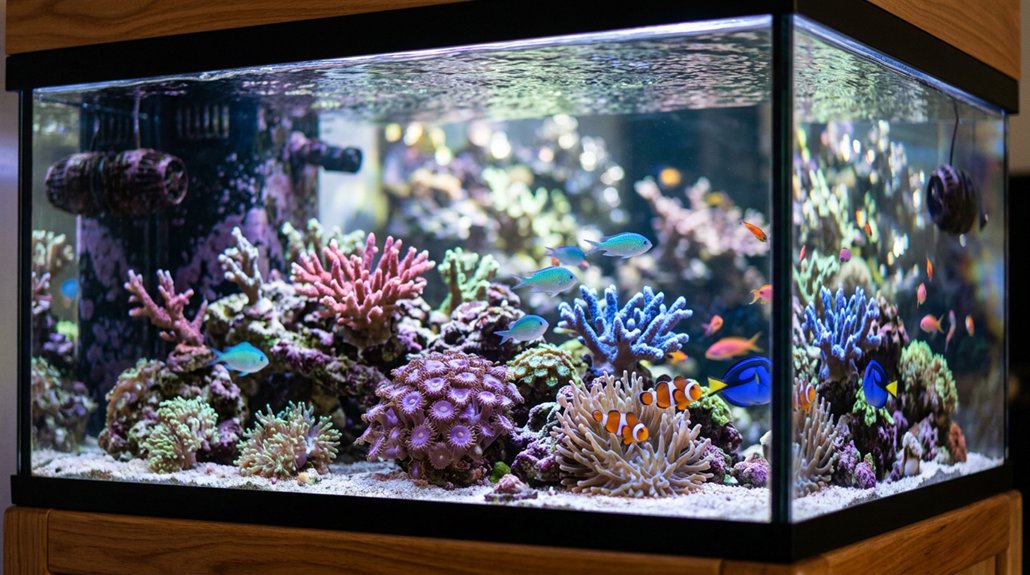
Cycling a saltwater aquarium usually takes about 4–6 weeks with standard fishless or live-rock methods, because you’re waiting for ammonia-oxidizing and nitrite-oxidizing bacteria to establish and convert ammonia to nitrite, then nitrate. If you use established live rock or live sand, you might shorten that to a few days to two weeks, but you’re also importing pests or pathogens. Bottled bacteria or cold-shipped cultures can bring some systems to 1–2 weeks, though test results can wobble. Dry rock or dry sand often takes many weeks or months. Keep equipment clean, control salt creep, and plan stocking density conservatively. Don’t add significant livestock until ammonia and nitrite read 0 ppm for several days, with nitrate ideally at or below 20–25 ppm.
What Happens During the Nitrogen Cycle?
During cycling, ammonia from waste and decaying organics builds first, then Nitrosomonas-type bacteria convert it to toxic nitrite. As ammonia drops, Nitrobacter and Nitrospira oxidize nitrite into nitrate, which is far less toxic and can be reduced through water changes, denitrification, or macroalgae uptake. You’ll know the cycle’s complete when both ammonia and nitrite test at zero on a consistent basis.
Ammonia To Nitrite
As the nitrogen cycle gets underway, ammonia (NH3/NH4+) from fish waste, uneaten food, and organic decay is the first toxic compound to build up, and it’s the fuel Nitrosomonas-type bacteria use to establish themselves. During this bacterial succession, rising substrate concentration drives these bacteria to oxidize ammonia into nitrite (NO2-), so you’ll usually see ammonia climb, then fall as the colony grows. This phase can take days to a few weeks, depending on your method and temperature; around 78°F usually speeds bacterial growth. Keep a steady ammonia source by dosing to about 2.0 ppm or using decomposing food, but don’t let it exceed 5 ppm, or growth can be inhibited. You’ll know progress is happening when ammonia reads zero and nitrite starts to appear.
Nitrite To Nitrate
Once nitrite appears, nitrite-oxidizing bacteria such as *Nitrobacter* begin converting NO2- into nitrate (NO3-), which completes the second major step of the nitrogen cycle. You’re seeing bacterial succession in action: after ammonia-oxidizers raise nitrite, a new population takes over and drives toxicity mitigation. In a saltwater cycle, nitrite often peaks days to weeks after the ammonia spike, then drops as nitrate rises. Because nitrite is toxic even at low ppm, its presence means your biofilter isn’t finished yet. Test every 2–3 days so you can track the pattern: ammonia peak, nitrite peak, then nitrite falling to zero. Once conversion is steady, nitrate becomes the stable end-product, and you’ll manage it around 10–25 ppm with water changes or denitrification.
Cycle Completion Signs
The clearest sign your saltwater tank is finishing its cycle is a predictable shift in test results: ammonia rises first, then drops as nitrite spikes, and finally nitrite falls to zero while nitrate becomes detectable and climbs. You’ll also see practical visual cues and need consistent equipment monitoring.
- Ammonia and nitrite test at zero for several days
- Nitrate remains measurable, ideally under 20–25 ppm
- Controlled ammonia disappears within 24–36 hours
- Cloudiness or yellow tint fades
- Any rotten-egg smell resolves as bacteria stabilize
If you add rock, sand, or livestock, watch for mini-cycles and retest often. When readings stay stable, your biofilter’s handling waste, and you can stock with confidence.
How to Start a Saltwater Aquarium Cycle
Kick off your saltwater cycle by seeding the tank with live rock, live sand, or a reputable bottled nitrifying bacteria product such as MicroBacter7 or Fritz TurboStart, then add an aquarium-safe ammonia source to reach about 2.0 ppm and feed the bacteria. Keep temperature at 76–80°F, maintain steady circulation, and leave lights off for the first few weeks to reduce algae pressure. Your equipment checklist should include a heater, pump or powerhead, test kits for ammonia, nitrite, and nitrate, and a reliable ammonia source. Follow a strict maintenance schedule: test daily, redose ammonia to 1–2 ppm as needed, and continue until ammonia falls from about 2.0 ppm to roughly 0.025 ppm within 24–36 hours. Then watch nitrite and nitrate trends closely before adding livestock.
Which Cycling Method Is Fastest?
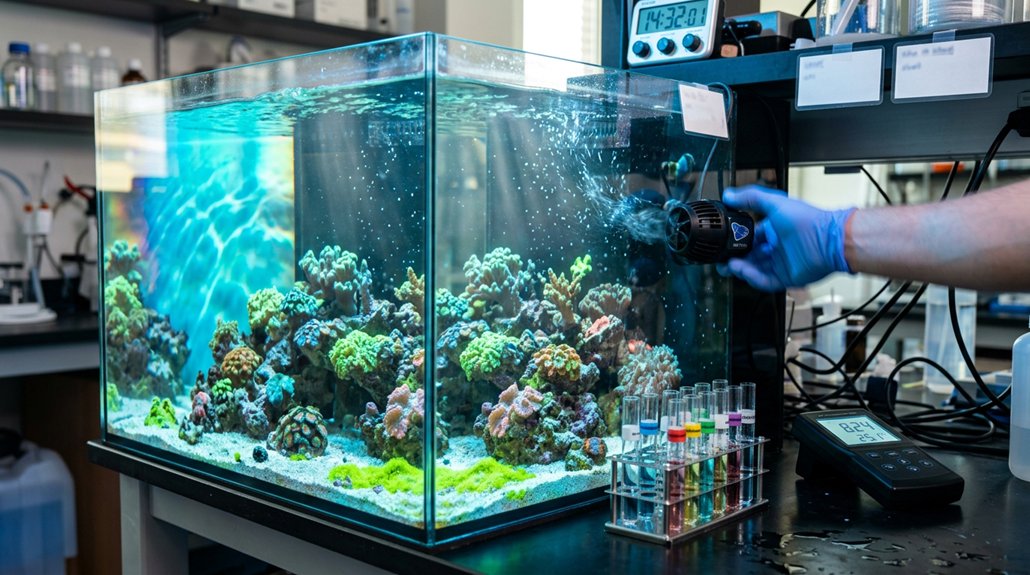
If speed is your priority, the fastest saltwater cycling methods are those that start with established biology, not raw inert media. You’ll usually see the best results with cured rock and fresh live bacteria.
- Mature live rock or live sand can finish in days to 1–2 weeks.
- Fishless cycling with pure ammonia and bottled live bacteria often takes 1–3 weeks.
- Cold-shipped, actively cultured products can outperform dormant strains if they’re fresh.
- Cured rock plus bacterial additives and a steady ammonia feed is often the fastest repeatable protocol.
- Dry rock, shrimp decay, or fish-in cycling are slower and riskier.
For the quickest outcome, dose ammonia to about 2.0 ppm, verify rapid clearance, and keep oxygen, temperature, and filtration stable throughout.
How Live Rock and Live Sand Speed Cycling
Introduce live rock and live sand early, and you’ll often cut a new saltwater tank’s cycle from the usual 4–6 weeks to as little as 1–2 weeks, because both materials bring in established nitrifying bacteria and microfauna instead of forcing the tank to build biology from scratch. Prefer cultured rock or maricultured pieces; they usually carry useful bacteria with fewer pests than wild rock. Live substrate also creates faster bacterial colonization and early anaerobic zones.
| Material | Effect |
|---|---|
| Live rock | Seeding ammonia-oxidizers |
| Live sand | Surface and deep bacteria |
| Existing system media | Near-immediate cycling |
| Dry media | Slower establishment |
If you seed from a healthy system, cycling can be very short, but test ammonia and nitrite daily until both read zero for several days before adding many fish.
How to Kickstart Ammonia Buildup
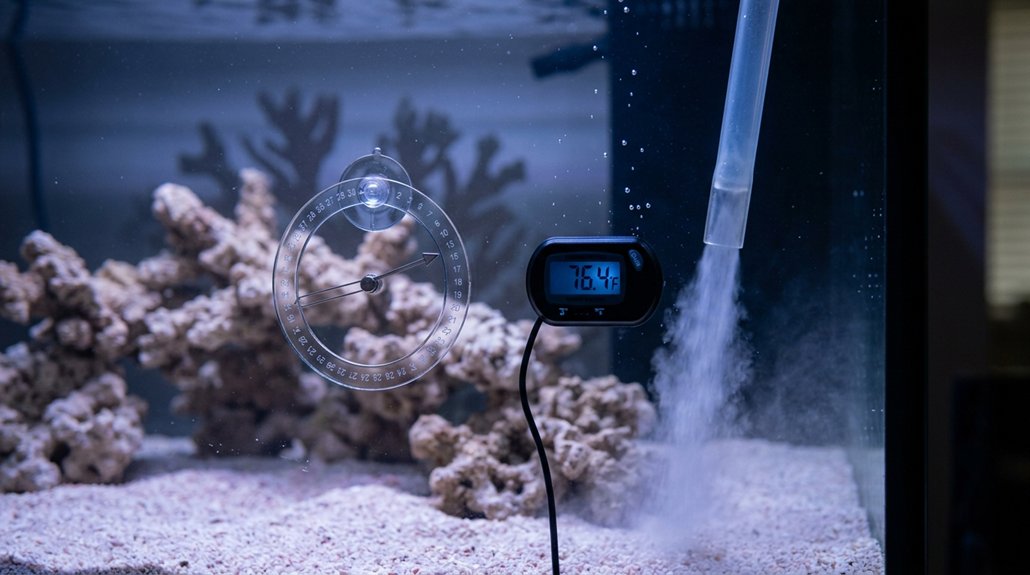
You can kickstart ammonia buildup by dosing a pure aquarium-safe ammonia source, like ammonium chloride, to about 2.0 ppm so nitrifying bacteria have a measured food supply. If you’re seeding with bottled bacteria, add it per the label a day before or after the first dose, then test daily and re-dose to hold roughly 1–2 ppm without exceeding 5 ppm. Keep circulation strong, temperature around 76–80°F, and lights off while you avoid skimmers or carbon that could strip ammonia during this phase.
Seeding Beneficial Bacteria
Seeding beneficial bacteria is the fastest way to jump-start a saltwater cycle: add cured live rock or live sand from an established tank, or dose a commercial bacterial supplement such as Fritz TurboStart or MicroBacter7, to immediately inoculate the system with nitrifying microbes. This beneficial bioaugmentation works best on starter substrates with high surface area.
- Use established rock or sand
- Add bottled cultures per label
- Keep water near 78°F
- Maintain strong circulation, lights off
- Test ammonia, nitrite, nitrate daily
Within about a day, you can begin controlled ammonia feeding to support Nitrosomonas and Nitrobacter, while colonization expands. If you use time-release media, follow the dose precisely and add bio-media for extra habitat. Continue seeding or re-dose until ammonia and nitrite fall to zero and nitrate appears.
Adding An Ammonia Source
Once beneficial bacteria are in place, the next step is to feed them a controlled ammonia source so the biofilter can begin processing waste. For a fishless cycle, dose pure ammonia, usually ammonium chloride, to about 2.0 ppm; that gives nitrifiers a steady substrate without exposing livestock. If you prefer ammonia alternatives, add a small pinch of fish food or a dead shrimp, which should release at least 1 ppm within a few days. Keep temperature near 78°F, maintain strong circulation, and leave lights off to limit algae. Test ammonia, nitrite, and nitrate daily. When ammonia falls from 2.0 ppm to 0.025–0.05 ppm within 24–36 hours, you’ve likely got a mature population. If ammonia exceeds 5 ppm, do a partial water change.
How to Tell When the Tank Is Ready
A saltwater tank is considered cycled when test results show the full ammonia-to-nitrite-to-nitrate progression has run its course and, for at least 2–3 consecutive days, both ammonia and nitrite consistently read 0 ppm while nitrate is present, typically below 20–25 ppm before stocking. Use reliable kits, and verify equipment calibration before each reading.
- Ammonia should spike first.
- Nitrite should peak after that.
- Nitrate should rise as the others fall.
- Visual inspection is secondary to testing.
- Cloudiness, odor, and microfauna can indicate progress.
When those readings hold steady, you can do a partial water change to lower nitrate to about 10–20 ppm. Then add fish slowly, one or two at a time, and retest every 2–3 days to confirm stability.
Why Ammonia and Nitrite Spike Again
Even after a tank has cycled and tests have stabilized, ammonia and nitrite can spike again if the biological load changes faster than the bacteria can keep up. You’ll usually see this after adding livestock, live rock, or when a die-off raises dissolved organics. Ammonia can rise first, then nitrite reappears as Nitrobacter and Nitrospira lag behind. Disturbing sand, rock, or filter media during maintenance can also strip away attached bacteria, so your maintenance timing matters. Large water changes, media swaps, sterilizers, or medications may reduce bacterial populations and upset bacterial resilience. Some additives can skew kit readings too, so confirm any spike with repeat testing over 24–48 hours before reacting. If levels hold, treat it as a real load imbalance, not a false alarm.
How to Add Fish Without Triggering a Mini-Cycle
Introduce fish gradually only after ammonia and nitrite have read zero for several consecutive days and nitrate is at or below 25 ppm, so the biofilter has a stable baseline before bioload increases. Add just one or two small, hardy fish at a time, then wait at least two weeks before the next addition.
Add fish slowly only after ammonia and nitrite stay at zero and nitrate remains low.
- Follow quarantine procedures before transfer.
- Use a deliberate stocking order.
- Feed sparingly; everything should vanish within a minute.
- Test ammonia and nitrite every 2–3 days for several weeks.
- If either rises above 0.25–0.5 ppm, do a partial water change.
Keep circulation steady, temperature near 78°F, and filter bio-media mature. You can also seed with media from a cycled system or dose a reputable live-bacteria product to help bacteria match the new load.
Frequently Asked Questions
How Do I Know When My Saltwater Tank Is Cycled?
You know your tank’s cycled when parameter testing shows ammonia and nitrite at 0 ppm for several days, while nitrate remains detectable. Beneficial bacteria are established; then you can water-change, stabilize, and stock.
How Long Should I Let My Saltwater Tank Cycle?
You should let it cycle 4–6 weeks, longer with dry rock. With live rock, it can be 1–2 weeks. Keep testing; if you’re using a refugium cleanup, add fish only after ammonia and nitrite stay zero.
What Is the Fastest Way to Cycle a Saltwater Tank?
You can fast-track cycling like jump-starting an engine: seed your tank with live rock and bacterial supplements, then dose pure ammonia to 2 ppm, keep 78°F flow, test daily, and wait until ammonia/nitrite hit zero.
Do Saltwater Tanks Need to Be Cycled?
Yes, you do need to cycle saltwater tanks so beneficial bacteria can process ammonia. Using live rock helps seed biofiltration, but you should still follow quarantine protocols, test water, and verify ammonia and nitrite’re zero.
Conclusion
So, how long will your saltwater aquarium take to cycle? You’ll usually wait 4 to 8 weeks, but the real answer depends on your method, your bio-load, and how carefully you monitor ammonia, nitrite, and nitrate. If you rush it, you risk a crash; if you wait for stable readings, you’ll know the tank’s ready. The cycle doesn’t truly end when the numbers drop—it ends when your system can handle the next test.