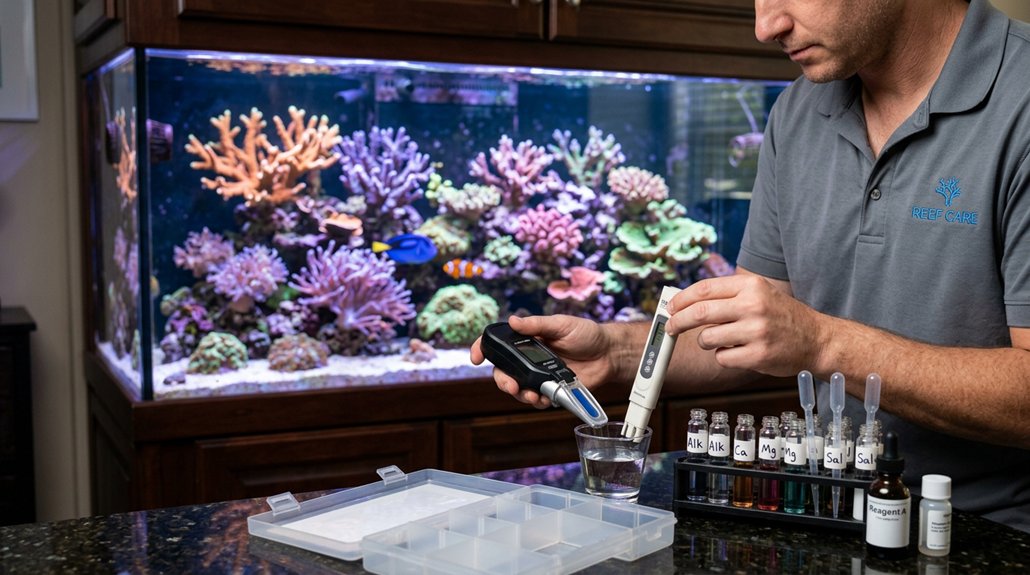
You should test a saltwater aquarium in priority order: temperature, salinity, and ammonia first, then nitrite, nitrate, pH, alkalinity, calcium, magnesium, and phosphate. Use a calibrated refractometer for salinity, a reliable thermometer, and liquid or digital kits for the rest. In new tanks, test weekly until chemistry stabilizes; in established reefs, check daily temperature and test key nutrients and alkalinity on schedule. Keep values stable, and you’ll see why each parameter matters.
Key Takeaways
- Test temperature and salinity first; keep 76–83°F and specific gravity 1.025–1.027 using a calibrated refractometer and thermometer.
- Check ammonia in new tanks or after livestock loss, and verify nitrite during cycling; both should be zero in stable systems.
- Measure nitrate weekly until stable; aim for 3–10 ppm and keep under 20 ppm.
- Test alkalinity, calcium, magnesium, and pH regularly, especially when dosing or after equipment changes, to maintain stable chemistry.
- Retest after major stocking, feeding, or equipment changes, and correct problems gradually with water changes or adjusted dosing.
What Water Parameters Should You Test First?
Start with temperature and salinity, since they set the foundation for every other water parameter in a saltwater aquarium; aim for 76–83°F, ideally 78–80°F, and a specific gravity of 1.025–1.027. Next, you should check ammonia first in new setups, after adding livestock, or following deaths or disturbances, because even low levels stress tissue and alter livestock behavior. During cycling or troubleshooting, verify nitrite, which should read 0 ppm, then track nitrate weekly until stable. You’ll also need to monitor alkalinity and pH regularly, especially if you’re dosing Kalkwasser or running reactors, because stability matters more than a single reading. As equipment maintenance, measure calcium, magnesium, and phosphate when you keep stony corals or suspect nutrient consumption.
How to Test Reef Tank Salinity, Temperature, and pH?
You’ll measure salinity with a calibrated refractometer, or a reliable hydrometer or conductivity meter, and target a reef specific gravity near 1.025–1.027. You’ll check temperature with a digital thermometer or probe and keep it stable around 76–83°F, since rapid fluctuation stresses livestock. You’ll assess pH with a colorimetric kit or calibrated meter, emphasizing stability and increasing test frequency when you’re dosing Kalkwasser or using a calcium reactor.
Salinity Measurement Tools
To measure reef tank salinity accurately, use a calibrated refractometer and set it to 1.000 with RO/DI or distilled water before taking readings; target a specific gravity of 1.025–1.027 for most reef systems. This instrument minimizes error when you’re testing mixed saltwater before water changes. Maintain proper refractometer care: rinse the prism, dry it, and avoid salt residue that skews results. If you use a hydrometer, confirm hydrometer placement is free of bubbles and debris.
| Tool | Accuracy | Use |
|---|---|---|
| Refractometer | High | Routine salinity checks |
| Hydrometer | Moderate | Backup verification |
| RO/DI water | Calibration fluid | Zeroing reference |
Record readings consistently, and watch for drift. Stable specific gravity matters more than perfect numbers.
Temperature Stability Checks
After confirming salinity with a calibrated refractometer, the next priority is temperature stability, since even small swings can stress reef organisms. You should measure with a reliable aquarium thermometer or digital controller probe, and keep the system between 76–83°F, ideally 78–80°F. Check readings before feeding and after equipment changes, because heater output and equipment placement can alter thermal gradients.
- Verify the probe against a known reference.
- Log readings daily to detect seasonal drift.
- Recheck after pump, light, or chiller changes.
- Correct any swing before it exceeds 1°F.
Stable temperature supports predictable metabolism and oxygen demand. In small or new tanks, frequent checks matter more, because rapid fluctuations are more damaging than slight deviations from target.
pH Testing Basics
pH is best treated as a stability parameter rather than a standalone target, because reef systems tolerate minor variation far better than abrupt shifts. You should use a calibrated pH meter; probe calibration is essential before each measurement series. High-quality liquid kits using indicator colorimetry can confirm meter readings when you’re troubleshooting.
| Method | Use |
|---|---|
| pH meter | Continuous or spot checks |
| Liquid kit | Cross-checking readings |
| Logging | Trend detection |
Measure pH when you’re dosing Kalkwasser, running a calcium reactor, or correcting low pH. If values drop, check excess CO2, aeration, skimming, and biological load. Improve gas exchange first; then adjust alkalinity in small increments, preferably at night, rather than forcing abrupt corrections. Record readings regularly so you’ll detect drift before it destabilizes the system.
How to Check Ammonia, Nitrite, and Nitrate?
Start by testing ammonia with a reliable total ammonia kit that measures NH3+NH4, or use a continuous Seachem Ammonia Alert if you want to monitor free NH3 directly; in a stable saltwater system, free NH3 should stay below 0.02 ppm, and total ammonia should be undetectable to 0.25 ppm at pH ≤8.2.
- For ammonia monitoring, note pH and temperature.
- Check nitrite during cycling; it should return to 0 ppm.
- Measure nitrate weekly with a kit or digital checker.
- Track nitrate conversion and keep reef levels near 3–10 ppm, ideally under 20 ppm.
If ammonia or nitrite rises, do a partial water change, cut feeding, and inspect the biofilter, livestock loss, or system instability.
How to Measure Alkalinity, Calcium, and Magnesium?
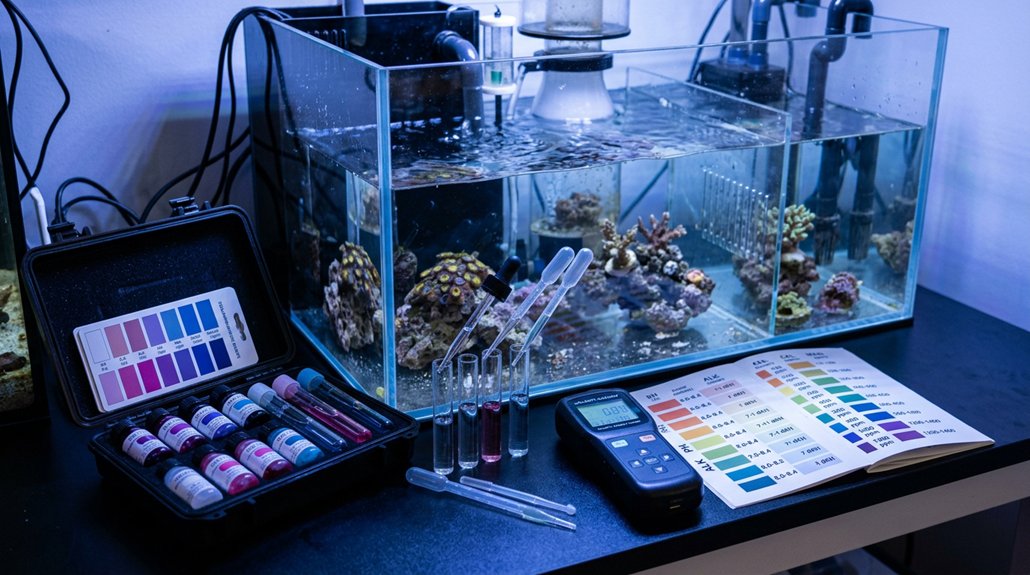
Once ammonia, nitrite, and nitrate are under control, the next step is to track the major ions that drive coral growth and skeleton formation: alkalinity, calcium, and magnesium. You can measure alkalinity with a reliable liquid kit or digital titration probe; keep it stable at 7–12 dKH, preferably 7–9 dKH. Check calcium with a dedicated colorimetric kit and maintain 380–500 ppm, near 420 ppm. Measure magnesium with a specific color test and target 1250–1400 ppm, near 1280 ppm. Use a drop checker only as a visual reference for gas exchange, not ion chemistry. Dose only after testing shows consumption, starting when alkalinity falls about 1 dKH from baseline. Add in small increments, wait 30 minutes between alkalinity and calcium, and avoid rapid rises.
How Often Should You Test Reef Water?
In new reef tanks, you should test ammonia, nitrite, nitrate, salinity, temperature, and phosphate weekly until the system’s chemistry is stable and predictable. In established systems, you can usually reduce routine testing to monthly for parameters that aren’t changing rapidly, while still tracking salinity before water changes and temperature daily. You should always retest after any major change in stocking, feeding, dosing, aeration, or equipment, because those shifts can alter water chemistry quickly.
New Tanks Weekly
During the first weeks of a new reef tank, you should test temperature, salinity, ammonia, nitrite, nitrate, and alkalinity at least weekly to track cycling and overall stability. Record each result to evaluate cycling progress and confirm equipment calibration.
- Check salinity before each water change.
- Use a calibrated refractometer and target 1.025–1.027 specific gravity.
- Keep ammonia below 0.02 ppm free NH3, nitrite at 0 ppm, and nitrate ideally 3–10 ppm.
- Measure alkalinity weekly, aiming for 7–12 dKH.
If you begin dosing or add stony corals, test alkalinity more often. Consistent weekly logs help you detect drift early, compare trends, and make precise water-change or dosing decisions before instability affects livestock.
Established Tanks Monthly
For established reef tanks, test alkalinity monthly when stony coral biomass is still low, but move to weekly testing once you begin dosing or coral growth accelerates. You should align testing with reef livestock demand and your dosing schedule, because carbonate consumption can change quickly.
| Parameter | Frequency |
|---|---|
| Salinity | Every partial water change; weekly spot-check |
| Nitrate | Weekly, then every 1–2 weeks when stable |
| Phosphate | Monthly; more often if algae appear |
Keep specific gravity near 1.025–1.027, nitrate around 3–10 ppm, and phosphate near 0.03–0.10 ppm, staying below 0.2 ppm. Measure temperature daily, or automate it, to hold 76–83°F. Check pH when you’re adjusting alkalinity or dosing kalkwasser, since those shifts can alter carbonate chemistry and instability can stress reef livestock.
Test After Changes
After any partial water change, test both the freshly mixed saltwater and the tank itself to verify salinity stays within the reef target of 1.025–1.027 sg. This post change monitoring prevents drift from mix errors, evaporation, or inaccurate replacement volumes.
- Check the new mix before it enters the aquarium.
- Recheck the display after circulation equalizes.
- Log any salinity shift for trend analysis.
- Make dosing adjustments if evaporation or salt creep altered concentration.
In new systems, test ammonia, nitrite, nitrate, salinity, and temperature weekly until the system’s behavior stabilizes. In established reefs, watch alkalinity, calcium, and magnesium more often when coral growth increases or you start dosing. Also test pH during active manipulation, and verify temperature after equipment changes or before feeding.
Which Test Kits and Meters Are Best?
Choose test kits and meters that are accurate, repeatable, and appropriate for the parameter you’re measuring. For salinity, you should use a refractometer, or a well-calibrated hydrometer or conductivity meter; calibrate refractometers to 1.000 sg with RO/DI or distilled water. For alkalinity, pick a reliable titration kit and verify 7–12 dKH. Measure calcium and magnesium with dedicated colorimetric kits or electronic analyzers, especially for LPS and SPS systems. Use low-range phosphate tests or a Hanna checker for phosphate accuracy, and nutrient kits for ammonia, nitrite, and nitrate. Calibrated electronic pH meters, plus thermometer or controller-based temperature monitoring, improve consistency. Good probe calibration and routine meter maintenance reduce drift, and a testing log helps you track trends efficiently.
How to Read Results and Fix Problems?
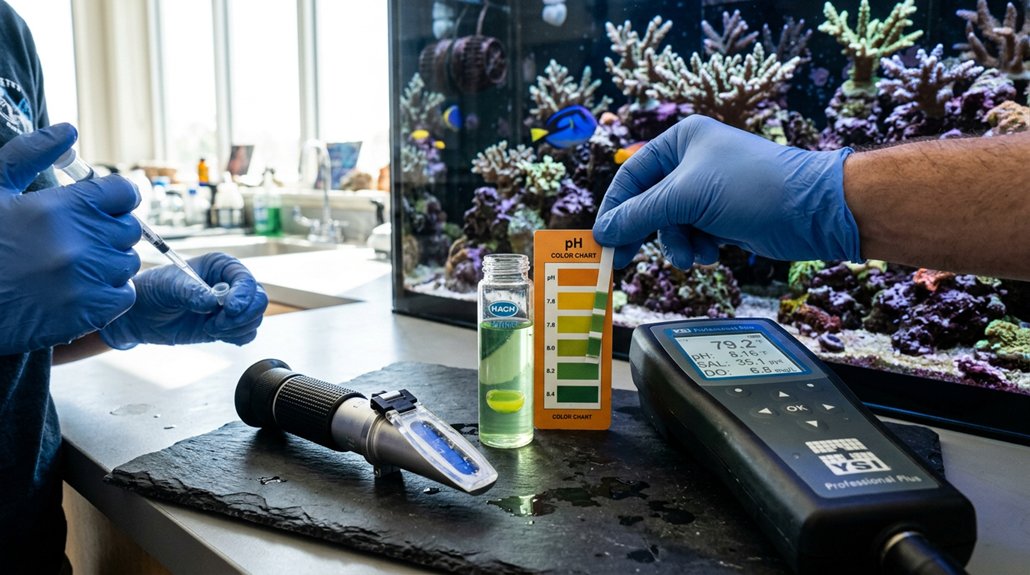
Start by comparing each result against the target range for that parameter, but prioritize stability over chasing a perfect number: temperature should stay about 76–83°F, salinity 1.025–1.027 sg, alkalinity 7–12 dKH, calcium 380–500 ppm, magnesium 1250–1400 ppm, nitrate 3–10 ppm, and phosphate 0.03–0.10 ppm. If salinity’s off, correct it gradually with RO/DI top-off or a partial change, then verify with a calibrated refractometer.
- Low alkalinity or calcium? Dose only after measurable consumption.
- Limit daily shifts to avoid precipitation and coral stress.
- Elevated nitrate or phosphate? Reduce feeding and use export methods.
- Detect ammonia immediately; improve aeration and water quality.
Watch fish behavior, coral bleaching, disease outbreaks, and lighting spectrum interactions, because these stress signals often confirm water chemistry problems before they become severe.
Frequently Asked Questions
What Should My Saltwater Tank Parameters Be?
You should aim for ideal salinity at 1.025–1.027 specific gravity, 76–83°F, alkalinity 7–12 dKH, calcium 380–500 ppm, magnesium 1250–1400 ppm, nitrate 3–10 ppm, phosphate 0.03–0.10 ppm, and stable trace element balance.
How to Test Aquarium Water Parameters?
You’ll test with calibrated instruments: thermometer, refractometer, and colorimetric kits or digital meters. Don’t worry, it’s routine aquarium maintenance. Match test frequency to tank age—daily for new systems, weekly thereafter—and record ammonia, nitrite, nitrate, alkalinity, calcium, magnesium, phosphate.
Is There a pH Tester for Saltwater?
Yes—you can use a handheld digital pH meter or probe for saltwater; it’s more accurate than color kits. Calibrate with buffer solutions, and verify salinity with a digital refractometer for reliable reef readings.
Is 1.026 Salinity Too High for Clownfish?
No, 1.026 isn’t too high for clownfish; it’s within reef range. You’ll want stable salinity, because abrupt shifts can trigger acclimation stress and osmoregulation effects. Maintain it consistently, and your fish should do well.
Conclusion
To keep your saltwater aquarium stable, you need to test the right parameters at the right time. Salinity and temperature shift fast; alkalinity, calcium, and magnesium change more slowly; ammonia and nitrite should stay at zero, while nitrate must remain controlled. You’ll catch problems early with accurate test kits and meters, but only if you test consistently. In reef keeping, precision isn’t optional—it’s the difference between a thriving system and a collapsing one.