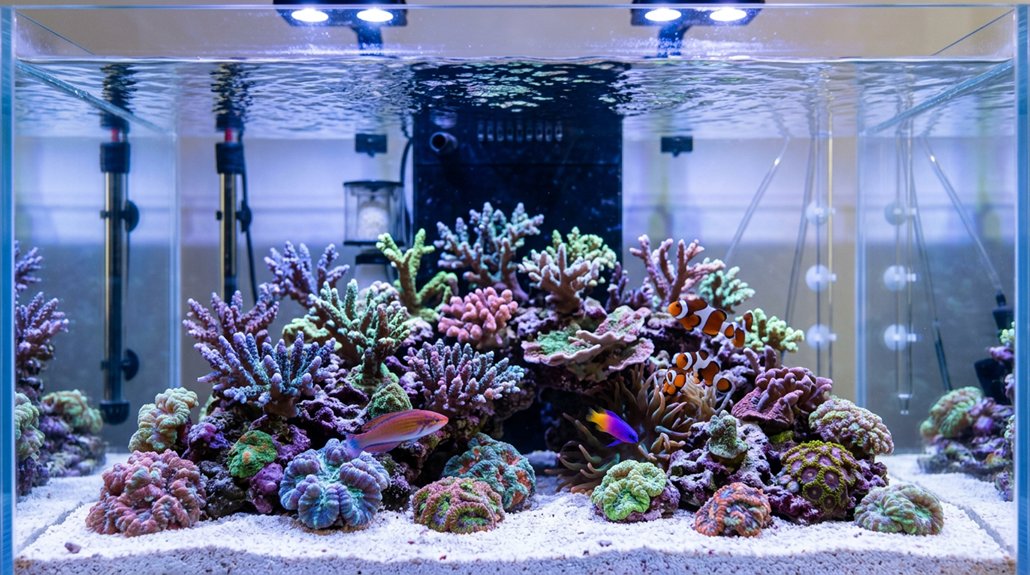
Keep your saltwater aquarium stable by using RODI water for mixing and top-off, testing salinity, alkalinity, nitrate, and phosphate twice a week, and logging every result. Run redundant heaters with a controller, steady flow, and a lid that fits your tank. Feed mostly frozen foods in small amounts, and do a 20% weekly water change with matched saltwater. Stick to one proven method, and you’ll see the rest of the routine become much clearer.
Key Takeaways
- Use purified RODI water, consistent salt mix, and premixed water for changes and top-off.
- Test salinity, alkalinity, nitrate, phosphate, and temperature regularly, logging results to catch drift early.
- Maintain redundancy with dual heaters, a controller, backup pumps, and spare equipment for failures.
- Feed mostly thawed frozen foods in small portions, and remove uneaten food within about three minutes.
- Do weekly 10–20% water changes, keep lighting and husbandry consistent, and upgrade gear only when needed.
Buy an RODI Filter First
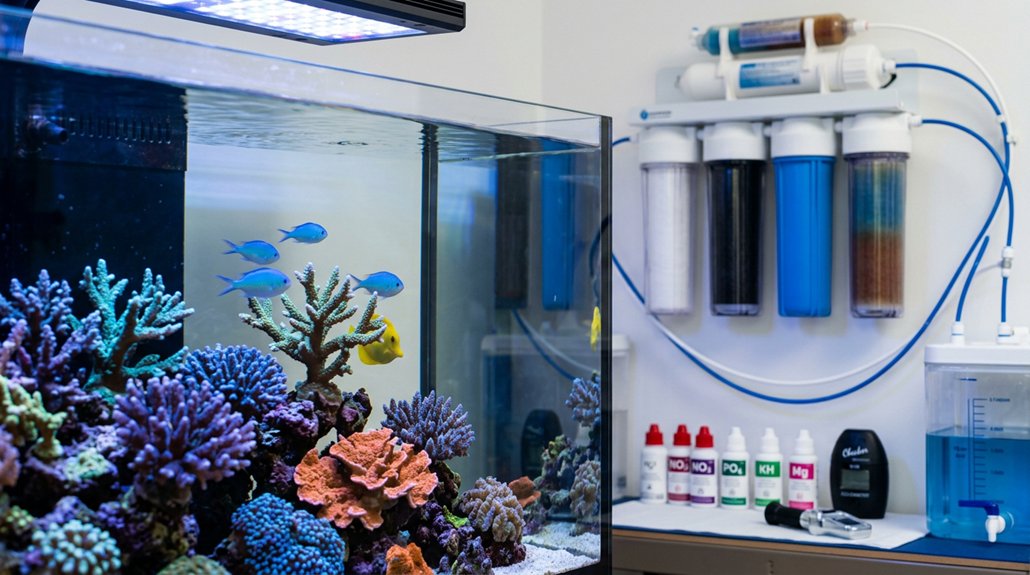
An RODI filter should be one of your first purchases, because it produces ultrapure water free of chlorine, chloramine, heavy metals, and dissolved organics that can destabilize a reef tank. You’ll use it to mix saltwater and top off evaporation without adding nitrate or phosphate. For most small to medium systems, a 50–75 GPD unit is usually adequate, though larger tanks may justify 150 GPD. Focus on pre filter selection, since sediment and carbon stages protect the membrane and extend service life. Plan for membrane maintenance by replacing pre-filters and carbon every 6–12 months, then changing DI resin when TDS or ppm rises above 0. Pair the unit with a TDS meter so you can confirm 0 ppm output and keep your water source consistent.
Test Saltwater Parameters Twice Weekly
With purified water production handled, the next priority is monitoring the tank itself. Set your test frequency to twice weekly for alkalinity, nitrate, phosphate, and salinity checks; during cycling, include ammonia and nitrite until both read zero. Use consistent water sampling, quality kits, or a lab, and log every value to identify drift early.
Monitor your tank twice weekly, track key parameters, and log every reading to catch drift early.
- Keep alkalinity near 8–9 dKH.
- Hold nitrate below 5–10 ppm.
- Keep phosphate under 0.03–0.05 ppm in sensitive systems.
- Act fast if alkalinity drops more than 1 dKH or nitrate jumps over 10 ppm.
Measure temperature daily, but don’t skip your scheduled tests. If readings move outside target ranges, correct them immediately with water changes, dosing, or equipment adjustments to protect coral health.
Set Up Redundant Heat and DC Flow
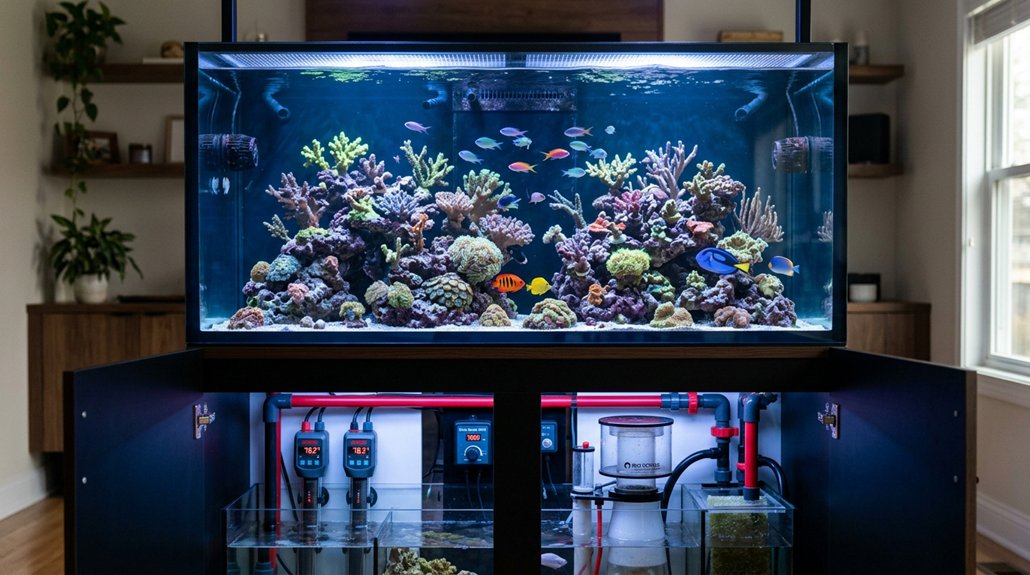
Build in redundancy for both heat and circulation so a single failure doesn’t destabilize the tank. Use a dual heater setup with a temperature controller; run one heater as primary and set the backup 1–2°F lower. Position them on opposite sides or at different heights to spread heat evenly and avoid hot spots. Target total wattage near 3–5 W per gallon, adjusted for room conditions. | Component | Purpose |
| — | — |
|---|---|
| Dual heater | Backup heating and stable control |
| DC return pump | Efficient, near-silent turnover |
| Wavemaker | Randomized flow for coral health |
Wire critical gear to protected outlets, and add battery backup or a generator for outages. Check temperature and flow daily, then clean heaters and DC pumps monthly so redundancy actually works when you need it.
Favor Frozen Food Over Pellets
You should favor frozen foods such as mysis, brine shrimp, and chopped silversides over pellets because they more closely match natural prey and usually provide better protein and essential fatty acid profiles. They also tend to reduce overfeeding and waste, which can help keep nitrate and phosphate levels lower and improve overall water quality. Thaw food fully, rinse it briefly in tank water, and feed only what your fish can consume within about 3 minutes to minimize pollution.
Better Nutrition Balance
Frozen foods such as Hikari Mysis or mysis/squid blends are often a better staple than pellets because they dissolve more slowly, are easier to portion, and reduce the risk of overfeeding that drives nitrate and phosphate spikes. You’ll also improve Fatty acid profiling and Microbiome support by rotating mysis, brine shrimp, and chopped seafood, since single-source pellets often miss key micronutrients.
- Thaw in tank-temperature saltwater.
- Rinse off excess blood and ice.
- Feed small portions twice daily.
- Use frozen foods as the base, then add nori, algae wafers, or marine pellets only when needed.
This approach gives you tighter nutritional control, steadier feeding response, and better overall dietary balance for fish that need varied marine inputs.
Reduced Waste Pollution
Better nutrition only works if the food also keeps the system clean, and frozen feeds help there by producing far less waste than pellets. When you choose frozen mysis or brine shrimp, you’re giving fish a dense, readily eaten ration that fragments less, clouds less, and leaves fewer particles to decompose into nitrate and phosphate. Portion only what they finish in about 3 minutes, because leftovers can raise nutrient levels within days. Thaw each dose fully in tank water or a small container so it disperses evenly and doesn’t create localized nutrient hot spots. Use pellets, nori, or algae wafers only sparingly for specialized feeders. This approach supports biofiltration enhancements and simplifies detritus removal, while reducing the water-pollution risk associated with frequent mixed pellet feedings.
Do a 20% Weekly Water Change
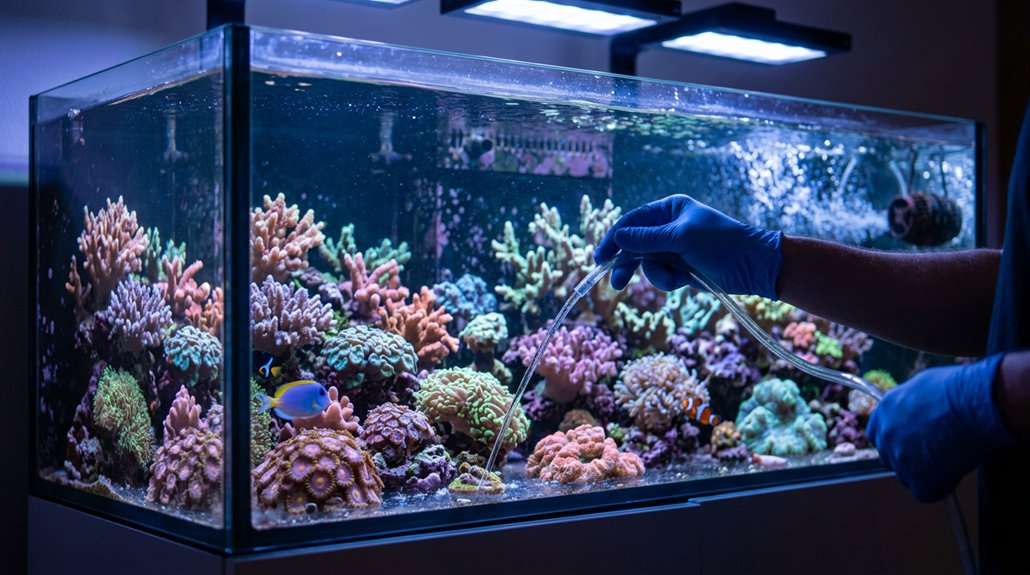
You should perform a 20% weekly water change because it removes dissolved waste, restores trace elements, and helps keep salinity and nutrient levels stable. To do it correctly, you’ll siphon out one-fifth of the tank volume with an aquarium-only bucket and replace it with pre-mixed saltwater that matches the tank’s temperature and specific gravity. Before you add the new water, you’ll aerate an RODI-and-salt mix, verify salinity with a refractometer or hydrometer, and unplug equipment that could run dry.
Why Weekly Changes Matter
Weekly 20% water changes help keep a saltwater aquarium stable by removing dissolved organics and excess nutrients such as nitrate and phosphate before they accumulate enough to fuel algae or stress corals. You also support nutrient cycling and microbial balance by preventing chronic enrichment that skews the system.
- Keep nitrate typically under 10 ppm for reefs.
- Replenish trace elements and minerals lost to skimming and uptake.
- Reduce swings in alkalinity and calcium between dosing intervals.
- Limit fish and coral stress by avoiding infrequent, large shifts.
Match replacement seawater to tank temperature and salinity, near 1.024 specific gravity, before addition. Test alkalinity, nitrate, and phosphate twice weekly early on so you can detect trends and adjust frequency if needed.
How To Change Water
Preparing a 20% weekly water change starts with premixing saltwater in an aquarium-safe bucket at the tank’s temperature and target salinity, typically 1.024–1.026 specific gravity, so it’s ready when needed. Before you begin, unplug heaters, powerheads, and filters as needed. Use a gravel siphon to remove exactly 20% of the tank volume, lightly agitating substrate to lift detritus. Then add the premixed seawater slowly, matching temperature and salinity to support livestock acclimation and prevent stress. Top off evaporative loss with fresh dechlorinated water, not saltwater, and restart all equipment. Check that pumps and heaters run normally, verify specific gravity, and confirm no leaks. Dispose of removed water responsibly, wipe spills, and record the date and parameters for equipment maintenance tracking.
Use a PAR Meter for Reef Lighting
A PAR meter is one of the most reliable tools for dialing in reef lighting, because it measures photosynthetically active radiation in the 400–700 nm range that corals can actually use. You should use waterproof quantum meters for depth mapping and take readings at coral level and across a grid to spot hot and cold zones.
- Match PAR to livestock needs: many soft corals thrive at 75–150 µmol·m⁻²·s⁻¹.
- Many SPS corals need 200–400+ µmol·m⁻²·s⁻¹.
- Measure after a 15–30 minute warm-up so LED output stabilizes.
- Recheck every 3–6 months, since lamps dim and spectra shift over time.
If your fixture lacks PAR charts, compare meter readings from similar setups to avoid under- or over-lighting your reef.
Stick to One Trusted Saltwater Source
Once your lighting is dialed in, keep the rest of your reef husbandry equally consistent by sticking to one trusted saltwater source and following its method without mixing in conflicting advice from multiple channels. Choose a single guide or contributor that documents both successes and failures, because that shows you how to troubleshoot common beginner problems realistically. Use that source for target salinity, test intervals, and water-change schedules so your parameters stay stable and your routine doesn’t drift. This kind of consistent sourcing reduces avoidable swings and keeps decisions reproducible. After you’ve built baseline experience, you can add secondary references to answer specific questions, but only if they don’t contradict your core method. Bookmark or print the key procedures, and lean on community mentorship to clarify exact steps when you’re setting up or maintaining your tank.
Protect Your Tank With a Lid and Backup Gear
Protect your tank with a lid that matches your system: a glass top helps cut evaporation and retain heat, while a mesh screen prevents jumpers without blocking gas exchange, so choose based on your livestock and room humidity. Your lid options should also allow fast access for maintenance and emergency removal. Keep emergency spares ready:
- an extra heater
- a backup return or powerhead
- a spare temperature controller
- premixed RODI and saltwater
Secure cords with Velcro ties, wipe salt creep weekly, and place the tank on a level stand away from direct sun. These controls reduce corrosion, prevent shorts, and give you a fast response if equipment fails or a leak forces rapid top-off or water change.
Learn As You Go Without Overbuying
Start with your end goal, then build only what that tank actually needs. If you want a 15-gallon frag tank or a 40–55-gallon mixed reef, choose gear from that plan, not from impulse. Begin with sponge or filter sock filtration, a RODI unit, refractometer, and heater(s) with a controller. Test ammonia and nitrite until cycling ends, then check alkalinity, nitrate, and phosphate twice weekly for six months. Let those results, not marketing, justify supplements, media, or dosing gear. Add a protein skimmer, refugium, UV sterilizer, or DC wavemakers only when tank maturity and measured deficiencies show real demand. Keep slow upgrades and experience journaling so you can link flow, cleaning, and livestock response. Avoid over-filtration; steady 10–20% water changes solve most issues.
Frequently Asked Questions
How Difficult Is It to Maintain a Saltwater Aquarium?
It’s moderately difficult: you’ll need disciplined maintenance scheduling, accurate testing, and careful equipment choices. If you stay consistent with water changes, top-offs, and monitoring, you can keep things stable; neglect quickly causes problems.
What Is the First Thing to Put in a Saltwater Tank?
You should put in cured live rock first, since it seeds beneficial bacteria and starts cycling. Then you’ll run your protein skimmer, heater, and circulation, stabilizing salinity before adding any livestock.
What Is the Average Lifespan of a Saltwater Aquarium?
Like a well-tended clock, your saltwater aquarium can last 10+ years, even indefinitely. With stable water chemistry, regular filtration maintenance, and equipment replacements, you’ll keep it thriving; poor care can make it fail within a year.
How to Keep a Saltwater Tank Crystal Clear?
You’ll keep your saltwater tank crystal clear with regular water changes, protein skimmers, phosphate control, strong flow, and clean mechanical filtration. Test nutrients often, remove detritus quickly, and use carbon or UV if haze persists.
Conclusion
Keeping a saltwater aquarium healthy is about consistency, not luck. If you buy RO/DI water, test twice a week, maintain redundant heat and DC flow, feed frozen food, change 20% of the water weekly, and track lighting with a PAR meter, you give your tank the stability it needs. Stick to one trusted source, protect your system with a lid and backup gear, and learn as you go. Your aquarium isn’t a decoration—it’s a living system.