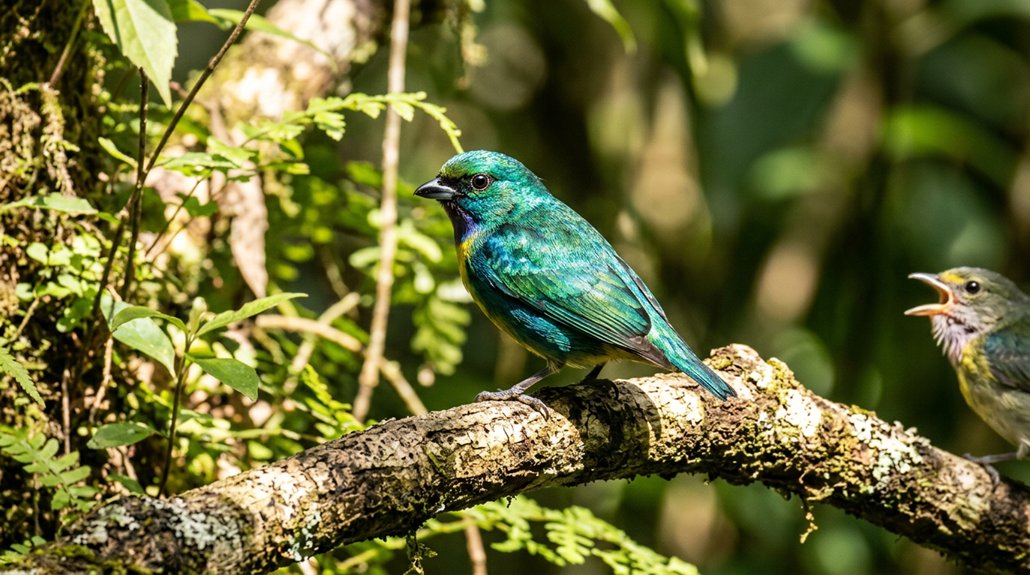
If you want birds that talk and mimic sounds, you’ll usually look at parrots, mynas, starlings, mockingbirds, ravens, and lyrebirds. You’ll get the clearest humanlike speech from African grey parrots, some Amazons, Indian ring-necks, and hill mynas, while budgies, cockatoos, and ravens can also learn many calls and phrases. Their vocal-learning circuits, syrinx anatomy, and social exposure shape what they can copy, and the next section shows how that works.
Key Takeaways
- Parrots, especially African greys, Amazons, and Indian ring-necks, are among the best bird species for talking and sound mimicry.
- Budgerigars, hill mynas, and European starlings can also learn impressive vocabularies and reproduce human-like sounds clearly.
- Songbirds and ravens mimic calls, environmental noises, and sometimes human phrases through social learning and repetition.
- Birds learn speech and sounds best when young, especially with close human contact, hand-raising, and frequent reward-based training.
- Mimicry in birds serves communication, bonding, territorial defense, and cultural transmission within flocks and wild populations.
Why Birds Talk and Mimic Sounds?
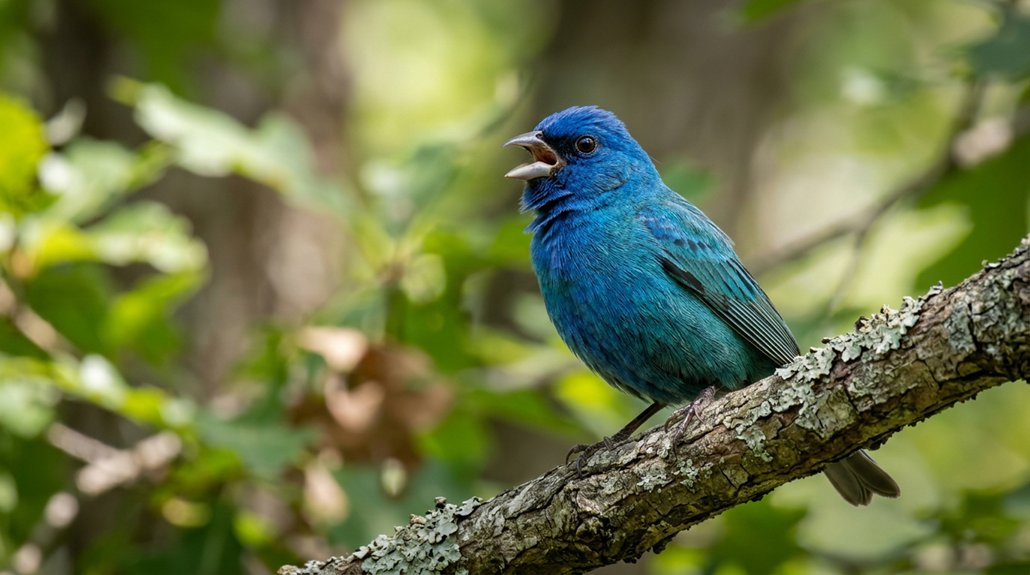
Birds talk and mimic sounds because vocal learning lets them copy and refine acoustic signals during a sensitive developmental period. You see this most clearly in songbirds and parrots, which learn from tutors such as parents, flock members, or humans. Their syrinx, along with species-specific beak, tongue, and throat anatomy, constrains which sounds they can reproduce, while parrots’ muscular tongues and specialized forebrain regions improve mimicry. You can think of copying as serving multiple functions: social bonding, territorial display, mate attraction, and local dialect formation for group recognition. In captivity, repeated exposure and reinforcement increase vocabulary, and in the wild, mimicry supports auditory exploration of the environment. Some sounds are learned intentionally, while others arise incidentally from mistaken attempts to match species-specific calls.
How Birds Learn Speech Through Social Copying
You can see speech learning in birds as a social-copying process, because juveniles typically imitate parents and dominant flock members during early development. In species with large repertoires and tight group structure, repeated exposure can shape local flock dialects and, in captivity, increase the likelihood that human phrases are copied and retained. These vocal habits are supported by specialized syrinx and forebrain circuits, although anatomical limits still constrain which sounds you’ll hear them reproduce.
Social Learning Basics
By listening and copying, young vocal learners acquire much of their speech-like repertoire during an early sensitive period, typically by attending to parents, dominant flock members, or human caregivers and then refining those sounds through repeated social feedback. During these critical periods, you show tutor preferences: familiar, attentive models are copied most often. Birds with larger repertoires and richer social exposure, especially parrots and songbirds, usually master human-like phrases more readily. Reinforcement matters too; when you respond with food, attention, or social acceptance, copied words persist. Their syrinx, tongue, and forebrain vocal-learning circuits support accurate imitation.
| Input | Social cue | Result |
|---|---|---|
| Adult phrase | Repeated attention | Stable copying |
| Caregiver word | Food reward | Higher frequency |
| Novel sound | Social acceptance | Retention |
Flock Dialects
In socially living parrots and songbirds, vocal learning doesn’t end with copying a single tutor; it continues as young birds absorb the local soundscape of their flock during sensitive early periods. You’ll see that these repeated calls create flock dialects, or regional accents, through cultural transmission. Individuals favor familiar variants from parents and dominant companions, so local phrases become shared signals for group identity. Birds often respond more strongly to their own dialect and may ignore, or even ostracize, outsiders whose calls differ. In larger, interactive flocks, frequent repetition speeds adoption and expands repertoires. Social reinforcement, including food and acceptance, can stabilize novel sounds, letting a repeated phrase become flock-specific and persist across generations, sometimes spreading between captive and wild populations through copying.
Human Phrase Copying
How do birds acquire human speech so effectively? You see it emerges through social learning: hand-raised or closely bonded juveniles copy owners and dominant flock members after early exposure, a process shaped by juvenile imprinting. Repetition matters because phrases that trigger attention, food, or social acceptance are retained under reward schedules that strengthen vocal output. In captivity, parrots, mynahs, starlings, and some corvids hear human models constantly, so they’re more likely to imitate speech and expand vocabularies. In wild urban flocks, introduced phrases can spread culturally and function as flock-specific dialect cues that affect recognition. Their syrinx, tongue, and forebrain vocal-learning circuits enable precise imitation, but they also limit which consonants and vowels you’ll hear reproduced accurately.
How Bird Anatomy Enables Mimicry
Bird anatomy sets the limits and possibilities of mimicry through a combination of sound production, airflow control, and neural processing. You can trace this to the syrinx, a vocal organ at the tracheal base that lacks vocal cords and can drive two sound sources independently. That syringeal biomechanics supports rapid frequency shifts and complex imitation. In parrots, tongue modulation, beak control, and a single syrinx reshape airflow and spectral form, so you hear clearer vowel- and consonant-like patterns. Because birds don’t have lips and their oral cavities differ from yours, exact speech remains impossible; they approximate by adjusting membrane tension, gape, and tongue position. Species such as lyrebirds, with three syringeal muscles, gain finer control. Dedicated forebrain song-learning circuits also support retention and flexible use.
Why Birds Mimic Sounds in the Wild
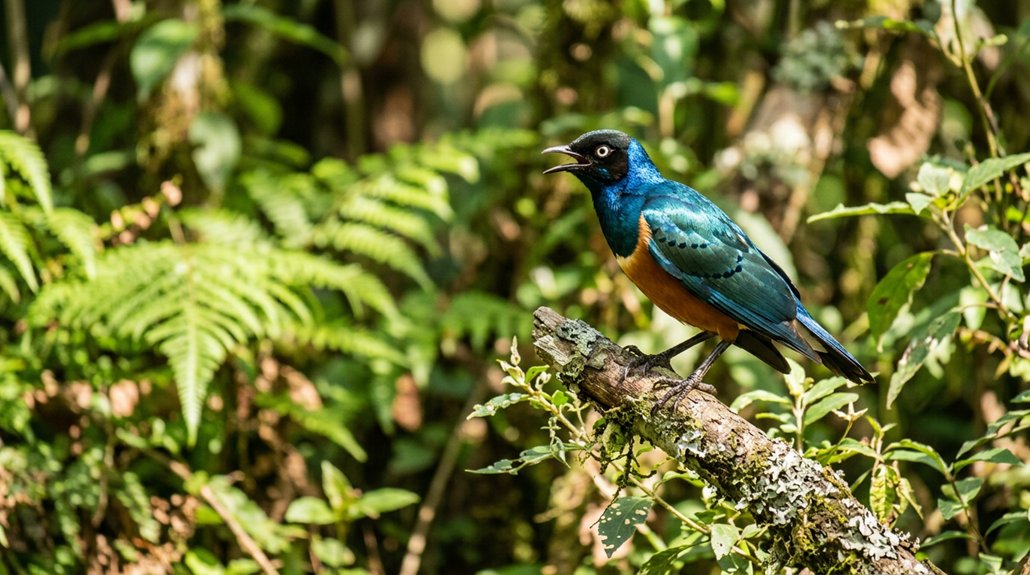
You’ll find that wild birds often mimic sounds through social learning, with flock-specific dialects reinforcing recognition and prompting stronger responses to familiar calls. You’ll also see mimicry used in territorial defense and individual signaling, where copied sounds can help mark space, deter rivals, or advertise identity. In some species, these vocal traits can increase mating success or survival, so the behavior’s prevalence depends on ecology, social structure, and early learning.
Social Learning In Flocks
Although mimicry can seem like playful copying, in wild flocks it’s usually a learned social behavior shaped by early exposure, hierarchy, and repeated interaction. You see juvenile imitation when young birds copy parents and dominant flock members, especially if hand-raising or close contact exposes them to novel sounds. Through cultural transmission, these borrowed calls can spread across a flock and become local dialects that members recognize for social identification. In captive settings, constant repetition and reinforcement often produce the most complex mimicry. Similar processes can move human-associated phrases into wild parrot populations. The resulting vocal repertoire is not random: it reflects social learning, retention, and context-dependent use. Depending on species, mimicry can support bonding, signaling, deception, or an auditory map of the local soundscape.
Territory And Recognition
In the wild, mimicry often functions as a tool for territory and recognition rather than novelty: flock members learn local dialects, including repeated human phrases, and use them as social markers that help maintain cohesion and identify outsiders. You can see this in wild parrots, where shared calls support neighbor recognition and reduce conflict within familiar groups. Birds often respond more strongly to sounds from their own flock, and individuals whose vocalizations diverge from local patterns may be excluded. Within territorial acoustics, some species also copy frequent environmental sounds, building an auditory map of their range. This repertoire can include human speech, other birds, or urban noise. Magpies and lyrebirds may pair mimicry with distinct territorial signals, and magpies may imitate predator calls to discourage intruders.
Sexual Selection And Survival
Mimicry in birds isn’t only a matter of flock identity or territorial signaling; it can also shape reproductive success and survival. You can see sexual selection in species such as the male superb lyrebird, where larger repertoires improve mate choice outcomes.
- Males with diverse mimicry often gain higher status.
- Accurate performance can signal fitness in parrots and passerines.
- Juveniles that learn local sounds may secure better resources.
- Some birds use predator deception, copying owl or alarm calls to deter intruders.
These vocal traits usually arise through social learning during sensitive periods, so your exposure to local sounds matters. In the wild, repertoire size and precision can consequently influence both reproductive success and anti-predation advantage.
Best Talking Birds in Captivity
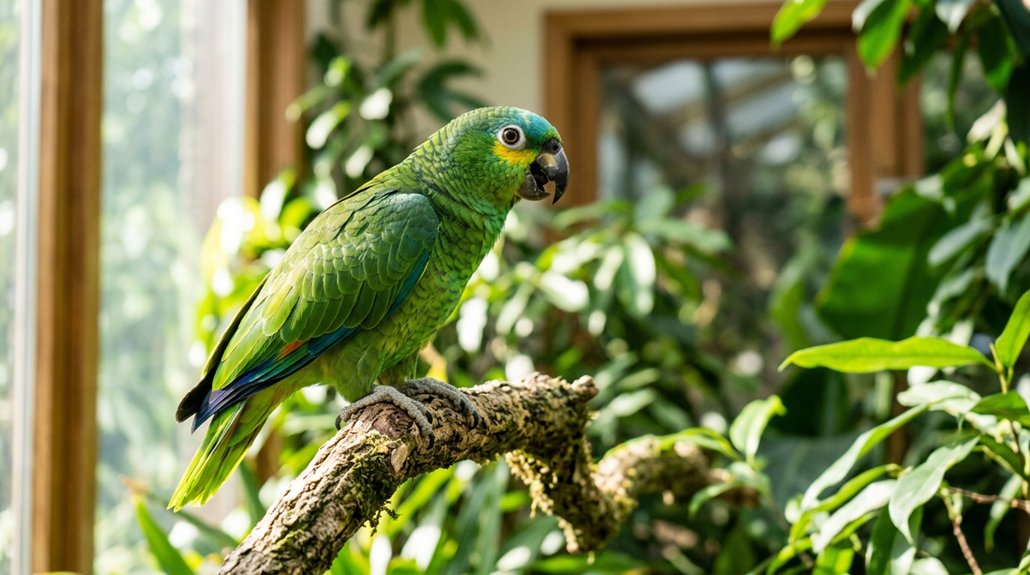
Among captive birds, African grey parrots—especially Congo and Timneh greys—are widely regarded as the strongest talkers, often learning 500–1,000 or more words and using them with notable clarity and context, but they typically need extensive daily social interaction, often 5+ hours, to reach that level. You’ll also see budgerigars with unusually large vocabularies; some individuals, like Puck, exceeded 1,700 words under intense repetition. Yellow-naped Amazons and related Amazons can produce coherent sentences and nuanced tones, while monk parakeets, Indian ring-necks, and eclectus parrots often learn 50–200+ words when trained early. Hill mynas, European starlings, and some captive ravens add striking vocal realism. For captive welfare, vocal enrichment and environmental enrichment matter, and training ethics should prioritize predictable, positive social reinforcement over coercion.
Parrots That Mimic Human Speech Most Clearly
African grey parrots, especially Congo and Timneh greys, are usually regarded as the clearest-speaking parrots because they can learn roughly 500–1,000 or more words and often reproduce them with unusually humanlike pronunciation and contextual use. You’ll notice that their vocal mechanics support precise imitation, and their learning timelines can be relatively fast when training is consistent.
- African greys: strongest clarity, broad vocabularies.
- Yellow-naped Amazons: clear, conversational tone, context-sensitive tempo.
- Indian ring-necked parakeets: sharp enunciation, long phrases, full sentences.
- Hill mynas, budgerigars, and monk parakeets: highly intelligible speech, with mynas excelling in humanlike voice quality.
In practice, you’d compare clarity by pronunciation, intonation, and word retention, not by size alone.
Songbirds That Copy Words, Whistles, and Calls
Songbirds can be remarkably adept at copying words, whistles, and environmental calls, even though their mimicry is generally less sustained than that of the best parrots. You’ll see this in northern mockingbirds, which can copy hundreds of songs and local sounds, sometimes adding short human speech snippets. European and common starlings are also strong mimics, routinely echoing other birds, machinery, and, occasionally, clear words. Common hill mynas and related mynahs can learn around 100 phrases with realistic voice quality. Ravens, brown thrashers, lyrebirds, and Australian magpies expand the range further, reproducing human voices and complex ambient sounds. In field studies, these species aid dialect mapping, and their vocal improvisation can be strikingly precise when hand-raised or closely exposed to people.
Bird Intelligence and the Language Debate
Mimicry in birds raises a deeper question than simple copying: what, exactly, are these animals understanding when they reproduce human speech or other sounds? You should weigh evidence for symbolic comprehension against explanations based on operant conditioning and social reinforcement.
- African grey parrots can acquire about 1,000 words and sometimes use labels contextually.
- Alex-like case studies suggest referential labeling, question-asking, and simple concepts beyond rote mimicry.
- Parrots and songbirds share specialized forebrain circuits for vocal learning, supporting flexible, context-dependent behavior.
- Replication limits, Clever Hans comparisons, and experimental ethics keep the language debate unresolved.
Because early hand-rearing and intensive interaction matter, you shouldn’t assume innate language competence from vocal accuracy alone. Instead, you should interpret each vocalization as a product of cognition, social learning, and reinforcement history.
Famous Talking Birds in History and Fiction
You can trace famous talking birds across history and fiction, where documented vocal learning and cultural storytelling often overlap. African grey parrots such as Alex and Prudle showed vocabularies exceeding 1,000 words, while Captain Flint, Grip, and the recurring hill myna and monk parakeet in media turned avian mimicry into lasting literary and pop-culture motifs. Historical accounts of Indian ringneck parakeets repeating prayers and courtly phrases further show that your examples of “talking birds” reflect both biological speech imitation and human interpretation.
Literary Bird Icons
Among literary bird icons, the talking raven and parrot recur as especially durable symbols of avian vocal imitation, because they link animal behavior to human speech in ways that are both dramatic and culturally familiar. You can see their avian symbolism and narrative function in 4 recurring patterns:
- Dickens’ Grip modeled speech-like mimicry, later echoing in Poe’s raven.
- Stevenson’s Captain Flint voices “Pieces of eight!” to intensify maritime realism.
- Travers and related tales use parrots to expose secrets or trigger plot shifts.
- Dolittle, Tintin, and film parrots extend the motif into multilingual comedy.
These figures aren’t random ornaments; they’re efficient devices for signaling intelligence, recall, and social proximity. In modern media, mynas and African greys continue that role by providing a recognizable standard for human-voice imitation.
Historic Parrot Stories
From literary symbols to documented cases, talking parrots have long occupied a narrow but revealing space between entertainment and cognition. You can trace parrot folklore through Captain Flint in Treasure Island, whose “Pieces of eight!” fixed pirate imagery, and through the fictional 200-year-old West African parrot in Doctor Dolittle. In contrast, Alex, the African grey studied by Dr. Irene Pepperberg, reportedly learned about 100 words and used labels referentially, so you can’t reduce his performance to simple mimicry. Prudle exceeded 1,000 words, while Sparkie Williams, a budgerigar, reached 531 words and 383 phrases, showing small parrots can acquire large repertoires. Grip, Dickens’s raven, also shaped avian omens in literature, where talking birds often signal intelligence, prophecy, or comic relief.
Birds In Pop Culture
Popular culture has long turned talking birds into shorthand for intelligence, mystery, and comic effect, drawing on both real avian behavior and fictional exaggeration. You can see this in recurring talking tropes and avian symbolism across media.
- Captain Flint in Treasure Island repeats “Pieces of eight,” reinforcing pirate lore.
- Alex, the African grey studied by Irene Pepperberg, showed referential labeling and about 100 words, influencing science-based portrayals.
- Grip, Dickens’s raven, helped shape literary corvid speech, linking mimicry to gothic meaning.
- Hill mynas, plus parrots in Doctor Dolittle, Tintin, and videogames, provide realistic speech models.
You’ll notice that these examples blend observation and fiction: species such as African greys, amazons, ring-necked parakeets, and mynas made talking birds seem plausible, durable, and culturally persuasive.
How to Encourage a Bird to Mimic Speech
To encourage a bird to mimic speech, start training as early as possible, ideally when the bird is young or hand-raised, because early socialization strongly improves later vocal learning. You should use early imprinting and environmental enrichment to increase exposure to human vocal patterns. Offer short, distinct phrases in a consistent tone, and repeat them in multiple brief sessions each day. Reinforce any accurate or approximate attempt immediately with attention, petting, or a food treat. Provide rich ambient speech through conversation, radio, or TV, since many species learn from background input. Adjust expectations to the species: budgies often respond quickly, while cockatoos may need stronger social motivation. Stay patient, because individual variation is large, and some birds won’t mimic despite ideal training.
Frequently Asked Questions
Which Bird Is Known for Talking and Mimicking Sounds?
The African grey parrot’s usually the bird you’d name: you’ll see exceptional vocal learning and parrot language, with clear mimicry and hundreds of learned words. Budgerigars and Amazon parrots can also imitate sounds impressively.
What Bird Can Mimic Noises?
Parrots, mynas, lyrebirds, starlings, and some corvids can mimic noises. You’ll see vocal learning, sound mimicry ecology, social communication, and behavioral conditioning shape their repertoires, especially in captive or highly social environments.
What Bird Is Known for Mimicking?
African grey parrots’re renowned mimics. You’d see strong vocal learning, enabling them to copy speech and sounds with precision; this likely supports social bonding, much like Hermes carrying messages, while helping them integrate into flocks.
What Is the Bird That Sounds Like It’s Talking?
Usually, you’re hearing an African grey parrot; its vocal mimicry is especially human-like. Parrot cognition and mimicry evolution help explain why it can learn words and use them contextually with remarkable clarity.
Conclusion
You see that bird speech is both imitation and intention: a parrot can echo your words, while a starling can weave whistles, alarms, and mechanical sounds into one flexible repertoire. Yet mimicry is not human language, and that contrast matters. You can value the precision of a bird’s syrinx, the social learning behind its voice, and the evolutionary reasons it copies. In the end, birds don’t merely repeat sound; they reveal how communication adapts.