To fix algae in your freshwater tank, you need to cut the fuel, light, and debris that support it. Test ammonia, nitrate, and phosphate, and treat any measurable ammonia as urgent. Reduce the photoperiod to 6–9 hours, block direct sun, and scrape glass and siphon detritus during water changes. Feed less, avoid overstocking, and improve filtration and aeration. UV, carbon, phosphate media, and algaecides can help in specific cases, and the details matter if you want lasting control.
Key Takeaways
- Reduce light to 6–8 hours daily, remove direct sunlight, and replace old bulbs that shift spectrum.
- Test ammonia, nitrate, and phosphate regularly; treat any measurable ammonia as an urgent imbalance.
- Perform frequent water changes, siphon the substrate, and remove visible algae to export excess nutrients.
- Cut feeding, avoid overstocking, and quarantine new fish to prevent waste buildup that fuels algae.
- Improve filtration and flow, add aeration, and use UV, carbon, or phosphate media if needed.
What’s Causing Algae in Your Tank?
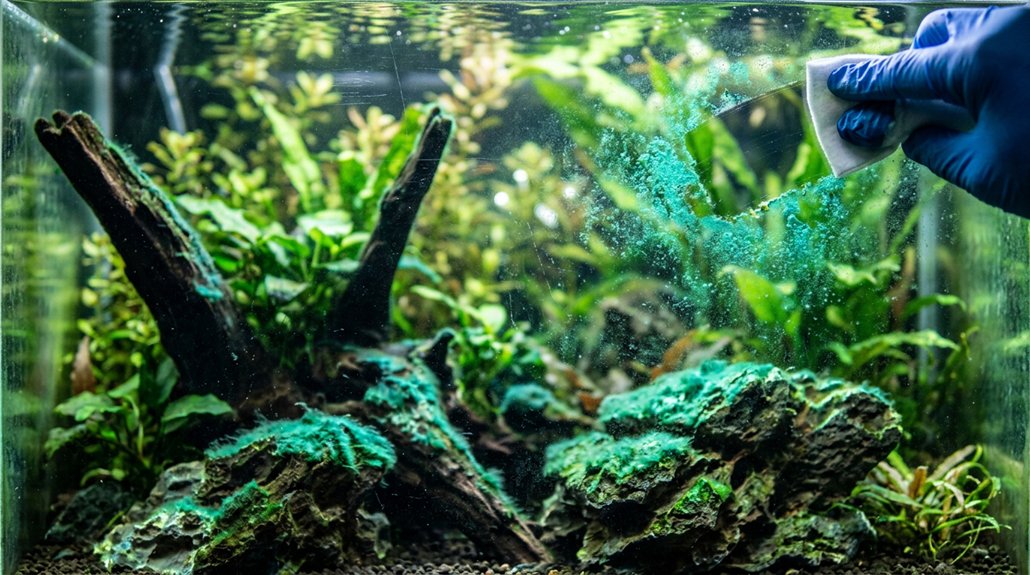
Algae blooms usually start when spores or cells are present and the tank has enough “fuel” to support rapid growth: dissolved organics, ammonia, nitrates, and phosphates. In your tank, that fuel often comes from poor husbandry, excess feeding, infrequent water changes, weak filtration, or limited plant uptake. If the system’s new or recently reconfigured, you’re also dealing with an uncycled biofilter and possible substrate leaching, so nutrients accumulate fast. Light then drives the outbreak: direct sun, long photoperiods, or an altered light spectrum from old bulbs can accelerate photosynthesis. Seasonal cycles can intensify exposure. Detectable ammonia in an established tank is a red flag; it usually means a serious imbalance that’s letting algae exploit available nutrients and available light.
Test Ammonia, Nitrate, and Phosphate
Start by testing ammonia, nitrate, and phosphate with a reliable aquarium kit, because any detectable ammonia in a supposedly cycled tank is abnormal and usually points to overstocking, overfeeding, or a dead organism that needs immediate correction. In routine water testing, record values and compare nutrient trends over time.
Test ammonia, nitrate, and phosphate regularly; even trace ammonia signals a problem in a cycled tank.
- Ammonia: treat any measurable level as an urgent fault.
- Nitrate: keep it well below problematic levels; many aquarists target under 25 ppm.
- Phosphate: use a sensitive test, since strips often miss low but relevant concentrations.
If nitrate or phosphate stays elevated, increase freshwater changes and consider phosphate-adsorbing media. Test your tap water first; imported nutrients can sustain algae. During outbreaks, test daily to weekly so you can correlate changes with algae and response.
Reduce Light and Shorten the Photoperiod
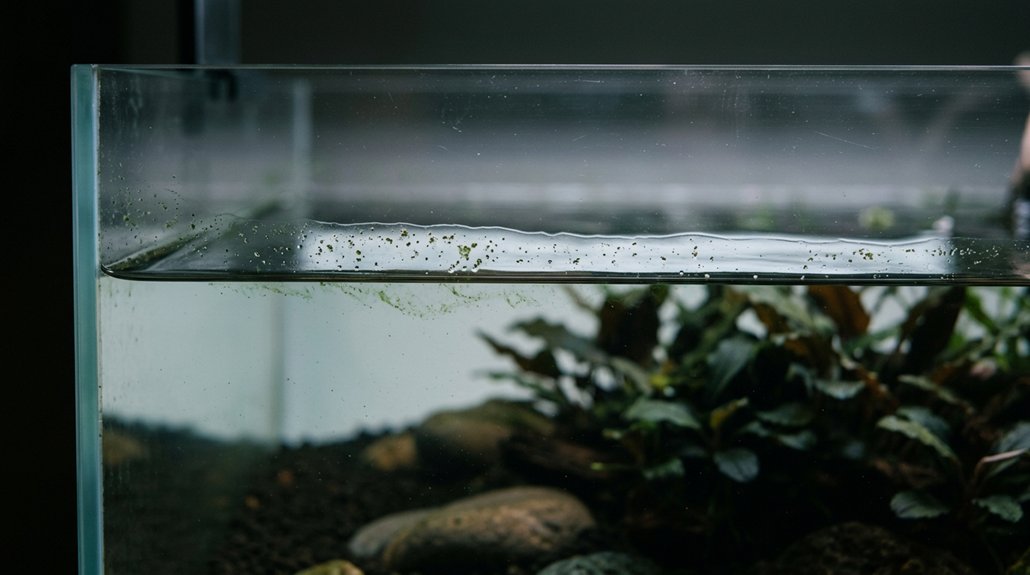
Once ammonia, nitrate, and phosphate are controlled, reduce the light load that’s feeding the bloom by limiting aquarium lighting to 6–9 hours per day, or 6–8 hours if the tank is algae-prone, and use a reliable timer so the schedule doesn’t drift. You should eliminate direct and reflected sunlight by moving the tank or blocking windows and mirrors, because seasonal daylight increases can trigger algae growth. Check lamp age; replace fluorescent bulbs yearly and VHO bulbs twice yearly, since an altered light spectrum can favor algae even when the photoperiod is unchanged. If the bloom is severe, use a 48–72 hour timed blackout with aeration, then restart at a shorter schedule. Match intensity to your setup; bright tanks need more plant competition or CO2, while low-light tanks still benefit from reduced daily exposure.
Scrape Glass and Siphon Debris
You should scrape the glass weekly with a dedicated algae pad or scraper, keeping close attention on the bottom 2 inches where buildup typically concentrates. As you clean, run a gravel vacuum to siphon loosened algae and trapped detritus from the substrate and around decorations, since these deposits supply nutrients that drive regrowth. In tight corners and behind decor, dislodge residue with a long-handled brush or toothbrush, then remove it immediately instead of letting it decompose in the tank.
Glass Scraping
Scrape the aquarium glass with a long-handled algae scraper or magnetic cleaner, working from top to bottom in overlapping strokes so the thickest growth comes off first and doesn’t disperse through the water column. Your glass maintenance should start with scraper selection: choose a rigid blade for glass or a nonabrasive pad for acrylic. Keep the tool at a shallow angle to avoid scratches. 1. Clear the front pane first. 2. Treat the lower 2 inches and shell edges gently. 3. Lift decorations only if needed for tight spots. Wipe the outside with aquarium-safe products only, never household cleaners. Rinse tools in tank water before reuse. Time this procedure just before your scheduled water change to reduce dissolved organics and limit immediate regrowth.
Debris Siphoning
After glass scraping, use a siphon or gravel vacuum to remove settled algae, detritus, and trapped debris from the substrate, especially in crevices, under shells, and around rockwork bases where organics accumulate. Use a controlled siphon technique: move slowly, then lift the tube periodically to dislodge trapped material so your filter can capture it before it resettles. Pair this with partial water changes of 10–25% to reduce dissolved organics and nutrients that drive algal growth. For effective substrate maintenance, target hard-to-reach areas where debris concentrates, but don’t overdisturb the bed. This routine removes attached waste before it decomposes, limits nutrient release, and helps prevent immediate regrowth. Consistent siphoning keeps the substrate cleaner and improves overall water quality.
Detritus Hotspots
Detritus hotspots form in low-flow zones, especially along the bottom two inches of glass and around shells, rock crevices, and other hardscape bases where algae and organic waste settle. You should treat these as microbial hotspots and remove macro detritus before it decomposes.
- Scrape the glass with a dedicated algae scraper to prevent seeded regrowth.
- Use a soft toothbrush on corners and rock spines, then siphon the loosened material.
- Gravel-vac the substrate or carefully siphon among shells during each water change.
Do this weekly or at every maintenance cycle. After cleaning, perform a 10–25% water change to export suspended organics and reduce nitrate and phosphate loading. Consistent removal keeps nutrient hotspots from reforming and limits algae’s fuel supply.
Boost Filtration and Aeration
You should increase filtration flow so the tank volume turns over at least 4–6 times per hour, which improves particulate capture and keeps algae-fed debris in suspension long enough to be removed. Add an air stone or powerhead to raise surface agitation, reduce dissolved CO2, and support aerobic bacteria that compete with algae. Position additional circulation to eliminate dead spots near the substrate and behind decor, and use chemical media on a regular replacement schedule if dissolved organics are building up.
Increase Aeration
Increasing aeration improves both gas exchange and filtration efficiency, which can help suppress algae in freshwater tanks. You should break surface tension with an air stone or powerhead so oxygen diffusion increases and CO2 declines. That shift favors aerobic bacteria, which outcompete algae for dissolved organics.
- Raise surface agitation to stabilize dissolved oxygen.
- Use multiple gentle flow paths, not one intense jet, to eliminate stagnant zones.
- Add a second filter or finer media if circulation still leaves dead spots.
Increased flow keeps particulates suspended long enough for mechanical media to capture them, reducing algal fuel. Don’t ignore maintenance; if you’re not cleaning filters and siphoning regularly, the stirred debris can just redistribute and worsen growth.
Improve Debris Removal
Step up debris removal by improving filtration and aeration together. You’ll want stronger surface agitation with an airstone or powerhead, since higher oxygen and CO2 off-gassing help aerobic bacteria dominate and keep debris suspended for capture. Upgrade mechanical filtration and clean media often.
| Action | Effect | Priority |
|---|---|---|
| Sponge pre-filter | Traps particulates | High |
| Fine floss | Catches small debris | High |
| Substrate raking | Removes detritus | Medium |
During water changes, use substrate raking with a gravel vac and remove at least 25% when nitrate or organics rise. More media surface area supports microbial biofilms that process dissolved waste faster. In green-water cases, a small UV sterilizer or diatom filter can clear free-floating algae while you restore balance.
Strengthen Filtration Flow
Once debris removal is improving, the next control point is flow. You need enough turnover to keep organics suspended and prevent nutrient pockets; target 6–10 tank volumes per hour, so a 70 gal system needs roughly 420–700 gph total. Use careful pump sizing and verify flow distribution around substrate, hardscape, and plant beds.
- Add a powerhead or upgrade the filter.
- Install fine sponge or floss, then rinse it weekly.
- Increase aeration with an airstone or stronger surface agitation.
This improves gas exchange, lowers CO2, and supports aerobic bacteria that outcompete algae for dissolved organics. If you use a canister, HOB, or skimmer, adjust settings incrementally so you don’t shock the biofilter.
Add Live Plants and Algae Eaters
Adding fast-growing live plants can quickly shift nutrient balance in your favor by absorbing nitrates and phosphates before algae can use them. You should add hornwort, northern milfoil, frogbit, or duckweed, and let their rapid growth suppress algae while improving plant propagation. In a 70-gallon tank, introduce several Amano shrimp plus a 4–6-inch pleco, or use multiple smaller plecos and snails, matched to your bioload. Combine grazers and scrapers so biofilm is removed from glass and décor, including any persistent aquatic turf. Add these organisms only after cycling, with ammonia at 0 ppm and nitrates below about 25 ppm. Monitor reproduction and waste output closely. This works best with regular water changes, controlled feeding, and stable circulation; otherwise, algae can persist despite biological control.
Stop Overfeeding and Overstocking
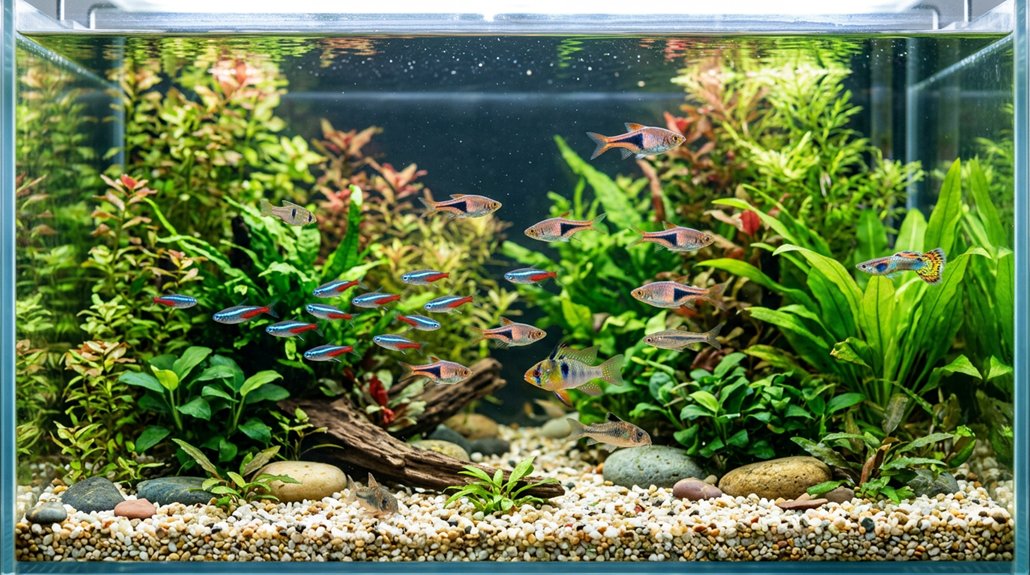
You should feed only what your fish consume within about 2 minutes, once or twice a day, so uneaten food doesn’t decompose into ammonia, nitrate, and phosphate. You’ll also need to keep stocking near 1 inch of adult fish per net gallon and avoid sudden additions that can overload the biofilter. If ammonia is detectable or nitrates stay high, reduce feeding and fish load, then perform a partial water change to lower dissolved nutrients.
Reduce Feeding Amounts
Feed only what your fish can consume within about 2 minutes, once or twice daily, to limit excess food breakdown into nitrates and phosphates that fuel algae. Use a strict feeding schedule and measured portions; don’t eyeball flakes or pellets.
- Pre-portion dry food with a scale or scoop, then feed only that amount.
- Remove uneaten food with a siphon immediately after feeding.
- If ammonia or nitrite rises, cut feeding to every other day and do a 25–50% water change until stable.
Keep biomass conservative: roughly 1 inch of adult fish per net gallon, adjusted for waste output. Even plecos and other cleaners add waste, so they aren’t a license to overfeed. Lower intake reduces chronic nutrient loading and helps suppress algae.
Balance Fish Stocking
Even with measured feeding, excess waste can still accumulate if the tank is overstocked. You should keep stocking density conservative: in a 70-gallon freshwater tank, aim for roughly 1 inch of adult fish per net gallon as a limit, not a target. Match species by behavioral compatibility so aggressive or messy fish don’t create chronic stress and waste. Avoid stacking multiple large algae-producing species; two plecos in one tank can generate enough organic load to elevate ammonia and nitrate. Feed only what’s eaten within about 2 minutes, then remove leftovers. When you add fish, increase water changes to 25% weekly and test ammonia and nitrate until the biofilter stabilizes. Quarantine new fish and inspect for decay or parasites to prevent hidden mortality and sudden nutrient pulses that trigger algae.
Use Water Changes to Cut Nutrients
Regular partial water changes are one of the most effective ways to cut the nitrate and phosphate load that fuels algae growth. You should treat this as scheduled maintenance, not an emergency reaction. During each change, test both tank water and source water so you don’t reintroduce nutrients from the tap.
- Change 25% every 1–2 weeks, or 10% weekly, to dilute dissolved waste.
- In a new or unstable tank, use 50% daily for one week, then every other day until ammonia and nitrate stabilize.
- After siphoning substrate and removing visible algae, complete the change to export suspended organics and limit regrowth.
Combine this with reduced feeding and mechanical removal so each intervention lowers the organic load more effectively.
Try UV, Carbon, or Phosphate Media
Clear green water with a properly sized UV sterilizer, which passes tank water through a UV chamber that inactivates free-floating algae and often shows visible improvement within 2–7 days. You should size it for at least your tank volume and matched flow. Perform UV maintenance by cleaning sleeves and replacing lamps on schedule. Activated carbon helps by removing dissolved organics that feed algae; replace or recharge it every 4–6 weeks, or per manufacturer. Use phosphate-adsorbing media to lower PO4, and keep correct media placement in high-flow filter areas so contact time stays effective. Replace or regenerate that media as directed. For best control, combine UV, carbon, and phosphate media while you keep testing nitrates and phosphates and continue regular water changes.
Use Algaecides Only as a Last Resort
Use algaecides only when you’ve exhausted safer corrections, because they suppress visible algae without fixing the underlying drivers—ammonia, nitrates, phosphates, excess organics, poor filtration, or excessive light—and regrowth is common once treatment stops. Before dosing, verify tank compatibility; these chemicals can stress fish, invertebrates, and beneficial bacteria. Prioritize targeted alternatives and preventative maintenance:
- Shorten photoperiods to 6–9 hours or blackout briefly.
- Increase water changes, improve filtration, and test ammonia, nitrate, and phosphate.
- Add plants or clean-up species, then reassess.
If you still use an algaecide, follow the label exactly, remove activated carbon if directed, and monitor water chemistry for 24–72 hours. Expect die-off to release organics and nutrients, so be ready for extra water changes and filtration to prevent rebound.
Frequently Asked Questions
How Do I Get Rid of Algae in My Fish Tank Fast?
Do a 25–50% water change, vacuum gravel, cut lighting to 6–8 hours, and remove direct sunlight. You’ll need a cleaning schedule, plant competition, and manual scraping; stop feeding briefly, boost filtration, and test nutrients.
What Kills Algae Permanently?
Nothing does permanently unless you eliminate the cause. You’ll need chemical control only as a stopgap, plus lighting adjustments, reduced nutrients, and better circulation. Otherwise, algae’ll come back; that’s the long and short of it.
What Will Kill Algae but Not Fish?
UV-C sterilization kills suspended algae without harming fish, and a 72-hour blackout helps too. You can also use algae eaters plus nutrient control, and spot-treat stubborn patches with diluted 3% hydrogen peroxide carefully.
What Kills Algae Immediately?
A flash of intervention: you’ll need manual removal and chemical treatment. Scrape visible growth, spot-dose 3% hydrogen peroxide, or use a UV sterilizer; they can kill algae fast, but no method works instantly everywhere.
Conclusion
If your tank is a small city, algae is the smoke that signals a hidden fire in your water quality, lighting, or load. You can restore balance by testing nutrients, trimming light, removing waste, and strengthening filtration before the bloom spreads again. Each correction is a controlled intervention, not a quick cure. Keep your system stable, and you’ll deny algae the excess fuel it needs to return and cloud your freshwater world.