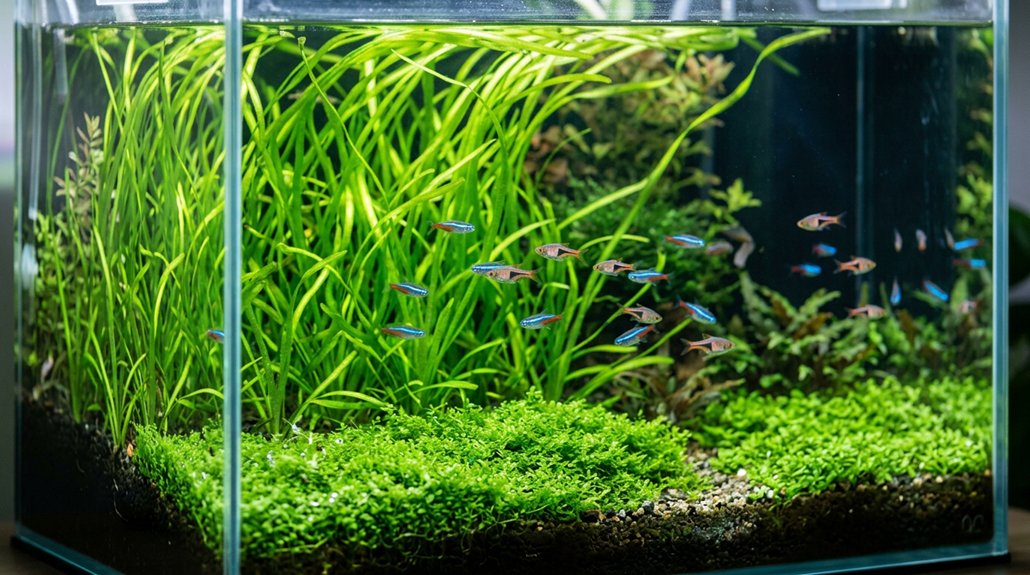
For freshwater aquariums, you’ll want an LED that matches tank size, plant demand, and depth. In nanos under 15 gallons, a 6,500–7,000K clip-on light works well for Anubias, Java fern, and moss. For 20–50 gallon planted tanks, choose adjustable bars with dimming and timers. If you’re running CO2 and carpeting plants, higher-PAR premium fixtures give better spread and control, and the details get more specific from here.
Key Takeaways
- For low-light freshwater tanks, full-spectrum LED clip-on lights work well for nanos under 15 gallons with easy installation.
- Choose 6,500–7,000K lighting for natural color and healthy growth in most planted aquariums.
- Match fixture size and spread to tank footprint and depth to avoid bright centers and shaded edges.
- For 20–50 gallon planted tanks, adjustable LED bars with app control support moderate to high-light plants and CO2 setups.
- Run lights 6–8 hours daily and monitor algae, using multiple fixtures for longer or denser aquascapes.
Aquarium Lighting Buying Guide
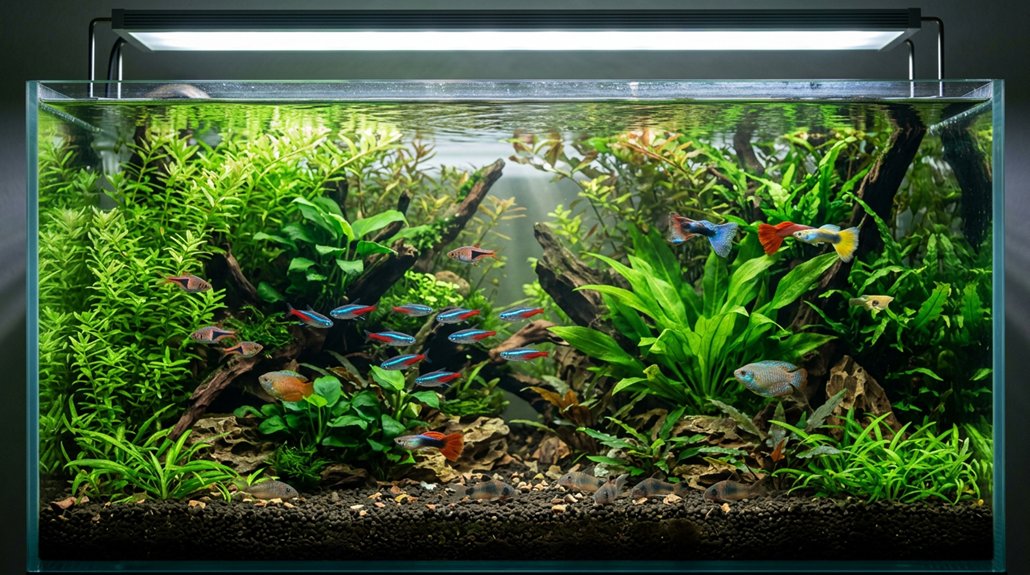
When you’re dialing in aquarium lighting, match the fixture to your tank’s size, depth, and plant needs: beginner freshwater setups, especially nanos under 15 gallons, do well with affordable full-spectrum LEDs like the AquaZen ZenGlow 7.5W ($45) or Lifegard 2.5W clip-on USB ($14.99) for low-light plants such as Anubias and Java Ferns, while 20–50+ gallon planted tanks usually need tunable LED bars or strips like the Chihiros B-Series ($61.99+) or AquaIllumination Blade ($153.99+) to support mid- to high-light species like Rotala and Dwarf Hairgrass. Prioritize spectral tuning near 6,500–7,000K, check coverage across the aquascape, and favor energy efficiency when comparing wattage. Use multiple units for long or deep tanks, start with moderate intensity, and run a timer for 6–8 hours to stabilize growth and reduce algae.
Best Beginner Aquarium Lights
For most beginner freshwater aquariums, you’ll want a full-spectrum LED fixture sized for a nano tank under 15 gallons, since these lights provide enough output for low- to moderate-light plants like Anubias, Java fern, and moss without needing CO2. Choose 6,500–7,000K output, low heat, and easy setup. Good starter options include AquaZen ZenGlow, Aqua Worx SOL LED, and Lifegard Full Spectrum 2.5 clip-on USB lights.
Beginner nano tanks do best with full-spectrum LEDs for easy, low-light plant growth.
- Set LED timers for 6–8 hours daily
- Use clip on fixtures for pico/nano tanks
- Expect modest PAR, not carpeting-plant power
- Favor energy-efficient, full-spectrum models
- Watch for algae if you overlight
These beginner fixtures keep maintenance simple, but they aren’t ideal for demanding plants or deeper aquariums.
Match Light Intensity to Tank Size and Plants
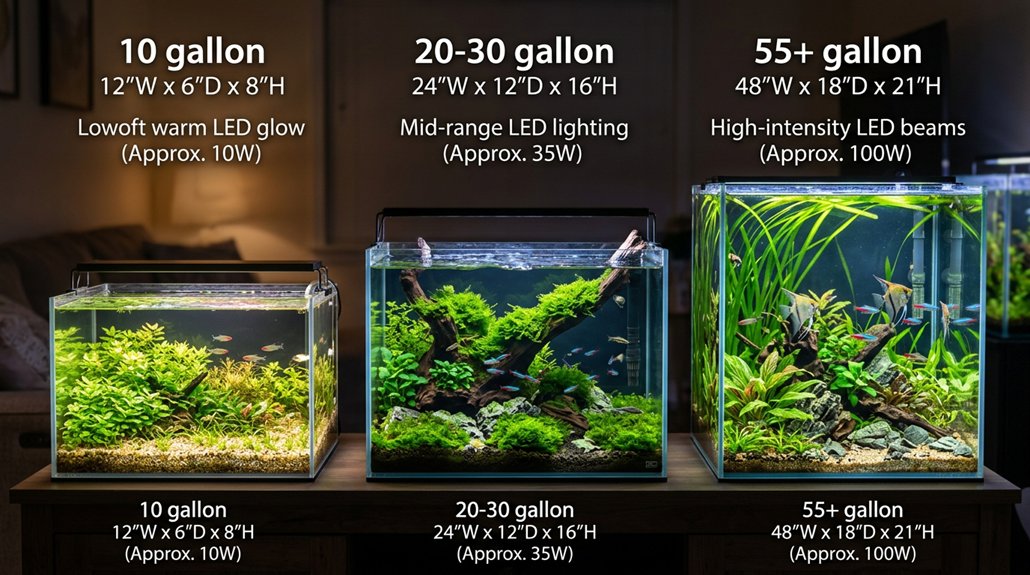
Match light intensity to both tank size and plant demand: in nano aquariums under 15 gallons with low- to moderate-light plants like Anubias, Java fern, and Crypts, a beginner LED in the 7.5–10.5W range is usually enough, while medium tanks around 20–50 gallons with plants such as Ludwigia, Rotala, and Dwarf Hairgrass need stronger intermediate strips or bars with broader spread. You should size fixtures for even coverage across the footprint, since long tanks can develop bright centers and dim edges. Adjust output for plant density, because thicker growth blocks light lower in the scape. Use photoperiod scheduling to match demand: 6–8 hours works for low-light setups, while higher-output systems need tighter timing and ramping to limit algae.
Intermediate Lights for Planted Tanks
Intermediate aquarium lights bridge the gap between basic fixtures and professional systems, giving you the PAR, spread, and spectrum control needed for moderate- to high-light plants like Ludwigia, Rotala, and Monte Carlo.
Intermediate aquarium lights bridge the gap, delivering PAR, spread, and spectrum control for demanding planted tanks.
Use spectrum tuning to favor red growth and tighter internodes without pushing excess algae.
- Chihiros B-Series and AquaIllumination Blade are strong value picks.
- They’re ideal for 20–50 gallon planted tanks.
- App controls let you dim, schedule, and adjust output.
- Full-spectrum, adjustable fixtures help with carpet cultivation.
- Run them 6–8 hours daily, and pair with CO2.
You can scale coverage by adding units on longer tanks. At roughly $62–$280, these lights balance cost and performance, giving you reliable plant growth, cleaner aquascapes, and enough intensity for dense, healthy stems and foregrounds.
Advanced LED Lights for High-Tech Aquariums
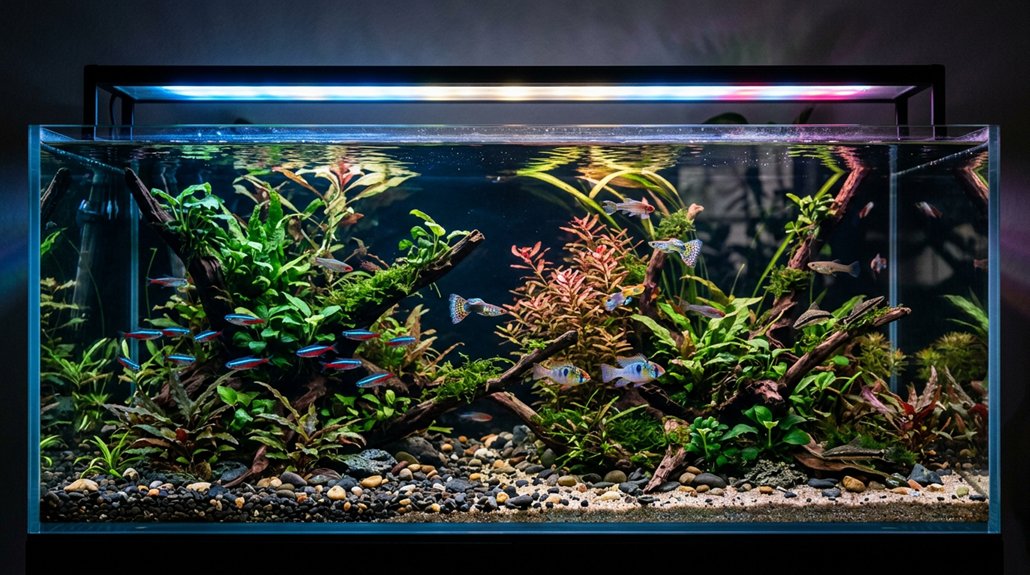
When your planted tank moves beyond moderate-light setups and into CO2-injected, high-demand layouts, advanced LED fixtures like the EcoTech Radion XR15/XR30, AquaIllumination Hydra/Hydra Edge, and Kessil Tuna Sun series give you the PAR, spectrum control, and consistency needed for dense stems, carpets, and demanding foreground plants. You’ll get spectrum tunability through deep blue, red, and white channels, plus programmable schedules and app control to fine-tune PPFD and sunrise/sunset shifts. Use PAR mapping to place multiple units or daisy-chain them on longer tanks, keeping substrate light even for Monte Carlo and Dwarf Hairgrass. Kessil’s dense-matrix LEDs add compact form and natural shimmer, while premium models cost more upfront yet deliver longevity, precise output, and stronger growth confidence for demanding aquascapes.
Frequently Asked Questions
What Is the Best Lighting for Freshwater Aquariums?
You’ll usually get the best freshwater aquarium lighting from a 6,500K–7,000K full-spectrum LED, since it supports plant growth and viewing aesthetics. Choose intensity by tank size, and run it 6–8 hours daily on a timer.
Do Fish Prefer Red or Blue Light?
You’ll usually find fish prefer blue over red light; in a planted 20-gallon tank, blue improves visibility and fish behavior. Red’s less natural, and at low light intensity, it’s mainly used for accenting colors.
Are LED or Fluorescent Lights Better for Aquariums?
LEDs’re generally better for you: they’re energy-efficient, run cooler, last longer, and offer tunable spectrum and intensity. Fluorescent drawbacks include more heat, shorter bulb life, and higher maintenance, though they can be cheaper upfront.
What Color Aquarium Light Is Best to Prevent Algae?
You’ll do best with balanced daylight white, around 6,500–7,000K; think of it as a steady metronome for plants. Use low intensity bulbs and spectral balance, because blue-heavy or red-heavy light can drive algae.
Conclusion
Choosing the right aquarium light helps you shape a healthy underwater world. You’ll see gentle ripples of brightness across the glass, while your plants unfurl under the correct intensity and spectrum. Start with a simple light for a basic tank, then step up as your aquascape demands more control. When you match light to tank size, plants, and skill level, you’ll give your freshwater aquarium the clear, balanced glow it needs to thrive.