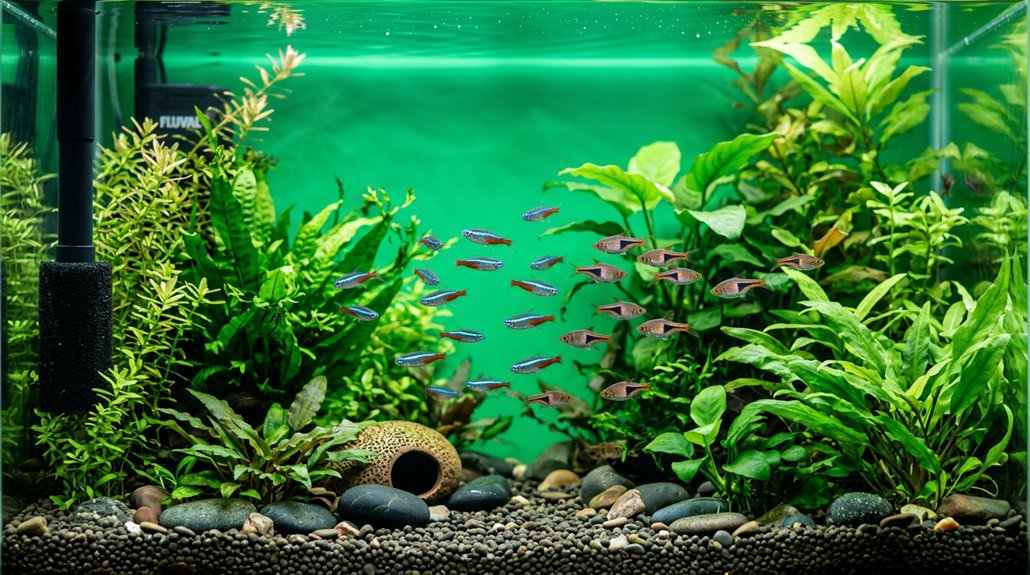
You fix green water by lowering nutrients and removing suspended algae fast. Do a 30–50% water change, vacuum the substrate, and rinse or replace filter floss in removed tank water. Cut direct sunlight and reduce the photoperiod to 6–8 hours, or use a 2–3 day blackout for severe blooms. Feed less, test nitrate and phosphate, and add fast-growing plants or a UV sterilizer if needed. With the right steps, the cause is easier to pin down next.
Key Takeaways
- Do large partial water changes and deep gravel vacuuming to remove suspended algae and excess waste.
- Cut lighting to 6–8 hours, block direct sunlight, or use a 2–3 day blackout for severe blooms.
- Feed less and reduce nutrients by testing nitrate/phosphate, cleaning decaying matter, and adjusting stocking or fertilizers.
- Improve filtration with fine floss or a diatom filter, and rinse or replace mechanical media regularly.
- Add fast-growing plants or a UV sterilizer to outcompete and kill free-floating algae long term.
What Causes Green Water in a Fish Tank?
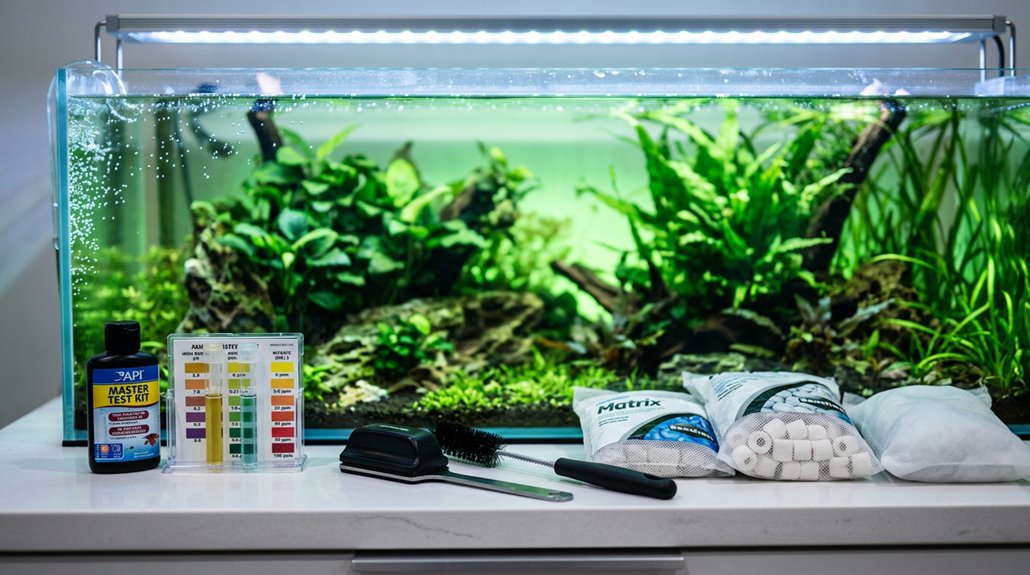
Green water in a fish tank happens when microscopic free-floating algae, called phytoplankton, multiply rapidly in nutrient-rich, well-lit water and turn it a pea-soup green. You’re seeing a bloom of algae species that exploit excess nitrate, phosphate, and dissolved organics from fish waste, overfeeding, decaying plants, or tap water with high nitrate. Strong light, direct sunlight, or photoperiods that run too long speed the bloom. If your biological filter’s immature or overloaded, nutrient cycling can’t keep pace, so suspended algae outcompete bacteria and plants. A disturbance such as filter failure, added stock, seasonal water shifts, or a cycling tank can trigger it suddenly. The result is cloudy green water, not a disease, but a sign that light and nutrients are out of balance.
Do a Big Water Change First
A large partial water change is the fastest first step when your tank turns green, because it immediately lowers the suspended algae, dissolved nutrients, and settled waste driving the bloom. Use a gravel siphon and replace 30–75% of the water with temperature-matched, dechlorinated water, adding it slowly. If you keep tetras or similar small tropicals, stay within 1–2°C of tank temperature. For severe blooms, do two 40–50% changes over 24–48 hours, with water testing between changes.
| Action | Purpose |
|---|---|
| Siphon water | Remove algae and waste |
| Match temperature | Reduce stress |
| Dechlorinate | Protect gills |
| Test water | Track stability |
| Avoid algae scrubbing | Focus on dilution first |
Vacuum the substrate while refilling, then continue regular maintenance and reassess feeding, lighting, and filtration.
Clean the Substrate and Filter
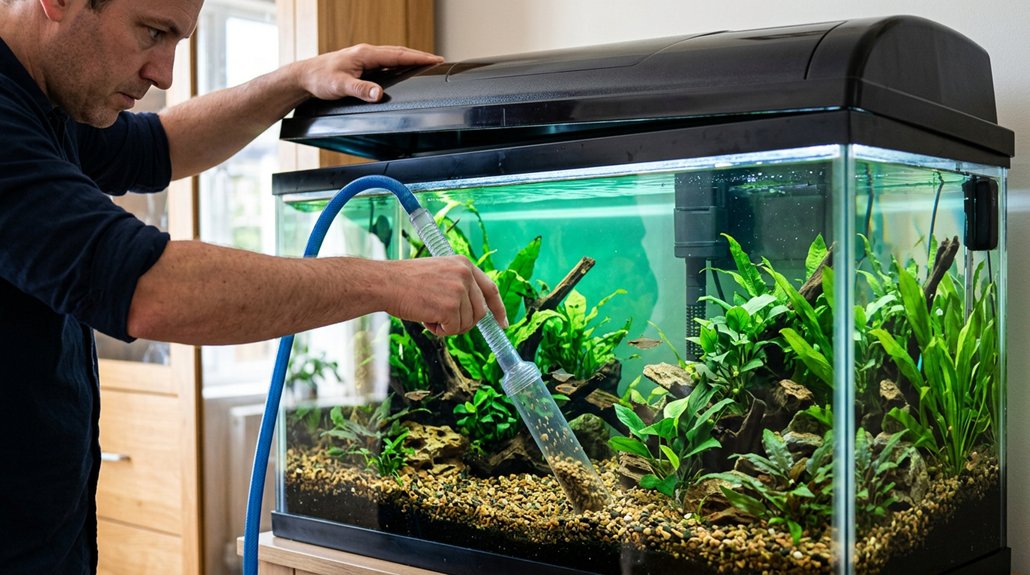
During the water change, vacuum the substrate deeply with a gravel siphon to pull out settled waste, trapped detritus, and other organic debris that feed the bloom. Push the nozzle into the sand or gravel bed when you can, so you flush out material at the substrate interface. Do this weekly during treatment, but leave part of the bed untouched so you don’t strip away all beneficial bacteria. For gravel maintenance, focus on removing what’s packed below the surface, not sterilizing the tank. On the filter side, clean or replace floss and polyfil every 3–7 days, rinsing them in removed tank water. Include filter inspection: check impellers, hoses, and media baskets, then add fine sponge or extra floss to improve mechanical capture of suspended algae.
Cut Back Light and Sun Exposure
You should block direct sunlight from the tank and keep it away from windows, since even brief sun exposure can trigger rapid algae growth. Set the photoperiod with a timer so you’re limiting light to about 6–8 hours per day, or 8–10 hours if you have a planted tank. If the fixture is still too strong, lower the intensity or switch to a weaker bulb to reduce light-driven green water.
Block Direct Sunlight
Direct sunlight and excess photo-exposure can fuel green-water outbreaks, so move the aquarium away from windows or block incoming light with blackout curtains, blinds, or UV-blocking window film. If relocation isn’t possible, add window tinting and light baffles to cut beam penetration. Even indirect sun can elevate intensity enough to trigger blooms, so you’ve got to reduce total daily light, not just direct rays. A detachable opaque cover or reflective hood helps during midday.
| Control | Effect |
|---|---|
| Blackout curtains | Stops direct sun |
| Blinds | Modulates glare |
| UV film | Filters window light |
| Window tinting | Lowers intensity |
| Light baffles | Blocks side spill |
For acute outbreaks, use a brief blackout to starve suspended algae of light and hasten clearing.
Reduce Photoperiod Hours
After blocking windows and taming incoming sun, the next lever is total light time: keep aquarium lighting to 6–8 hours per day in planted tanks, and 6 hours or less in unplanted tanks, ideally on an automatic timer so the schedule doesn’t drift. If you’re shortening an existing schedule, use gradual dimming by cutting 30–60 minutes every few days; this supports plant acclimation and reduces stress on fish and invertebrates. Don’t compensate with brighter output or extra midday light. In severe green-water cases, a 2–3 day blackout can suppress suspended algae, but keep feeding lights brief only. Track clarity over the next week; if the water stays green, your issue likely involves excess nutrients or filtration limits, not photoperiod alone.
Use A Timer
A reliable timer is one of the quickest ways to cut off the light that fuels green water, because consistent on/off cycles keep algae growth in check and prevent plants from being confused by irregular photoperiods. Set your aquarium lights with a digital timer or smart plug so you’re not guessing each day. Use:
- 8–10 hours for planted tanks
- 4–6 hours for non-planted tanks
- 2–4 hours, or a 48–72 hour blackout, when blooms’re active
Keep the tank away from windows, and use blackout curtains if sunlight hits it. Once the water clears, add 30–60 minutes every few days, but only to the minimum your plants need. Consistency matters: erratic light favors suspended algae and slows recovery.
Remove Nitrate and Phosphate Sources
Trim the fuel feeding green water by monitoring nitrate and phosphate weekly with a reliable test kit, aiming for nitrate below 20 ppm and phosphate below 0.5 ppm. Keep your test frequency consistent so you can spot rising nutrients before algae does. Reduce phosphate sources by avoiding phosphate-rich tap water additives, certain fertilizers, and decaying plant matter. Feed only what your fish finish in about 2 minutes, then remove leftovers immediately. If nitrate stays elevated, cut feeding frequency and increase partial water changes with dechlorinated or RO/DI water: 10% weekly or 25% bi-weekly, more if the bloom is severe. Rinse new filter media and replace activated carbon or phosphate-removal media every 4–6 weeks so they keep binding nutrients effectively.
Add Live Plants and Better Filtration
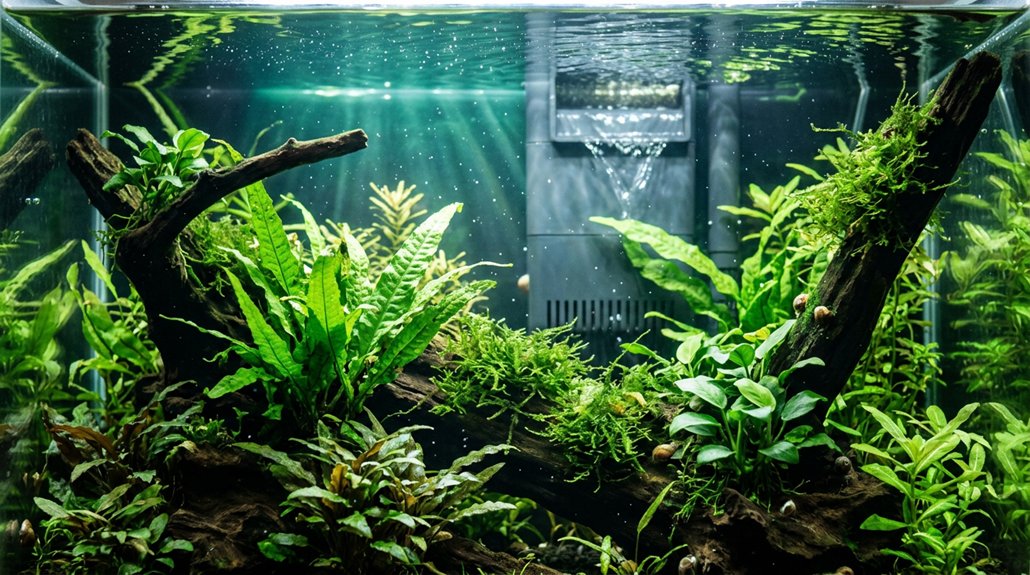
Adding fast-growing live plants and upgrading filtration gives you two strong defenses against green water: plants such as hornwort, water sprite, Hygrophila, duckweed, or frogbit absorb excess nitrate and phosphate while also shading the tank, and improved filtration physically removes suspended algae before it can spread.
- Use dense stems for plant nutrient management; they’ll outcompete phytoplankton fast.
- Add floating cover to cut light 30–70%, reducing photosynthesis pressure.
- Pack your filter with fine floss or a polishing pad, and keep turnover at 4–6× tank volume per hour.
If you run an aquarium refugium, let it grow aggressively, then trim often. Maintain beneficial media, dose nitrifying bacteria as directed, and keep 10–25% weekly water changes. Replace or rinse mechanical media every 2–7 days.
Use a UV Sterilizer or Diatom Filter
Install a UV sterilizer to target the free-floating algae driving green water: as tank water passes through a UV-C chamber, the cells are inactivated and clarity often improves within 2–7 days when the unit is sized and plumbed correctly. For a 20–40 gallon tank, use an 8–12 watt in-line or submersible unit; bigger aquariums or heavy blooms may need 24W+ and faster turnover. Plumb it on the return line or in a sump so flow matches the manufacturer’s 1–2× hourly chamber turnover. If you need faster polishing, a diatom filter can trap microscopic algae immediately, but it needs frequent backwashing or media changes. Keep up UV maintenance, and don’t expect algae resistance from the device itself; it clears blooms, but it doesn’t remove the nutrient load behind them.
Stop Green Water From Coming Back
To keep green water from returning, you’ve got to remove the conditions that let algae explode in the first place: limit lighting to the proper photoperiod, block direct sunlight, and avoid leaving planted tanks lit longer than 8–12 hours or unplanted tanks longer than 6 hours. Then tighten control of nutrients and flow.
- Feed only what your fish finish in about 2 minutes, keep stocking close to 1 inch per net gallon, and change 10% weekly or 25% biweekly.
- Test tap and tank water for nitrate and phosphate; use RO/DI if levels stay high, and don’t overdo fertilizers.
- Build biological filtration with nutrient exporting plants, algae resistant stocking, beneficial bacteria, plus filter floss or UV.
Stay consistent after cleanup.
Frequently Asked Questions
Is Green Water Bad for Fish Tanks?
Usually, no, but you can’t ignore it. Green water signals algae blooms that reduce visibility, raise nighttime oxygen demand, and can cause fish stress. You should fix the nutrient imbalance before it worsens.
Will Green Algae Go Away on Its Own?
Yes, it can, but only if you cut nutrient sources and limit light; then the algae lifecycle may collapse naturally. In heavily loaded tanks, though, you’ll likely need intervention, or the bloom won’t clear.
Why Is My Fish Tank Water Turning Green so Quickly?
You’re seeing a rapid algae bloom: suspended phytoplankton can multiply in just 24–72 hours when light exposure is high and nutrients spike. Excess feeding, waste, weak filtration, or sunlight can trigger it fast.
What Kills Green Algae in Water Naturally?
You can kill green algae naturally with barley straw, which releases compounds that suppress growth, and UV sterilization, which destroys free-floating cells. You’ll also get better results by reducing light, nutrients, and excess feeding.
Conclusion
To stop green water from clouding your tank, you’ve got to tackle the trigger, trim the nutrients, and tighten your tank routine. Do the big water change, clean the substrate and filter, and cut back on light and sun exposure. Then lower nitrate and phosphate sources, add live plants, and upgrade filtration if needed. If algae still lingers, use a UV sterilizer or diatom filter. Stay consistent, and you’ll keep clear water long term.