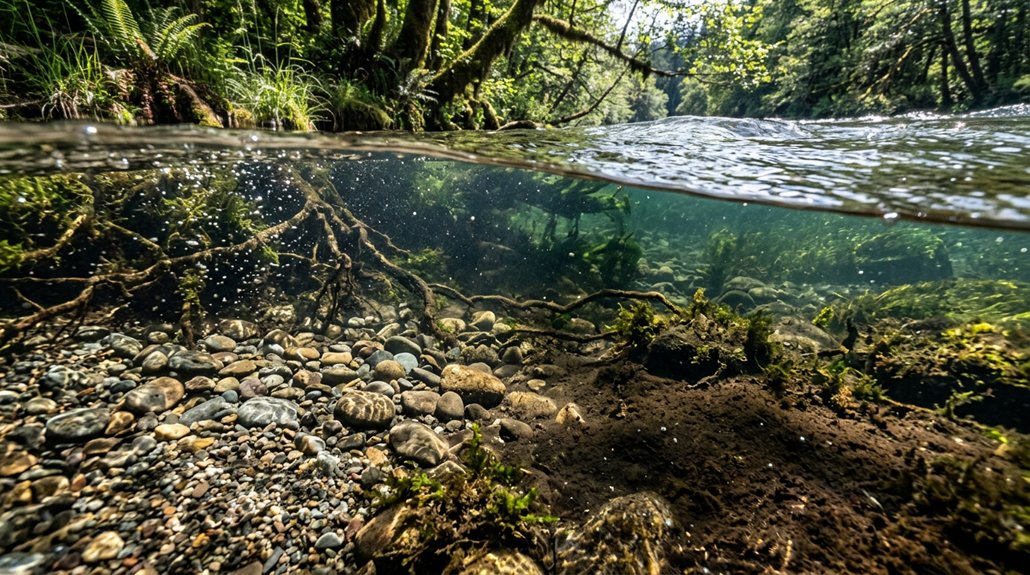
Substrate can change your tank water quality by altering pH, alkalinity, hardness, ammonia, nitrate, and microbial activity within weeks. If you use carbonate-rich gravel, shell, dolomite, or limestone, you may see calcium and magnesium rise as buffering increases and pH falls more slowly. Porous media also boosts biofilms and nitrifying bacteria, which can lower unionised ammonia and shift nitrate. Gravel usually traps more debris than sand, so your maintenance needs can change too, especially over time.
Key Takeaways
- Substrate can lower pH or buffer it by dissolving carbonates, which release calcium, magnesium, and bicarbonate into the water.
- Gravel and porous media boost biofilms and nitrifying bacteria, improving ammonia conversion and overall biological filtration.
- Substrate type affects nitrate handling because anoxic pockets can promote denitrification, while porous surfaces increase microbial processing.
- Mineral substrates change hardness over time by slowly leaching calcium and magnesium, affecting long-term water chemistry.
- Depth, particle size, and maintenance matter because deep or compacted substrate can trap debris, create anaerobic zones, and reduce water quality.
What Substrate Does to Tank Water Quality
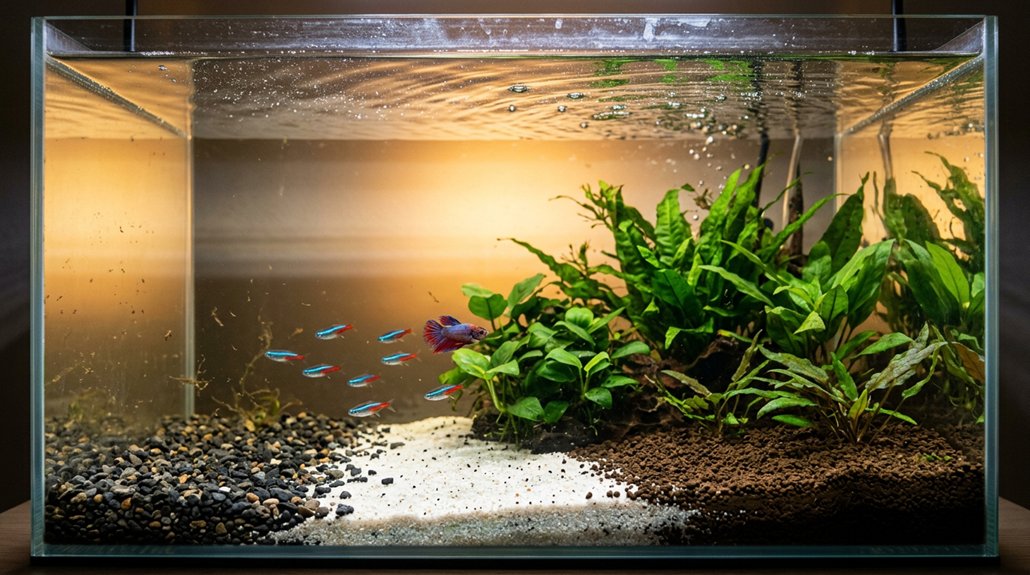
Substrate can measurably change tank water quality over time, rather than simply providing a physical base. You can see pH shift over weeks, with gravel treatments in a 7-week study producing lower pH than bare tanks, and seasonal conditions further altering that trend. Mineral substrates can also release or buffer ions, so calcium and magnesium concentrations often differ by substrate type across weeks. In your tank, substrate leaching may contribute to these changes, alongside microbial colonization on biofilms that affects chemistry. Tanks with substrates have shown time-dependent differences in unionised ammonia and nitrate versus unenriched tanks, with effects varying by week and season. You should expect summer and winter to modify both the magnitude and direction of these responses, and substrate-enriched tanks may also show increased Pseudomonas spp. detection.
Gravel vs Sand: What Changes in the Tank
Gravel and sand don’t just change the look of a tank—they can shift its water chemistry and microbiology in measurable ways. In your aquarium, substrate choice alters pH, calcium, magnesium, unionised ammonia, and nitrate across weekly sampling. Gravel tanks showed lower pH than bare or sand setups in the 7-week trial, and the effect varied by season. You’ll also see treatment-linked differences in Ca and Mg, with summer and winter responses not matching. Microbial data matter too: Pseudomonas spp. were recovered at different rates depending on enrichment and season. Beyond water metrics, particle size changes the aesthetic impact and the maintenance effort you face. Gravel depth can increase debris trapping, while sand’s finer texture may reduce circulation within the bed.
Why pH and Alkalinity Shift Over Time
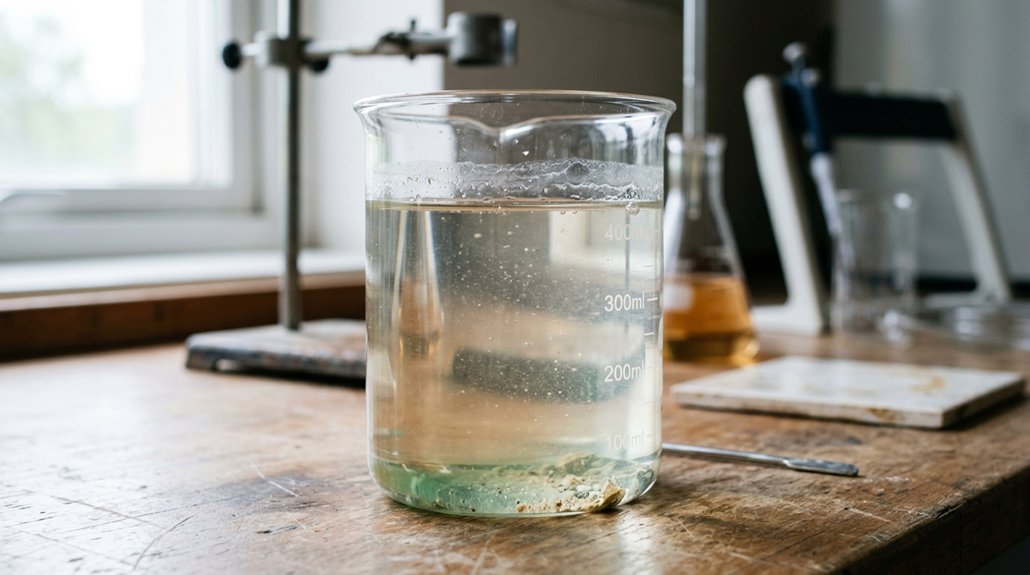
Those substrate-driven differences in water chemistry don’t stay fixed; over time, pH and alkalinity shift as the tank’s mineral and biological processes keep working on the water. You’ll see carbonate dissolution from shell gravel, dolomite, or limestone add Ca2+ and Mg2+, increasing bicarbonate and buffering pH. Meanwhile, acidification processes such as organic matter decay and sulfide oxidation consume alkalinity and release H+, lowering pH. Seasonal temperature changes can intensify CO2 production and other acid loads, so summer tanks often drift faster than winter ones.
- Higher carbonate content usually raises TA.
- Lower TA means faster pH decline.
- Small Ca and Mg changes often track these shifts.
Net pH depends on balance, so similar tanks can diverge by tens of mg·L–1 as CaCO3.
How Substrate Affects Ammonia and Nitrate
Ammonia dynamics shift with the bottom material because substrate changes how well nitrifying microbes colonize and process waste. In your tank, gravel and other porous media create microbial hotspots with more surface area for biofilms, so ammonia oxidizers and nitrite oxidizers convert NH3/NH4+ more efficiently than bare bottoms. That usually lowers unionised ammonia, though the exact effect depends on ammonia speciation and pH. Across a 7-week study, tanks with sand or gravel showed substrate-linked differences in ammonia and nitrate, and summer produced greater variability than winter, consistent with temperature-sensitive nitrification and decomposition. You may also see nitrate accumulate or decline differently because anoxic microzones in substrate can support denitrification. Substrate chemistry can further shift toxicity by altering pH.
Why Calcium and Magnesium Change
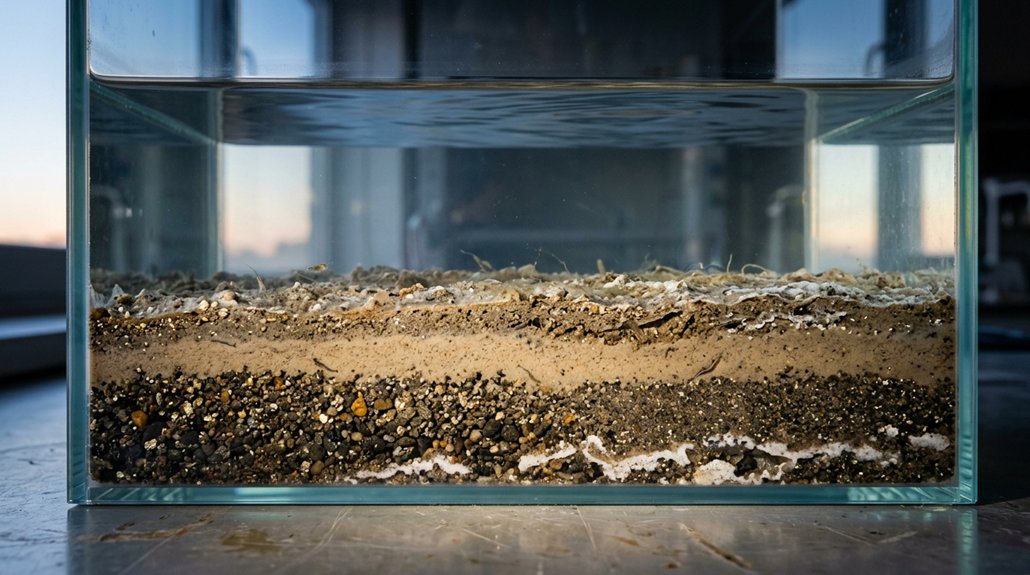
When your substrate contains carbonate minerals—such as shell gravel, limestone, or dolomite—it can dissolve gradually and release Ca2+ and Mg2+ into the water, which raises hardness while also buffering pH by consuming acidity. You’ll see mineral leaching increase when CO2 is lower or pH stays higher, because carbonate solubility changes. Seasonal and temperature shifts can also alter dissolution and biological uptake, so concentrations may vary over weeks.
- Carbonate-rich media elevate ppm Ca and Mg.
- Lower acidity slows buffering, but acidity accelerates release.
- Substrate choice, amount, and replacement directly affect trends.
Organic loading and temperature matter too, since they influence dissolution rates and ion demand. In managed tanks, you can expect measurable hardness changes as substrate chemistry and biological uptake interact over time.
How Substrate Builds Beneficial Biofilms
Substrate surfaces create the physical platform for beneficial biofilms: sand, gravel, and shell media offer high surface-area-to-volume ratios that let heterotrophic and autotrophic microbes colonize efficiently, and mature aquarium biofilms can exceed 100 mg dry weight per cm². You’re supporting microbial succession as pioneer cells attach, secrete extracellular polymers, and stabilize communities. Surface chemistry matters too: mineral composition affects adhesion, ion exchange, and local micro-pH at the substrate-water interface. Once established, these biofilms recruit nitrifiers such as Nitrosomonas and Nitrobacter/Nitrospira, converting ammonia to nitrate. They also compete for dissolved organic carbon, while protozoa and bacteriophages help suppress pathogens. In calcium- and magnesium-rich media, calcifying biofilms may further enhance carbonate buffering and shape water chemistry in closed systems.
Why Season Changes Water Quality
Seasonal shifts can change water quality quickly because temperature, rainfall, and organic inputs all affect chemistry and biology at once. You’ll see seasonal stratification in warm periods, when surface warming lowers mixing, raises microbial rates, and can reduce dissolved oxygen while increasing ammonia and pH variability. During cooling, thermal turnover redistributes oxygen, nutrients, and suspended material through the water column.
- Hot, dry weather concentrates salts and nutrients through evaporation.
- Wet seasons dilute ions but add runoff, leaf litter, and debris, increasing biochemical oxygen demand.
- Temperature-driven geochemical shifts alter carbonate dissolution, changing calcium and magnesium levels.
These processes also change microbial communities and plant-algal growth, so your water chemistry won’t stay stable across seasons, even in the same substrate.
What the Ornamental Fish Study Found
In the ornamental fish study, substrate didn’t just sit there passively; it shifted several water-quality variables over the 7-week trial. You can see that gravel and sand both lowered pH relative to no substrate, with clear summer–winter differences. Unionised ammonia also changed by week and season, so the pattern wasn’t stable across treatments. Nitrate accumulation differed markedly with substrate type and season, showing that substrate chemistry affected nitrogen dynamics over time. Calcium and magnesium likewise varied by treatment and season, indicating measurable ion exchange in tanks with substrate. Even Pseudomonas spp. tracked enrichment and season, supporting microbial succession on or within the substrate. Taken together, the study shows that substrate alters chemistry, nutrients, and bacterial presence in ways you can quantify.
How to Choose the Right Substrate
To choose the right substrate, start by matching grain size and chemistry to the species and system you’re keeping: fine sand (<0.5 mm) works best for bottom-sifting and burrowing fish, while 2–8 mm gravel is usually better for planted tanks and larger-bodied fish because it reduces the risk of impaction and gill abrasion. For stable water chemistry, choose inert silica sand or washed quartz; use calcareous media only if you need higher pH and hardness. Consider this: 1. porous substrates boost nitrifying bacteria, 2. 2–5 cm depth supports roots and biofilm, 3. excess depth can create anaerobic zones. You should pre-rinse and test substrate before stocking, since pH and Ca/Mg can shift over weeks. This also affects substrate aesthetics and your maintenance routines.
Frequently Asked Questions
What Are the 4 Ways Water Quality Is Affected?
You see four main effects: chemical shifts, physical turbidity from particle resuspension, biological oxygen loss, and toxicant mobilization. Nutrient diffusion can change pH, conductivity, and dissolved oxygen, while suspended sediments reduce clarity and habitat quality.
What Is Substrate in Water?
You’re asking about substrate in water: it’s the bottom material—sand, gravel, rock, or sediment—that supports aquarium chemistry and microbial colonization. Its grain size, porosity, and composition affect ion exchange, oxygen penetration, and waste retention.
What Is the Effect of Substrate on Water Quality in Ornamental Fish Tanks?
Time-traveling to your tank, substrate can lower pH, raise calcium and magnesium, and shift ammonia and nitrate through nutrient cycling and beneficial bacteria. You’ll see seasonal variation, with gravel, sand, or bare-bottom each changing water chemistry.
How Does Dirt Affect Water Quality?
Dirt lowers water quality by increasing turbidity, reducing light, and clogging gills. It also promotes sediment resuspension and nutrient adsorption, releases contaminants, depletes oxygen during decay, and can trigger algal blooms and hypoxia.
Conclusion
You can see how substrate directly shapes your tank’s chemistry over time. In one ornamental fish study, gravel systems raised pH by 0.4 units and alkalinity by 18% more than sand systems, while also reducing ammonia spikes. That matters because substrate isn’t just decorative; it drives buffering, nutrient cycling, and biofilm growth. If you’re choosing between gravel and sand, you’re really choosing a water-quality control system, not just a bottom layer.