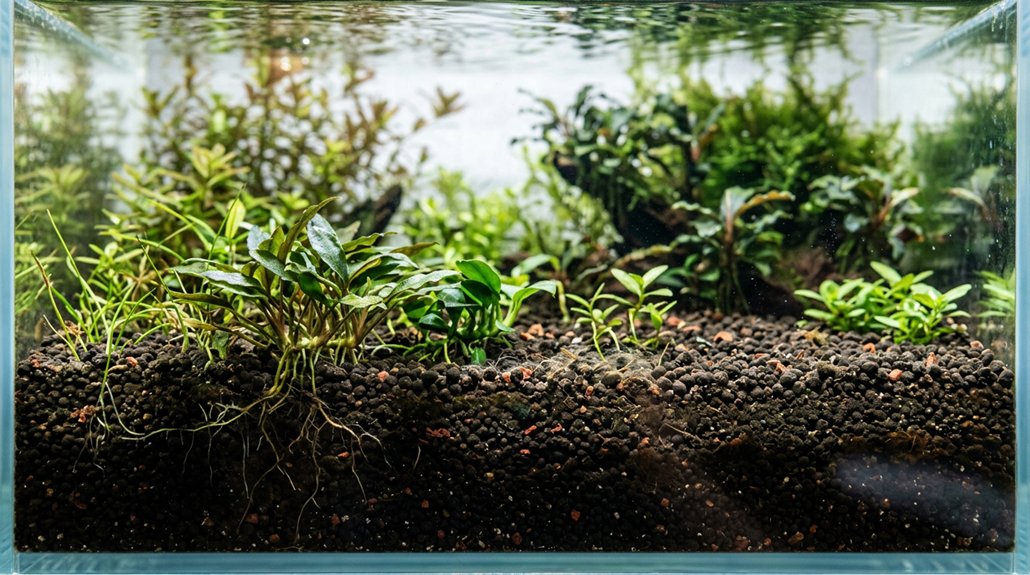
For most planted aquariums, you should choose aquasoil because its high cation exchange capacity buffers iron, potassium, calcium, and magnesium at the roots, supports a healthy root microbiome, and feeds heavy root plants like swords, crypts, and vallisneria better than inert sand or gravel. You can still use sand or gravel with root tabs and liquid fertilizer, but aquasoil gives you stronger, steadier growth and a cleaner planted layout that keeps improving as your tank matures.
Key Takeaways
- Aquasoil is often best for planted tanks because its high cation exchange capacity stores and releases root nutrients effectively.
- Use aquasoil for heavy root feeders like swords, crypts, and vallisneria, which grow stronger in nutrient-rich substrates.
- Inert sand or gravel can work well if you add root tabs and liquid fertilizer regularly.
- Build the substrate 2–3 inches deep in back, tapering forward to prevent compaction and anoxic pockets.
- Choose natural-colored, coarser sand for foregrounds; avoid fine bright white sand that traps detritus and compacts easily.
Why Aquasoil Is the Best Planted Tank Substrate
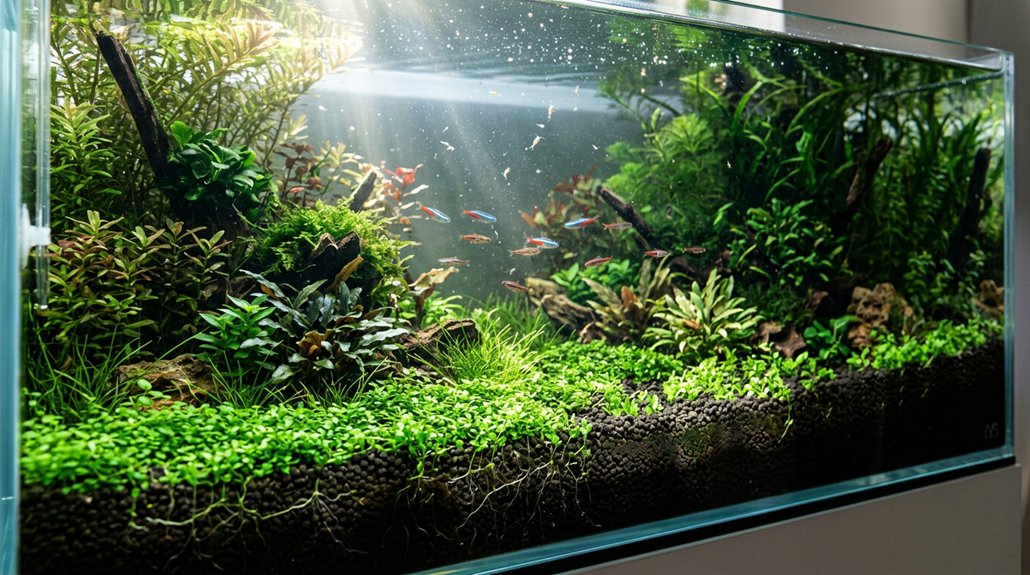
Aquasoil is the best planted tank substrate because it offers far higher cation exchange capacity than gravel, sand, or most inert substrates, so it can store and release root-available nutrients far more effectively. You get strong nutrient buffering, which keeps iron, potassium, and other cations accessible at the root zone instead of washing away. Its fine grain size and porous, hardened-clay structure improve nutrient retention without collapsing into sludge. Because many aquasoils start with nutrient-rich granules, you’re providing a planted bed that’s biologically active from day one. A 2–3 inch layer gives roots enough volume to exploit that reserve, while weekly water changes help manage any initial ammonia from richer blends. Pair it with liquid fertilization, and you’ll maintain stable, high-performance growth.
How Aquasoil Supports Rooted Plant Growth
What makes this substrate especially effective for rooted plants is how it stores and exchanges nutrients right at the root zone. You’re using a medium with high CEC, so aquasoil buffers nutrients by binding K+, Ca2+, and Mg2+ and releasing them as roots absorb them. That nutrient buffering supports steady uptake instead of losses after water changes. A 2–3 inch layer gives roots enough volume to anchor and expand, and the porous structure encourages a healthier root microbiome. Many aquasoils also release nutrients slowly, so they keep feeding roots while you dose liquid fertilizers above. For layout, keep it a few inches from the front glass and slope it deeper in back to preserve circulation, reduce anoxic pockets, and maintain long-term root performance.
Which Plants Need Aquasoil Most?
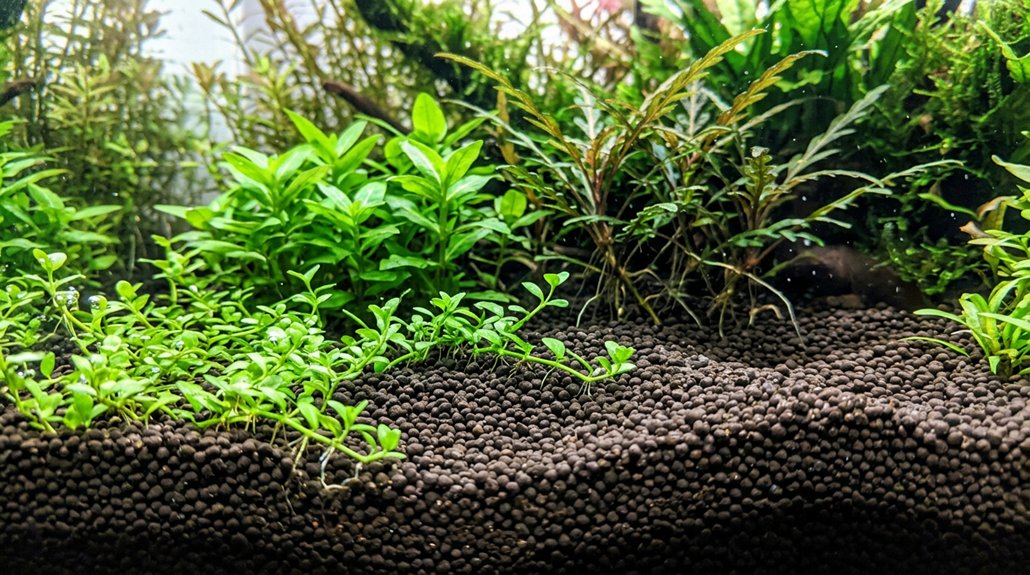
If you’re growing heavy root feeders like Echinodorus, Cryptocoryne, Vallisneria, or large stem plants, aquasoil gives their roots access to a much higher cation exchange capacity and a larger reservoir of exchangeable nutrients. You’ll usually see faster, more stable growth and fewer deficiency symptoms in rooted bulbs and rhizome plants that draw minerals from the substrate. By contrast, epiphytes like Anubias, Java Fern, Java Moss, and Bucephalandra don’t rely on substrate nutrition, so they won’t benefit much from aquasoil.
Root Feeders Need More
Heavy root feeders—especially Amazon swords (Echinodorus spp.), Cryptocorynes, Vallisneria, and similar Echinodorus varieties—benefit the most from aquasoil because they draw much of their nutrition directly from the substrate rather than the water column. You’ll get the strongest growth when you give them a deep, nutrient-rich bed with high CEC, since that keeps ions available at the root zone and reduces root competition. Inert sand or gravel can work, but only if you use root tabs and liquid fertilizer consistently. Aquasoils like ADA Amazonia, Fluval Stratum, and Tropica Aquarium Soil usually outperform low-CEC media, though fresh blends may leach ammonia. To limit stress, avoid substrate compaction, choose a 2–3 inch depth, and match the soil’s chemistry to the plants’ rooting demands.
Aquasoil for Heavy Rooting
Aquasoil gives the biggest advantage to plants that feed heavily through their roots, including Cryptocorynes, Vallisneria, Echinodorus swords, Sagittaria, and most aquarium bulbs. You’ll see the strongest response when the substrate is 2–3 inches deep, so roots can anchor and exploit its high CEC for nutrient buffering.
- Crypts and swords need constant root access.
- Vallisneria and Sagittaria spread faster in nutrient-rich layers.
- Bulbs rely on stable, buried reserves.
- Fine grains suit nano tanks; thicker beds or capped dirt suit larger layouts.
Fresh aquasoil can leach ammonia, so you should change water often at first or choose a lower-leaching product. To extend aquasoil longevity, add root tabs every few months and run a balanced liquid fertilizer regimen.
When to Use Sand or Gravel Instead
Sand or gravel can be the better choice when you want an inert, low-maintenance substrate and plan to supply nutrients separately through root tabs and liquid fertilizers rather than relying on aquasoil. Use coarser, natural-colored sand if you want a clean foreground, stable plant spacing, and better biotope authenticity; it’s also easier to pair with plant safe decor. Choose gravel if you need more bacterial surface area and want simpler anchoring for heavy root feeders, since stems hold more securely and periodic root tab dosing works well. In shrimp or cichlid tanks, sand or gravel avoids aquasoil’s stronger nutrient release and possible ammonia leaching. For large tanks, a sand cap over soil can preserve nutrient supply while keeping the surface safe.
How to Layer Substrate for a Clean Look
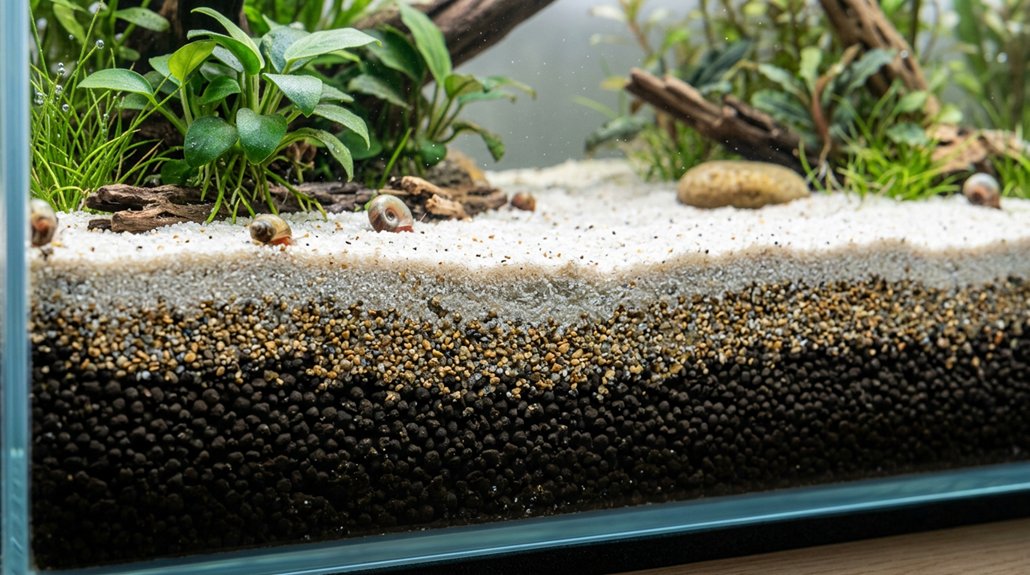
You’ll get a cleaner planted-tank layout by building aquasoil thicker in the back, then tapering it to a thin foreground so you maintain root depth without creating front-glass pockets. Stop the nutrient-rich layer short of the glass and cap the front with a narrow band of natural-colored sand or fine gravel for a bright, defined foreground. Keep the gradation gradual and blended, since a gentle slope and soft seam look more natural and help keep substrate from shifting.
Front-to-Back Slope
To get both a clean layout and healthier substrate chemistry, slope the bed gently from about 0.5–1 inch at the front to 2–3+ inches toward the rear, with the deepest points closer to the back corners rather than the center. This gives you a stronger depth illusion and better maintenance access at the glass line.
- Keep the front shallow so detritus won’t collect and anaerobic pockets won’t form.
- Build a gradual rise; avoid abrupt steps that look artificial and trap waste.
- Let the rear corners hold the most depth, which improves perspective and root volume.
- Blend shifts with mixed grains so the substrate profile stays tidy and stable.
Sand Foreground Detail
A clean planted-aquarium foreground usually works best when the nutrient-rich aquasoil stops a few inches behind the front glass and the visible front band is capped with just 1/4–1/2 inch of natural-colored sand. You’ll preserve clean edges, circulation, and microfauna dynamics while avoiding a buried aquasoil front. Slope the aquasoil upward behind it.
| Layer | Goal | Benefit |
|---|---|---|
| Sand | Thin cap | Bright foreground |
| Aquasoil | Hidden rear mass | Root nutrition |
| Shift | Tan gravel/lava | Natural break |
| Grain size | Larger, natural | Less compaction |
| Profile | Shallow front | Better light reflectivity effects |
Don’t overbuild the sand; thicker caps look amateurish and can trap detritus. Use occasional root tabs behind the shift, not under the foreground.
Why Natural Sand Works Better Than White Sand
Natural sand usually outperforms bright white sand in planted aquariums because its larger, more natural grain structure keeps pore spaces open, allowing better water flow, oxygenation, and root penetration. You get more stable substrate function with natural grainstones and oxygenated porosity.
- Coarser, naturally rounded particles resist compaction.
- Open pores improve gas exchange around roots.
- Less anoxic buildup means lower cyanobacteria pressure.
- Neutral coloration conceals detritus and plant debris.
White sand’s fine grains clump, restrict anchoring, and can trap anaerobic pockets that generate hydrogen sulfide. Natural-colored sand also keeps the foreground looking cleaner longer, so you’re not fighting visual defects every week. With the right grain size, you support healthier roots, better microbiology, and a more resilient planted layout without needing excessive depth.
Add Root Tabs and Liquid Fertilizer
Even with a well-chosen substrate, planted tanks still need direct nutrient delivery to keep roots and leaves supplied. You can push root tabs 4–6 inches apart for swords, crypts, and lilies, then replace them every 3–6 months to match root fertilizer timing. These tablets release macronutrients and trace elements slowly, which matters when your sand or gravel has low CEC. Pair them with a thorough liquid fertilizer, dosed weekly or per label, so foliage gets macros and micros while aquasoil adsorbs and stores them. In inert beds, this dual approach prevents deficiencies and sustains growth. When you add microbial inoculant benefits, roots colonize faster and uptake improves. Watch for yellowing lower leaves or stunting, then adjust tab frequency or liquid concentration.
Avoid Common Substrate Mistakes
To keep a planted aquarium healthy and clean-looking, you need to avoid a few common substrate errors. You should shape substrate chemistry and microbial dynamics deliberately, not by accident.
Shape substrate chemistry and microbial dynamics deliberately, not by accident, to keep your planted aquarium healthy and clean-looking.
- Keep aquasoil thin at the front glass; slope it deeper toward the back to limit anoxic pockets and improve depth perception.
- Don’t use fine, bright white sand in the foreground; it compacts, traps detritus, and can favor cyanobacteria. Choose larger-grained, natural-colored sand instead.
- Don’t cap nutrient-rich aquasoil with a thick sand layer at the front; stop it several inches back so roots stay oxygenated.
- Don’t rely on inert sand for heavy root-feeders. Its low CEC can’t compete with aquasoil, so use root tabs or a higher-CEC base.
Frequently Asked Questions
What Substrate Is Safe for Aquarium Plants?
You can safely use nutrient-rich aquasoil or clay granules for rooted plants; aquarium sand also works if you add root tabs. Avoid bare potting soil, and keep substrate 2–3 inches deep for healthy roots.
Which Soil Is Best for a Planted Aquarium?
You’ll want a true aquarium soil, especially ADA Amazonia, Fluval Stratum, or UNS Controsoil: they’ve got high CEC, feed roots, and support growth. If you need aqua soil alternatives, Eco-Complete’s a solid, lower-nutrient option.
What Can I Put in My Fish Tank to Help Plants Grow?
You can add aquasoil, root tabs, liquid fertilizers, and CO2 injection to boost plant growth. If you’re using inert sand or gravel, you’ll need regular nutrient supplementation so your roots and stems don’t starve.
Conclusion
So, if you want your planted tank to look less like a decorative puddle and more like a functioning ecosystem, choose aquasoil. It feeds roots, anchors heavy feeders, and gives your plants a far better start than inert gravel pretending to be useful. Use sand only when aesthetics matter more than growth, and don’t sabotage everything with bad layering or sterile substrate. Add root tabs, dose lightly, and let your plants do what they’re actually built to do.