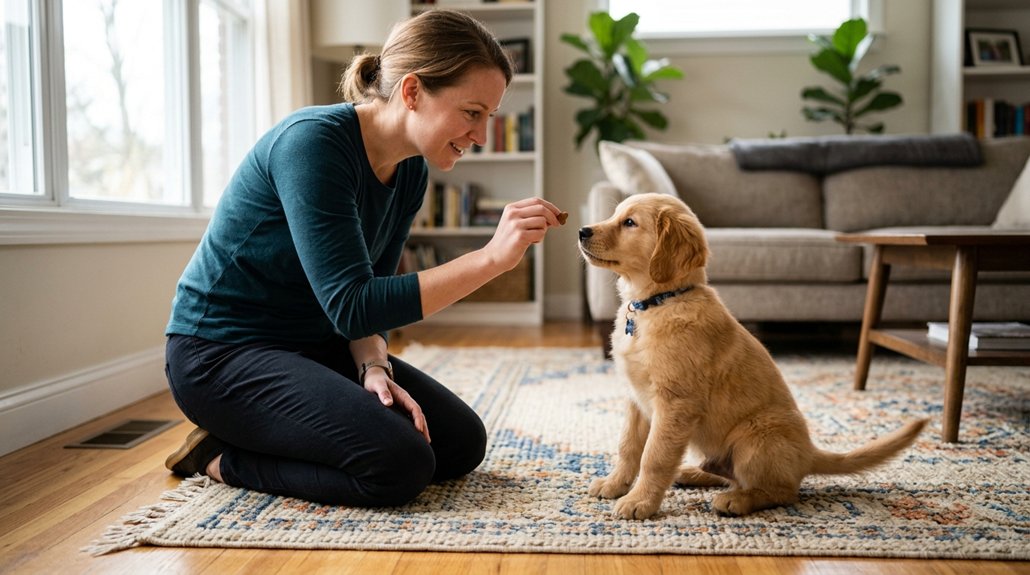
Using positive reinforcement with puppies involves rewarding desired behaviors promptly to boost learning. Start training as soon as you bring your puppy home, using varied rewards like treats, praise, and play. Consistency in commands and reward timing is essential; deliver rewards immediately to reinforce good behavior effectively. Use brief, engaging training sessions and avoid punishing mistakes. Align everyone in your household on the training approach, and explore the benefits of clicker training for clear communication. Discover more strategies to enhance training success.
Key Takeaways
- Deliver rewards immediately after desired behaviors to strengthen associations and learning.
- Use varied rewards like treats, toys, and praise to maintain the puppy’s interest and motivation.
- Consistently use clear commands to establish expectations and avoid confusion.
- Employ clickers or verbal markers for precise communication of rewarded actions.
- Ignore unwanted behaviors to avoid reinforcing them and focus on rewarding desirable actions instead.
Understanding Positive Reinforcement in Puppy Training
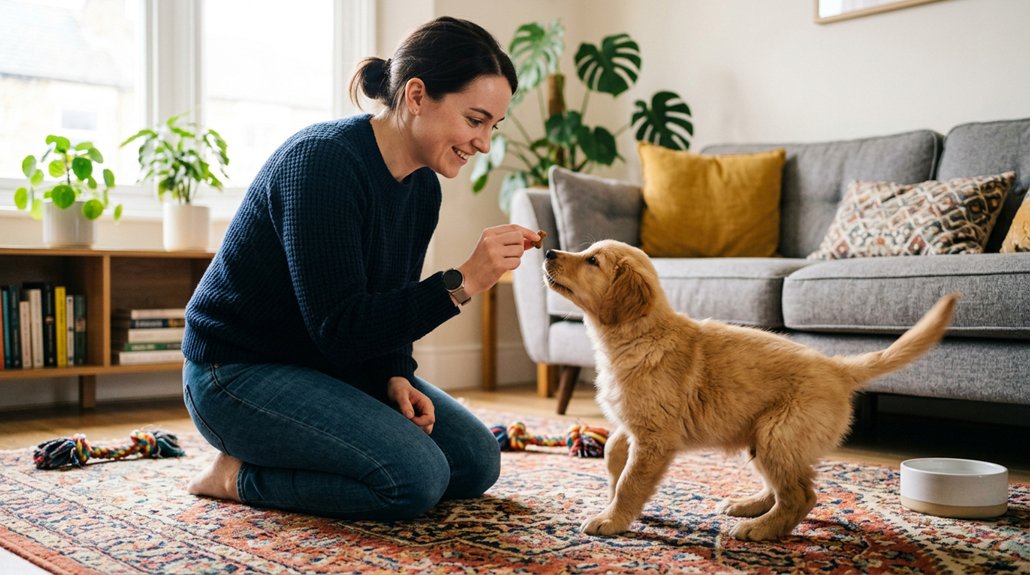
When you’re training a puppy, understanding the core principles of positive reinforcement is vital for effective learning and relationship building. This method focuses on rewarding desired behaviors, ensuring your puppy associates good actions with positive outcomes. Importantly, reward timing is key—delivering treats, praise, or affection immediately, ideally within seconds, reinforces the behavior association. This quick feedback loop allows your puppy to clearly link their action with the reward, boosting their confidence and willingness to learn.
To keep training effective, use varied rewards to maintain your puppy’s interest and prevent dependency on one type. Whether you’re offering toys, snacks, or cuddles, consistency in your approach is essential. Remember, your goal is to shape a well-behaved pup who’s enthusiastic to please.
Initiating Training: Welcoming Your Puppy Into Structured Learning
When welcoming your puppy home, start their training immediately to establish strong, positive habits. Use positive reinforcement techniques, offering rewards for behaviors you want to encourage, which helps your puppy understand what’s expected. Make certain everyone in the household is consistent with commands and rewards to create a clear and effective learning environment.
Begin Training Immediately
Initiate your puppy’s training the moment they step into your home to establish a solid behavioral foundation. Early training fosters puppy bonding through tasks and commands, supporting good habits. Encourage early socialization using positive reinforcement techniques to create a positive learning environment. Consistency is vital: make certain everyone uses the same commands to prevent confusion. Use short, direct commands and promptly reward good behavior with treats or praise.
| Command | Reward |
|---|---|
| Sit | Treat |
| Stay | Praise |
| Come | Playtime |
| Down | Affection |
| Heel | Walk |
Consider enrolling in training or socialization classes within the first few months. These classes broaden your puppy’s experiences while teaching essential commands, enhancing their development and integration into diverse situations.
Establish Ground Rules
To establish a structured learning environment for your puppy, it’s vital to set ground rules from the start, reinforcing them consistently. Begin training as soon as they enter your home to clearly outline puppy expectations. Incorporate crate training to guarantee safety, aid in house training, and provide your puppy with a comfortable environment. Consistently withhold rewards for unwanted behaviors to communicate acceptable conduct. Avoid offering attention that might reinforce negative actions. Enroll your puppy in a training class to introduce basic commands while enhancing their social skills with other dogs. It’s important that all household members adhere to the same training methods. This unified approach will streamline communication, helping your puppy understand and meet the established expectations efficiently.
Utilize Positive Techniques
Having established ground rules for your puppy, you can now focus on utilizing positive techniques to initiate structured learning. Begin training the moment your puppy arrives home. This early start is vital for nurturing good behavior and effective puppy communication. Crate training is a valuable part of this process, offering comfort and safety, while setting the foundation for housetraining and structured routines. Use immediate rewards like treats or praise to reinforce desired actions, helping your puppy create strong behavioral associations. Keep sessions engaging and brief, around 10 minutes, to maintain their focus and enthusiasm. Consistency is essential; guarantee everyone in the household uses the same commands and rewards to maintain a unified training environment, further solidifying your puppy’s learning experience.
Setting Ground Rules for Your Puppy’s Success
To set effective ground rules for your puppy’s success, start by establishing consistent training practices from day one. Make certain you’re implementing positive reinforcement rewards, like treats or praise, to encourage desired behaviors and strengthen your bond. Remember, consistency is key, so practice these techniques regularly to instill lasting good habits.
Establishing Consistent Training Practices
Commence your puppy’s training journey by establishing consistent practices that lay the foundation for success. Begin by introducing habit formation early, once your puppy enters your home, guaranteeing they learn good behaviors from the start. Every household member should use the same training cues, maintaining consistency in their training environments. This collective approach aids effective communication and reinforces desired behaviors.
Incorporate crate training as it offers safety, comfort, and aids in routine development, essential for housetraining success. At the same time, consider enrolling your puppy in a puppy school where foundational commands and socialization are emphasized. This not only reinforces skills learned at home but also guarantees a well-rounded training experience. Consistency in these areas plays a crucial role in your puppy’s development.
Implementing Positive Reinforcement Rewards
Once you’ve established consistent training practices, it’s important to implement positive reinforcement to guide your puppy’s behavior effectively. Begin by immediately rewarding desired behaviors to strengthen associations. Develop a reward hierarchy, ensuring your puppy understands which behaviors earn the best rewards. Mixing in a reward variety, such as treats, toys, and verbal praise, keeps your puppy interested and motivated.
It’s essential that all household members use consistent commands and reinforcements to avoid confusion. Crate training can double as a tool for positive reinforcement, creating a safe space where good behaviors are praised.
Here’s a table to guide your reward strategy:
| Behavior | Reward Type |
|---|---|
| Potty outside | High-value treat |
| Sitting on command | Toy or praise |
| Calm in crate | Verbal praise |
What Motivates Your Puppy? Exploring Reward Types
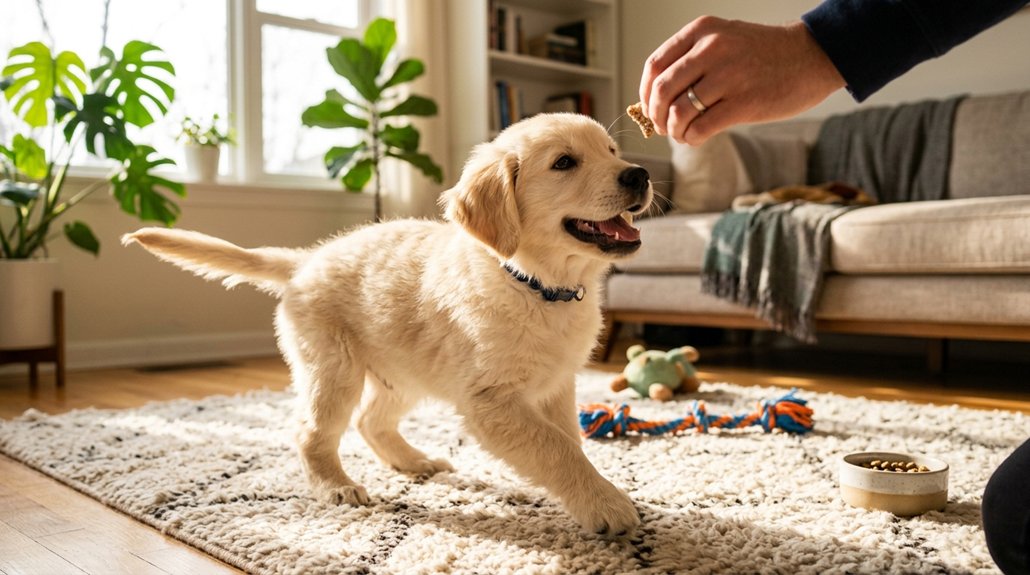
Understanding what motivates your puppy is essential for effective training. By exploring different reward types, you can tailor your approach to maximize engagement. A treat variety enhances motivation; small, soft, high-value treats such as cheese or chicken pieces offer significant incentives, especially in distracting settings. However, non-food rewards hold equal importance. Play motivation taps into your puppy’s natural energy, making toys and playtime effective motivators. Physical affection like petting and verbal praise also encourages positive behavior. To discover what works best, experiment:
- Edible Treats: High-value bits like cheese or chicken.
- Toys: Captivate attention during training.
- Verbal Praise: Reinforce with enthusiastic affirmations.
- Physical Affection: Express love through petting.
- Playtime: Engage through energetic activities.
Identify preferences through trial and error for ideal results.
Reward Timing: Key to Positive Reinforcement
When you’re training your puppy, the timing of rewards is absolutely critical to success. Immediate reward delivery, ideally within seconds of the desired behavior, guarantees reward clarity, solidifying the connection between the action and the reward. Timing consistency is key, as delayed rewards can confuse your puppy, leading to misassociations and hampering effective training. Use markers like clickers or verbal cues to highlight the exact behavior being rewarded. This strengthens learning and fosters a clear understanding for your puppy, enhancing trust and encouraging repeated good behavior. Consistently reward not only the final action but the steps leading to it, reinforcing the learning process and motivating your puppy. Proper timing aligns rewards with correct behaviors, promoting successful positive reinforcement training.
Ensuring Family Members Reinforce Commands Consistently
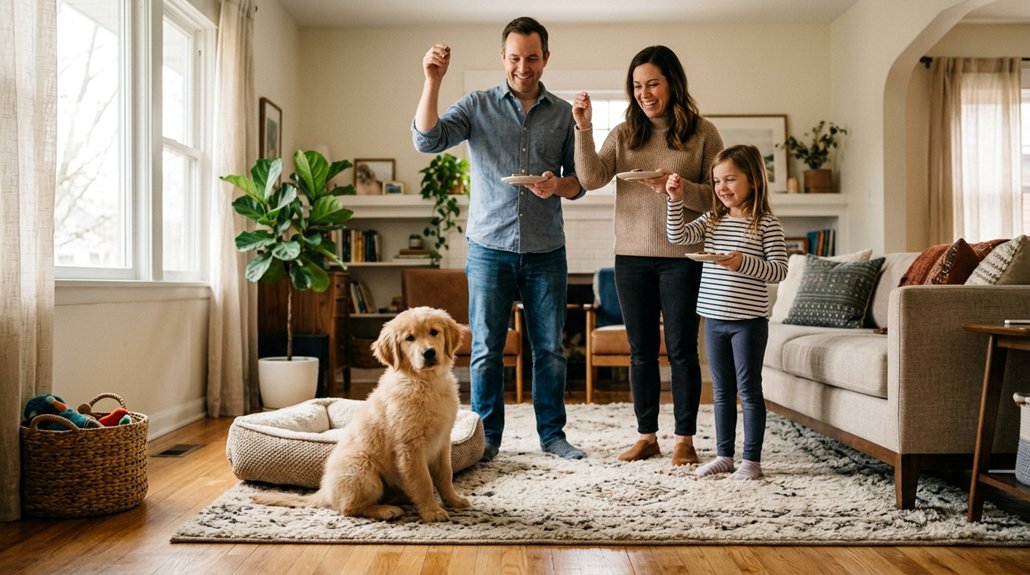
To guarantee seamless learning, all family members must reinforce puppy commands consistently. Family involvement reinforces command clarity, vital for your puppy’s progress. Begin by posting training cues in a visible location so everyone stays aligned with the language used. Consistent verbal cues prevent confusion:
- Establish a shared training agreement among family members to unify efforts.
- Reward desired behaviors immediately, maintaining clarity through precise timing.
- Post training cues visibly for easy reference and to enhance practice uniformity.
- Hold regular communication with family to discuss progress and strategies.
- Conduct joint practice sessions, reinforcing consistency and solidifying commands.
These steps promote a structured approach, guaranteeing everyone participates actively. Your puppy will learn more effectively when each command is consistently reinforced.
Strategies for Addressing Unwanted Behaviors
While consistent reinforcement of commands is essential for smooth learning, dealing with unwanted behaviors requires a different strategy. Begin by ignoring the undesired actions; giving them attention can reinforce what you want to eliminate. Instead, use behavioral redirection by guiding your puppy towards a preferable activity. Once your puppy chooses the desired behavior, reward them immediately with verbal praise or treats. Persistence strategies involve patience—avoiding verbal or physical punishment—and maintaining a structured environment. This guarantees your puppy understands clear expectations, builds confidence, and lessens anxiety about acceptable behavior. Consistently rewarding alternative good behaviors helps diminish those unwanted actions driven by attention-seeking. Create a dependable setting where your puppy feels secure, aiding their learning and growth.
Incorporating Clicker Training to Enhance Learning
Though puppies can be a handful, incorporating clicker training into your routine can greatly enhance their learning process. By using a small handheld device, you can mark the exact moment a desired behavior occurs, allowing for immediate reinforcement. Clicker benefits include providing a clear, consistent cue, helping puppies understand what’s expected, and promoting focus during training sessions. By pairing the sound with a reward, you’re linking behavior to a positive outcome, improving engagement and reducing distractions. This method allows you to shape behaviors by rewarding small steps toward complex goals, fostering patience and consistency.
- Use a clicker for clarity and consistency
- Reinforce good behavior immediately
- Improve puppy focus and attention
- Shape complex behaviors gradually
- Promote patience and consistency
Keeping Training Sessions Short and Engaging
Since puppies have brief attention spans, it’s essential to keep training sessions concise, ideally around 10 minutes, to maintain their focus and prevent boredom. Engage your puppy by varying rewards—such as treats, toys, and praise—to keep their interest piqued. This variety not only makes sessions more enjoyable but also teaches your pup to associate training with positive outcomes. Incorporate playful breaks within these short sessions, blending engaging activities with learning to create a fun experience for your puppy. Consistent practice using the same commands in these brief interactions helps reinforce learning and builds confidence. Always conclude with a positive note, like a successfully performed command or a short playtime, to leave your puppy enthusiastic for more training.
Frequently Asked Questions
What Is an Example of Positive Reinforcement for Puppies?
When your puppy sits on command, give them a treat for recognition. This shapes their behavior. Use enthusiastic verbal praise or a clicker to mark good actions. Incorporate toys as rewards, encouraging positive behaviors through consistent reinforcement.
What Is the 7 7 7 Rule for Puppies?
The 7 7 7 Rule in puppy training techniques suggests exposing your puppy to seven different people, places, and experiences by seven months, aiding behavior modification by building confidence, adaptability, and reducing potential anxiety or aggression.
What Is the 3-3-3 Rule With Puppies?
The 3-3-3 rule guides you through a puppy’s adjustment period, focusing on socialization techniques and training consistency. You’ll foster trust by observing their behavior over three days, three weeks, and three months for maximum growth.
What Is the 10 10 10 Rule for Puppies?
The 10 10 10 rule for puppies is a training essential. Introduce your puppy to 10 people, 10 environments, and 10 experiences. These exposures foster positive behavioral cues, preventing fear and anxiety as they develop.
Conclusion
Incorporating positive reinforcement into your puppy’s training isn’t just about doling out treats—it’s about fostering trust and understanding. You might worry that rewarding every good behavior spoils your pup, but think of it as building a foundation for lifelong learning. Rewarding at the right moment instills good habits, while consistency among family members guarantees a unified approach. Embrace this structured method, and you’ll cultivate a well-mannered companion who thrives on encouragement and love.