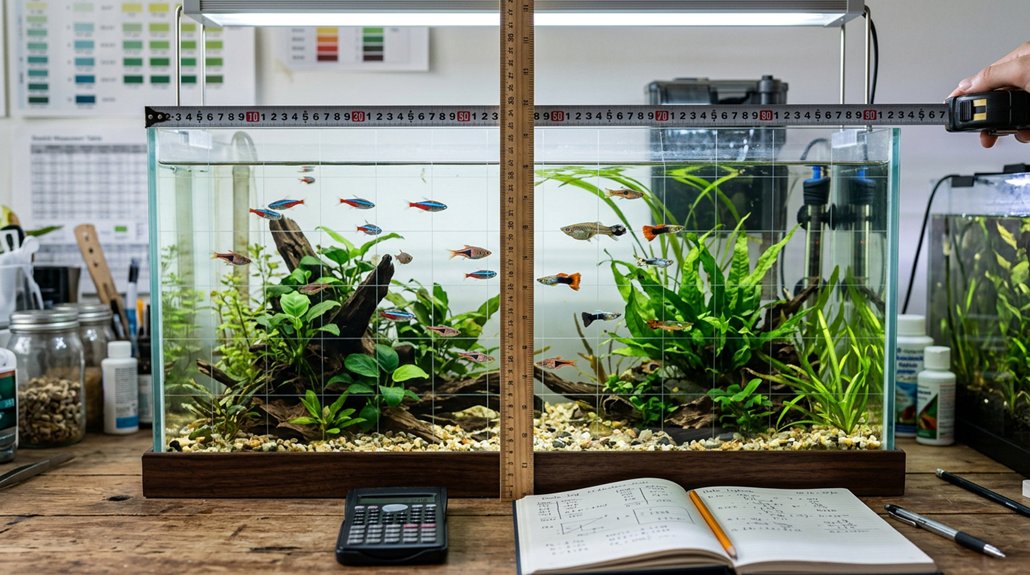
To calculate fish capacity for any tank size, first find the tank’s actual water volume in liters or gallons, using its shape and subtracting displacement from substrate and decor. Then use adult fish size, not juveniles, and start with a conservative stocking estimate: about 1 inch of slim-bodied fish per gallon, less for medium or heavy-bodied species. Check filtration and water tests too. If you keep going, you’ll see how to refine the estimate safely.
Key Takeaways
- Measure tank dimensions in the same units, then calculate volume by shape and convert to liters or gallons.
- Rectangular tanks use length × width × height; cylinders use π × radius² × height; bow-front tanks need curved-volume adjustment.
- Use adult fish size, not juveniles, and start with the rough rule of one inch of slim fish per gallon.
- Adjust stocking for body type: slim fish need less space, while medium and heavy-bodied fish require more gallons per inch.
- Subtract displacement from substrate and decor, match filtration to bioload, and keep ammonia and nitrite at zero.
Calculate Aquarium Volume First
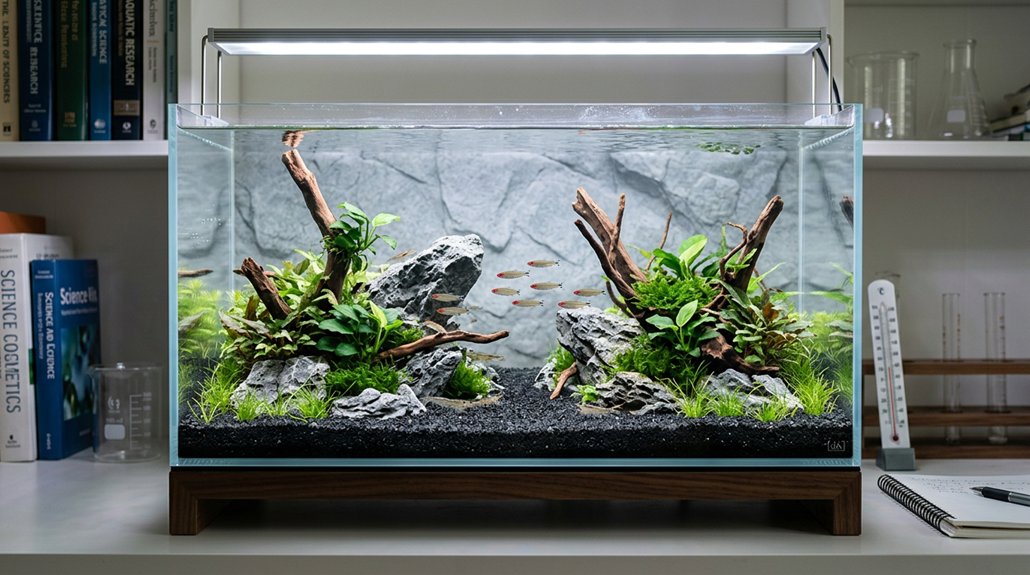
Before you can estimate stocking capacity, you need the tank’s actual water volume. Use consistent measurement units: length, width, and height must match before you calculate. For a rectangular tank, multiply length × width × height; 91 × 60 × 60 cm equals 327,600 cm³, or 327.6 L. For a cube, use edge³; a 40 cm cube holds 64,000 cm³, or 64 L. For cylinders, use π × (diameter/2)² × height, then divide cubic centimeters by 1000. Bow-front tanks need the box volume plus the curved-front term from the bow geometry. Report liters and US/UK gallons, and remember these estimates don’t include glass thickness, substrate, or equipment displacement, which affect water chemistry.
Apply the Main Fish Stocking Rule
A useful starting point is the “one inch of adult fish per gallon” rule, but it’s only a rough guide and works best for small, slim-bodied freshwater community fish. You should base every estimate on adult size, not juvenile growth, because young fish can outgrow the limit quickly. If your tank is under 10 gallons, or you’re keeping heavy-bodied species, don’t rely on that rule alone; they often need 2–3 gallons per inch, sometimes more, because bio-load rises faster. For tanks of 10 gallons or more, cross-check with surface area and filtration capacity, then stock conservatively, staying below 100% of the guideline. That buffer helps prevent ammonia spikes, reduces stress, and leaves room for maintenance changes.
Choose Stocking by Fish Body Type
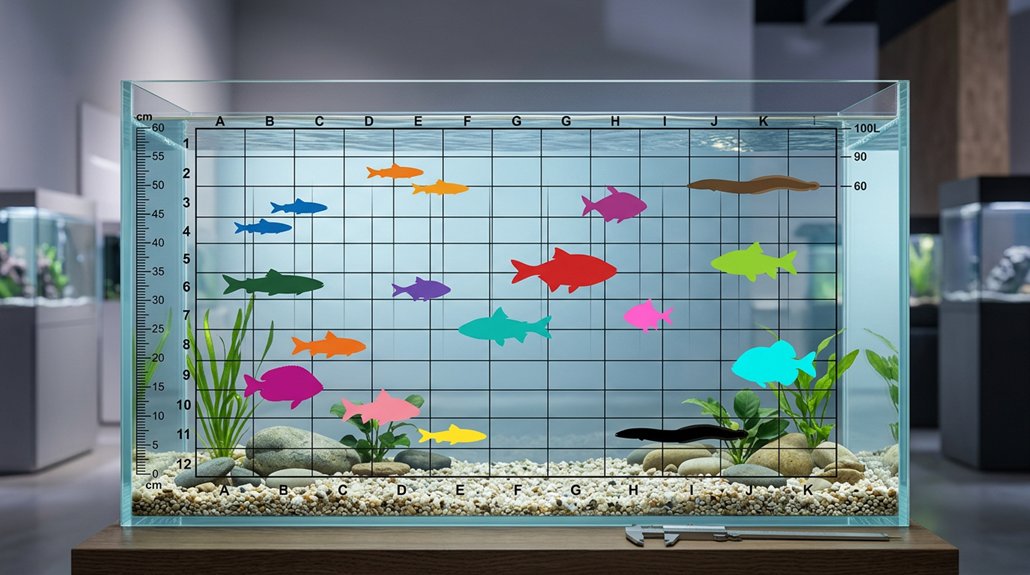
Sort fish by body type first, because shape is a practical proxy for waste output, swimming room, and stocking stress. You’ll usually group species as slim-bodied, medium-bodied, or heavy-bodied. Slim-bodied fish such as tetras and rasboras often fit the rough 1 inch per gallon rule. Medium-bodied fish like gouramis and mollies need more room, about 1.5 to 2 gallons per inch. Heavy-bodied fish, including goldfish and cichlids, usually need 2 to 3+ gallons per inch, so stock them conservatively. When you estimate capacity, use adult size, not juveniles. For tanks 10 gallons or larger, check surface area and bio-load estimates as a second pass. Also consider color preferences and breeding behavior, since active courtship or territoriality can change practical stocking limits.
Factor in Shape and Filtration
Tank shape and filtration both affect how many fish you can safely keep, because the aquarium’s true water volume isn’t always what the label suggests and the filter’s turnover sets how quickly waste is processed. You need accurate volume, then convert it to litres or gallons for comparison.
| Tank shape | Volume note |
|---|---|
| Rectangular | L×W×H |
| Cylindrical | πr²h |
| Bow-front | Add curved segment |
| Corner bow | Use half segment |
Shape changes flow dynamics, so subtract substrate, rock, and equipment from usable water. For filtration, target a turnover rate of 4–6× per hour; higher rates help with heavier bio-loads. Don’t rely on “1 inch per gallon.” Instead, size stocking by waste output and the filter’s real processing capacity.
Stock Conservatively and Monitor Water
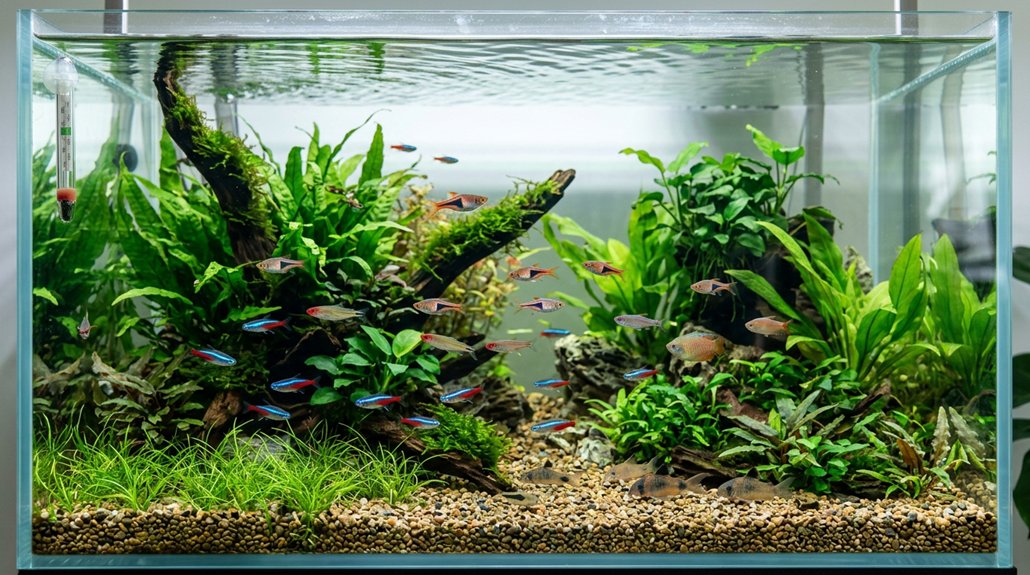
Once you’ve accounted for tank volume, shape, and filtration, stock conservatively and let the system prove it can handle the load. Use adult size, not juvenile size, when estimating capacity, and start below the limit: about 1 liter per 1 cm of adult fish for slim species, less for heavier-bodied fish. For long-term stability, make slow introductions, adding only a few small fish over several weeks so bacteria and filtration can adjust. Do weekly ammonia testing, plus nitrite and nitrate checks. Any detectable ammonia or nitrite, or nitrate staying above about 40 mg/L, means you’re overstocked or under-maintaining the tank. If parameters drift or fish show stress, cut stocking, increase water changes to 25–30% weekly, or upgrade filtration.
Frequently Asked Questions
How to Calculate the Capacity of a Fish Tank?
You calculate it by multiplying length × width × height, then convert to liters or gallons. Use that volume to set stocking density, while checking water quality, filtration, fish size, and species-specific bio-load.
How Many Gallons Is a 24x16x12 Tank?
A 24×16×12 tank holds about 20 gallons—precise yet practical. You’ll also want to match aquarium lighting and filtration choices to that volume, since equipment needs can differ from the tank’s raw geometric capacity.
How to Calculate How Many Fish to Put in a Tank?
Start by converting your tank to litres, then apply a conservative stocking density: about 1 litre per 1 cm of adult slim-bodied fish. Check species compatibility, filtration, and maintenance, then add fish slowly.
How Many Gallons Is a 36x12x18 Tank?
You’re looking at about 33.6 US gallons for a 36×12×18 tank; a hobbyist using aesthetic aquascaping and moderate water movement would plan for slightly less, since substrate, décor, and fill level reduce usable volume.
Conclusion
In your tank, capacity starts with volume, then tightens with body type, filtration, and shape. You can’t just count fish like coins in a jar; you’ve gotta match load to the system’s real processing power. If you stock conservatively and monitor water quality, you’ll keep the balance stable and avoid spikes. In practice, your aquarium works best when every inch of space is treated like a lane, not a parking spot.