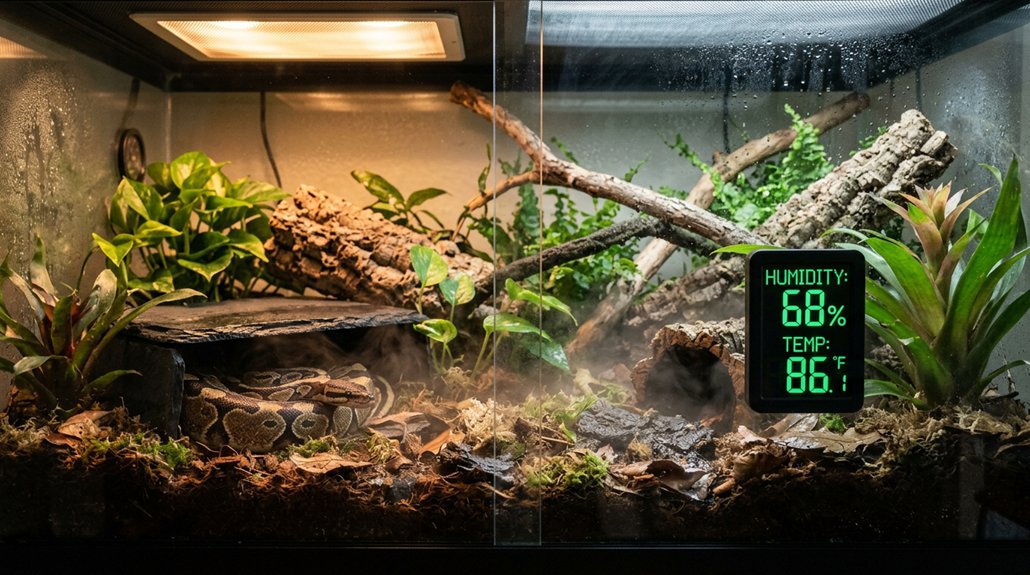
For your ball python enclosure, maintain a temperature gradient with a basking area at 86-90°F and a cool side at 72-80°F. Night temperatures should drop to 70-78°F. Make certain daytime humidity is 60-80%, increasing to 80-100% at night. Enclosure size should be at least 0.9 times the snake’s length, accommodating thermoregulation and natural behaviors. Proper environmental controls are essential, and further insight into ideal setups will enhance your understanding.
Key Takeaways
- Maintain a temperature gradient: 88-92°F (31-33°C) warm side, 75-80°F (24-27°C) cool side for thermoregulation.
- Ensure humidity levels of 60-80% day, 80-100% night, monitored with a digital hygrometer.
- Select enclosure size based on snake length: 2-foot needs 15-gallon, 5-foot needs 55-gallon.
- Use low-strength UVB fluorescent lighting on a 12-hour cycle for healthy vitamin D3 synthesis.
- Include hides on both warm and cool sides with deep substrate for moisture retention.
Setting the Right Temperature for Your Ball Python Enclosure
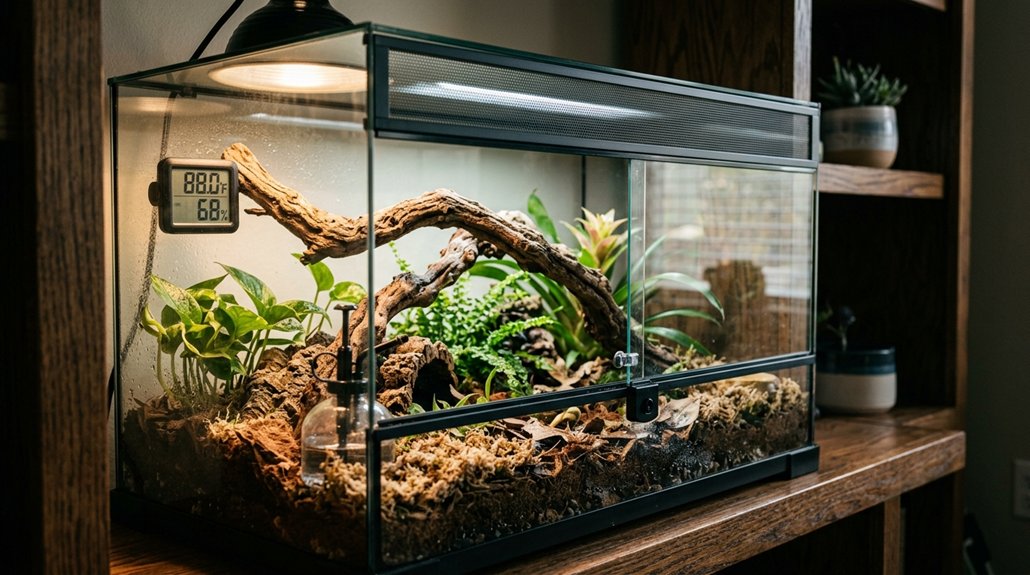
When setting up a ball python enclosure, it’s crucial to maintain specific temperature zones to support the snake’s thermoregulatory needs. You should verify the warm side of the enclosure remains between 86-90°F (30-32°C), which provides a prime basking environment. The cool side should range from 72-80°F (22-27°C), facilitating effective temperature monitoring and enabling the snake’s essential thermoregulatory behavior. At night, allow temperatures to drop to 70-78°F (21-26°C) to simulate a natural day/night cycle. Creating this temperature gradient is critical for your ball python’s physiological needs. Overhead heat sources like halogen bulbs are preferred over heat mats; they deliver even heating and reduce hot spots, maintaining the integrity of the basking spots. Providing thorough temperature monitoring helps you maintain these conditions.
Maintaining Optimal Humidity Levels
Maintaining ideal humidity levels is essential for a healthy ball python, as it directly influences their respiratory function and ability to shed skin effectively. Ball pythons thrive with 60-80% humidity during the day and 80-100% at night. To achieve optimal levels, employ humidity measurement techniques using a digital hygrometer to monitor conditions accurately. Substrate selection tips include using a moisture-retentive base like coconut husk or cypress mulch, laid at least 4 inches deep to facilitate moisture retention. Regular misting, or utilizing automated misting systems, can help maintain desired humidity levels more easily. Additionally, creating a humid hide with moistened sphagnum moss offers your python a microclimate with elevated humidity, vital during shedding phases for skin health.
Lighting Needs to Enhance Health and Circadian Rhythm
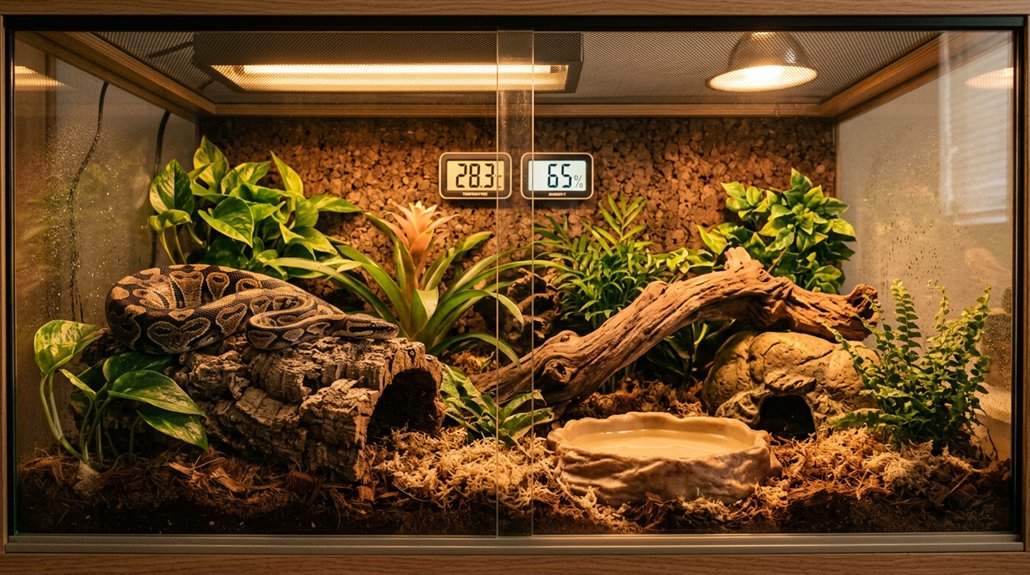
When setting up your ball python’s enclosure, you should consider the role of lighting in promoting health through vitamin D3 synthesis and supporting natural circadian rhythms. Although ball pythons don’t depend solely on UVB light for survival, providing a low-strength UVB fluorescent bulb in a 12-hour on-off cycle can enhance their physiological well-being and mimic their crepuscular activity patterns. Avoid colored heat bulbs, as these can adversely affect their sensory perception and disrupt their biological processes.
UVB Light Benefits
Incorporating UVB lighting into your ball python’s enclosure is a scientifically-backed method to enhance its overall health and circadian rhythm. Ball pythons, capable of perceiving ultraviolet light, benefit from using specific UVB bulb types like the T5 HO fluorescent. These bulbs offer ideal UVB exposure duration and intensity, promoting vitamin D3 synthesis essential for physiological well-being. Although not necessary for survival, UVB lighting markedly improves appetite, activity, and psychological health. Recommendations for a 4x2x2 enclosure include a 22-inch T5 HO fluorescent UVB bulb, maintaining a UVB output range of 5-7%. This type of lighting closely mimics natural conditions, aligning with their crepuscular patterns and enhancing energy levels without dependence on less effective coil bulbs.
Optimal Light Cycle
While UVB lighting provides significant health benefits for ball pythons, understanding their ideal light cycle is essential in further enhancing their physiological and behavioral well-being. Being crepuscular, ball pythons require a light cycle of 12 hours on and 12 hours off. Adjust this slightly to 12.5 hours during summer and 11.75 hours in winter to replicate natural conditions. Light intensity plays a critical role; guarantee the enclosure’s ambient brightness is sufficient without overexposing the snake. Proper light placement, such as a low-strength UVB fluorescent light like a 22″ T5 HO bulb, can aid vitamin D3 synthesis. Avoid visible-light heat sources at night—opt for ceramic heat emitters or radiant heat panels to maintain necessary temperature declines without disrupting natural rhythms.
Enhancing Circadian Rhythm
To enhance the health and circadian rhythm of your ball python, replicating natural light cycles is essential. Ball pythons thrive with a lighting schedule that mimics their crepuscular lifestyle, featuring 12 hours of light and 12 hours of darkness. A low-strength UVB fluorescent light, like a 22-inch T5 HO bulb, contributes to vitamin D3 synthesis and supports overall health, albeit ball pythons can survive without it. However, avoid colored heat bulbs; they may disrupt circadian rhythms and alter natural behaviors. It’s vital to guarantee adequate enclosure illumination beyond ambient room lamps for ideal appetite and activity levels. Utilize full-spectrum lighting to enhance the environment:
- Boosts vitamin D3 synthesis
- Supports natural behaviors
- Enriches habitat aesthetics and plant health
Choosing the Perfect Enclosure Size
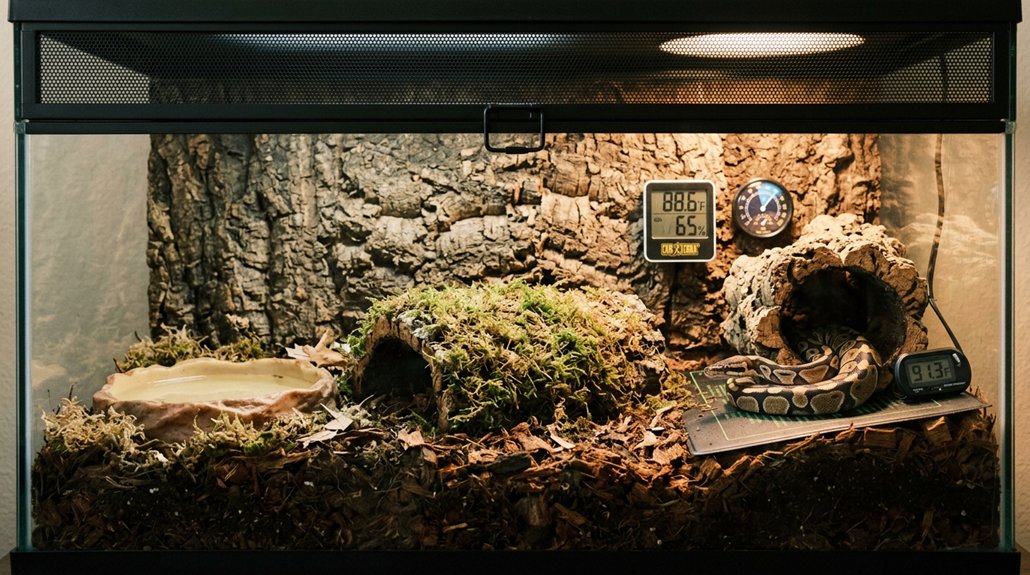
When selecting the perfect enclosure size for your ball python, understanding the relationship between the snake’s length and its habitat needs is essential. ball pythons, with lengths between 2 to 5 feet, necessitate enclosures approximately 0.9 x 0.45 x 0.3 times their length. For a 3-foot snake, a 2.7 x 1.35 x 0.9 ft (25-gallon) space supports stretching, climbing, and facilitates snake enrichment. Utilize enclosure materials like PVC for effective humidity control, ensuring a suitable microhabitat.
| Length (Feet) | Recommended Size (Feet) | Recommended Volume (Gallons) |
|---|---|---|
| 2 | 1.8 x 0.9 x 0.6 | 15 |
| 3 | 2.7 x 1.35 x 0.9 | 25 |
| 4 | 3.6 x 1.8 x 1.2 | 40 |
| 5 | 4.5 x 2.25 x 1.5 | 55 |
| — | — | — |
Always house them singly to reduce stress.
Finding the Best Heating Solutions
When establishing ideal heating techniques for your ball python’s enclosure, it’s critical to use heat lamps placed above the habitat to guarantee effective infrared radiation, maintaining a temperature gradient of 86-90°F (30-32°C) on the warm side. Consider halogen bulbs like the Reptile Systems Eco Halogen, which efficiently cover larger areas when used in clusters. To safely maintain temperature, avoid using hazardous heat rocks and instead utilize thermostats and thermometers to monitor and regulate the environment, ensuring the warm side remains between 88-92°F (31-33°C) while the cool side stays around 75-80°F (24-27°C).
Optimal Heating Techniques
While guaranteeing your ball python’s enclosure provides the right temperature gradient, you need to prioritize selecting the most effective heating methods. Effective heating enhances thermoregulation by creating important temperature gradients, critical for the snake’s health. Infrared radiation mimics natural sunlight, providing heat that permeates the python’s body efficiently.
Consider these ideal heating methods:
- Heat lamps: Emit effective infrared A radiation. Used in clusters, they create natural warmth and are ideal for sizeable enclosures. Guarantee placement above the enclosure to mimic sunlight exposure.
- Heat mats: Serve as secondary heat sources when thermostatically controlled. Position them to supply ground-level warmth, simulating the natural heat absorption from the substrate.
- Radiant heat panels: Suitable for large enclosures, providing overhead warmth. Connect them to a proportional thermostat for consistent temperature control.
Choosing Heat Sources
Building from ideal heating techniques, recognizing the best heat sources for a ball python’s enclosure is essential for maintaining optimal thermoregulation conditions. Heat lamp types, specifically halogen bulbs, emit infrared A radiation providing efficient warmth. To establish a conducive environment, arrange a temperature gradient: a warm hide at 86-90°F and a cool hide at 72-80°F. Heat mats, though useful, serve solely as supplementary sources. Their operation demands stringent heat mat safety measures—they must be coupled with a thermostat to avert burns and guarantee stable temperatures. Radiant heat panels, while dispersing warmth across larger enclosure sections, fall short in efficiency compared to heat lamps. Always refrain from using heat rocks, notorious for causing burns, and diligently monitor enclosure conditions.
| Type | Effectiveness |
|---|---|
| Halogen Bulbs | High, direct infrared warmth |
| Heat Mats | Supplement, requires thermostat |
| Radiant Panels | Moderate, large area coverage |
| Heat Rocks | Unsafe, burn risk |
| Temperature Gradient | Essential for thermoregulation |
Safe Temperature Maintenance
Achieving safe temperature maintenance in a ball python’s enclosure involves implementing a well-calibrated heating system, essential for preserving your python’s health and well-being. Effective thermoregulation techniques necessitate maintaining a heat gradient strategy. A warm side of 88-92°F (31-33°C) empowers your python to warm up, while a cool side of 75-80°F (24-27°C) facilitates temperature regulation.
- Opt for heat lamps with halogen bulbs, emitting infrared A radiation, ensuring warmth without exceeding 95°F (35°C).
- Avoid relying on heat mats as the exclusive source; instead, use them as secondary aids controlled by thermostats.
- For expansive enclosures, integrate radiant heat panels connected to proportional thermostats to distribute heat safely and evenly.
Regular temperature checks at the snake’s level bolster consistent enclosure conditions.
Must-Have Enclosure Accessories for Ball Pythons
Creating an ideal environment for your ball python is essential for ensuring its health and wellbeing. A couple of strategically placed hiding spots are vital; one on the warm side and another on the cool side of the enclosure. These provide a secure retreat, reducing stress and promoting natural behaviors. Equally important is a heavy, non-tip water bowl, sized sufficiently for your python to fully submerge itself for hydration and soaking purposes.
Incorporate a layer of substrate at least 4 inches deep to retain moisture and regulate humidity levels within the 60-80% range, peaking to 100% at night. Sturdy branches or stands should be added to promote climbing for physical health. Use a digital thermometer/hygrometer for precise monitoring of temperature and humidity, ensuring ideal conditions prevail.
Frequently Asked Questions
How Often Should You Clean a Ball Python Enclosure?
You should clean the enclosure at least weekly for ideal enclosure maintenance. Health studies suggest increased cleaning frequency prevents pathogen buildup and mites, promoting a healthier environment by reducing waste and maintaining a stable bioactive substrate ecosystem.
Are Live Plants Suitable for Ball Python Enclosures?
Live plants offer benefits such as enhancing humidity and creating a natural aesthetic. However, they require maintenance, including consistent light, humidity levels, and regular care. Carefully select resilient species resistant to trampling or nibbling.
What Substrate Is Best for a Ball Python Habitat?
You’ll want to choose natural substrates like coconut fiber, cypress mulch, or aspen bedding. These substrate materials provide excellent humidity retention, which benefits your ball python’s skin health. Regular substrate maintenance prevents bacterial buildup, ensuring a hygienic environment.
Can Ball Pythons Be Housed Together in the Same Enclosure?
Oh, cohabitating ball pythons––a decision ripe with risks! You’ll find stress indicators like aggressive behavior and poor feeding. Evidence shows separate enclosures reduce territorial disputes, ensuring ideal health and well-being. Science rarely supports social housing.
How Do You Prevent Mites in Ball Python Enclosures?
You prevent mites in ball python enclosures by ensuring ideal enclosure maintenance. Clean substrate regularly, maintain proper humidity levels, and employ mite prevention methods like quarantining new snakes and utilizing specialized mite repellents scientifically proven to deter infestations.
Conclusion
Creating the ideal environment for your ball python involves precise temperature and humidity control, and choosing the right enclosure size. Did you know that a ball python can live over 30 years with proper care? To guarantee their longevity, aim for a temperature gradient between 76-92°F and maintain 50-60% humidity. Incorporating essential accessories and professional heating solutions guarantees comfort and health, enriching your snake’s habitat while supporting crucial biological processes like thermoregulation and circadian rhythms.