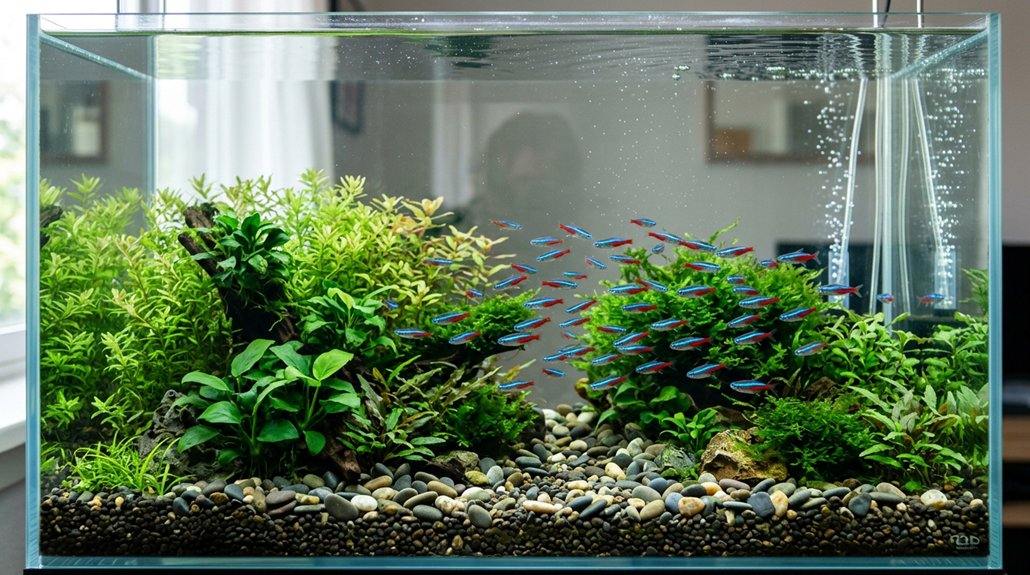
How many fish you can put in a freshwater tank depends on adult size, body shape, activity, waste output, and filtration, not just labeled gallons. In a 29-gallon tank, usable volume is usually closer to 25 gallons, so a rough upper limit is about 24 inches of small, low-waste fish, or closer to 12 inches for messy species. You’ll also need proper groups, open swim space, and stable water quality, and there’s more to get right.
Key Takeaways
- Use adult fish size, not juveniles, when calculating stocking.
- A 29-gallon tank holds about 24–25 inches of adult fish after displacement.
- For messy or active species, use the stricter rule: about 1 inch of fish per 2 gallons.
- Match stocking to filtration, keeping ammonia and nitrite at 0 ppm and nitrate below 40 ppm.
- Consider fish behavior, school size, and tank shape, since swimming space and compatibility affect safe stocking.
How Many Fish Fit in a 29-Gallon Tank?
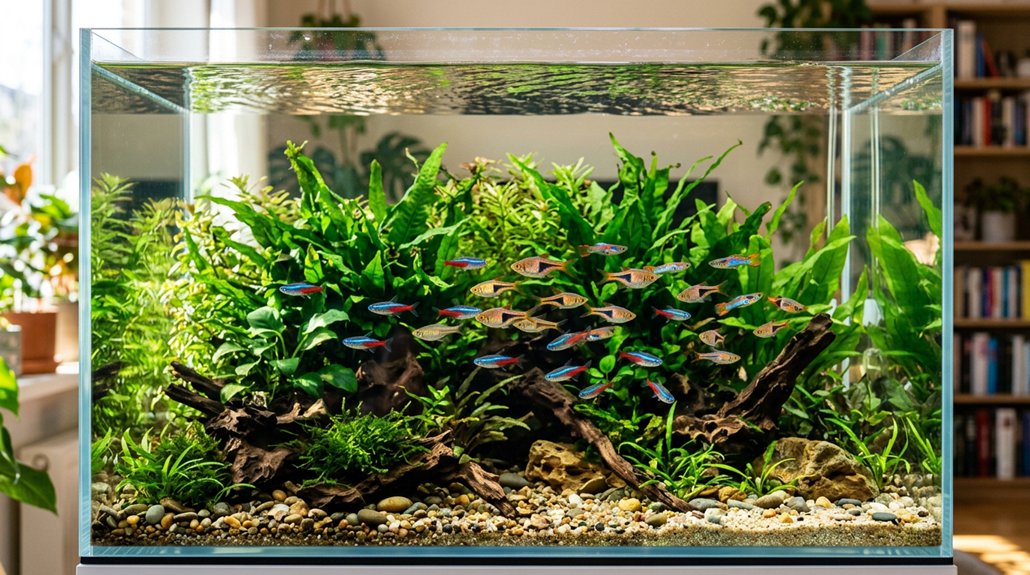
For a 29-gallon tank, you should base stocking on the usable volume, which is closer to 24.7 gallons after accounting for displacement by substrate, decor, and equipment. You can use the 1 inch per gallon rule only as a rough baseline; that yields about 24–25 inches of adult fish total. For messy species, use the stricter 1 inch per 2 gallons standard, giving roughly 12 inches total. You should evaluate school dynamics, swimming activity, and body shape, not just length. A long tank can support 8–12 small tetras plus 2–4 bottom cleaners, while taller species need fewer individuals. Breeding considerations also matter because pair formation and fry increase bioload. Stock gradually after cycling, test nitrates weekly, and keep them under 40 ppm.
Why Fish Size Changes Stocking Limits?
Fish size changes stocking limits because you should always calculate capacity using adult, full-grown dimensions, not the size the fish is when you buy it. Juveniles often look compatible, but as they mature, body mass, adult metabolism, and waste output rise disproportionately. Because of shape scaling, an 8-inch fancy goldfish occupies far more usable space than several small tetras, and the old 1 inch per gallon rule becomes unreliable. You also have to account for behavior: tall-bodied angelfish need vertical clearance, while active swimmers need horizontal length. Schooling species require group minimums, and reduced usable volume means the tank holds about 15% less than its label. Use adult size, surface area, and activity level to determine realistic stocking limits.
How Filtration Affects Fish Capacity?
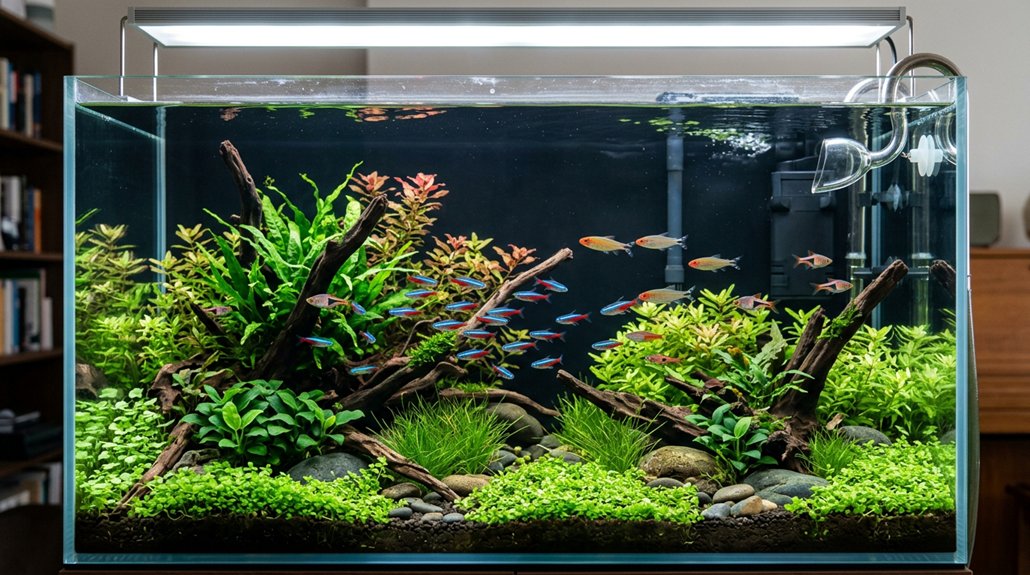
Adequate filtration directly increases safe stocking capacity by controlling dissolved and suspended waste, but it must be matched to the tank’s real bioload, not just its label volume. You should target at least 4x turnover per hour during stocking; a 29-gallon tank needs about 116 GPH. Strong mechanical capture and ample filter media support bacterial establishment, which drives nitrification. Add fish gradually, and you can accelerate cycling with used media or live bacterial additives. Keep ammonia and nitrite at 0 ppm, and keep nitrate under about 40 ppm with water changes. Even then, high-waste fish, including goldfish and cichlids, need more filtration and lower density; a conservative guide is one inch per two gallons.
How Tank Shape and Swim Space Matter?
Tank shape can quietly change how many fish you can keep because surface area, not just gallons, affects gas exchange and usable bioload. You should treat width × length as a primary stocking variable, especially in tall or irregular tanks. A 20-gallon long gives far more horizontal flow and swim distance than a tall 20-gallon, even though volume is equal. Active schooling fish need length for continuous movement; laterally shaped fish also need adequate turning radius. Use the surface-area rule of thumb—about 1 inch of fish per 12 sq in—for unconventional shapes. Account for gravel, plants, decorations, and the fact that actual water volume is often about 15% lower than the label. Match adult body shape to dimensions, and understock slightly to preserve open space.
Which Fish Can Live Together Peacefully?
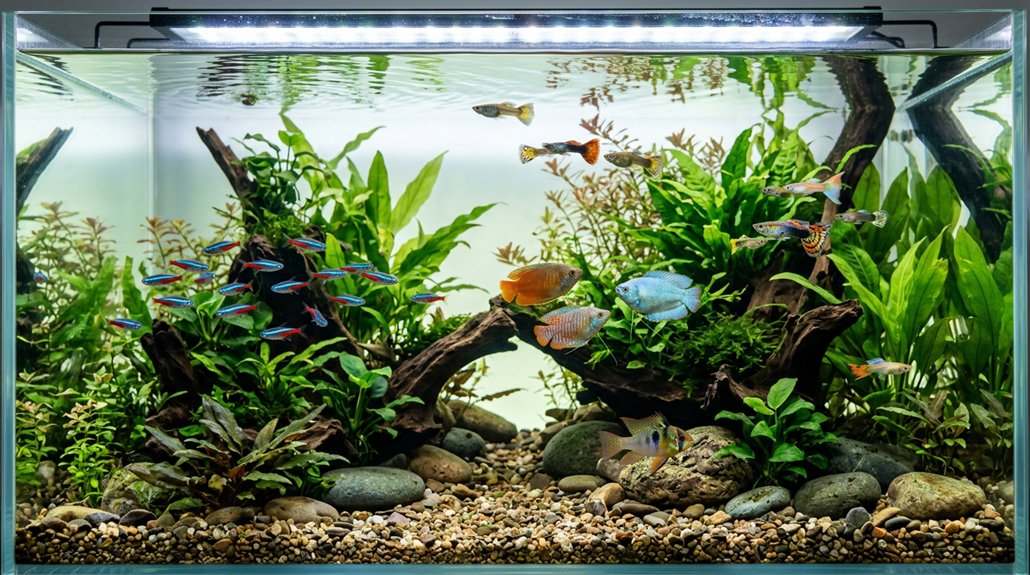
To keep a freshwater tank stable, you should pair species that share similar temperament, adult size, and water-parameter requirements, because mismatches quickly lead to stress and aggression. You’ll get the best results by choosing fish with compatible temperaments, such as neon tetras, guppies, or zebra danios, which tolerate similar community conditions. Schooling fish shouldn’t be isolated; keep them in proper groups and match them with calm tankmates that won’t harass them. Use habitat layering to reduce conflict: reserve upper zones for peaceful swimmers, midwater for active shoalers, and bottom areas for corydoras or kuhli loaches. Don’t combine bettas with flashy top-dwellers, or mix large, messy species with small, delicate fish. Match activity, size, and waste load.
How to Stock a Tank Without Overcrowding?
You should base stocking on the adult size of each fish, then compare the total to usable water volume and bioload, not just the tank label. Match filtration and maintenance to the species’ waste output, and keep ammonia and nitrite at 0 ppm while nitrate stays below 40 ppm during gradual additions. You also need enough space for behavior: schooling fish need proper group sizes, active fish need long swim space, and territorial fish need room or cover to reduce aggression.
Bioload and Filtration
Bioload, not tank size alone, determines whether a freshwater system stays stable, so stocking must be matched to filtration capacity rather than guessed by volume. For effective bioload management, you should use filtration sizing that targets about four tank turnovers per hour during stocking, with extra media for higher-biomass tanks. You’ll want ammonia and nitrite at 0 ppm, nitrate below 40 ppm, and you should test regularly with kits or strips. Add fish slowly: no more than 25% of the final intended biomass at once, then wait weeks before the next increment. If waste rises, increase water changes. Use cycled media, bacterial starters, and fast-growing plants to strengthen biofiltration. Large, high-metabolism species need reduced stocking density.
Space and Behavior
Even when filtration is adequate, overcrowding can still occur if fish are selected by tank volume alone. You should calculate stocking from adult size, not juvenile length, because growth changes waste output and space demand. The 1 inch per gallon rule is only a rough screen; it ignores swim patterns, body shape, and territoriality. Active, long-bodied fish need more horizontal room, while tall species such as angelfish need extra vertical clearance. Schooling fish require groups of six or more, so their collective bioload rises. Territorial species, including bettas and cichlids, need defined boundaries and hiding sites to limit aggression. Use usable water volume, not label gallons, and verify nitrates weekly. Keep them below 40 ppm with water changes and adequate biological filtration.
Frequently Asked Questions
Can We Keep 10 Fishes in an Aquarium?
Yes, you can keep 10 fishes if your tank’s stocking density and bioload management match the species’ adult size, behavior, and filtration. You’ll need proper cycling, adequate surface area, and stable ammonia, nitrite, and nitrate.
Can You Put 3 Guppies in a 1 Gallon Tank?
No—you can’t. Three guppies in a 1-gallon tank’ll overload your system, and that’s no coincidence: similar stress hits gourami compatibility tests. You’ll need better filtration options, or you’re risking ammonia spikes and rapid losses.
Can I Put 2 Goldfish in a 1 Gallon Tank?
No—you can’t put 2 goldfish in a 1-gallon tank. That violates goldfish ethics and causes rapid ammonia buildup. You’d need a much larger setup; consider tank alternatives like shrimp, snails, or upgrading.
Can You Put Too Many Fish in a Tank?
Yes, you can overstock a tank. Excess stocking density raises waste, stresses filtration, and can cause oxygen depletion. You’ll see ammonia, nitrite, and nitrate rise, while fish become crowded, stressed, and prone to disease.
Conclusion
In your 29-gallon freshwater tank, you should treat stocking as a capacity calculation, not a guess. Fish size, adult behavior, filtration efficiency, and tank shape all change the safe limit. You need compatible species and measured additions to avoid overcrowding and stress. If you stock slowly and monitor water quality, you’ll keep the system stable. Think of your aquarium like a small engine: every extra load affects performance, balance, and long-term health.