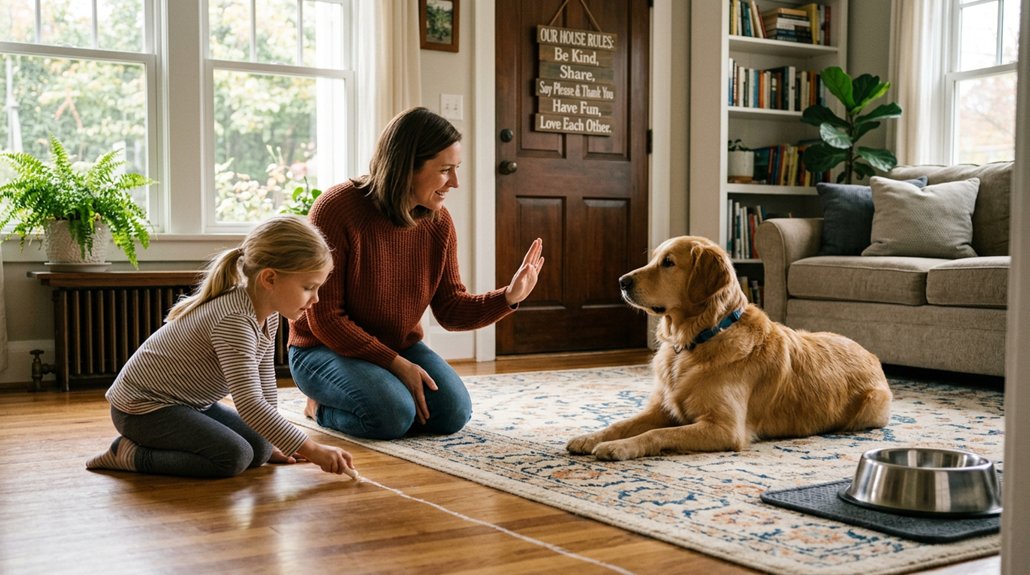
To train your dog to respect household rules, start by understanding their background to tailor your approach. Establish boundaries using designated areas and consistent commands like “spot.” Teach impulse control at doorways and prevent jumping with “sit.” Use chew toys and positive reinforcement to correct behavior. Create a routine with structured play, mental stimulation, and quiet time. Consistency across all household members is essential. There’s more to explore if you’re enthusiastic for a well-mannered pup.
Key Takeaways
- Establish consistent boundaries with designated off-limit areas and enforce them using a cue word like “spot” or “place.”
- Build trust by understanding your dog’s background and responding to their unique history and behavioral traits.
- Redirect unwanted behaviors using commands like “sit” or “stay,” and reward compliance to reinforce self-control.
- Manage excitement during guest arrivals by keeping the dog leashed and practicing impulse control exercises.
- Create a structured routine with predictable feeding, playtime, and exercise to ensure stability and respect for household rules.
Discover Your Dog’s Background for Better Training
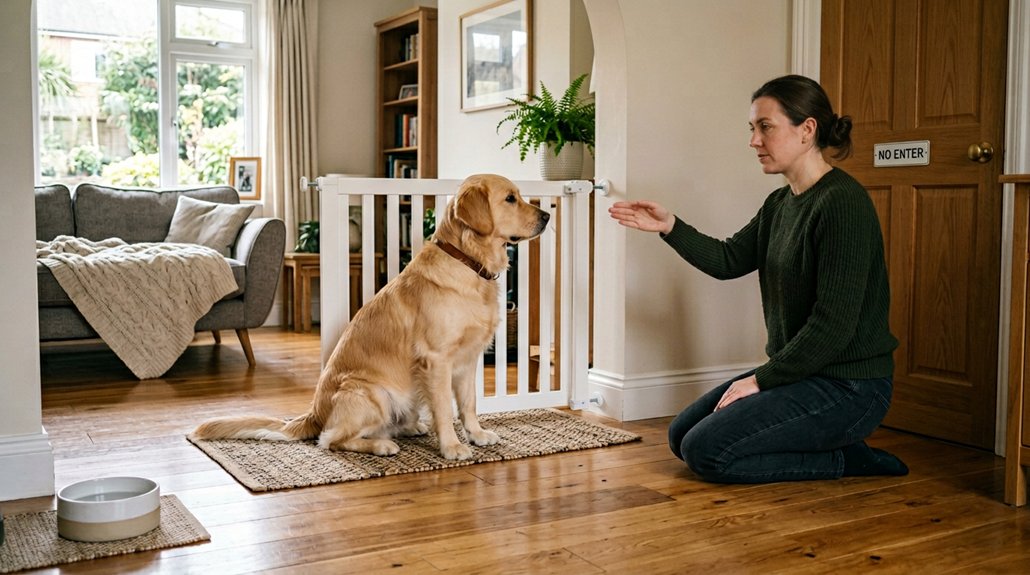
Understanding your dog’s background is vital for effective training, as it allows you to tailor your approach to meet their specific needs. Explore your dog’s history to uncover potential trauma impacts that could affect behavior. Recognize breed traits that might predispose certain responses or necessitate unique communication styles. Assess their past socialization skills to determine comfort levels with new environments. Your involvement as an owner is significant; building trust requires patience and emotional support. Look for behavioral cues that signal stress or trust. With this knowledge, you can implement trust-building techniques that foster respect. By understanding their history, you’ll guide training more effectively, ensuring patience in your approach and ultimately enabling better adherence to household rules.
Setting Up Boundaries: Mat and Command Training
To teach your dog to understand boundaries, start by designating a specific mat in a quiet area of your home, and use a clear cue word like “spot” or “place.” This association helps your dog recognize their command through consistent practice, reinforcing their understanding and respect for the boundary. Gradually increase your distance while instructing them to stay on the mat, rewarding compliance to build their self-control and command consistency.
Teaching Command Consistency
When you’re guiding your dog towards respecting household boundaries, employing consistent command training becomes essential. Establish cue consistency by selecting a designated word like “spot” or “place.” Use this command every time you direct your dog to their designated area, which reinforces these boundaries. Confirm you’ve established a clear spot, like a mat or dog bed, where your dog should relax during family activities or meals. Start by luring your dog to the mat with treats, immediately rewarding them and using a marker word to acknowledge their success. Gradually increase your distance from the mat while your dog stays put, reinforcing command and boundary training. Consistently practice this in various settings to instill solid respect for household boundaries.
Effective Use of Mat
Creating specific boundaries for your dog can greatly enhance their behavior and understanding of where they should relax within your home. Mat training is an effective method for boundary reinforcement. Designate a mat or dog bed as their relaxation area. Use a consistent cue like “mat” or “place” to build a strong association. Here’s how you can effectively implement mat training:
- Introduce the mat by tossing treats onto it to form a positive connection.
- Reward them with treats or praise once they step onto the mat.
- Gradually increase difficulty; guarantee they stay on the mat despite distractions.
- Consistency in using the cue word solidifies the boundary and command.
Following these steps will guide your dog in respecting household rules.
Training Techniques for Preventing Jumping
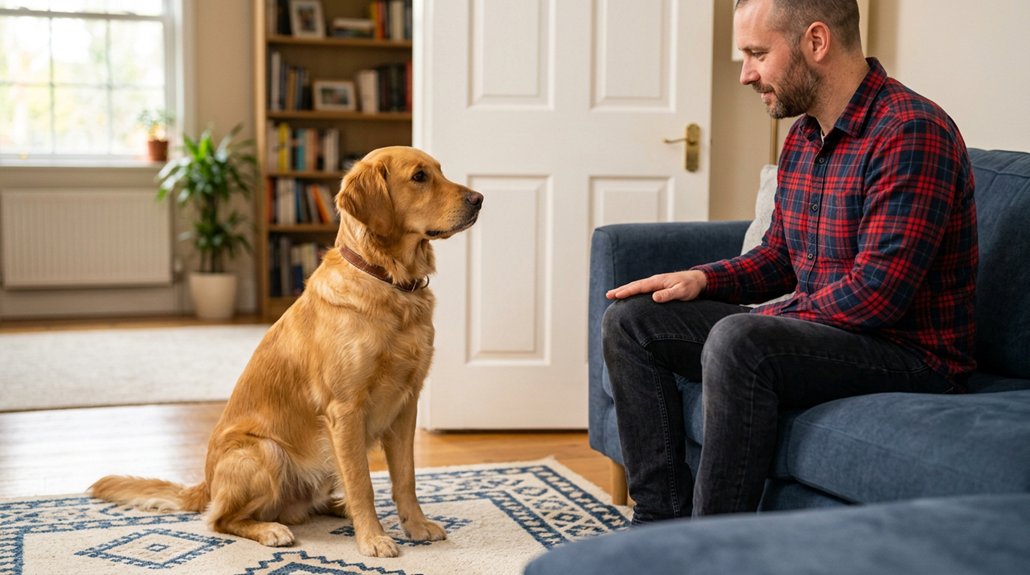
To prevent your dog from jumping, focus on redirecting their excitable behavior by training them to sit when meeting others, an action that channels their energy into calmness. Consistently reinforce this behavior with rewards, providing positive associations that encourage and solidify their calm demeanor. Practice alternative greeting methods with the help of friends or family and utilize controlled group classes to help your dog maintain composure amidst distractions.
Redirecting Excitable Behavior
One effective method for managing a dog’s tendency to jump is to redirect their excitable energy into a calm and acceptable greeting behavior. By teaching your dog to sit or lie down when meeting people, you can transform their jumping impulse into calm greetings. To reinforce impulse control, consistently ignore jumping behavior and only reward them once all four paws are on the ground. Use treats and praise to associate this quiet conduct with positive outcomes. Controlled practice sessions across different settings can strengthen impulse control, especially when distractions are present.
- Reward calm postures with treats and praise.
- Ignore jumping, offering attention only when paws stay ground-bound.
- Gradually increase distractions for impulse control strengthening.
- Socialize through classes and playdates for structured correction.
Alternative Greeting Methods
Although dogs often express excitement by jumping, training them to adopt alternative greeting methods can help manage this behavior effectively. Begin with calm interactions by instructing your dog to “sit” before any attention or treats are given when visitors arrive. During visitor introductions, consistently ignore any jumping. Instead, reinforce polite greetings when your dog is calm and seated. Practicing controlled scenarios, like inviting friends over, can prepare your dog for real-life distractions. Use positive reinforcement, praising and rewarding with treats when all four paws stay grounded, to encourage the desired behavior. Additionally, incorporate impulse control exercises, such as “wait” and “stay,” to develop your dog’s ability to greet others without jumping, ensuring a well-mannered household interaction.
Reinforcing Calmness Consistently
Whenever you train your dog, consistent reinforcement of calmness is essential for preventing jumping. Focus on rewarding calm behavior during guest interactions. Welcome your dog with treats or praise only when they remain composed. Intervene by teaching your dog an alternative task like sitting or staying in a “place” command. Practice under controlled settings before advancing to more dynamic guest interactions.
- Guarantee everyone in the home follows a routine for greetings to reinforce calm behavior consistently.
- Initially keep distractions to a minimum to help your dog focus; slowly introduce more complex social scenarios.
- Attend group classes to further expose your dog to various situations, reinforcing calm greetings.
- Ignore jumping entirely, guaranteeing only calm behaviors receive acknowledgment.
Your efforts will be repaid with a well-mannered canine companion.
Teaching Dogs to Respect Furniture Rules
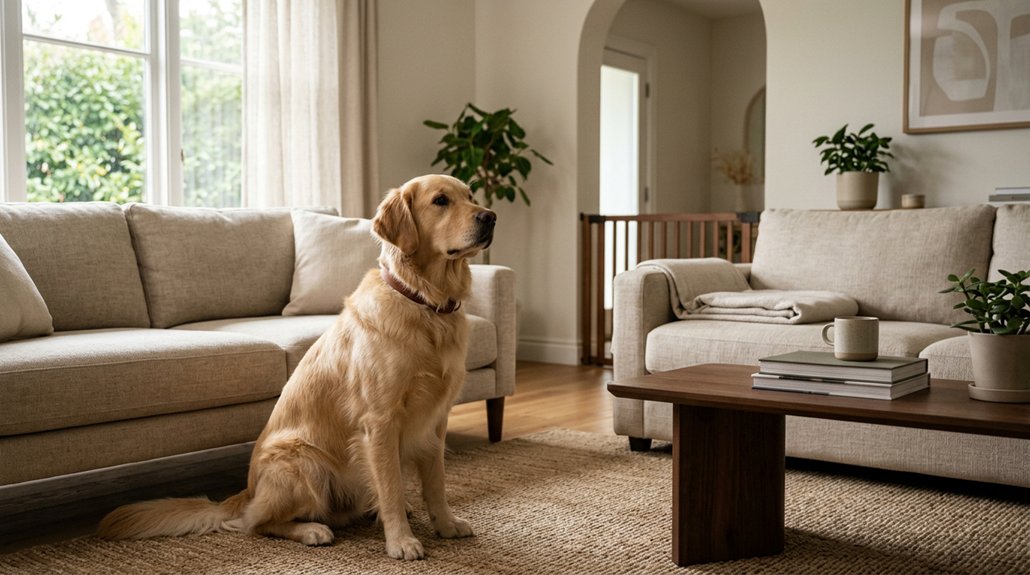
Curious about how to keep your dog off the couch without constant supervision? Establishing clear furniture boundaries is essential. Decide which pieces are off-limits, and make certain everyone in your household is consistent in enforcing these rules. Redirect your dog to a designated spot, like a mat or dog bed, whenever they attempt to jump on the furniture. This approach offers a positive alternative and reinforces respect for your boundaries. Utilize training rewards, such as treats or praise, to commend your dog when they stay on their spot. Incorporate positive reinforcement techniques like clicker training to mark when your dog complies. Consistency and clarity in your expectations help promote understanding and guarantee your dog respects household furniture rules.
Effective Strategies to Stop Door Dashing
Just like enforcing furniture boundaries, preventing your dog from rushing through doors requires clear expectations and consistent training. Focus on effective door training to develop their impulse control. Start by teaching a reliable recall command like “come” to keep them from dashing out. Command them to “wait” or “stay” at doorways to encourage patience. Reward and reinforce their behavior when your dog holds back at a door, promoting long-term compliance.
Prevent door dashing by training impulse control using commands like “wait,” coupled with consistent reinforcement.
- Use baby gates to limit their access to doors while training impulse control.
- Practice door etiquette consistently in low-distraction settings to build solid habits.
- Gradually shift to more challenging scenarios after mastering the basics.
- Celebrate small victories to maintain enthusiasm and encourage repetition.
Implementing these strategies guarantees a safer, more respectful household.
Creating No-Dog Zones: Enforce and Maintain Boundaries
Establishing no-dog zones within your home is a practical way to maintain order and respect for shared spaces. Begin by using baby gates to clearly designate these areas, providing visual cues that aid in boundary reinforcement. It’s essential for every household member to consistently enforce access management, ensuring your dog understands where they’re not allowed. Encourage compliance by rewarding your dog with praise or treats when they stay outside these zones. Utilize a marker word when your dog successfully respects the boundaries, reinforcing the desired behavior. To strengthen their understanding, gradually add distractions during training sessions so your dog learns to maintain boundaries even when tempted. Consistency and clear boundaries are key to creating harmonious no-dog zones.
Positive Reinforcement: Chew Toys Over Valuables
To effectively guide your dog’s chewing instincts, it’s important to offer durable chew toys as substitutes for your valuables. By rewarding your dog each time they opt for these toys with treats or praise, you reinforce the positive behavior and discourage destructive chewing. Remember to keep valuables out of reach, ensuring your dog associates chewing with permitted items only.
Encourage Chewing on Toys
Encouraging your dog to chew on toys instead of valuable items is crucial for maintaining a harmonious home environment. Chew toy benefits are numerous; they not only fulfill your dog’s natural chewing instincts but also provide engaging activities that keep their minds active and focused. It’s important to reward your dog with treats and praise when they choose their toys over valuables, reinforcing positive behavior. Supervise playtime to redirect any inappropriate chewing immediately. Here’s how you can encourage appropriate chewing:
- Provide a variety of durable chew toys.
- Keep valuable items out of reach to prevent accidents.
- Use the “leave it” command to teach proper focus.
- Consistently reinforce the toy-chewing habit with rewards.
Implement these strategies consistently to guide your dog toward better choices.
Discourage Destructive Chewing
Curb destructive chewing by firmly establishing boundaries and channeling your dog’s energy toward appropriate chew toys. Introduce a variety of chewing alternatives to steer them away from your shoes or furniture. Dogs often chew due to boredom or a need for stimulation, so keep their interest by regularly practicing toy rotation. Supervise your dog in the initial stages and redirect them to these toys whenever they attempt to chew on valuables. Use positive reinforcement—reward them with treats or praise when they opt for the designated toys. Consistency is key; correct and redirect each time you catch them in the act of chewing something inappropriate. This disciplined approach reinforces that only their toys are acceptable chewing outlets.
Encouraging Calm Behavior With Guests Around
When guests arrive at your home, maintaining a calm environment is essential for fostering good behavior in your dog. Proper guest interactions involve guiding your dog to approach calmly and confidently, minimizing any nervous behavior. Start by keeping your dog on a leash to control excitement and prevent jumping.
- Teach the “place” command, guiding your dog to a designated spot with rewards for staying put.
- Practice impulse control exercises like “stay” or “wait” before guests arrive to enhance composure amidst distractions.
- Reward calmness with treats and praise, reinforcing positive behavior while ignoring jumping or barking.
- Ensure that all household members consistently apply these strategies, reinforcing your dog’s understanding of appropriate social interaction during visits.
Establishing a Routine for Busy Households
Creating a consistent routine is essential in bringing order to a bustling household and providing your dog with a sense of security. Start with a regular feeding schedule, which lays the foundation for predictability. Incorporate designated playtime activities and structured exercise routines to manage energy and maintain focus. Mental stimulation should be a daily priority; puzzle toys or short training sessions bolster both learning and obedience. Consistency tools like a calendar or schedule chart are invaluable, aligning all household members in maintaining this routine. Involve everyone in sticking to these set times, ensuring your dog knows what to expect. Allocating quiet time for relaxation is equally important, enabling your dog to recharge and handle busy moments more effectively.
Building Trust With Consistent Training Commands
To cultivate a strong, trusting relationship with your dog, the consistent use of specific training commands is essential. The foundation of trust is built on these commands, which simplify communication and enhance command retention. Incorporating trust building exercises, like the repetition of commands in varied settings, helps your dog generalize their training across different situations in your home. To maximize success, apply positive reinforcement—treats or praise—whenever they respond correctly. This not only boosts their confidence but also strengthens your bond.
- Use clear, simple commands to minimize confusion.
- Introduce a marker word to reinforce desired behaviors.
- Practice commands in different scenarios for better adaptation.
- Schedule regular training sessions for routine and predictability.
Implement these steps for a reliable and respectful canine companion.
Frequently Asked Questions
What Is the 3-3-3 Rule With Dogs?
The 3-3-3 rule helps you understand dog behavior during changes. It’s essential for your training techniques. First 3 days—stress; next 3 weeks—adjustment; after 3 months—settling. Patience and consistency are key for successful training.
How Do I Say “I Love You” in Dog Language?
Imagine your interactions as a two-way street of love. Show “I love you” through dog communication by understanding canine body language. Engage in their favorite activities to foster an emotional connection and recognize affection expressions like nudges and wagging.
Can Dogs Lower Cortisol?
Yes, dogs can lower cortisol levels in humans. The dog cortisol connection emphasizes how petting and interacting with your dog provides effective canine stress relief, reducing your stress hormones and creating a calming, supportive environment.
What Are the 4 Signs Your Dog Thinks of You as a Parent?
Your dog’s parental bonding is evident through these four canine behaviors: seeking proximity, following you everywhere, looking to you for reassurance during stress, and displaying enthusiastic response to your commands. These all indicate your parental role.
Conclusion
Consistency is key in maintaining household rules with your dog. Imagine a rescue named Max, initially unruly, who transformed with routine and patience. By respecting boundaries, avoiding door dashing, and learning commands, Max now thrives in a busy household. Positive reinforcements, like chew toys, offer alternatives to destructive habits. Trust fosters from balanced training and setting clear expectations. Your commitment empowers your dog to respect your home, ensuring harmony and understanding between you and your furry friend.